Day 857: Dark Fire

Cover for Dark FireAt the start of this second Matthew Shardlake mystery, Matthew’s disillusionment with his master Thomas Cromwell has caused him to break free from Cromwell. He has had his own law practice for the past three years. The rumor now is that Cromwell may be failing in his influence over Henry VIII after he backed the marriage of Henry with Anne of Cleves. The political maneuverings around Cromwell overshadow the entire novel.

But first Matthew takes on a case for a friend, Joseph Wentworth, whose niece Elizabeth has been accused of murdering her 12-year-old cousin Ralph by pushing him into a dry well. Although no one actually witnessed the crime, both his sisters were on the scene shortly afterwards and say that Elizabeth was the only one there. Elizabeth herself isn’t talking.

Matthew goes to see her in prison and is struck by her expression of fury. In court, he tries to argue lack of competency, but according to the laws of the time, if she won’t speak, she must be pressed until she will, a cruel death by crushing. Matthew is unable to prevent her from being sentenced to be pressed.

Next, he is summoned to see Cromwell by a rude young man named Jack Barak. Matthew learns that Cromwell was offered the secret of a powerful weapon called Dark Fire, or Greek Fire. This secret was brought back from the East years before by a monk. A container of it was found by Michael Cristwood in a deconsecrated abbey, along with the formula, and he and his alchemist brother worked on the formula and a dispenser before demonstrating the weapon to Cromwell. Now Cromwell has promised a demonstration to the king in 10 days, but the Cristwoods have disappeared.

Cromwell wants Matthew and Barak to find the Dark Fire and the formula within ten days. He is counting on this discovery to save his position. Matthew makes a deal with Cromwell—if he will save Elizabeth from pressing, Matthew will look for the Dark Fire.

Matthew and Barak soon find Michael Cristwood dead but no sign of the apparatus or formula. Two thugs seem to be just ahead of them, murdering anyone who knows about Dark Fire and attempting to murder Matthew and Barak. Soon it becomes clear to Matthew that some powerful patron is behind the thugs, but who is it?

Although this Matthew Shardlake novel also has a powerful sense of place, London during a sultry 1540 summer, his investigation seems bogged down in this novel. He just seems to be questioning the same people over and over to little result. In any case, I was far more interested in the mystery of Elizabeth and her cousin, which was only incidental to the story. Some of the truth of that case seemed apparent almost at once, although not to our protagonist.

Still, I will continue with the series. I have as a goal to read all the Walter Scott Prize winners and nominees, and Samson’s Heartstone, the fifth in this series, is on the list. But I want to read the books in order. So, I’m committed to the series at least until book five.

Related Posts

Dissolution

Bring Up the Bodies

Wolf Hall

Day 831: Fresh from the Country

Cover for Fresh from the CountryOne of the pleasures I have not had for years is to read a novel by Miss Read, who wrote quite a few books over the course of 50 years, beginning in the 1950’s. Many of these novels are gentle stories about village life, but Fresh from the Country is about living in town.

Anna Lacey is a country girl who has recently finished training as a teacher and has taken a position as a primary school teacher in a new suburb of London. The school and the town are suffering the results of the post-war baby boom. Shoddy houses are going up quickly, and lodging is scarce. In the first scene of the novel, Anna inspects the grim quarters that will be her new home and is clearly cheated in her rent by her miserly landlady, who also underfeeds her throughout the novel.

The school, too, is crowded, as 48 children are crammed into her class in space meant for 20. The numbers in her class are a constant worry as she learns how to control the children, work in limited space, and keep the class productive. She also has to cope with the peculiarities of the various inspectors, since as a new teacher she is on probation.

Anna flees joyfully home on the weekends and holidays, to the large old farmhouse, her cheerful parents, and the beauties of the countryside. She finds the ugly scenery and the noise of the suburb hard to take.

Although Anna is a nice person, she at first tends to look askance at some of the foibles of her coworkers. It is her friendship with another teacher, Joan Berry, that teaches her not to be so hard on people who haven’t had the advantages of loving parents and a stable upbringing.

This is a gentle novel about the difficulties of being away from home for the first time, about learning new skills and learning to understand others, about the problems of the teaching profession. It has a tinge of light romance as well. It is mildly humorous, especially in the details of Anna’s life as a teacher.

Related Posts

South Riding

Miss Bunting

A God in Ruins

Day 822: Miss Pettigrew Lives for a Day

Cover for Miss PettigrewBest book of the week!
This novel is a confection. It is absolutely delightful.

Miss Pettigrew is a poor, middle-aged governess with no family who has been haunting an employment agency hoping for a job. This morning she is in luck. The agency has two openings, one for a maid and one for a nursery maid. The agency sends her off to interview with Miss La Fosse (by mistake).

Miss Pettigrew is received by a beautiful young woman in a negligee. She is clearly entertaining a young man. Miss Pettigrew has been brought up to be a proper lady, but instead of being shocked, she is entranced by this glimpse of an exotic lifestyle.

Without even inquiring who Miss Pettigrew is, Miss La Fosse asks her to find a way of getting her friend Phil to leave before her other friend Nick arrives. Miss Pettigrew is successful in doing this and begins to discover in herself an untapped capacity for organization. Soon, she is responding to Miss La Fosse’s pleas to stay with her during Nick’s visit. Miss Pettigrew sees that Nick is an attractive but dangerous man.

Over the period of a day, Miss La Fosse and her friends involve Miss Pettigrew deeper in their affairs. She is fascinated by this view into a more Bohemian existence, even though her mother would have considered her new friends vulgar. Attracted by their affectionate natures and their colorful lives, she decides that for one day she will enjoy herself and worry about the future tomorrow.

I thoroughly enjoyed this lovely novel about a timid spinster who learns to unfurl her petals. It is a Cinderella story with a 1930’s edge.

Related Posts

The Making of a Marchioness

Nightingale Wood

Love in a Cold Climate

Day 763: The Vet’s Daughter

Cover for The Vet's DaughterIt was several days before the doctor came. It was my father who sent for him. Even he noticed something was wrong with Mother. When he saw her all doubled up over the dining room sideboard, he suddenly bellowed, “For Christ’s sake, woman, send for the doctor, and if he can’t put you right, keep out of my sight!”

Best Book of the Week!
Alice and her mother live in terror of her father, the vet, in this novel written in 1959. He ignores Alice and treats his wife with brutality and contempt. Alice is in her teens, living in a dreary house in a London suburb with only one friend, a deaf girl, when her mother becomes ill. The one bright light for Alice is it brings vulgar but kindly Mrs. Churchill to help.

Mrs. Churchill continues to come after Alice’s mother dies, but within weeks Alice’s father has brought his lover home to live there, so Mrs. Churchill leaves. Rosa Fisher moves into Alice’s mother’s room and stays until she tries to pimp Alice out to an acquaintance.

Alice occasionally seems to have what first appears to be some kind of fits. But they are actually the slow development of an uncanny ability.

As with Sisters by a River, the simple, innocent manner in which this novel is narrated gives it a distinctive tone. Alice is a naive and unsophisticated girl whose isolation from society means she doesn’t always understand very common things. The plot is impossible to predict, as it takes us to some unusual places. The Vet’s Daughter is another strange and vivid novel from Barbara Comyns.

Related Posts

Sisters by a River

The Lace Reader

The Death of Bees


Day 693: Fallout

Cover for FalloutMost of Fallout is told as a flashback, but the opening section is very short, so we can say we really encounter Luke Kanowski in 1961, when he is 14. He has busted his mother out of the mental asylum where she’s lived since he was five to take her to visit the art museum in London. The expedition is not a success, but while they are being questioned by a security guard, Nina Hollings notices them.

Nina is with her mother Marianne, a selfish woman who hands her off to her sister Mat when Nina is in her way but reclaims her before she can gain any stability. Later, she does other things to sabotage Nina’s self-confidence. Marianne works sporadically as an actress.

Luke is a young adult when he meets Paul Driscoll and Leigh Radley. He has been working at a mill, but shortly after he meets the two, he decides his life is harmful to him. Luke feels immediate friendship for Leigh and Paul and has soon moved to London. There the three of them work together with a few others to open a new theater.

Leigh has fallen immediately in love with Luke, but Luke is busy seducing practically every woman he meets, so Leigh becomes Paul’s girlfriend. Leigh’s father was unfaithful to her mother, so Leigh decides to stick with the man she feels is safe.

Then Luke meets Nina, who her mother has essentially pimped out to Tony Moore, a theatrical producer. Tony and Nina are soon married, Nina naively not realizing that Tony is using her as his beard. That is, she doesn’t realize until she finds him with two waiters during a party.

Luke’s first play is being produced as he and Nina begin an affair. This affair and the things Luke is willing to do to try to “save” Nina have repercussions for several people.

This novel is completely different from Jones’ The Uninvited Guests, which I enjoyed more. Although I was compelled to read the novel, I really don’t enjoy fiction where men betray themselves for a woman, or vice versa. Usually, the woman in these novels is bad. Nina isn’t, but she is weak and selfish and eventually asks Luke to betray his friends and his art.

Finally, I feel as if the ending of the novel is unrealistically hopeful and pat, when I think of the wreckage that has gone before. The background of the theater and play production with a bit about the politics of theatre is very interesting, though.

Related Posts

The Uninvited Guests

A Visit from the Goon Squad

The Cuckoo’s Calling

Day 692: The Devil in the Marshalsea

Cover for The Devil in the MarshalseaTom Hawkins has been leading a dissolute life ever since his ordination ceremony was sabotaged by his stepbrother’s reports of his behavior at school. In a desperate attempt to save himself from debtor’s prison, he goes out gambling with his disapproving friend Charles and manages to win enough money to save himself. But on the way home, he is attacked and robbed of everything. Soon, he is on his way to the Marshalsea.

In 1727, the Marshalsea is not the place Dickens described in Little DorritAlthough Dickens’ prison was a place of lost hope, in the early 18th century, the Marshalsea is a hell-hole run by a venal and vicious governor, Mr. Acton. Hawkins is astounded to find that it costs more to live in the Marshalsea than it does outside, and if you can’t pay your lodging you will be banished to the horrors of the Common Side, from which bodies are brought out daily. Hawkins has no money at all except what he gets for pawning his mother’s cross and a bit of money from Charles.

To support himself, Hawkins takes on the job of investigating the death of another debtor, Captain Roberts. Although Roberts’ death was deemed a suicide, it was almost certainly a murder, and his ghost is reported as roaming the prison.

Hawkins has taken Roberts’ room, so his roommate is Samuel Fleet, whom all of the prison inhabitants fear. Fleet claims to have been asleep when Roberts’ body was dragged from the room that night. But Hawkins soon observes that Fleet never sleeps.

This novel is terrific. It is thoroughly researched and richly imagined so that both the setting and characters come to life. Hodgson explains at the back of the book that many of the characters are based on actual historical figures. This is Hodgson’s first book, and I’ll be looking for more.

Related Posts

Jack Maggs

Great Expectations

The Solitary House

Day 637: The Quick

Cover for The QuickAt first, The Quick seems like a straightforward historical novel about a young writer in 19th century London. But it has a twist. To be honest, if I’d known what the twist was beforehand, I probably wouldn’t have chosen this novel to read, because frankly, I’m tired of this subject. That said, I’m glad I read the book, because it is absorbing, well written, and quite suspenseful.

James and Charlotte Norbury grow up neglected in a rambling house in Yorkshire. Their father rarely comes near them after their mother dies and seems to forget they might need attention or tutors or governesses. So, while the two children run wild, it is the older Charlotte who takes care of James and teaches him to read.

After their father’s death, James goes away to school while Charlotte stays in the care of Mrs. Chickering, an elderly relative. James eventually moves to London to try being a writer, but he is not wealthy and has difficulties finding acceptable lodgings he can afford. An acquaintance introduces him to Christopher Paige, a young aristocrat looking for someone to share his rooms. Although the more austere and shy James does not envy Paige’s life of frivolity, he slowly begins to realize that Paige is his first friend—then that he is more than a friend.

One night, though, a terrible event takes place. Christopher Paige is killed and James disappears. When James does not appear at Mrs. Chickering’s funeral, Charlotte travels to London to find him.

In London, Charlotte’s inquiries attract the attention of the members of a powerful and mysterious club, the Aegolius. There has been an unexpected event at the club, and other people are looking for James. Soon, Charlotte finds herself involved with a secret substrata of the city.

Owen depicts a wonderfully atmospheric London. Although I was at first disappointed with the direction the story took, I still was unable to put this book down.

Day 635: The Secret Life of William Shakespeare

Cover for The Secret Life of William ShakespeareAs I am interested in Shakespeare and recently enjoyed a Regency romance by Jude Morgan, I wanted to enjoy this novel a lot more than I did. There is of course a risk in making a historical figure a main character in a novel, and that is that no author truly knows the mind of the real person. The truly successful novel of this type bravely forges a persona. Morgan’s solution, however, is to make Shakespeare, about whom little is known, truly amorphous in character.

The novel centers mostly on the relationship between Shakespeare and his wife, Anne Hathaway, an interesting choice, since we know they lived apart for much of their marriage. Morgan explains the marriage between Shakespeare and his bride, almost ten years older, as a love match, which is perhaps more unlikely than many different explanations for it (although of course not impossible). He has Anne reluctantly agree to Will’s eventual decision to join a group of players only on the condition that he is never unfaithful to her. Anne does not understand Will’s fascination with the theatre and views it with jealousy.

To go along with the amorphous nature of Will’s character, the details of his London life are murky. Morgan hardly ever shows him at his work or refers to any of the events of his life. Instead, he has him in conversation with various players and writers, particularly Christopher Marlowe and Ben Jonson. The introduction of Jonson into the novel is particularly confusing, as often we side track to examine his life and career as a playwright. In fact, he is a much more definite character than Shakespeare is.

It felt to me as though, in being perhaps reluctant to misinterpret Shakespeare’s personality, Morgan just doesn’t interpret it at all. Wife and friends find him equally unknowable. I had a hard time reconciling my knowledge of the plays with this reticent character. In particular, it seemed as though a man who was so fascinated with language would play with it more in his speech, as he does in Anthony Burgess’s much more adventuresome book Nothing Like the Sun. I did not buy Morgan’s idea of Shakespeare’s personality at all.

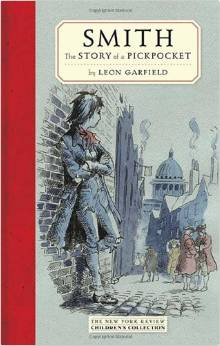
Day 621: Smith, The Story of a Pickpocket

Cover for SmithI did not understand from the reviews I read for this book that it was a children’s book until I noticed its sprightly and simple tone. (My copy did not have this cover.) However, it is not suitable for just any child, because it begins with a murder and includes other violent acts. When I read in the introduction that Garfield wanted to write books full of adventure, like those by Robert Louis Stevenson, that made sense to me. The book is also described as Dickensian, but whereas some of Dickens’ and Stevenson’s books appeal to both adults and children, Smith does not have as much to offer adults.

Smith shares some plot elements with Oliver Twist, if the hero of the latter had been the Artful Dodger instead of the more innocent Oliver. For Smith is a twelve-year-old pickpocket. His adventures start when he picks the pocket of an old gentleman. Right after he does that, he sees the man murdered by two men dressed in brown. These men chase after Smith, but he eludes them.

Smith finds that all he has stolen is a paper that he can’t read. He is smart enough, though, to figure out that the paper must be important, since the men in brown are looking for him. Soon he finds he must leave the cellar where he lives with his two sisters and flee for his life. He goes looking for someone to teach him to read.

Smith’s adventures lead him to meet lots of characters who are vaguely Dickensian but somehow not as fully drawn as Dickens’ own. He finds shelter with a kindly blind man and his gruff daughter, is friends with a boastful highwayman, and meets an untrustworthy lawyer.

I found Smith only mildly entertaining but think that a child of the right age could be fascinated with this book—both by the life of a Victorian street urchin and by Smith’s adventures.

Day 598: Mrs. Palfrey at the Claremont

Cover for Mrs. PalfreyI’ve read two books by Elizabeth Taylor, who is beginning to be appreciated as a novelist years after she authored the books. Both the novels are melancholy, about sad people in realistic situations.

Mrs. Palfrey is an old lady who takes a permanent room at the Claremont, a hotel that has seen better days. Staying at the Claremont are several other older people who are all living on limited means.

One reason Mrs. Palfrey chose the Claremont instead of a seaside resort her daughter recommended is because her grandson Desmond lives in London and works at the British Museum. Mrs. Palfrey regrets having mentioned him to the other guests, though, as day after day passes and no one comes to visit.

The life of all the permanent residents of the Claremont is similar to hers, as they sit waiting for something to happen. Mrs. Post knits while Mr. Osborne writes letters to various newspapers hoping to see them in print. Any incident, no matter how trivial, constitutes a break in the monotony.

One day while out walking, Mrs. Palfrey falls. A young man runs out from a nearby building and helps her. He is Ludo Myers, an impoverished would-be novelist. After this encounter, the two become friends of a sort. Mrs. Palfrey doesn’t know that Ludo has decided to write about old people and is using her as a model. Still, they both behave kindly to one another, he even pretending to be her grandson so she can save some face with the other hotel residents.

Underlying the lives of all the old people are sadness and boredom, but Ludo also feels lonely. His mother goes from one affair to another and doesn’t seem to care if he comes to visit. He eventually takes up with Rosie, a young woman who also doesn’t care for him much.

This novel is observant enough of people’s behavior that it is sometimes funny, but mostly it sensitively explores the solitude that is in all of us. I saw the movie a few weeks after I read the book and was interested, but not surprised, to see how the movie was just enough more heartfelt and touching to make it avoid the central message and atmosphere of the book. I liked the movie, but it missed the point.