Review 2133: The Secret River

Kate Grenville started out writing a nonfiction account of her great-great-great grandfather’s family, but she ended up with too many questions. So, she fictionalized their story and combined it with what she had read about other Australian pioneers.

William Thornhill grows up in poverty in early 19th century London, but he sees a future for himself when Mr. Middleton, a waterman on the Thames, takes him on as an apprentice. William has grown up with Sal Middleton, his boss’s daughter, and he marries her shortly after he reaches journeyman status. However, things go wrong for Middleton, and William finds his livelihood is much more difficult to earn. Finally, he is caught stealing part of a cargo to support his family.

Although he is sentenced to death for theft, William manages to get his sentence reduced to transportation, and his family is allowed to accompany him. In Australia, although life is primitive, it doesn’t take him long to realize he can make money there and maybe return to England in style. However, when he takes a job ferrying goods from a river where settlers have begun farming, he sees a piece of land he can own by settling on it.

Now begins a conflict, with William realizing he will never return to England and Sal only wanting to return. The conflict is heightened when some of the settlers have clashes with the aboriginal people.

I was certainly engaged by this novel, and I felt that Grenville did a good job of portraying the conflicts with the aborigines. Grenville’s characters are flawed but totally believable. She looks unflinchingly at Australia’s brutal origin story, which is very similar to our own.

Related Posts

A Room Made of Leaves

Salt Creek

Rush Oh!

Review 2132: Death of Mr. Dodsley

On his rounds, a young police constable encounters a drunken young man late one night. The man tells him he saw a door opened and closed by a cat, so after the man leaves, the constable goes ahead checking doors and finds the door to a bookstore open. When he looks into the store, he finds a man shot to death in the office. It’s Richard Dodsley, the owner.

Inspector Mallet’s team finds that someone, possibly two people, waited in the store while Dodsley was out and shot him when he returned late to work on a sale catalog. They also learn that a mystery was recently published by Margery Grafton, the daughter of a prominent politician, the circumstances of which closely match those of the murder. It seems more than a coincidence that Margery Grafton is keeping company with Dick Dodsley, the dead man’s nephew, who worked in the shop.

The police find that Dodsley hired a private investigator, MacNab, to find out who has been stealing rare books from his store. MacNab has not been successful, but he gets more closely involved when Margery Grafton hires him to find the murderer because she thinks the police suspect Dick.

Death of Mr. Dodsley does not present us with a super-complicated puzzle , which is a point in its favor. On the other hand, characterization isn’t super important and there are a few important characters that we see almost nothing of, such as Dick Dodsley, the prime suspect. MacNab himself is a fairly laid-back character, and at times the plot seems to be moving very slowly.

Although it’s possible to guess the murderer, there is a surprise at the end that I didn’t see coming. It’s also fun that British Library has been lately publishing these “bibliomysteries.”

I received this book from the publisher in exchange for a free and fair review.

Related Posts

Death of a Bookseller

The White Priory Murders

Death in the Tunnel

Review 2128: Phineas Redux

In summarizing Phineas Redux, the fourth of Trollope’s Palliser novels, I can’t help giving away some of what happened in the previous books, so if you’re planning to read them, beware. All of the books so far in the series have shared characters but been reasonably independent. In fact, it didn’t much matter that I read the first two out of order. Although you could probably read this one by itself, it begins to tie the events and characters from the previous novels more closely.

Phineas Finn has been working at a government job in Ireland since we last saw him two books ago. However, after a short marriage, his wife Mary has died, and his friends, who think there will be a change in government, ask him to run for a seat in Parliament. He does and loses by only a few votes, but there are indications of bribery on the other side, so the election is challenged and Phineas must wait until January for the result.

Phineas has not seen his friend Laura Kennedy since she left her husband and went to Dresden to live with her father. However, she begs him to visit her. Before he leaves for Dresden, he is summoned by Kennedy, he believes to take a message to Laura. But all Kennedy does is berate Laura, tell Phineas it is her duty to return, and allege that she and Phineas are having an affair. They are not, but Phineas feels he owes Laura friendship. Unfortunately, Laura has learned too late that she married the wrong man.

Phineas gets his seat in Parliament, but he has managed to offend the editor of the equivalent of a tabloid newspaper, who brings him a libelous letter from Kennedy that he intends to print. Phineas goes to Kennedy about it, but Kennedy tries to shoot him. The editor is compelled not to print the letter but begins attacking Phineas in print, making suggestions about his relations with Laura and referring to the attack as if Phineas is to blame. The result is that he doesn’t receive a paid position in government as he expected, and he is still very poor.

In the meantime, Phineas’s friend Mrs. Max Goesler has befriended the failing Duke of Omnium. She has refused his proposal of marriage but continued to visit him. When he dies, she finds he has left her a large sum of money and his jewels, none of which she wants. As a result of his death, Plantagenet Palliser becomes the Duke of Omnium and Lady Glencora the Duchess. Plantagenet is mostly upset because his new position forces him into the House of Lords and out of the House of Commons, where he feels he has been doing important work.

Things are not going well for Phineas, and they are about to get worse, even to threaten his life.

In this book, I found the parliamentary issues a little harder to follow, but I was not expecting what is essentially a murder mystery. Once that plot got started, I was rivetted.

Related Posts

The Eustace Diamonds

Phineas Finn

Can You Forgive Her?

Review 2101: A House in Bloomsbury

Dora Mannering is a little brat when we first meet her at 16. She and her father are tenants of a house in Bloomsbury. They are not wealthy—he is a scientist who works at a museum—and they occupy three rooms although the rooms are well-appointed. Dora has no understanding of what it means to be very poor and disdains thoughts of money.

Dora doesn’t remember her mother, and her father never speaks of her. Someone sends her a box of gifts once a year, anonymously, and he is not happy when it arrives.

Dora’s father becomes very ill, which throws Dora more into the company of others in the household. Miss Bethune is one, a wealthy Scottish spinster who lives with her maid. Dr. Roland, who believes he could treat Mr. Mannering’s illness better than the expensive society doctor called in, is another.

Then a strange lady appears, or rather, her envoy, a young man, who approaches Miss Bethune with a request that she receive the lady and invite Dora over at the same time. It’s not too hard to guess who the lady is, but the circumstances of the original separation also come out.

Miss Bethune also has a secret.

I’m not sure if this novel would have been considered a sensation novel in its time, because the secrets don’t turn out to be that shocking, but there are a few emotional scenes and two different women who are hysterical at times. However, the novel features likable characters and has a satisfying ending. The heroine grows up, and people are kind to each other.

Related Posts

Hester

Phoebe Junior

Miss Marjoribanks

Review 2079: Partners in Crime

I decided to read all of the Tommy and Tuppence novels in order when I read that they were Christie’s favorite sleuths. Partners in Crime is the second book in the series, set six years after the first.

Tuppence is beginning to be bored when Mr. Carter, Tommy’s boss, asks him to take six months off his work in the Secret Service to reopen the Blunt Detective Agency, which the department believes is connected with espionage. They are to look for a Russian blue stamp on a letter and further contacts.

Partners in Crime is not exactly a collection of short stories, but it is about a series of crimes Tommy and Tuppence solve in between tussles with the bad guys. Each case takes up one or two chapters. The book also has a running theme of either Tommy or Tuppence taking on the persona of a different detective from literature in each case. Unfortunately, I didn’t know who most of the detectives were, so I missed some jokes.

Some of the mysteries are laughably obvious, but others are more difficult. The novel suffers slightly from the problem I find with short detective fiction—not a lot of time to develop plots, red herrings, and characters. However, Tommy and Tuppence are funny and charming, so I enjoyed the book.

Related Posts

The Secret Adversary

The Man in the Brown Suit

The Seven Dials Mystery

Review 2068: The Secret Adversary

I decided to read all of Christie’s Tommy and Tuppence novels after learning that they were her favorites of all her sleuths. There are unfortunately only a few of these novels, and The Secret Adversary is the first.

Tommy and Tuppence are old friends who haven’t seen each other for a while when they meet again after World War I. They are both broke and have been looking for work, so they decide to band together to look for jobs, calling themselves Young Adventurers, Inc. On leaving the café where they have been lunching and discussing this plan, Tuppence is approached by a man who overheard them and says he thinks he has a job for them, but when he asks her name, she says, “Jane Finn,” a name she heard mentioned in the café. He reacts indignantly and leaves.

After placing an ad, Tommy and Tuppence are contacted for work and find that the job oddly involves Jane Finn, who was a passenger on the Lusitania when it was sunk five years before and is believed to have been the recipient of a package important to the government. Tommy and Tuppence are hired to find Jane Finn.

The search brings with it many adventures, during which their steps are dogged by a mysterious Mr. Brown, apparently a criminal mastermind. This novel has a silly Cold War plot before the Cold War, and the slang spoken by an American millionaire seems completely unlikely. I think Christie must have watched too many gangster movies. However, Tommy and Tuppence are delightful and resourceful, so this was a fun reading experience.

Related Posts

By the Pricking of My Thumbs

The Seven Dials Mystery

Destination Unknown

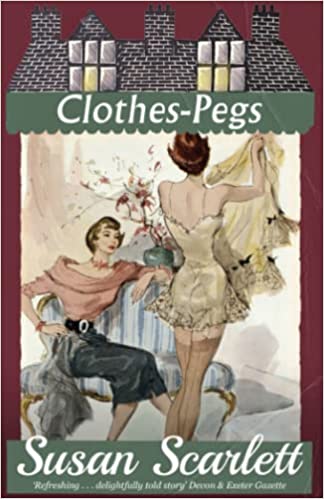
Review 2064: Clothes-Pegs

After reading Susan Scarlett’s Summer Pudding, I wasn’t sure she was my jam. However, I was surprised by how much I enjoyed Clothes-Pegs, a Cinderella story.

Annabel Brown is an unassuming young woman whose only ambition is to do well at her job as a seamstress before marrying some young man whom she loves. She has no idea that she is beautiful.

Her employer, Tania Petoff, has noticed her, though. Tania runs an exclusive dress shop, designing and making her own creations in the shop. When one of her models quits without notice, she decides to give Annabel a try.

At first, Annabel feels totally out of place in her promotion. Of the three other models, Bernadette, Freda, and Elizabeth, only Bernadette is nice, and she helps Annabel out with suggestions.

When Annabel sees Octavia Glaye at a fitting, she thinks she’s the most beautiful woman she has ever seen. But Octavia is jealous of how much attention her friend, Lord David de Bett, pays to Annabel. Annabel soon notices David, though, and falls in love with him on sight. She doesn’t have any illusions of a future with him. She is content to love him.

For his part, David is struck by Annabel’s naturalness and innocence but thinks he’ll probably marry Octavia. Octavia is ready to try to make Annabel regret any attention David pays her.

The Cinderella story was fun, but I especially enjoyed the parts about Annabel’s engaging middleclass family. Annabel is a nice, occasionally foolish but usually practical heroine who only gets into situations because of her lack of experience and the venom of others.

I received this book from the publisher in exchange for a free and fair review.

Related Posts

Summer Pudding

Beneath the Visiting Moon

Touch Not the Nettle

Review 2063: Can You Forgive Her?

Can You Forgive Her? is the first of Trollope’s Palliser novels. Phineas Finn, which I read first, is the second. Palliser doesn’t actually appear in this novel until page 150, but then he plays an important role.

At issue in this novel are three romances, which explore the theme of who has the power in courtship and marriage. The most important is that of Alice Vavasor, and as I read her story, I couldn’t help reflecting how different it reads now. Alice is in love with and engaged to John Grey, but she feels that he is too perfect. Further, she is inclined to marry a man in politics while he prefers a retired life in the country.

As Trollope explains it, she overthinks her impending marriage. She goes on a trip to Switzerland with her cousin Kate Vavasor and Kate’s brother George. Years before, Alice was engaged to George but he somehow betrayed her and the engagement was broken off. But Kate is determined that Alice will marry George. George seems indifferent, but he frankly needs Alice’s money for a run for parliament. Slowly, though, readers learn that George is a scoundrel.

Another love triangle involves Alice’s cousin Lady Glencora. Lady Glencora is newly married to Plantagenet Palliser, the heir to the Duke of Omnium. Lady Glencora, a great heiress, is very young, and she was madly in love with Burgo Fitzgerald, a young wastrel. Her horrified relatives quickly pushed her into a marriage with Palliser, but he doesn’t have much in common with her and doesn’t know how to handle her. Lady Glencora befriends Alice and confides in her that Burgo wants her to run away with him. She is unhappy enough to be tempted.

The final love triangle is a comic one. Kate Vavasor’s Aunt Mrs. Greenow is a wealthy widow who has two suitors. Mr. Cheeseacre is a vulgar wealthy farmer who talks about his money all the time. The other is Captain Bellfield, who has some style and panache but probably isn’t a captain and has no money.

Modern audiences may have problems with some of the assumptions of this novel, but I always try to keep modern judgements out of my opinion of older novels. I found this novel interesting and especially got involved in Alice’s situation. She is so honest yet so misguided that it made her story intriguing. I was a little bored with the comic romance, although it dealt with some of the same issues as the other relationships.

Related Posts

Phineas Finn

Doctor Thorne

Barchester Towers

Review 2038: The Last Protector

It’s 1668. When James Marwood’s boss Williamson sends him to secretly observe a duel between the Duke of Buckingham and Lord Shrewsbury, James is alarmed. He has already come to the attention of the powerful Duke, and not in a good way. He has to do what Williamson asks, but he is observed and must flee for his life.

Cat Lovett has come to regret her marriage to the elderly Mr. Hakesby. As he has become less able, he has begun demeaning her and making demands of her. What she believed would be a marriage of just companionship has turned out not to be so, and she finds it distasteful.

When an old friend, Elizabeth Cromwell, the daughter of the last Protector, Richard, claims her acquaintance and behaves as if they were closer than they were, Cat eventually recognizes she is using her to get the plans for a building called the Cockpit from her husband. She also realizes that Richard Cromwell, who is supposed to be banished to Europe, is in the country. The Cromwells want the Hakesbys’ help to regain a personal possession, they say, but Cat thinks Hakesby is foolishly getting embroiled in treason.

The Last Protector is another fine entry in the James Marwood/Cat Lovett series set during the Restoration. It combines political intrigue with suspense in a realistic seeming historical setting.

Related Posts

The Ashes of London

The Fire Court

The King’s Evil

Review 2014: Something to Hide

Tani Bankole, a teenage boy of NIgerian descent, believes that his father, Abeola, has arranged a marriage for Simi, his eight-year-old sister. He begins making preparations to flee with her, because his mother, Monifa, seems totally subservient. Soon, though, he is horrified to realize that Simi is being prepared for female circumcision to “cleanse” her in preparation for marriage.

DS Teo Bontempi is found unconscious on the floor of her apartment after being bashed on the head and dies later in the hospital. When DCI Lynley and his team begin investigating, they find that her boss, DCI Mark Phinney, had her transferred shortly before, out of a project she loved, trying to shut down female genital mutilation in London. Phinney reports that she tended to do too much on her own instead of working with the team. But it soon comes out that he was having an affair with her. Phinney’s wife Pete is wholly subsumed with caring for their severely disabled daughter and is so afraid of having another child that she refuses sex, encouraging Phinney to look elsewhere. Only Phinney had fallen in love with Teo.

Teo also had a husband, although they were separated, who wanted to get back with her. He, Ross Carver, discovered her injured but acceded to her request to help her to bed instead of calling an ambulance. Teo’s sister Rose has her eye on Ross and has become pregnant by him during the separation.

These are the immediate suspects in the murder, but suspense is added when Tani flees with his sister from their abusive father.

Although as usual Linley is having romantic problems, this series continues to be really good. George takes her time getting to the crime, but the preceding background is necessary and interesting. Although the series went astray for several books after Linley’s wife Helen’s death, it has improved again with the last few books and is getting even better. We find out more about DS Winston Nkata’s home life in this one, too.

Related Posts

The Punishment She Deserves

A Banquet of Consequences

Just One Evil Act