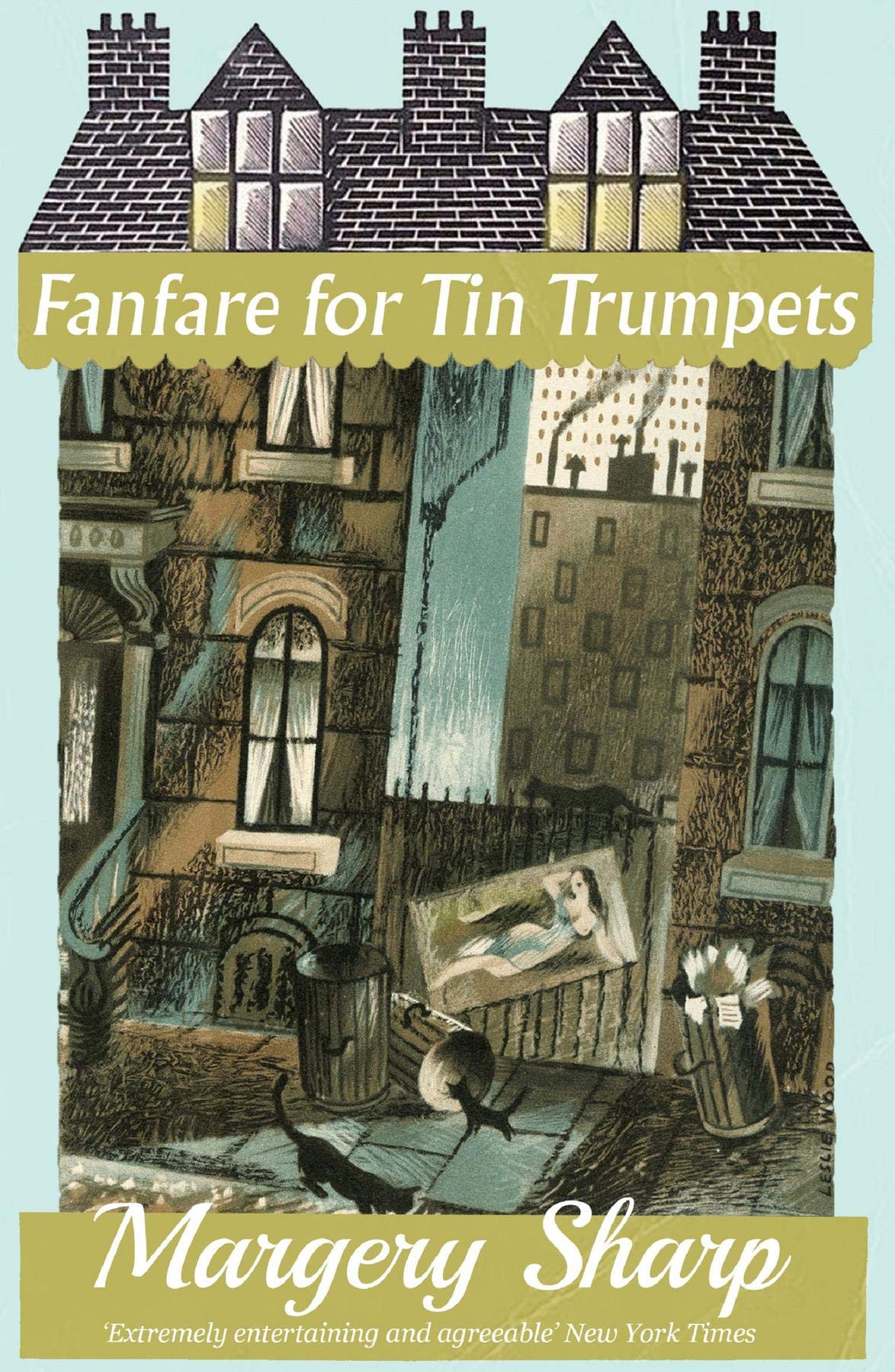
Review 2269: Fanfare for Tin Trumpets

Young Alastair French is offered a place in his family’s stationers business, but he decides to take a room in northwest London with his friend Henry, who is going to be a student. Alastair has £100, and he figures he can support himself for a year while he becomes a writer.

Alastair and Henry move into an apartment building with an assortment of friendly neighbors, particularly Winnie Parker, who is always surrounded by young men. Although he starts a novel, Alastair decides to become a playwright mostly because plays are shorter. He doesn’t do much work but he does write up a scenario.

Then he meets Cressida Drury, an actress, and is immediately smitten. She returns some of his interest when she learns he is a playwright, but it’s hard to tell how much, and he didn’t think of dating when he made his budget.

This is a frothy, funny novel about youthful optimism and first love. It’s a lot of fun.

Related Posts

Harlequin House

Rhododendron Pie

The Foolish Gentlewoman

Review 2263: The Shadows of London

Cat Lovell and her partner Brennan have a commission to build a new almshouse and some houses where the old almshouse burnt down in 1666. However, workmen find a body in a rubbish pile on the site. Not only does the body need to be identified because it has no face, but a magistrate named Rush closes down the entire site until the inquest. This is unnecessary, but Cat’s employer Mr. Hadgraft, says that Rush originally was a partner in the undertaking and pulled out, so he is trying to get back at Hadgraft. For Cat and Brennan, the situation is urgent, because they only have a few months before winter closes the work down.

Cat’s friend James Marwood now works entirely for Lord Arlington, who assigns him the task of discovering the corpse’s identity. He finds there are two missing men who might be the victims. One is John Ireton, a civil servant who has disappeared. The other is a Frenchman, Monsieur Pharamond (a pseudonym). Both were involved in fleecing a young French lady-in-waiting in Dieppe.

This novel also tells the true story of that lady-in-waiting, Louise de Keroualle, who has attracted the attention of Charles II. Both Lord Arlington and the King of France see a benefit in having a young French, Catholic girl in the King’s bed. But Louise herself is hoping for a way out.

Marwood’s investigations indicate that his and Cat’s old nemesis, Roger Durrell, a tough for Buckingham, might have killed the dead man. Another issue is that James has become infatuated with Hadgraft’s daughter, and Hadgraft seems unexpectedly eager for the marriage. Cat finds herself surprisingly jealous.

This is an excellent series, and another exciting entry in it. I especially liked the ending.

Related Posts

The Royal Secret

The Last Protector

The King’s Evil

Review 2246: One Year’s Time

Liza, a “bachelor girl” in 1930s London, has a job as a secretary in an office where she likes all the people and a basic flat that she’s fixing up. It’s January 2 and she’s painting the floor and feeling lonely when she gets a call from Walter, a young man she met at a party. She invites him over and they quickly become lovers.

Everything is smooth at first, and she quickly falls in love, but she is always trying to match his mood and to appease him. When he disappoints her, she thinks it is her fault for being disappointed. She madly wants to marry him, but he doesn’t ask.

In April, he decides to spend the summer in the country. He asks her to go, and with very little planning, she quits her job and gives up her flat.

Liza is the type of person who’s either very happy or in the depths of despair. She has high expectations for this trip, but we already know it won’t go as planned.

I hope girls have gained more self-confidence, but I’ve known girls like this who spent a lot of time waiting by the phone (which you presumably don’t have to do anymore, because you carry it with you), and even when I was young, quite a few decades after this book is set, I knew girls who were focused only on marriage. It was interesting but sometimes excruciating to observe what’s going on in Liza’s mind. When will she realize she always puts Walter first and so does he, charming as he may be?

This is an unusual novel for the 30s, showing how things have opened up a little for women sexually but not too much, as her fretting over her fake wedding ring shows. I felt both impatient with and sympathetic to Liza for most of the book.

I received this book from the publishers in exchange for a free and fair review.

Related Posts

Grand Hotel

Which Way?

Sally on the Rocks

Review 2228: The Island of Missing Trees

I’ve now read three books by Elif Shafak, but I always have the same problem. Some choice she makes in the narrative style separates me from getting fully involved. In this case, it’s the blasted fig tree.

In the 2010s, Ada is the sixteen-year-old daughter of Cypriot parents living in London. Her mother died the year before, and she is grieving. Her father, an introverted plant scientist who is also grieving, is not much help. Her parents went through traumatic events when they were in their teens during the invasion of Cyprus. Further, their marriage meant a break from their families, as Kostos is Greek and Defne was Turkish. Ada would like to understand more, but Kostos promised Dephne not to talk to Ada about their past.

Just before the holidays, Ada has a sort of breakdown in school, and her behavior is recorded and put on social media. She is depressed and hostile until her Aunt Meryem, whom she has never met, arrives for a visit. She is angry with her aunt because she didn’t come to Dephne’s funeral, but from her she begins to learn about Cyprus and her parents.

The chapters involving humans are separated by chapters narrated by a fig tree that Kostos brought from Cyprus. This fig tree knows all about the history of Cyprus as well as about various creatures. Plus, it is visited by numerous birds and insects, all of which have stories to tell or the tree has facts about them to impart. Every time I came close to getting involved in the flow of the story, there was a chapter by the fig tree to interrupt it. I finished the book, but I almost put it down numerous times, and I started skipping through the tree’s sections.

Related Posts

The Bastard of Istanbul

10 Minutes 38 Seconds in This Strange World

The 40 Days of Musa Dagh

Review 2190: Bleeding Heart Yard

Detective Inspector Harbinder Kaur has transferred to London, where she is just meeting her two flatmates and her new team. Then she gets a high-profile case—while attending a school reunion, Conservative MP Garfield Rice, called Gary by his friends, has died of an apparent cocaine overdose. The only thing is, his friends say he doesn’t take drugs.

Attending the reunion are some notable figures—Isabelle Ister, a famous actress; Kris Foster, a rock star; Henry Skep, Labour MP—who used to belong to a popular group in school called The Group. Also members of The Group were Anna Vance, a teacher now living in Italy who is in London caring for her dying mother, and Cassie Fitzberbert, Harbinder’s Detective Sergeant. We know right from the beginning that Cassie believes she killed a boy when she was in school.

Of course, it turns out that Gary was murdered by an injection of insulin. His friends find it hard to believe, because Gary was liked by everyone.

There turns out to be more than one line of inquiry. Gary had received several anonymous letters featuring a bleeding heart, and he was regularly meeting other Conservative leaders at a restaurant in Bleeding Heart Yard. Also, the team learns that during exam week before the reunion attendees graduated years ago, a boy named David died when he fell in front of a train, and Gary was the principal witness. Harbinder wonders if David was actually pushed.

The book alternates narrators with members of The Group in first person and Harbinder in third person. I don’t remember if Griffiths used this form of narration in the other Kaur novels, but it began to irritate me. First, the first-person narrators should each sound different, but they don’t. More importantly, with the narration skipping around across very short chapters, the novel started to feel choppy.

So far, I have enjoyed the Harbinder Kaur series, but I didn’t like this one as much, despite it having an unpredictable ending. I still like Griffiths’ Ruth Galloway series best.

Related Posts

The Stranger Diaries

The Postscript Murders

The Locked Room

Review 2185: The Transit of Venus

The Transit of Venus spans the 1950s through the 1970s. It is a modernist exploration of the love affairs, both unconsummated and consummated, of the characters surrounding two Australian sisters in England, Caroline and Grace Bell.

The novel begins when Grace Bell is engaged to Christian Thrale. Grace is a few years younger than her sister Caroline, who is 21. Both are staying with the Thrales when Ted Tice, an astronomy graduate, arrives to plan the placement of a new telescope with Professor Sefton Thrale, Christian’s father. Ted, who is shabby and unprepossessing at the time, falls in love with Caroline at first sight.

Caroline, for her part, falls in love with Paul Ivory, whose play is being produced and who has just become engaged to Tertia Drage, the daughter of a neighboring lord. Caroline and Paul have an affair, but Paul drops her for Tertia, choosing position and wealth over love.

Caroline is devastated. She goes off with a friend of the Thrales, a middle-aged roué who has been bedding Tertia, but she ends up in London, working at a poorly paid government job and leading a bleak existence. All the while, she is loved by Ted Tice.

As the years go by, most of the main characters of the novel are overtaken by love. Caroline and Paul rekindle their affair for a time, but Caroline eventually happily marries a wealthy American philanthropist, Adam Vail. Christian becomes briefly obsessed with a young secretary, while Grace falls deeply in love with her son’s noble doctor. Grace and Caroline’s difficult older half-sister marries, to their relief, but then is robbed and abandoned by her husband.

Until the ending of the novel, I felt that the novel was a fairly detached examination of these various relationships in terms of the dynamics of who holds the power. Then Caroline learns a secret that makes her re-examine her entire adult life and made me re-evaluate my liking for the book. It turns everything on its head and makes the novel a great one.

Related Posts

Outline

Old Filth

Stoner

Review 2169: The House on Half Moon Street

In Victorian London, Leo Stanhope is leading a difficult existence as a clerk for a hospital mortuary. His only extravagance is a weekly trip to the whorehouse, where he meets Maria, with whom he is madly in love. She is one of only a few people who knows his secret—that he was born a girl but has always believed he’s a boy. At 15, he left a comfortable home to live as a man.

One day the body of a murdered woman arrives at the mortuary. It is Maria, who did not turn up for the date they had for Saturday. Leo is soon brought in for questioning, but he is let go, and he becomes obsessed with trying to find Maria’s killer. He believes that her death may be related to that of another corpse brought in a few days before.

Of course, Leo finds that almost nothing Maria told him about herself was true, and that leads me to the first general discomfort I had with this novel even before Maria’s body turned up. That is, I really hate the trope of a young man being obsessed with a woman who is leading him on, especially one who exhibits stalker behaviors. If that wasn’t bad enough, Reeve puts Leo through so much physical and mental torment before he’s through that it made me very uncomfortable.

I think the mystery was complex and interesting, but Leo, who is self-obsessed and humorless, reminded me a lot of C. J. Sansom’s depressing hero, Matthew Shardlake. At one point, another character tries to point out that he is not only jeopardizing his own life but hers, but he thinks only of himself and continues to go on the same way.

Related Posts

Special Assignments: The Further Adventures of Erast Fandorin

The Gods of Gotham

Rustication

Review 2162: Shrines of Gaiety

It’s 1926. Ma Coker is being released from jail, and it’s like a circus in front of the prison. Nellie Coker is the head of a crime family in London, the owner of five clubs that Frobisher, the new broom at the police station, thinks are responsible for the disappearance of quite a few girls.

Miss Gwendolyn Kelling has unexpectedly inherited some money, so she quits her job in York as a librarian and decides to search for her friend’s sister, Florence Ingram, and Freda Murgatroyd, both 14, who have gone to London to make their fortunes, Freda being positive that she is going to be a star. When she goes to the police station, Frobisher asks her to visit one of the Coker clubs to report what she can observe.

Niven Coker, Nellie’s oldest son, by coincidence comes upon Miss Kelling on the street after she has been mugged. He gives her a ride to her ladies hotel, and afterwards she receives her purse.

Frobisher has been asking at the office for Maddox, one of the inspectors, but he has been on sick leave. Frobisher is sure Maddox is corrupt, but what he doesn’t know is that Maddox is putting the final pieces in place to take over Nellie Coker’s clubs. To start with, there is arson.

Maddox isn’t the only one after the Coker empire. There’s also Mr. Azzopardi, who begins by trying to exploit the weaknesses of Nellie’s youngest son, Ramsey.

There are some dark deeds in this novel, but it is written with a lightness that conveys more the fevered fun seeking of the time. For a crime family, the Cokers are curiously benign, and Nellie Coker seems to be three steps ahead of everyone else. The novel is more of an ensemble piece and doesn’t have a main character, although we admire Miss Kelling and also the plucky but naïve Freda. Although ostensibly a crime novel, I found it more a portrait of a particular period and enjoyed it very much. Atkinson has based some of it on the life of Kate Mayrick, the owner of clubs in Soho.

Related Posts

Big Sky

Transcription

A God in Ruins

Review 2143: Death of an Author

Death of an Author wasn’t my favorite book by E. C. R. Lorac, but it certainly is a clever one. And Lorac airs that recurring question, Can a women’s writing be differentiated from a man’s? in her book set in the publishing world.

Andrew Marriott, the managing editor of a publishing company, is asked by one of his best-selling authors, Michael Ashe, to invite another of his authors, Vivian Lestrange, to dinner along with himself. Since Lestrange is a recluse, this subterfuge is necessary if Ashe is to meet him. Lestrange accepts, and Ashe is astonished to meet a self-possessed young woman.

A few months later, the same young woman goes to a police station. There she explains that she is Eleanor Clarke, the secretary for the author Vivian Lestrange, and she fears something has happened to her employer, as when she tried to go to work, no one answered her knock.

The police find the house impossible to enter except through a walled door and have to climb a ladder to get in. They find a perfectly cleaned house with no one inside but open French doors with a bullet hole through one. Miss Clarke says that not only is her employer missing but his housekeeper, Mrs. Fife, is not even known at the address she gave Clarke.

Inspector Bond is suspicious of Miss Clarke, and after some investigation shows no proof that Lestrange even existed, he theorizes that she was the author of the Lestrange books and is for some reason spoofing the police. However, Chief Inspector Warner is inclined to believe her, and his belief seems justified when a body with Lestrange’s notebook in his pocket is found burned up in a remote cottage.

After learning about Michael Ashe’s interest in Lestrange, the police look for him, but he appears to be out of the country. However, the timing of his departure makes it feasible for him to be the killer.

The detectives find a possible connection to two brothers, one of whom embezzled funds from a trust both were responsible for and escaped, while the other served in prison for it claiming he was innocent. Could one of the authors be one of these brothers? or both?

Although I had a feeling that the police made a mistake about the brothers, I did not figure out exactly what happened. I’m not quite sure why I didn’t enjoy this one as much as some others by Lorac, though.

I received this book from the publisher in exchange for a free and fair review.

Related Posts

Post after Post-Mortem

Checkmate to Murder

Death of a Bookseller

Review 2141: The Foundling

As a young woman, Bess Bright, a shrimp seller, has a first sexual encounter with Daniel Callard, a merchant. He disappears, leaving her with only a keepsake, half a whalebone heart, and a pregnancy. In 1748 London, she and her father, who already support her lay-about brother, cannot afford to keep the baby, so she takes her newborn daughter to a lottery at a foundling hospital, and she is accepted. She leaves the half heart as an identifier, so she reclaim her daughter.

Six years later, Bess believes she has saved enough money to redeem her daughter. But when she returns to the foundling hospital, she is told that she herself redeemed her daughter one day after leaving her, even identifying the keepsake.

Bess has discovered that Daniel died a few months after their encounter and that he was married. When she goes to consult Dr. Mead of the foundling hospital, he takes her to chapel, where she sees Mrs. Callard. With her is a six-year-old girl that Bess knows immediately is her daughter.

With unwitting help from Doctor Mead, Bess gets a position as a nursemaid with Mrs. Callard. There, she finds a strange household, where no one leaves the house except for the weekly chapel visit. Here the point of view shifts to that of Alexandra Callard, a woman full of fears and given to ritual.

I thought I had read a book by Stacey Halls before, but I was mistaken. I was at first disturbed by the first person narration, because it sounds nothing like a woman of Bess’s time and lack of education. Also, the first person narrative taken up later by Alexandra doesn’t sound like a different person. Hall could have easily avoided this problem by employing limited third person instead.

I got accustomed to the narrative style eventually and was pulled along by the story. However, without saying what it was, I found the ending spectacularly unlikely, especially the sudden change in Alexandra.

Related Posts

Birdcage Walk

The Mermaid and Mrs. Hancock

The Bass Rock