Day 478: Mr. Timothy

Cover for Mr. TimothyAlthough not typical holiday fare, Mr. Timothy picks up some of Dickens’ characters about 20 years after A Christmas Carol and has the added similarity of being set at Christmas time. The main character is Timothy Cratchitt, familiar to us as Tiny Tim.

Timothy is depressed and aimless. The patronage of Ebenezer Scrooge, or Uncle N as he is known in this novel, has had the unfortunate effect of making Timothy dissatisfied with his roots while not fitting him for much else. Most of his family has died or moved away, and he is depressed about the death of his father six months before. In despair, he has left his usual haunts and gone to live in a brothel, where he teaches the owner, Mrs. Sharpe, how to read. Although he has some desire to make his own way, he lacks purpose and initiative, still accepting an allowance from Uncle N. He seems to be on his way down in life.

Timothy goes out dragging the river for bodies one night with his friend Captain Gully, and they pull out a young girl. She has an odd brand on her back, like a G with eyes. Timothy realizes he has seen this brand before, on another girl the police were examining as he went by, who was found dead in an alley.

Timothy has several times spotted another young girl around the city and tried to approach her, but she has always run away. With the help of a street urchin named Colin, he finally tracks her down. Philomela is Italian and has had something traumatic happen to her of which she will not speak. When Timothy tries to take her home to safety, two different parties attempt to remove her from his custody on the street. A charity worker insists she will take Philomela to a home, and a mysterious man in a coach tries to kidnap her. Philomela and Timothy get away, but now Timothy is determined to find out what is going on.

This novel is a slow starter and fairly depressing at the beginning. Although it is feasible to theorize that Scrooge’s help could result in such unhappiness (ala Great Expectations), I wasn’t sure I wanted to think of the original story in these terms. However, the novel successfully invokes a Dickensian atmosphere, including the comic characters and character names, and it picks up its pace as Timothy gets involved in the mystery. After the first 50 pages or so, I was involved and trying to figure out the mystery, which is as entangled as any Dickens effort.
Day 366: The Pale Blue Eye

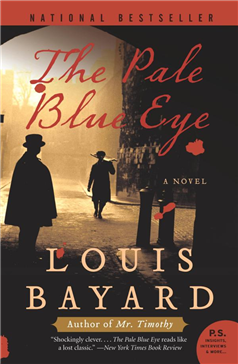
Cover for The Pale Blue EyeGus Landor, a retired New York police detective, is dying, and he writes the account of his last case in The Pale Blue Eye. Gus is a lonely widower who earlier moved up to the mountains near the Hudson Valley with his wife and daughter to help improve his lungs. But his wife died within a year, and his daughter left him soon after. So, Gus lives as a veritable hermit.

On an October morning in 1830, an officer from West Point fetches him. The body of a cadet named Fry was found hanged the night before, presumably a suicide, but during the night his body was stolen and later he was found with his heart removed. Superintendent Thayer and Commander Hitchcock wish to hire Landor to find who stole the heart. Landor is quick to figure out that Fry did not commit suicide but was murdered. A mysterious message clutched in his hand seems to indicate an assignation.

Landor soon realizes that his investigations on the reservation will be sorely hampered without the assistance of an inside man. So, he asks for the help of an unusual cadet he has met who is not in good favor with the academy–Cadet Edgar Allan Poe.

This is a clever novel with a macabre mystery that would have been completely to Poe’s taste. Just when we think everything is figured out, Bayard presents us with a twist. His portrait of the young Poe, bombastic, ridiculously romantic, and fearfully intelligent, is a great pleasure.

I would only fault the novel for a slow-paced middle section, and only because Landor doesn’t seem to be doing anything. Most of the plot is driven forward by Poe’s reports, which begin to dwell on his infatuation with a lovely young woman, Lea, the daughter of the post doctor, who unfortunately suffers from the “falling sickness,” or epilepsy.

Of course, Landor is doing something–he’s deciphering Fry’s diary–but since he doesn’t relate its revelations, his investigation seems to flag, and he barely seems to look into a second death, with a second missing heart. Otherwise, the novel is well written, with well-developed and interesting characters and a surprising ending.

Day 201: The School of Night

The School of NightCoincidentally, this summer I read and reviewed Shadow of Night, and The School of Night by Louis Bayard is another novel that deals with the School of Night, a group of Elizabethan scholars who pursued forbidden knowledge. Its members were Sir Walter Raleigh, Thomas Harriot, and Kit Marlowe, among others. The School of Night follows events in two time periods, the present and 1603.

Ten years ago Henry Cavendish was an Elizabethan scholar with a promising future, but he was disgraced when he accepted as legitimate a forged letter supposedly by Sir Walter Raleigh and presented it at a conference. Since then, he has barely eked out a living, teaching part-time, doing editing work, and taking whatever jobs he can get. His only true friend is the eccentric Alonzo Wax, a collector and purveyor of rare books.

But Alonzo is dead, having drowned himself after trying to contact Henry, and Henry finds himself the estate executor. Shortly after the funeral, Henry is contacted by another collector, Bernard Styles, who shows him the second page of a letter by Raleigh that he alleges Alonzo stole from him. This letter makes a rare reference to the School of Night. Styles offers Henry a lot of money to find the letter in Alonzo’s papers and give it to him.

Henry also meets Clarissa Dale, who claims to have made Alonzo’s acquaintance after a lecture about the School of Night. Although she is not an academic, she has been having visions of Thomas Harriot and an assistant named Margaret and wants to find out why.

Henry has barely begun to work with Alonzo’s papers when Alonzo’s secretary, Lily Pentzler, is murdered and all of Alonzo’s books are stolen. This incident makes Henry and Clarissa wonder if Alonzo was murdered, too. Soon, Henry and Clarissa find themselves investigating the secrets of the letter.

Alternating with the present-time story is that of Thomas Harriot, the leader of the School of Night, as he explores Virginia and later works on his forbidden experiments while hidden away on the estate of the Earl of Percy. Finding that his maid servant Margaret can read, he begins to train her to assist him in his experiments.

Although I guessed one important secret early on, I found this novel deeply satisfying. It is full of twists and betrayals and has interesting characters. It treats the historical plot intelligently, and although this comment is not meant as a criticism of Shadow of Night, it deals more seriously with the School of Night than does Shadow of Night (which of course has a completely different focus).

I had not read Bayard before, but he is known for writing historical mysteries that feature such characters as a grown-up Tiny Tim (Mr. Timothy) and Edgar Allan Poe (The Pale Blue Eye). I am interested in reading more.