Day 482: The Map of Love

Cover for The Map of LoveBest Book of the Week!
The Map of Love is an absorbing novel to read now, just after the Arab Spring and during the troubled times that have continued on. It is a love story certainly, its title tells you that, but it also explores the roots of the political turmoil in present-day Egypt and some of the other countries that used to be a part of the Ottoman Empire.

The novel follows the course of two cross-cultural love affairs 90 years apart. In 1900 Anna Winterbourne travels to Egypt in an attempt to overcome her grief. She is the widow of a man who recently served in the Soudan, and even though their marriage was not a happy one, she is sorrowful that she could not help him overcome his despair at participating in an unjust war. Almost accidentally, she meets Sharif al-Barroudi, a Cairo lawyer and activist, and falls in love with him.

Anna’s diary and letters are discovered by her great-granddaughter, Isabel Cabot. Isabel herself has fallen in love with ‘Omar al-Ghamwari, a famous Egyptian-American orchestra conductor who is rumored to work with the Palestinians. ‘Omar feels that their age difference is too great for a relationship, but he suggests that Isabel take her find to his sister Aman in Cairo so that she might help Isabel translate some of the materials.

Aman becomes absorbed in reading Anna’s diaries and letters and realizes very soon that she and Isabel are related, for Anna’s beloved sister-in-law Layla is Aman’s own grandmother. With Layla’s diaries of the same time period, she begins to reconstruct Anna’s story and that of Egypt’s history during a turbulent period. Aman has returned from life abroad to live in Cairo in another turbulent time.

Anna’s courtship is fraught with difficulties, but once she and Sharif are married, she is caught up in his work for Egyptian independence from the Ottoman Empire and from British oversight. As the years go by, his efforts extend to attempts to keep Palestinian land, once owned by his family and by his neighbors and occupied by hundreds of thousands of Muslims, from being bought up by Zionists who would expel them.

The blurb for this novel stresses the similarities between the two love stories, and there are many points of similarity, but the focus of the story in the current time is more with Aman than with Isabel and ‘Omar. Aman is at first at loose ends in Cairo, but she becomes involved with trying to help the fellaheen who occupy her family’s land, as they are treated unjustly by a corrupt and paranoid government. I was frankly more interested in Aman and in Anna and Sharif than I was in Isabel and ‘Omar, who are much less present in the novel.

For me, not very politically aware in regard to problems in this part of the world, this was a fascinating and revealing reading experience. It points up the complex history of the area from a point of view we westerners seldom hear. It is affectingly told in the context of a great love affair between two lovingly created characters. The characters of the two sisters, Layla and Aman, are also vivid. This novel is beautifully written and evokes for us a vibrant culture.

Day 477: The Fault in Our Stars

Cover for The Fault in Our StarsBest Book of the Week!
It seems as if I have read more books lately from which I do not get a sense of the characters’ personalities. I don’t feel as if they could be real people but just projections of the author’s plot. But that is not the case with The Fault in Our Stars, which creates for us some unforgettable personalities.

Hazel Lancaster is a sixteen-year-old with thyroid cancer that has spread to her lungs. Unlike the other kids in the support group her mom has talked her into attending, she doesn’t have any hope of survival. She just wants to live as long as she can. At the group, she meets Augustus Waters, a seventeen-year-old ex-basketball player who has lost one leg to osteosarcoma but has a generally good prognosis.

Hazel is witty, smart, and well read. She is obsessed with a novel called An Imperial Affliction by Peter Van Houten, which is about a young girl suffering from a fatal illness, and literally ends in the middle of a sentence. As she and Augustus discuss their favorite books, Hazel explains that she just wants to know what happened to everyone else in the novel. Augustus decides to use his wish from the Genie Foundation to take Hazel to Amsterdam, where she can meet Peter Van Houten and find out what happened after the novel ended.

This novel is about teenagers falling in love, and rarely has fiction depicted two more appealing people. My one very small criticism is that they are scarily smart and funny, in intelligence reminding me more of Salinger’s Glass family than of normal kids. But Green has got the juvenile speech patterns down.

Frightfully well written, touching, funny, and ultimately sad, this novel has much to offer teens, young adults, and adults. Hazel and Augustus are affectingly human, and even Hazel’s parents, those cumbersome quantities so often ignored or eliminated in children’s or young adult fiction (note, for example, how much we see of Bella’s father in Twilight), are deftly characterized by their affectionate jokey interactions with Hazel.

Again, I feel that my capabilities are stretched here in my inability to adequately express how good this novel is. When I first started reading it, I was afraid of manipulation, as there seem to be a lot of “affliction of the month” children’s books out there right now, but that feeling left me almost immediately.

Day 476: The House of Special Purpose

Cover for The House of Special PurposeThe House of Special Purpose is an alternative history novel that looks at the end of the Russian monarchy with just a slightly different twist. It’s a familiar one, though, that Grand Duchess Anastasia escaped the execution of the royal family. Why is it always Anastasia, I wonder? This information is not a spoiler, for it is evident early on.

Most alternative histories start with the change to history and show how things would be different. This one is the portrait of Anastasia’s relationship with the main character, Georgy Danilovich Jachmenev. In fact, history isn’t changed in this novel except for that of a couple of people.

Unfortunately for my enjoyment of this novel, I could not suspend my disbelief for two of the foundations of the plot. The first is that the Tsar would appoint a peasant’s son, Georgy, to guard the Tsarevich Alexei on the basis of one incident, misunderstood as bravery. The second, even more vitally, is that Anastasia would give a boy with this background, and presumably no education (although oddly well spoken), the time of day. That she would throw herself into a love affair with him almost at first sight is utterly unbelievable. It is unlikely that he would even have been allowed to talk to her.

I’m not sure why Boyne had to stretch our disbelief so far. He could have made our hero a minor member of nobility or even a middle class boy and I would have bought it. Think me elitist if you will, but I don’t believe Boyne has any idea what life was like in the Russian peasantry.

With this problem always in mind, it was difficult for me to enjoy the novel, which, except for journeys back to the past, is about a fairly complex marriage. But again, it doesn’t deal with, for example, any difficulties Anastasia—or Zoya as she is called through most of the novel—might have had coping with the problems of a normal, even impoverished life. We skim over things like that, as well as how effortlessly Georgy seems to adjust to life in the Winter Palace. Or whether in post-revolutionary Russia, any couple could just jump on a train and travel to Paris without identity papers.

So, on the one hand I was absorbed by the novel at times, on the other it seemed too unrealistic. It is well written, and Georgy and Zoya are appealing characters, but it does not, in the end, constitute a convincing story.

Day 463: The Luminaries

Cover for The LuminariesBest Book of the Week! Year!

This last year I read several books that played wonderfully with structure. I’m thinking particularly of A Visit from the Goon Squad, a series of stories linked by their characters that somehow forms a whole, and Life After Life, in which the heroine’s life is repeated, with slight changes that lead to significant ones. I loved both of these inventive approaches to structure, and now I add to this list The Luminaries, the latest winner of the Man Booker Prize. This book is also my second recently reviewed novel set in New Zealand.

Walter Moody is newly come to the gold fields of the South Island of New Zealand in 1866. He has arrived in rough seas and is shaken by an apparition he has seen in the bowels of the ship. Seeking warmth and comfort, he checks into a seedy waterfront hotel and enters the parlor, where he accidentally interrupts the meeting of 12 other men.

After some initial hesitancy, the men begin telling him a series of tales, all interconnected, but the whole of which they cannot make out. The tales concern a missing trunk, a fortune found in a dead man’s cabin, the disappearance of a prominent citizen, the apparent attempted suicide of a whore. Each man at the meeting has his own part of the story to impart. Moody is able to make some sense of the story, but all go away from the meeting knowing that pieces are missing.

This section of the book is the longest, making up almost half its length. The cover of the novel, showing a waning moon, gives you a hint to its structure. It is divided into 12 sections, each one shorter than the one before but each one adding to the revelations of the original tales, until the final very short slivers of sections reveal all.

Each of these sections is also headed with an astrological chart that shows how the heavenly bodies are positioned within the signs of the 12 initial characters. This I did not understand at all, but Catton provides some indication at the beginning of the sections about what the astrology predicts.

The chapters of the novel are charmingly headed with old-fashioned descriptions of what happens in the chapter. Over time, the descriptions themselves begin to drive the narrative.

In The Luminaries, we’re presented with a novel that embodies a puzzle, a complex tale of villainy and foul crimes but also of love and loyalty. I was completely engrossed in  entangling the threads of this story. Despite its beginnings as a tale of cheats and chicanery, you may be surprised to find that you are reading a love story about two characters connected by their stars.

Day 449: The Signature of All Things

Cover for The Signature of All ThingsBest Book of the Week!

I was not really eager to read Elizabeth Gilbert’s memoir Eat, Pray, Love a few years ago for my book club, especially the pray part. But I discovered writing that was comic and intelligent and a story that was much more interesting than I expected.

In The Signature of All Things, Gilbert turns to fiction to tell the story of the life of a remarkable woman. Alma Whittaker is the daughter of a man born in poverty, the son of a frutier for Kew Gardens. Determined to become a wealthy gentleman, Henry Whittaker as a boy steals cuttings from the gardens to sell, and after he is caught, is dispatched by Sir Joseph Banks to gather plants on several voyages of discovery, including Captain Cook’s last.

Eventually, Henry breaks from Banks to start a pharmaceutical industry in Philadelphia. He marries a Dutch wife from a family of botanists and builds a series of greenhouses filled with plants from around the world.

Alma spends her childhood roaming the woods around her house and becomes a brilliant botanist but an unattractive girl and woman, tall and ungainly. She is much better with plants than with people, and when her mother Beatrix decides to adopt the beautiful orphaned daughter of a local prostitute, Alma is never able to develop a sisterly feeling for Prudence.

Although Alma spends much of her life there on her father’s estate, it is nonetheless an exceptional one, as she develops her own professional reputation, and eventually she ends up traveling farther than she ever expected she might. Gilbert takes time with her—time to develop her into a complex personality.

The course of her life takes a fateful turn when she encounters Ambrose Pike, an artist who has been living in South America and has painted the most beautiful pictures of orchids she has ever seen. Ambrose is of a spiritual turn of mind. He believes in the “signature of all things,” an old idea that god has left his imprint on everything on earth so that man will know its use. Although Alma, as a scientist, understands the fallacies in this notion, she finds she loves the man. But he has ideas about the pursuit of human perfection that she doesn’t comprehend.

This novel is beautifully written, completely different from Gilbert’s first book except for being a voyage through a human heart. I became fully engaged with Alma’s story. I grieved with her over her romantic disappointments and was impressed by how she snapped herself back into a productive life. This novel is an enthralling and satisfying story of an early woman scientist, about how a lonely but determined woman makes her own place in the world. Although Alma is not really a lovable person, Gilbert is able to make readers understand and care about her.

Day 297: Persuasion

Cover for PersuasionMost people have probably read Pride and Prejudice, which is a wonderful book, but if I had to pick my favorite Jane Austen heroine, it would be hard to decide between Elinor Dashwood of Sense and Sensibility and Anne Elliot of Persuasion. Probably fewer people are familiar with Persuasion.

Anne is no longer in the bloom of youth. Seven years ago she fell in love with a young naval officer named Frederick Wentworth, but Sir Walter, her superficial, supercilious father, did not approve. Perhaps the gentle Anne would not have been dissuaded from marriage, but her older friend and mentor, Lady Russell, talked her out of the engagement because of Wentworth’s lack of wealth and social position. Anne listened because she viewed Lady Russell as a surrogate mother, and she hasn’t heard from Wentworth since.

Now the family has fallen upon hard times, and Sir Walter is forced by his profligacy to lease their house and take rooms in Bath. He and Anne’s fashionable sister Elizabeth care very little for Anne, and they leave her to close up the house and make all the arrangements for its occupation by an Admiral Croft. Much harassed, she readies the house and tends to her hypochondriac, selfish sister Mary Musgrove. At least she enjoys the company of the children and Mary’s genial in-laws, with their two daughters Henrietta and Louisa and Anne’s brother-in-law Charles.

Anne meets the friendly Admiral and Mrs. Croft, and between their society and that of the Musgroves, begins to find a little pleasant enjoyment. However, she is soon dismayed to learn that Frederick Wentworth is Mrs. Croft’s brother, and he will be arriving soon. Wentworth is now wealthy and has retired from the service.

When he arrives, Wentworth pays little attention to Anne; in fact, she overhears him saying that she has changed so much he would not have recognized her. This remark distresses her very much, as her feelings have not altered. Soon he appears to be courting Louisa Musgrove. Anne finds it easiest to send Mary off into company while she stays home with her nephews.

After Louisa has a fateful accident on an outing in Lyme Regis, Anne finds herself taking charge and summoning help. Then she returns with Wentworth to notify Louisa’s parents. Feeling superfluous after the Musgroves leave with Wentworth for Lyme Regis, Anne decides she has no choice but to join her unpleasant father and sister in Bath.

What I love about Anne is her understated good will. Despite the insults by her family members and their general bad treatment of her, she tries to help them and to be a true sister and daughter to them. Despite Wentworth’s slights and attention to Louisa, she hides her feelings and remains faithful in her heart. Anne has much in common with Elinor Dashwood, except that Elinor is well regarded by her family and Anne is not. There is something delicate and understated in this novel, and in all of Austen’s work, that I appreciate in this more tempestuous modern world.

Day 228: The Night Circus

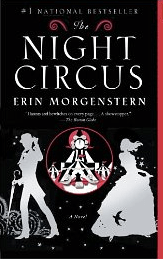
Cover for The Night CircusIt is the mid-19th century. Prospero the Enchanter raises his daughter Celia Bowen as if she were an apprentice magician, only it is not magic she is working. Continuing an ancient disagreement, Prospero challenges the man in the gray suit to a competition–his daughter against any opponent. So, the man in the gray suit takes a young boy out of an orphanage.

Both children grow up training for this elusive competition, and when they are adults, the man in the gray suit collaborates in creating the Night Circus and sends his protégé Marco to work for its designer. Soon Celia is employed by the circus as an illusionist, and Celia and Marco take up the competition with no understanding of its rules. Celia doesn’t even know who her opponent is.

The Night Circus is a marvelous place, all white and black and gray, constantly growing and changing. It becomes the venue for and creation of the competition.

The Night Circus has been extremely popular, and it seemed like it was right down my alley. However, although it is entertaining enough and is certainly based on an original idea, at some point my interest began flagging.

I think one major problem of the novel is that we are constantly told how wonderful the circus is, but Erin Morgenstern fails to describe it in a compelling way. Descriptions are vague instead of specific enough for readers to imagine a scene. In two or three consecutive pages, for example, I just happened to notice that Morgenstern used the word “elaborate” five or six times with no attempt to describe each object beyond that word. The details she does divulge don’t sound as if they would be that interesting, and frankly, a black, white, and gray circus seems to be the invention of a person more concerned with style than enchantment. An important part of a circus is the vibrancy of color. I felt no sense of wonder, was never surprised or beguiled, and I was occasionally confused, especially concerning the “wonderful coalescence” described in one scene. What does that mean? Although the competition turns out to be about life and death, I also never felt any sense of danger.

Another problem for me is the fable-like quality of the novel, which treats the characters more emblematically than as real people. You feel some sympathy for Celia and Marco, but you don’t know what they are like. Overall, I found the novel mildly disappointing.

Day 43: A Discovery of Witches

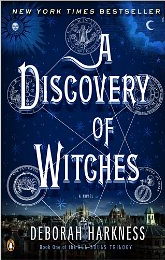
Cover for A Discovery of WitchesBest Book of Week 9!

A Discovery of Witches by Deborah Harkness is like Twilight for adults. A couple of years ago I decided to try the wildly popular Twilight series and found the first book terribly juvenile. But recently, I picked up A Discovery of Witches, also extremely popular and with similar themes. I just finished reading it and had a lot of fun.

Diana Bishop is a Yale science historian visiting at Oxford to study alchemy. She is also a witch, from a long line of witches. But ever since her parents were murdered in Africa when she was seven, she has refused to learn about and tries not to use witchcraft.

She is working in the Bodleian Library when among the manuscripts she calls up is one called Ashmole 782. As soon as she touches it, she can tell it is powerfully enchanted. To keep true to her vow not to use witchcraft, she refers to it as she would any other manuscript and then sends it back.

Not long after, she meets a mysterious vampire named Matthew Clairmont, a well-known but reclusive genetic scientist. He is interested in the book but disturbingly warns her to beware of other witches. As she has been brought up to fear vampires, she is appalled at his warning and tries to avoid him. But she soon figures out he is actually trying to protect her from the other vampires, witches, and daemons who have suddenly appeared in the library, despite the dictum that the three species are not supposed to draw attention to themselves from humans. Matthew explains that they all want Ashmole 782.

Soon Diana and Matthew have formed a strong bond of attraction, but because Diana has neglected her education in her heritage, she is unaware that relationships between the species are strictly forbidden.

This is a lively and engrossing book, sometimes light and comic but other times fraught with romance, danger, action, and suspense. You care about Diana and Matthew and are interested to see where their story is leading. The book also introduces other fascinating characters, such as Diana’s aunts, Matthew’s family, and Diana’s aunt’s house. Yes, it is a character. Matthew–overly protective, quick to anger, not always under control–makes a much more convincing vampire than does the sulky, languishing Edward from Twilight, and Diana is a lot smarter and more interesting than Bella. This book is the first of a series of three, and I’ll be looking forward to the second book.

Day 27: Major Pettigrew’s Last Stand

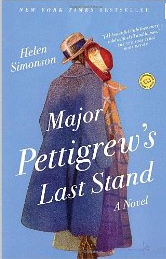
Cover for Major Pettigrew's Last StandBest Book of Week 6!

A touching love story, Major Pettigrew’s Last Stand is also a wry and witty jibe at small village life in England. Major Pettigrew is a proper widower who leads a life of quiet and habit, comfortable in his village and local golf club. Still suffering from the loss of his wife, he has just learned about his brother’s death and he is so shaken by this that he has a dizzy spell. Mrs. Ali, the widow of a Pakistani grocery store owner, has come to his house collecting for charity and helps him recover. The two begin a friendship based around discussions of books.

Besides missing his brother and wife, Major Pettigrew has other worries. He is concerned about his son, who seems only interested in money and prestige, and at times lacks gentility and honor, for which Major Pettigrew cares deeply. He is also concerned about his brother’s greedy wife and daughter, who do not seem likely to honor his father’s request that two valuable heirloom shotguns given to each of the sons be reunited when one of them dies.

Mrs. Ali is having her own battle with relatives. Her husband’s family wants her to give over her store to her religious fundamentalist nephew while she takes her expected widow’s place as a family servant.

Major Pettigrew must navigate the murky waters of village and family disapproval of his relationship because of racism and class snobbery and decide how much he wants to keep his quiet life. Mrs. Ali must in turn decide how much duty she owes to her family.

This novel is charming and delightful, one of my favorite books of 2011. Major Pettigrew’s dry and clever comments amused me throughout. The novel is beautifully written. I have been eagerly waiting to see what Ms. Simonson does next.