Day 944: Checkmate

Cover for CheckmateBest Book of the Week!
I thought I finished reviewing Dorothy Dunnett’s Lymond Chronicles series ages ago, so it was with some surprise that I discovered I never reviewed the last book. Here it is!

* * *

In this last book of the Lymond Chronicles, Francis Crawford of Lymond has returned from Russia to France. Although I have concentrated in my previous reviews on the swashbuckling and intrigue of the novels, I have not mentioned the shadows that haunt Lymond, particularly the question of his parentage. This question was brought forward in an earlier book by the appearance of the mysterious Marthé, who looks exactly like him. These shadows have put him under tremendous pressure in the last couple of novels, culminating in horrendous migraines and even temporary blindness.

Another problem is his marriage to Philippa Somerville in a previous novel. He married her to save her reputation when they were travelling together, but both of them have since found that they are in love with the other. However, he considers his reputation and lineage to be too besmirched to keep her as his wife, so he has not told her of his feelings, and they have been trying to get an annulment. Their marriage has been in name only.

In any case, Lymond is now fighting the English for France in the Hapsburg-Valois war, a position he has taken on to hurry along his annulment from Philippa. As the wife of a Scottish nobleman, Philippa has been ordered to attend Mary Queen of Scots in France as Mary prepares for her marriage to the French Dauphin.

In trying to help Lymond find out the truth about his past, Philippa places herself in horrible danger and subsequently has a breakdown. Lymond leaves his post to care for her, and they discover their feelings for each other. But the result of her trauma is that Philippa feels unable to be more intimate with him, so Lymond eventually asks leave to go back to battle and preferably his own death.

It is much more difficult to review this final book without giving away spoilers. Suffice it to say that Lymond’s questions about the Dame of Doubtance prophecies and his own heritage are answered, there is plenty of action, and a satisfying conclusion. All the tangled knots that appeared in the previous books are untied. In any case, if you’ve been reading the series, you are already hooked, and will be unhappy, like me, to see the series end.
Related Posts

The Disorderly Knights

Pawn in Frankincense

The Ringed Castle

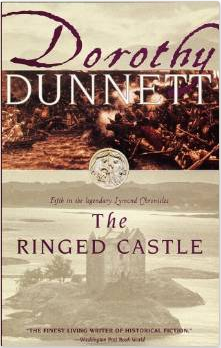
Day 701: The Ringed Castle

Cover for The Ringed CastleBest Book of the Week!
In this fifth book of the Lymond Chronicles, Francis Crawford of Lymond goes on a journey to an uncivilized land. He has already traveled and battled his way over Europe, North Africa, and Asia Minor, but this time he takes his small band of mercenaries to Russia. In an attempt to avoid the consequences he fears from a prophecy by the Dame of Doubtance, he feels he must stay away from his home in Scotland. So, he decides to go to Russia and offer to fight for Ivan IV (Ivan the Terrible) against the Ottoman Turks.

With Lymond and his mercenaries goes the mysterious Guzel, a beautiful, cultured former mistress of the Ottoman admiral Dragut Rais. She wants to make Lymond a powerful ruler. Lymond sees Russia as an undeveloped country full of opportunity for an intelligent leader, a place that will allow him the scope to create something great. Since Russia has no modern army in the sense of those of 16th century France and England, he offers to build one for the tsar.

Lymond’s struggles to work with the erratic tsar are complicated by his relationship with Dmitri Vishnevetsky, or Baida, the volatile Hetman of the Ukrainian Cossacks and a man of legend who has pledged his help to the tsar. Baida sees Lymond as a possible companion but also as a threat to his own power, and he desires Guzel for himself.

Back in England, Philippa Somerville has made a debut at the court of Mary Tudor that is surprising to even her mother, because her sojourn in the sultan’s harem has changed her from a scruffy teenager to a beautiful, polished, and sophisticated young woman. The treacherous Margaret Lennox and the queen’s sister Lady Elizabeth seem to be interested in involving her in their various schemes, but Philippa is tactful and cautious.

This novel, like the others, involves plenty of political maneuvering, adventure, danger, and battles, but also features winter sledge races and the burning of Moscow. Lymond, as usual, is arrogant, frightfully intelligent, and always ready with a blistering comment. Still, we find him irresistible. I cannot tell more for fear of spoilers, but if you decide to read this series, you will not regret it.

Related Posts

Pawn in Frankincense

The Disorderly Knights

Queen’s Play

Game of Kings


Day 334: Pawn in Frankincense

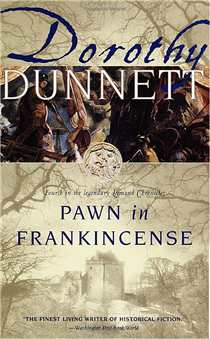
Cover for Pawn in FrankincenseBest Book of the Week!

In the fourth exciting book of the Lymond Chronicles, Francis Crawford of Lymond sets out to find his two-year-old child by Oonagh O’Dwyer, hidden somewhere in the vast Ottoman Empire. He disguises his personal mission with the official one of delivering an elaborately decorated piano from the King of France to the Sultan in Constantinople. Another goal is to find and kill the traitor Graham Mallet Reid, who has the child in his power. The problem of the child is complicated because Lymond doesn’t know which of two boys, one Reid’s by his sister Joleta, is his own. Another complication is that if any harm comes to Reid, the boys, under the protection of Sulieman, will both be murdered.

Accompanying him and his household are a couple of merchants, including the mysterious Marthe. Raised in the household of the Dame de Doubtance, Marthe, except for her sex, could be Lymond’s identical twin.

After some disastrous adventures, Lymond believes he has sent home the redoubtable fifteen-year-old Philippa Somerville, who foisted herself upon him thinking he would need her help to care for the child. However, she is actually on her way to join the seraglio to find one of the boys, Kuzum, while Lymond searches in the stews of the city for the other one, Khaireddin. Philippa’s role in this novel is a major one, with her character and her opinion of Lymond changing and maturing as their adventures continue.

Aside from the intrigues taking place in an empire that is Byzantine in its complexity (not to make a pun), Lymond is hampered in his activities because of sabotage by a member of his own household staff. He also suffers from his usual problem of failing to explain his actions to his adherents, such as Jerrott Blyth, so that they become angry and occasionally work against him.

In action that moves from Marseilles across Europe to North Africa and finally to Constantinople, Lymond’s concerns grow to involve the fate of nations.

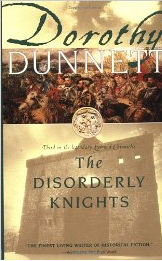
Day 251: The Disorderly Knights

Cover for The Disorderly KnightsBest Book of the Week!
The Disorderly Knights is the third novel in Dorothy Dunnett’s rousing Lymond Chronicles series. I previously reviewed the first two novels, The Game of Kings and Queen’s Play.

Upon his return to Scotland from his adventures in France, Francis Crawford of Lymond establishes a small fighting force of independent knights and begins training them. As their reputation spreads, the band begins to attract more knights, and he hears that they are to be joined by a renowned fighter, Sir Graham Reid Mallett, Knight Grand Cross of the Order of St. John. Many of the men who know Reid Mallet consider him almost a living saint. In disposition and talents he seems to be a perfect foil for Lymond, but they clash, and some of Lymond’s men begin to turn against him. As usual, Lymond’s behavior appears to put him in the wrong, and Reid Mallett seems to want to usurp the fighting force.

This conflict eventually leads to Malta, where Lymond arrives just before the Ottoman Turks attack. During the siege, Lymond becomes involved in the political maneuvering and feuds among the various national factions of the declining Order of St. John. He also hears that Oonagh O’Dwyer, the beautiful Irish rebel he encountered in Queen’s Play, is captive in another city on the island. After the siege, he follows her to North Africa in an attempt to free her.

It is difficult to write more about this novel because of spoilers, but also because the plot becomes increasingly complex from this point on, with threads that are not all explained until the sixth book. Suffice it to say that, although this is a slow-starting series, if you get this far, you will be hooked. The novel is suspenseful and exciting, and Lymond makes a complicated and compelling main character, almost an anti-hero at times. These books were written in the 1960’s and 1970’s, and I think the only series to compare with them might be George R.R. Martin’s Song of Fire and Ice or Dunnett’s own House of Niccolo series.

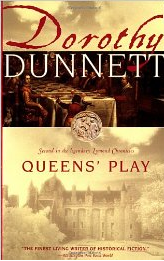
Day 176: Queens’ Play

Cover for Queen's PlayBest Book of the Week!

Queens’ Play is the second book of Dorothy Dunnett’s excellent historical fiction series, the Lymond Chronicles. Although it is not absolutely necessary to read the first book, Game of Kings, you will enjoy the other books more if you do. If you decide to continue this series, it is important to read them in order after this one.

Francis Crawford of Lymond enters the scene disguised, and it is some time before we figure out which of two characters he is. Francis has been asked by Mary de Guise, Queen Dowager of Scotland and mother of Mary Queen of Scots, to travel to France and protect Mary. Although Mary is still a little girl, plots revolve around her, and her mother is afraid her life is at risk.

The Irish prince Phelim O’Liam Roe’s arrival into France is a spectacular one, as his ship almost crashes into another one when entering the harbor. This incident is perhaps not an accident, as evidence mounts that someone is trying to kill the prince. To the French court, O’Liam Roe is unbelievably provincial, and he is immediately the butt of ridicule. He is attracted to Oonagh O’Dwyer, an Irish woman living on the borders of society, but she disdains him. In fact, she is the mistress of the Irish rebel Cormac O’Connor.

O’Liam Roe has brought with him Thady Boy Ballagh, an ollav, or trained master poet. Untidy, fat Thady Boy is gaining popularity with the decadent French court through a series of reckless deeds and his brilliant musical performances.

It seems that the Queen Dowager’s fears are correct. During a hunt that employs the king’s leopards as hunting animals, someone lets Mary’s pet hare out in front of the cat near her pony. As she struggles to save her pet, the cat turns its sights on Mary.

As always, Dunnett combines heart-stopping action and suspense with a detailed knowledge of the period. This book begins some of the plot threads that will continue throughout the series.

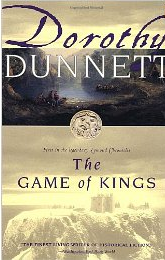
Day 61: The Game of Kings

Cover for Game of KingsBest Book of Week 13!

If you love an authentic, well-researched, exciting historical novel that makes you almost feel like you are in the period, then I can’t recommend a better author than Dorothy Dunnett.  I have been trying to get people to read her for years with the caveat that her books are challenging, not for the reader of light romantic history.

Lady Dunnett is described on her Wikipedia page as a “leading light in the Scottish arts world and a renaissance woman.” Her books are loaded with detail about medieval customs, dress, politics, religion, food, and literature, and have labyrinthine plots full of action. She is most renowned for two series, the Lymond Chronicles, written in the 1960’s and 70’s and set in 16th Century Europe and Africa, and the House of Niccolò, written in the 1980’s and 90’s and set in 15th Century Europe, Asia, and Africa. Dunnett died shortly after finishing the last book in this series.

Game of Kings is the first book in my favorite series, the Lymond Chronicles. Francis Crawford of Lymond makes a rollicking and disruptive re-entrance into his home country of Scotland despite the charge of treason hanging over his head. He forms a band of outlaws and begins roaming around the countryside, sneaking across the border to play tricks on the British and harassing his own family. For quite some time, you don’t know whether he is a hero or a villain. He never explains himself, so it is left up to the reader (and the other characters) to figure out his motives for sometimes seemingly wrongful acts. His enemies think he is responsible for the explosion that killed his sister and is trying to murder his older brother Richard so he can inherit the estate. His friends are absolutely devoted to him but suffer doubts when he misbehaves, as he often does. His brother doesn’t know what to think, and his mother, Sybilla, is silent.

Francis is a mimic and a rogue, a musician and a polyglot, a poet and a swordsman, as swashbuckling a character as you will ever meet with in a novel. In among the action of cattle raids, impersonations, intrigues, duels, and archery contests, you actually learn a lot about Scottish history and politics.

Game of Kings is Dunnett’s first book, and my only criticism of it is that Lymond is a bit too fond of quoting poetry in antique languages. Most of it is incomprehensible unless you are a medieval scholar, but skipping over it does not hurt your understanding of the novel. Dunnett does this much less in the other books in the series. If you read this book and continue with the series, by the second book you won’t be able to stop.