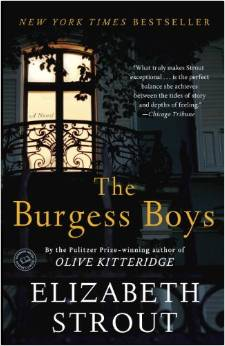
Day 542: The Burgess Boys

Cover for The Burgess BoysBest Book of the Week!
I had an unusual reaction to The Burgess Boys. Part of the way through, I was interested in how it would come out but at the same time wondered if I was liking it. By the end of the novel, though, I found it extremely satisfying.

The novel is about the clearly dysfunctional Burgess family, from a small town in Maine. When the three Burgess children were small, their father was killed in a freakish accident, run over by his own car rolling down the hilly driveway. All three kids were inside the car, and four-year-old Bob was behind the wheel when their mother came out to find their father dead. Mild-mannered Bob has carried this burden all his life, dealing with ridicule from his brother Jim and dislike from his twin sister Susan.

Jim and Bob long ago left Maine for New York City. But they are called back by a distraught Susan. Her son Zach has committed the inexplicable act of throwing a pig’s head into a mosque during Ramadan. Although Susan shows a good deal of ignorance about the local Somali population, the family cannot comprehend Zach’s action. He is a quiet misfit teenager, confused and pathetic, who has no friends. Unhappy especially since his father left for Sweden, he nevertheless does not seem to be angry or have any strong feelings at all except for being plainly terrified by the trouble he is in. He has a reason for his actions that is generally clueless, but it takes awhile for the family to discover it.

A former hotshot lawyer in Maine and famous for having won a high-profile case, Jim is the person Susan is relying on. Zach goes in to the police station to confess to the crime, and it seems as if the case will be handled quietly, but the civil liberties groups get involved and soon there is an uproar. When Jim’s grandstanding at a political event does more harm than good, Zach is charged with a hate crime.

As Jim takes charge while Bob tries to calm and comfort, the dynamics within the family emerge. At the same time, we learn a little about the terrified, disoriented Somali community. During the initial hearings, shopkeeper Abdikarim glimpses the true Zach and tries to help him.

As for the characters, I heartily disliked the person that everyone else admires. I think Strout intended that, and part of my satisfaction with the novel is about how that turns out.

Strout’s rich, detailed exposition is matched by her empathy for all her characters. Although I disliked some of them, they are complex and deeply human. This apparently simple story wisely examines the dynamics of guilt, family tensions, social isolation, and blind political correctness.

Life in the small Maine town seems gray and dismal at first, brightened only by the fall foliage and the hues of Somali garments. Jim and Bob have fled, and Susan and Zach are unhappy. There is little employment or hope for the residents. By the end of the novel, everyone has a little more hope.


Day 157: Empire Falls

Cover for Empire FallsBest Book of the Week!

I’ve been picking up Richard Russo novels at the bookstore for years and putting them back down because I wasn’t sure I’d like the subject matter, but now that I’ve read Empire Falls, I wish I’d been reading them all along.

Miles Roby’s life hasn’t been going too well. He quit college to run a diner in his dying home town in Maine when his mother was ill, and 20 years later he’s still flipping burgers. His wife Janine has left him for her dim-witted personal trainer. He has been in love with one of his waitresses, Charlene, since high school but sees no sign that she returns his feelings. He has an uneasy relationship with the owner of the diner, Mrs. Whiting. The only thing that seems right in his life is his teenage daughter Tick, and she is having problems at school.

Miles’s father is an alcoholic ne’er-do-well who was hardly ever around when he was a child. He comes around when he wants to earn a few dollars or hit up Miles for money. The mill has been shut down for years, and most of the townspeople don’t feel like they have much of a future.

Miles’s brother David is recovering from a drug habit, but his cooking and new ideas have recently been responsible for an increase in the diner’s business, and he wants Miles to move the business to a larger restaurant. Miles has been avoiding a decision. He has only been hanging on because he doesn’t know what else to do and because Mrs. Whiting long ago promised to leave him the diner in her will. She owns most of the town and behaves as if she owns him, too.

Miles doesn’t realize it, but his fortunes have been stymied for years because of events in the past. His only clue to these events is his recollection of a summer spent with his mother on Martha’s Vineyard when he was a small boy.

A pleasure of this book is its myriad of small-town characters and the warm, witty way that Russo depicts them. Russo is skilled at involving you in the fortunes of Miles, his friends, his family, and even his town. This novel is delightful.