Day 668: The Sea

Cover for The SeaIn this contemplative novel, recently widowed Max Morden returns to the small Irish seaside resort where his family used to live when he was a boy. It was there he met and became fascinated by the Grace family, much above his own in social strata.

Max’s memories are assisted by his residence as a boarder at The Cedars, the house where the Graces stayed that summer. The Cedars has become a boarding house that is now managed by Miss Vavasour.

The young Max became the companion of the Grace’s oddly feral twins, Chloe and Myles. They are two very unpleasant children who torment their teenage nanny Rose. At first infatuated with the voluptuous Mrs. Grace, Max eventually turns his attentions to the spiky Chloe.

Through his memories of the extraordinary events of that summer and his feelings about his wife’s death, Max eventually gains some self-knowledge. Looking back, he also gains some understanding of the dynamics between people that he did not grasp as a child.

The Sea is stylistically exquisite, with its sussurating and rhythmic prose a striking meditation on death, grief, and memory. Although I guessed one of its revelations much earlier than intended, that did not take away from the power of the prose.

Related Posts

The Sense of an Ending

Bridge of Sighs

Nora Webster


Day 463: The Luminaries

Cover for The LuminariesBest Book of the Week! Year!

This last year I read several books that played wonderfully with structure. I’m thinking particularly of A Visit from the Goon Squad, a series of stories linked by their characters that somehow forms a whole, and Life After Life, in which the heroine’s life is repeated, with slight changes that lead to significant ones. I loved both of these inventive approaches to structure, and now I add to this list The Luminaries, the latest winner of the Man Booker Prize. This book is also my second recently reviewed novel set in New Zealand.

Walter Moody is newly come to the gold fields of the South Island of New Zealand in 1866. He has arrived in rough seas and is shaken by an apparition he has seen in the bowels of the ship. Seeking warmth and comfort, he checks into a seedy waterfront hotel and enters the parlor, where he accidentally interrupts the meeting of 12 other men.

After some initial hesitancy, the men begin telling him a series of tales, all interconnected, but the whole of which they cannot make out. The tales concern a missing trunk, a fortune found in a dead man’s cabin, the disappearance of a prominent citizen, the apparent attempted suicide of a whore. Each man at the meeting has his own part of the story to impart. Moody is able to make some sense of the story, but all go away from the meeting knowing that pieces are missing.

This section of the book is the longest, making up almost half its length. The cover of the novel, showing a waning moon, gives you a hint to its structure. It is divided into 12 sections, each one shorter than the one before but each one adding to the revelations of the original tales, until the final very short slivers of sections reveal all.

Each of these sections is also headed with an astrological chart that shows how the heavenly bodies are positioned within the signs of the 12 initial characters. This I did not understand at all, but Catton provides some indication at the beginning of the sections about what the astrology predicts.

The chapters of the novel are charmingly headed with old-fashioned descriptions of what happens in the chapter. Over time, the descriptions themselves begin to drive the narrative.

In The Luminaries, we’re presented with a novel that embodies a puzzle, a complex tale of villainy and foul crimes but also of love and loyalty. I was completely engrossed in  entangling the threads of this story. Despite its beginnings as a tale of cheats and chicanery, you may be surprised to find that you are reading a love story about two characters connected by their stars.

Day 450: The Bone People

Cover for The Bone PeopleThe Bone People is a very unusual novel, and I’m not sure what I think of it. I would give an unreservedly enthusiastic review except for one overriding facet of the plot and an ending that radically changes course.

Kerewin Holmes is a wealthy half-European, half-Maori woman who builds a tower on the New Zealand seaside. She clearly identifies more with the Maori culture than the European. Kerewin is an artist who for some time has been unable to create art and has separated herself from her family. She fills her tower with beautiful objects and oddities and stays away from people.

One day she comes home to find a young boy hiding in her house and quickly discovers he does not speak. The boy takes a liking to her, which turns out to be unusual. Although the boy appears to be purely of European descent, the man who eventually arrives to pick him up is a Maori man she has seen bragging in a local bar, Joe Gillayley.

The boy, Simon, turns out to have been a shipwreck victim as a very young child, the couple found with him not his parents. His identity has never been discovered, and Joe and his family adopted him. However, Joe’s wife Hana and son Timote died later from an illness.

Simon has an unruly streak, and Kerewin finds him spending the day with her at the tower when he decides to skip school. Kerewin feels there is something wrong about both the man and the boy, but soon begins to care about them and even tries to find out about the boy based on an unusual ring in his possession.

The blurb on this book calls it a mystery and a love story, but if you go into it with that kind of expectation, you are going to be confused. The narrative style is unusual. It is told from multiple viewpoints, although mostly from Kerewin’s, and Kerewin makes up poetry or sings little songs almost constantly. As the novel progresses, more Maori cultural references and mysticism appear.

Spoilers in this paragraph: I would normally not reveal this important a plot point, as it appears well into the book, but I feel I have to in order to explain my mixed reaction. It takes some time before Kerewin discovers that Joe, who usually treats Simon lovingly, sometimes beats him savagely in an attempt to control his behavior. Moreover, the whole town appears to be aware of this but does nothing. Kerewin is torn because she feels Joe really loves Simon and bitterly regrets these beatings, but she does not seem to realize (nor is there a sense of this in the book at all) that this is classic abusive behavior. So, no one turns Joe in to the authorities. Kerewin’s solution is to beat the crap out of Joe, as she has training in aikido, and then to make him promise not to discipline Simon without talking to her. This solution is obviously a stupid one, although it works for some time. When things come to a head, the result is horrendous.

Then the novel continues from there in another direction, which is disconcerting. I could not reconcile my feelings about what happens to Simon with my interest in the book up until that point. In fact, having the novel almost immediately shoot off in another direction was very distressing to me, and even though it eventually returns to the original events and ties everything up, the direction it goes in the closing sections seems to belong to a different novel.

If the child in peril theme is not one for you, I can tell you that the ending is unexpectedly and, I feel, unrealistically happy, and delves into the theme of a re-emergence of Maori culture. Maybe I am viewing this novel through some kind of cultural myopia, but the ending seems to me to magically wipe out a lot of problems, including legal complications. I understand that this novel was severely edited from its original form, much against Hulme’s wishes, which makes we wonder what the original novel would have been like.


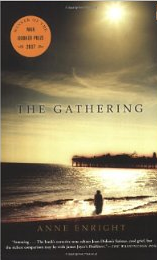
Day 295: The Gathering

Cover for The GatheringA large family in Ireland is gathering together for the wake of their brother, Liam, who drowned. Veronica Hegarty, his sister, travels to London to collect the body and keep vigil with it.

This novel follows her consciousness as she thinks about her relationships with her own husband and the rest of her family and considers why her brother’s life turned out the way it did. She describes Liam as a “terrible messer,” who was an alcoholic and finally put stones into his pockets and walked into the sea.

She also remembers her grandmother Ada, and imagines scenes involving her grandmother’s relationship to Veronica’s grandfather and to another man when she was a young woman. Veronica muses about life growing up in her grandparents’ house and the connection with her brother’s secrets and troubles. She feels guilty that she did not help him and that no one sympathized with him when he was alive.

This novel is angry, heavy, and sometimes repels the reader. By page 55, I felt that the narrator was inordinately concerned with the mechanics of men’s penises. Still, it is an evocative story about a woman’s grief and her struggle to understand her brother.

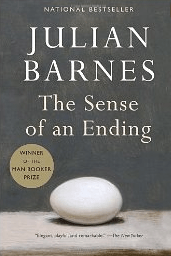
Day 214: The Sense of an Ending

Cover for The Sense of an EndingBest Book of the Week!

The Sense of an Ending is a quiet novel that made me stop and consider. It is a meditation on memory–how we reinterpret past events. It is also about the lost opportunities of life.

Tony Webster begins the novel by considering his past, particularly his relationships with his pals from school. He and two other close friends chose to enlarge their circle to include a new boy, Adrian Finn, who was extremely intelligent and analytical. Adrian’s indifference to seeming cool made him very cool indeed. The four friends remained close throughout college and for awhile after, until Adrian committed suicide.

Tony also remembers his first serious relationship, with Veronica Ford, particularly an unpleasant weekend he spent with Veronica’s family. After they broke up, Adrian went on to date Veronica. He wrote Tony a letter apprising him of this as if he were asking permission to date her, and Tony’s recollection is that he ironically assented.

Tony has lead a comfortable life avoiding too much effort in his relationships. He sees himself as a “peaceable man.” He believes he understands the events from the past until he receives a legacy from Sarah Ford, Veronica’s mother–the only member of her family who seemed sympathetic during that long-ago visit. In addition to a small bequest, she has left him Adrian’s diary. This legacy confuses him. Why would a person he only met once leave him anything, and why would she possess Adrian’s diary? When Tony asks for it, he finds that Veronica has taken it.

In Tony’s attempts to gain the diary and his subsequent inquiries, he learns things that force him to re-examine and reinterpret his memories of long ago events and to reconsider the consequences of his own actions. He ends up also contemplating where his own life has gone and how he has evolved into this “peaceable man” from a boy full of curiosity and promise.

This very short novel is crammed with thoughtful observations, often wittily and wryly expressed. I found myself turning back to re-read and reconsider certain passages, which is something I seldom do. Sparely and beautifully written, the novel is an excellent illustration of the use of an unreliable narrator.

Day 84: Bring Up the Bodies

Cover for Bring Up the BodiesBest Book of the Week! Year!

If Wolf Hall was a wonderful historical novel, Bring Up the Bodies is masterly. In this second of a trilogy, Hilary Mantel continues the story of Thomas Cromwell. Bring Up the Bodies is more focused than the last book, because it deals with a much shorter time period and defined subject–the downfall of Anne Boleyn.

The writing is elegant and impeccable. I have read a few comments that Wolf Hall was sometimes difficult to follow because the readers could not always tell who was meant by “him” or “he.” Mantel has written both books using a strict third person limited point of view, from that of Cromwell, and people don’t think of themselves by their first names. Hence, the difficulty, which I did not notice as a problem in Bring Up the Bodies. This technique is very difficult to employ successfully–we are much more used to a third person that changes from character to character or even to third person omniscient. But Mantel uses it effortlessly to create a memorable character in Cromwell–kind but implacable, one who fosters the growth of others but does not forget the crimes and indignities committed against Cardinal Wolsey, whom he loved as as a father.

Henry VIII has already decided he wants to rid himself of Anne Boleyn and marry Jane Seymour, but Anne has one more chance. She is carrying a child, and if it is born alive and is a boy, she is safe. Henry must have an heir, and he has decided that if he hasn’t been given one, God must have found some fault with his marriage to Anne just as there was one for his marriage to Katherine of Aragon. Thomas Cromwell must find him some way out of his difficulties.

Of course, Cromwell helped Anne to her position in the first place, but the Boleyns have made many enemies in their enjoyment of power, and they have treated him with disdain. More importantly, Anne Boleyn destroyed the Cardinal, and her brother mocked him in his downfall.

From the moment you begin reading, you find yourself plunged into the Tudor world of shifting politics and intrigue. Of course, we know what happens to Anne Boleyn, yet the novel maintains its suspense. The Boleyn and Howard families are going to suffer a huge defeat, but they will go down fighting.

Day 77: Wolf Hall

Cover for Wolf HallBest Book of Week 16!

This is a good time to write about Wolf Hall, because I was thrilled to learn that Hilary Mantel’s sequel to it has just come out. My copy is arriving soon. Mantel is always an interesting writer whose work does not occupy any one genre, although her last few books have been historical fiction. Wolf Hall won the Man Booker Prize and was one the best books I read in 2010.

The novel looks at the political and religious machinations of Henry VIII through the eyes of Thomas Cromwell, who rose from low origins to become Henry’s chief minister. Although Cromwell has traditionally been viewed as Henry’s “heavy,” recent historians have looked at his career more kindly, showing that his work as chief minister brought England into more modern statehood and that his changes created more order for government functions that were less controlled by the whims of nobility.

Mantel depicts Cromwell as a loyal man who cares for his dependents and works to reform England. He builds up a great household as he moves from the position of secretary to Cardinal Wolsey to work for the king. Later, after the Cardinal’s downfall, he slowly, almost imperceptibly, works to bring down those who furthered their own interests by destroying the Cardinal, including the rapacious Boleyns.

Cromwell is loving to his family and friends, completely faithful to the Cardinal and then to Henry, intelligent, able in many spheres of work, and decent. Mantel paints a charming pictures of his home life. In contrast, she turns the tables on Thomas More, venerated for centuries, showing him as a sadistic torturer of Protestants who is in love with his own martyrdom.

Cromwell meets Jane Seymour when she is a young, lonely lady’s maid to the queen, teased and neglected by the rest of the court, and feels pity for her. Later, after he is long widowed, he falls in love with her. The title of the book is the name of her ancestral home, Wolf Hall.

Mantel’s approach is understated, leaving the reader sometimes to connect the ideas. The details in this novel seem completely authentic, and Mantel handles the period brilliantly. She somehow manages to generate tension and suspense even about things we know all about, like what will happen to Anne Boleyn.