
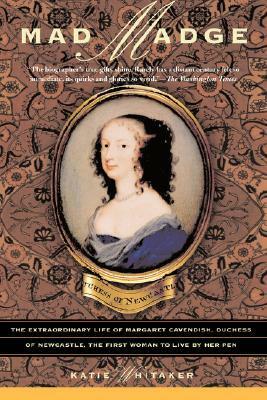
Before reading Margaret the First for Novellas in November, I had never heard of Margaret Cavendish, which is interesting because I have a master’s degree in English Literature. But that all falls into place once you read Whitaker’s epilogue to this biography.
In fact, Margaret was the first woman to publish prolifically and publicly, as opposed to having writings privately printed and distributed or, more likely at the time, including a poem or two in her husband’s writings.
Margaret Lucas, according to her own writings, was determined to be famous. Unfortunately, she was very shy. She wrote even from a girl, what she called her fancies, and commented that her mind was full of ideas.
The Lucases were a prominent Royalist family. Margaret was still fairly young when she left home to be a lady in waiting for Queen Henrietta Maria at the court of Charles I. Margaret wasn’t very good at this job, because her shyness made her seem standoffish.
The English Civil War broke out, and first the court moved to Oxford, but eventually it had to move overseas. There, Margaret met William Cavendish, fully 30 years her senior, who had valiantly fought on the Royalist side but eventually left when things seemed hopeless. At the time, he was the Marquis of Newcastle. The couple married, despite having little income, William’s estates having been taken by Parliament, and most of his money gone to the Royalist cause. However, it was in William’s house that Margaret got what she had long sought, the opportunity to meet and discuss issues with men of note and with philosophers and scientists.
Margaret began writing prolifically—plays, poems, essays on philosophy and science. Once she published, many people supposed that her works were actually written by her husband.
Eventually, she became one of the first female literary celebrities, and her name was known throughout Europe. In the epilogue, though, we learn that not too long after her death, critics began to disparage her work, and she was almost lost to history. We learn that the nickname of “Mad Madge” was bestowed on her centuries after her death (and repeated by Virginia Woolf). I looked at my own 1985 Norton Anthology of Literature by Women, and despite her prolixity, they only included one page by her and perpetuated the story of her strangeness, which apparently was based only on her original clothing, designed by herself, and her odd social behavior (not speaking much).
Although this material is undoubtedly interesting, I think that Whitaker falls over the too much/not enough detail line that I find plagues a lot of biographical writing. Whitaker falls over on the “too much” side, synopsizing every section of every work Margaret wrote, quoting every person of note who respected Margaret’s work, describing details of every house she lived in, and so on. This got a little tedious when it continued for pages, although now, having read the epilogue, I see why Whitaker felt that she needed to prove that in her lifetime, Margaret was a famous and respected figure with very early feminist leanings.

 What? Me Read?