
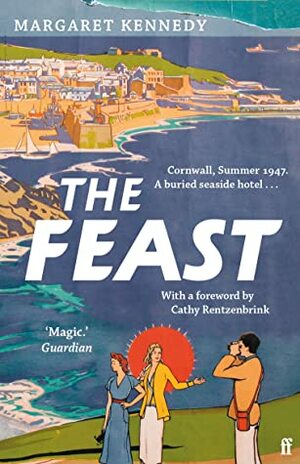
At the beginning of The Feast, we’re informed that a cliff came down near a resort town in Cornwall, obliterating a bay and a hotel beneath the cliff. Some of the people from the hotel survived.
With that information in hand, Kennedy begins the novel a week before the cataclysm. So, she cleverly sets out a source for some suspense while the readers form an opinion about which people they hope will survive.
The small hotel is owned by the Siddal family, run somewhat incompetently by Mrs. Siddal. Mr. Siddal is an educated man who has done nothing for years. They have three grown sons, the oldest of whom, Gerry, is the most helpful and least appreciated.
Other characters do almost nothing, too. Miss Ellis is supposed to be the housekeeper, but she does nothing but spread vicious gossip and order the maid around. A character who acts like an invalid is Lady Gifford. The Giffords have adopted three children, but Lord Gifford works all the time and Lady Gifford spends all her time in bed. She seems to dislike her mischievous daughter Hebe.
Mrs. Cove has three young daughters who yearn to give a feast like one they’ve read about in books. In reality, they have very little. Their mother is so stingy that she sells any candy they’re given, saying it is to buy children’s books. But they have no books. Blanche, the oldest, has problems with back pain but has never seen a doctor.
Two women are abused by their male relatives. Evangeline is at first so shy that she can barely utter a sentence. But her father, a Canon, accuses her of chasing after men and berates everyone else. At the beginning of the novel, they have been tossed out of another hotel because he is so obnoxious.
For his part, Mr. Paley seems to be holding something against his wife, but she doesn’t know what it is. Instead of talking to her about it, he bullies her.
These are a few of the characters, which also include a lady author who likes to take on younger male writers as protégés, her chauffeur being one. And there is Nancibel, the housemaid who does most of the work in the hotel . . . and others.
Despite pending fate, I enjoyed this novel very much. It shows a lot of insight into human nature. I have only read one other book by Kennedy, but I enjoyed it as well.

 What? Me Read?