Day 1019: The White Cottage Mystery

Cover for The White Cottage MysteryThe White Cottage Mystery is not one of Margery Allingham’s Albert Campion mysteries, and there is a good reason for that. But explaining that remark gives away too much. This novella instead features W. T. Challoner and his son Jerry.

Jerry falls into the mystery when he offers a lift to an attractive girl who lives at the White Cottage. Just after he drops her off, when he is in conversation with a policeman, he hears a gun shot. Then a parlor maid runs out of the house asking for help.

It seems that someone has shot and killed a visitor to the house, Eric Crowther, the next door neighbor. Crowther was disliked by the entire household. However, the finger of guilt seems to point to Mr. Cellini, an occupant of Crowther’s house, who has fled to France.

About a third of the way through the book, I gave a sigh. Golden Age mystery writers seem to love larger-than-life plots, so when mention was made of a huge crime syndicate, I thought, why can’t this be a straightforward mystery? But the syndicate turns out to be a red herring, I don’t mind saying.

link to NetgalleyThe solution to the mystery turns out to be quite surprising. Challoner unearths some juicy secrets, and the situation is complicated by Jerry falling in love with Norah Bayliss, the sister of the house’s owner.
The cover of the new Bloombury Reader edition is retro and lovely. It reminds me of some of the covers coming out lately from Poison Pen Press and the British Crime Series.

Related Posts

The Tiger in the Smoke

Traitor’s Purse

The Singing Sands

Day 949: Traitor’s Purse

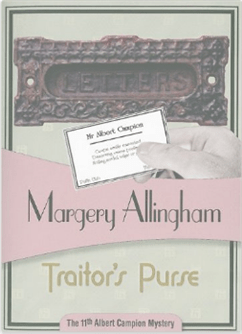
Cover for Traitor's PurseA man awakens in a hospital to realize that he remembers nothing about who he is or what has happened to him. Then he overhears a nurse and policeman talking. Someone has killed a policeman. Thinking they are talking about him, he escapes in the outfit of a fireman.

We soon learn that the escaping man is Albert Campion. Although he is picked up outside the hospital by his fiancée Amanda, he soon realizes that something important is happening and everyone is looking to him for instruction. He must stop something from happening, but he doesn’t know what.

This mystery, which is set during World War II, has to do with a plot to destroy the foundations of the country. All Campion knows is that it involves the mysterious Institute of Bridge, an organization called the Masters, and the number 15.

In this novel, we understand a little more about Campion’s thinking, precisely because he’s not behaving in character. I believe he is normally supposed to be somewhat inscrutable, because he’s frequently described as “wooden-faced.” Because of the unique situation of the novel, it is truly suspenseful.

Related Posts

The Tiger in the Smoke

The Singing Sands

At Bertram’s Hotel

Day 843: Murder at the Manor

cover for Murder at the ManorMurder at the Manor is another collection of classic mystery short stories published by Poisoned Pen Press. Each of these stories is set at a country manor.

This collection features writers the likes of Arthur Conan Doyle, G. K. Chesterton, Margery Allingham, and Ethel Lina White. Some of the stories are ingenious, and one is an amusing satire of the genre.

The satire was the story that most stood out, “The Murder at the Towers” by E. V. Knox. Just the first sentence gives a sense of it:

Mr. Ponderby-Wilkins was a man so rich, so ugly, so cross, and so old, that even the stupidest reader could not expect him to survive any longer than Chapter 1.”

And he doesn’t. Mr. Ponderby-Wilkins is found hanging from a tree, suspended by a muffler. His guests decide to “go on playing tennis as reverently as possible” until the detective arrives. When the detective, Bletherby Marge, arrives, he is described as a person who is sometimes mistaken for a baboon. The story continues on to turn the genre on its head.

“The Copper Beeches” by Arthur Conan Doyle is the only story I had previously read. Miss Hunter comes to consult Sherlock Holmes about an unusual offer of employment. She has been offered a job as governess at an inflated wage under the condition she bob her hair. Holmes advises her to take the position but promises to come immediately to her assistance if she summons him. She soon does and explains she has been asked to put on a certain blue dress and sit with her back to the window. Holmes immediately realizes he can prevent a crime.

“The Problem of Dead Wood Hall” by Dick Donovan is another early mystery. This case refers to two mysterious deaths, two years apart, of first Mr. Manville Charnworth and then Mr. Tuscan Trankler. Although no cause of death can be determined, both men show signs of having died the same way. Unfortunately, this story is turgidly written, and the method of murder and identity of the killer are easy to guess.

“Gentlemen and Players” by E. W. Hornung is a Raffles mystery. Raffles takes his friend Bunny along on a weekend at a country house, where they have been invited because Raffles is such a good cricket player. Raffles doesn’t usually rob his hosts, but he resents being invited as if he were an entertainer. And old Lady Melrose has such a nice necklace.

“The Well” by W. W. Jacobs is more of a psychological study than a  mystery. Jem Benson is about to be married. He has a cousin, Wilfred Carr, who continually borrows money from him. But this time Wilfred threatens to tell Jem’s fiancée Olive a disreputable secret if he won’t cough up. The two men walk out to the woods near a disused well and only one of them comes back.

“An Unlocked Window” by Ethel Lina White raises a lot of suspense when two nurses are left alone with their patient. A maniac in the neighborhood has been murdering nurses. Nurse Cherry suddenly realizes she left a window unlocked.

link to Netgalley“The Mystery of Horne’s Copse” by Anthony Berkeley is quite entertaining, about Hugh Chappell, who stumbles over the corpse of his cousin Frank late one night on the way home from dining with his fiancée’s family. Only the body isn’t there when he brings the police back, and Frank and his wife are on vacation at Lake Como. This is an odd state of affairs, but then it happens again and again until the last time the body is indeed Frank’s, and Hugh is wanted for murder. In this story, I particularly enjoyed Hugh’s spunky fiancée Sylvia.

All in all, I found the collection mixed in quality but enjoyable. Some of the stories are truly suspenseful, and some present a good puzzle.

Related Posts

Silent Nights

Thirteen Guests

The Hog’s Back Mystery

Day 448: The Tiger in the Smoke

Cover for The Tiger in the SmokeI have only read one other Albert Campion novel, and that was so long ago that all I can remember is not having much of a sense of Campion. I can say the same thing after reading this novel, although it has other qualities. Perhaps one can only get an understanding of Campion through reading the series.

In this post-World War II novel, we get a feel for the effect of the war on London. The wealthier households no longer have servants, shoddy neighborhoods have sprung up near where service men used to gather, the ruins of bombed buildings are everywhere, as are groups of unemployed veterans. To this setting Allingham adds the further atmosphere of a heavy fog that persists over the course of the novel. This fog is vividly described and is almost a character in the novel.

Meg Elginbrodde, a young war widow, has recently announced her betrothal to Geoffrey Levett, a wealthy businessman. Beginning directly after the announcement, however, Meg receives poor-quality street photographs of someone who looks like her husband, Martin Elginbrodde, supposedly blown to bits during a battle. No message has arrived explaining these photos, and when we meet the engaged couple, Geoffrey is dropping Meg off for a rendezvous that Campion has arranged as a trap for the culprit.

Meg is to walk into the train station to meet the man, where Campion and the police will capture him. However, when Meg sees the man at a distance, his resemblance to Martin is so strong that she shouts his name and runs toward him, startling him away. Campion eventually captures him, and Meg is embarrassed and puzzled to find that close up, the man doesn’t look like Martin at all. He turns out to be a low-level criminal named Duds Morrison.

Campion and Detective Charlie Luke are fairly confident that someone hired Duds for the impersonation, but what was it meant to accomplish? Duds isn’t talking; in fact, he seems terrified, and rightly so. Within an hour of his release, he is found stabbed to death in an alley.

Campion notices one thing that helped Meg mistake Duds for her husband. He is wearing Martin’s distinctive coat. When Campion repairs to the unusual household of old Canon Avril, Meg’s father and Campion’s uncle, to investigate, he finds the coat was recently in the house. How could it have fallen into the imposter’s hands?

Soon the police find a connection between this case and the escape from jail of a very dangerous man, who calls himself John Havoc. Havoc murdered an eminent physician to escape and subsequently killed three people trying to break into the law office that handled Martin Elginbrodde’s estate. He did not escape, though, early enough to have killed Duds.

In the meantime, Geoffrey Levett is missing.

The plot of this novel, like many of those from the Golden Age of Detective Fiction, is absurd. However, the novel is notable for its strong and vivid characterizations—of one of fiction’s first sociopaths as well as of the many unusual and delightful characters living in Canon Avril’s house. Campion himself remains a quiet character instead of being a presence such as Lord Peter Wimsey or any of Christie’s detectives.