Review 2281: Who Killed Father Christmas?

British Library Crime Classics’ latest book is another of their holiday mystery collections. This one includes some clever puzzles, some ghost stories, and one truly exciting chase.

“The Christmas Thief” by Frank Howel Evans, published in 1911, features the adventures of two endearing young men, Tommy and Harry, two homeless boys who thwart a gang of thieves.

In “The Christmas Spirit” by Anthony Gilbert from 1952, Sedley busts the ghost of the Green Girl—or does he?

In Patricia Moyes’ “Who Killed Father Christmas?” from 1980, someone murders the substitute Father Christmas in the toy department of a store, and he turns out to have been an undercover policeman. The motive for the murder was fairly obvious, I thought, but not so much identity of the murderer.

In “Death at Christmas” by Glyn Daniel from 1959, a colleague dies of a heart attack after telling Dilwyn Rees he is being haunted by his dead wife. Although his boss thinks an overactive imagination killed him, Rees isn’t so sure.

Another crime in the toy department takes place in “Scotland Yard’s Christmas” by John Dickson Carr from 1957. Detective Inspector Robert Pollard is accompanied by his girlfriend and her nephew, and all I can say is, he’d better not marry her.

Will Scott’s “The Christmas Train” from 1933 features a Simon Templar-ish thief who intends to steal some jewels on the train, even though the owner is accompanied by the police.

“Herlock Sholmes’ Christmas Case” by Peter Todd from 1916 is a spoof of another mystery writer’s detective stories.

“A Present for Two” by Ellis Peters from 1958-9 features a quite exciting kidnapping and chase after someone steals a priceless manuscript from the village museum.

As usual, I enjoyed some of the stories more than others, but this is a fun seasonal read for mystery lovers.

I received this book from the publishers in exchange for a free and fair review.
Related Posts

The Christmas Card Crime and Other Stories

Silent Nights

Murder at the Manor

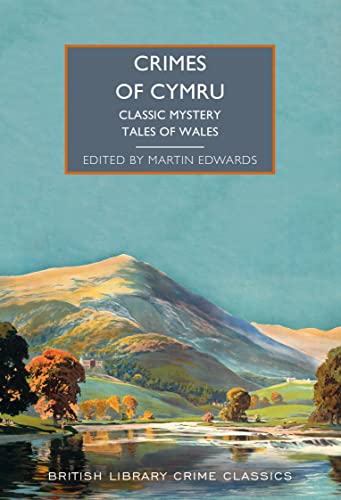
Review 2212: Crimes of Cymru: Classic Mystery Tales of Wales

This latest British Library Crime Classics collection features mystery and crime short stories written by Welsh authors or located in Wales. The stories were written from 1908 to the mid-1980s, and some of them are quite eerie in nature.

For example, in the 1936 story “Change” by Arthur Macken, holiday makers scoff when Vincent Rimmer tells them lights are on all night in the cottages of Tremant to keep the fairies away. Yet later a child is apparently exchanged by the fairies. Or is he?

In “The Way Up to Heaven,” Roald Dahl (born in Wales) tells the story of Mrs. Foster, whose husband purposefully torments her by being late even on the way to her flight to Paris to see her grandchildren for the first time. She figures out a way to take care of that problem.

In “No More A-Maying” by Christina Stead, the lies of two children with a guilty secret create an injustice in rural Wales.

Although most of the earlier stores are more traditional, “Water Running Out” by Ethel Lina White explains how Harvey deals with his aunt, who has been preventing his marriage to Annie for years by blackmail.

And another attempt to prevent marriage is perpetrated in “The Chosen One” by Rhys Davies. Rufus, whose family has occupied his cottage for hundreds of years, gets a note from his eccentric landlady, Audrey P. Vines, telling him his lease is up and she’s throwing him out.

This was one of the more entertaining and atmospheric of these collections that I have read. I usually like them, but prefer getting into a longer work.

I received this book from the publishers in exchange for a free and fair review.

Related Posts

The Edinburgh Murders and Other Tales of Scottish Crime

Final Acts: Theatrical Mysteries

Murder at the Manor

Review 2091: Final Acts: Theatrical Mysteries

British Library Crime Classics’ latest collection of mystery short stories has some connection to the theater. Some stories are only peripherally connected—feature an opera singer, perhaps—while others are set there and show a deep knowledge of that environment. As usual, the stories are ordered chronologically, beginning with a 1905 story by Baroness Orczy and ending with one from 1958 by Christianna Brand.

Baroness Orzcy’s “The Affair at the Novelty Theater” is a complicated story about the disappearance of some priceless pearls.

“The Affair at the Semiramis Hotel” by A. E. W. Mason is one of the super-complicated crime stories common in the earlier years involving people in costumes, a robbery, and a burglary.

“In View of the Audience” by Margarite Steen is a creepy one about a young man who gets on the wrong train and ends up accompanying a strange man to a derelict theater, where he hears about an old unsolved murder.

“Blood Sacrifice” by Dorothy Sayers leaves the reader to decide if there is a crime or not. Young playwright John Scales is furious with Mr. Drury, who has bastardized Scales’s play to make it a success. Then an accident places Drury in Scales’s power. This is the first story in the book in which characterization plays much of a role.

“The Blind Spot” by Barry Perowne is about a playwright who had a brilliant idea for a locked room mystery when he was drunk but can’t remember it sober.

“I Can Find My Way Out” by Ngaio Marsh probably shows the most knowledge of the theater, as a leading man is murdered in his dressing room.

“The Lady Who Laughed” by Roy Vickers is a strange story about a clown who murders his wife for finding him funny.

I enjoyed the satisfying surprise ending of “The Thirteenth Knife” by Bernard J. Farmer.

In “Credit to William Shakespeare” a poisoning onstage is solved through a man’s knowledge of Hamlet.

I think my favorite story was “After the Event” by Christianna Brand, where her detective, Inspector Cockrill, ruins the Great Detective’s favorite story by explaining how he got it wrong.

I received this book from the publishers in exchange for a free and fair review.

Related Posts

The Christmas Card Crime and Other Stories

The Edinburgh Mystery and Other Tales of Scottish Crime

Silent Nights

Review 2032: The Edinburgh Mystery and Other Tales of Scottish Crime

The Edinburgh Mystery and Other Tales of Scottish Crime is the latest British Library collection of crime short stories, edited by Martin Edwards. These stories are either set in Scotland or written by Scottish writers, like the first, “Markheim,” by Robert Louis Stevenson. They are arranged in chronological order by publication date, ranging from 1885 to 1974.

Some of the stories, like “The Field Bazaar” by Sir Arthur Conan Doyle, are simple puzzles. In this one, Sherlock Holmes explains to Watson how he knows what is in the letter he just received. Others, like “The Running of the Deer” by P. M. Hubbard, are about the supposition of crime. “Madame Ville d’Aubier” by Josephine Tey tells the story of the heavy atmosphere emanating from a woman at a bakery and how later this woman murdered her sons and husband. In “Footsteps” by Anthony Wynne, a man figures out the connection between apparently ghostly footsteps and an attempted murder.

I liked some of the stories more than others, but they altogether make an enjoyable collection for an escapist evening.

I received this book from the publisher in exchange for a free and fair review.

Related Posts

Murder at the Manor

Deep Waters

The Tuesday Club Murders

Review 1450: The Christmas Card Crime and Other Stories

For a Christmas season treat, I read this latest British Library Crime Classic short story collection, published in October. Most of its stories are set in winter and several around Christmas. This collection includes crime stories published between 1909 and 1965.

I was surprised to find the first story was written by Baroness Orczy, whom I associate with the Scarlet Pimpernel. It turns out that she started by writing crime fiction. In “A Christmas Tragedy,” her detective is Lady Molly, who is convinced that the accused Mr. Smethick did not murder Major Ceely. The police theorize that the motive was the major’s refusal to allow his daughter’s engagement to Mr. Smethick. Lady Molly discovers a more obscure motive for the crime.

In “By the Sword” by Selwyn Jepson, Alfred Caithness plots and kills his cousin Herbert after Herbert refuses to lend him more money. Alfred’s guilt is explored in an unusual way.

“The Christmas Card Crime” by Donald Stuart is more of a crime adventure, as a criminal tries to steal an heiress’s proof of her identity.

Although some of the stories were more clever than others, the only story I couldn’t finish was “Twixt the Cup and the Lip” by Julian Symons, a caper story that seemed to go on and on.

I received a copy of this book from the publishers in exchange for an honest review.

Related Posts

Silent Nights

Murder at the Manor

Deep Waters

Review 1397: Deep Waters

I have read several of British Library Crime Classics’ mystery story collections, usually themed around a locale. In Deep Waters, most of the stories are set at sea, although some involve rivers and one each a pond and a swimming pool. The stories are in chronological order by when they were published, from 1893 to 1975.

The first story, “The Adventure of the ‘Gloria Scott'” by Arthur Conan Doyle, is a Sherlock Holmes I have never encountered before, supposedly his first case. Like several of the first few stories, it presents and solves a puzzle so quickly that I was barely aware there was a puzzle. In fact, as I read these stories, I felt as if I was watching the evolution of the mystery story.

“The Eight-Mile Lock” by L. T. Meade and Robert Eustace, only the second story, was one of three written by women. It details the theft of a diamond bracelet from a party staying on a houseboat. The mystery is not so much about who stole the bracelet or how but where he put it to evade the police.

“The Gift of the Emperor” is a Raffles story written by E. W. Hornung, who was Arthur Conan Doyle’s brother-in-law. I don’t know if it was the last of Raffles’s career, but it seemed to be.

One of the stories I liked best was “A Question of Timing” by Phyllis Bentley. The main character, Robert Beringer, uses his observation skills as a writer to foil a criminal, save a detective’s life, and get the girl, all during a walk. This story takes place on an embankment of the Thames.

I have a frustration in general with mystery short stories as they really only have space to pose and solve a puzzle. So much that I enjoy about mystery novels is not possible at this length. Some of these stories, though, had beautiful descriptions of their settings. In any case, this is a good collection for those interested in the evolution of the mystery story.

I received a copy of this book free from the publishers in exchange for an honest review.

Related Posts

Murder at the Manor

Silent Nights

The Mistletoe Murder and Other Stories


Day 843: Murder at the Manor

cover for Murder at the ManorMurder at the Manor is another collection of classic mystery short stories published by Poisoned Pen Press. Each of these stories is set at a country manor.

This collection features writers the likes of Arthur Conan Doyle, G. K. Chesterton, Margery Allingham, and Ethel Lina White. Some of the stories are ingenious, and one is an amusing satire of the genre.

The satire was the story that most stood out, “The Murder at the Towers” by E. V. Knox. Just the first sentence gives a sense of it:

Mr. Ponderby-Wilkins was a man so rich, so ugly, so cross, and so old, that even the stupidest reader could not expect him to survive any longer than Chapter 1.”

And he doesn’t. Mr. Ponderby-Wilkins is found hanging from a tree, suspended by a muffler. His guests decide to “go on playing tennis as reverently as possible” until the detective arrives. When the detective, Bletherby Marge, arrives, he is described as a person who is sometimes mistaken for a baboon. The story continues on to turn the genre on its head.

“The Copper Beeches” by Arthur Conan Doyle is the only story I had previously read. Miss Hunter comes to consult Sherlock Holmes about an unusual offer of employment. She has been offered a job as governess at an inflated wage under the condition she bob her hair. Holmes advises her to take the position but promises to come immediately to her assistance if she summons him. She soon does and explains she has been asked to put on a certain blue dress and sit with her back to the window. Holmes immediately realizes he can prevent a crime.

“The Problem of Dead Wood Hall” by Dick Donovan is another early mystery. This case refers to two mysterious deaths, two years apart, of first Mr. Manville Charnworth and then Mr. Tuscan Trankler. Although no cause of death can be determined, both men show signs of having died the same way. Unfortunately, this story is turgidly written, and the method of murder and identity of the killer are easy to guess.

“Gentlemen and Players” by E. W. Hornung is a Raffles mystery. Raffles takes his friend Bunny along on a weekend at a country house, where they have been invited because Raffles is such a good cricket player. Raffles doesn’t usually rob his hosts, but he resents being invited as if he were an entertainer. And old Lady Melrose has such a nice necklace.

“The Well” by W. W. Jacobs is more of a psychological study than a  mystery. Jem Benson is about to be married. He has a cousin, Wilfred Carr, who continually borrows money from him. But this time Wilfred threatens to tell Jem’s fiancée Olive a disreputable secret if he won’t cough up. The two men walk out to the woods near a disused well and only one of them comes back.

“An Unlocked Window” by Ethel Lina White raises a lot of suspense when two nurses are left alone with their patient. A maniac in the neighborhood has been murdering nurses. Nurse Cherry suddenly realizes she left a window unlocked.

link to Netgalley“The Mystery of Horne’s Copse” by Anthony Berkeley is quite entertaining, about Hugh Chappell, who stumbles over the corpse of his cousin Frank late one night on the way home from dining with his fiancée’s family. Only the body isn’t there when he brings the police back, and Frank and his wife are on vacation at Lake Como. This is an odd state of affairs, but then it happens again and again until the last time the body is indeed Frank’s, and Hugh is wanted for murder. In this story, I particularly enjoyed Hugh’s spunky fiancée Sylvia.

All in all, I found the collection mixed in quality but enjoyable. Some of the stories are truly suspenseful, and some present a good puzzle.

Related Posts

Silent Nights

Thirteen Guests

The Hog’s Back Mystery

Day 806: Silent Nights

Cover for Silent NightsSilent Nights is a collection of classic mystery stories set at Christmastime. Represented are well-known writers such as Arthur Conan Doyle, G. K. Chesterton, and Dorothy L. Sayers as well as writers who are not as well known now, such as Ethel Lina White and Leo Bruce. At least, I am no expert, but I have not heard of them before.

Like most mystery short stories I’ve read, these are more concerned with posing a puzzle. They are not long enough for much serious characterization or detailed plotting. Still, I found some of them surprisingly effective.

In “Waxworks” by Ethel Lina White, for example, atmosphere is created in a story of a female reporter who decides to spend the night in a haunted wax museum. She is stalked there by a jealous coworker.

“Stuffing” by Edgar Wallace has an ending reminiscent of “The Gift of the Magi” in which the ill-gotten gains from a robbery that are hidden in the crop of a Christmas turkey end up in the hands of a poor, innocent couple about to depart for Canada. They think both the turkey and the money are gifts from the woman’s rich uncle.

In “The Unknown Murderer,” H. C. Bailey’s detective Dr. Reggie Fortune figures out the game of a pathological murderer. In “Cambric Tea” by Margery Bower, a jealous man tries to frame two innocent people for murder.

link to NetgalleyNot all are that successful. “A Problem in White” by Nicholas Blake doesn’t tell the solution (which I guessed) unless you turn to the back of the book. “The Name on the Window” by Edmund Crispin depends its puzzle on which side of the window the victim supposedly wrote the name of his attacker. Yet for this solution, we must suppose that the victim was stabbed and then walked around a building and down a long hallway for no apparent reason than that he could collapse on the other side of the window. Not, I think, the behavior of a dying man. (And, typically, he didn’t just write the name of his attacker; he hinted at it.)

In any case, this collection made me interested in looking for some of the longer works by some of these authors.

Related Posts

The Santa Klaus Murder

Thirteen Guests

The Hog’s Back Mystery