
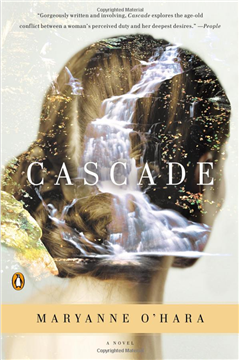
 It would be nice to know how much O’Hara expects us to like Desdemona Hart Spaulding, the heroine of Cascade. Unfortunately, I think we may be thrust too abruptly into Dez’s troubles to get to like her.
A promising artist who has studied in Boston and Paris, Dez has already been forced to leave that life when we meet her. The Great Depression cost her father his fortune, and he had to close down the famous theater he founded in the resort town of Cascade and sell his treasured First Folio of Shakespeare. Dez was forced to withdraw from art school and hastily married her childhood friend Asa Spaulding so that she and her father would have somewhere to live. Her father dies soon after, and she is taken aback to find he has left the theater to Asa.
Still, considering she married a man with little interest in or understanding of her drive to create art, Asa has set aside a bright room in their house for her studio, and she paints for several hours on most days. Asa wants a child, though, and Dez fears that her precious painting time would be taken up with child rearing. She is secretly doing what she can to prevent conception.
Two things soon make her dissatisfied with her life. Her art school friend Abby stops by on her way to a new life in New York, and suddenly everything in the depressed town looks shabby, even the beloved playhouse. Dez has also formed a friendship with a Jewish man named Jacob Solomon, who has taken over his father’s peddlar’s route. Jacob, though, is a gifted artist who plans to sell his father’s inventory and move to New York, hoping for a job with the Works Progress Administration. He meets Dez once a week to discuss art, but after a dispute, Asa asks her to stop meeting Jacob.
Asa is concerned because the town is under threat. Cascade is one of two possible towns that may be flooded to create a reservoir that will supply water to Boston. Asa wants to mobilize an effort to save Cascade, and Dez has the idea to paint a series of postcards showing Cascade in the past and present in an attempt to garner public support for the town. She is able to sell this idea to a prominent national magazine. All the while, however, she is secretly hoping the town will lose and she will have an excuse to move to a large city. The agreement she makes with the magazine and other disastrous decisions cause her to betray her husband, her town, and finally even Jacob.
I think O’Hara wants us to sympathize with Dez in her growing ambition to go to New York and take up a career in art. But some of her actions don’t just show poor judgment; they are despicable. As the plot advances, I feel less and less sympathy for her.
A review from the Boston Globe calls Dez complex and says she doesn’t always make the right choices. I think it’s worse than that; the trouble is really with where she places her priorities. The town is in danger of dying, in the horrible economy many people’s welfares are at risk, but Dez puts her future as an artist first and barely gives the other townspeople a thought, in fact, seems to feel superior to them. She supposedly yearns to reopen her father’s playhouse but doesn’t seem to give it much attention when it is threatened, although she eventually makes a deal that saves it. She has married for selfish reasons and is all too ready to give up on her marriage.
Of course, the principal theme of the novel is how much to give up for art, but in this case, it is not Dez who does the sacrificing. I wish I had liked this novel better. I think that if we’d had a longer time with Dez in her art student life and gotten to know her before she began a series of lies, deceptions, and betrayals, I could have felt more sympathy with her struggle.
 What? Me Read?