Day 222: The Hare with Amber Eyes: A Hidden Inheritance

Cover for The Hare with Amber EyesBest Book of the Week!

In 1994, the world-class ceramics artist Edmund de Waal inherited a collection of 264 netsuke from his great uncle Ignace (Iggie). De Waal decided to trace the history of the netsuke from the time they came into his family, and in doing so, to trace the history of the family itself and the times they lived in. The result is a fascinating combination of memoir, history, art history, and collection of musings on related topics, The Hare with Amber Eyes.

Charles Ephrussi originally purchased the netsuke in Paris during the second half of the nineteenth century. The Ephrussis were at that time a wealthy family of bankers, originally from Odessa, who in previous generations had expanded their offices to Vienna and from there to Paris. Charles Ephrussi was not a banker but a noted art collector and critic, friend of Impressionists such as Degas and Manet, and one of the two models Proust used for his character Charles Swann.

De Waal attempts to understand Charles through an examination of his writings and possessions and through events in his time, particularly the effect of the Dreyfuss case on antisemitism in France. Charles’s work in art was an important part of his life, and in this section of the book I was struck by the connection de Waal makes between Japonisme–the interest in and collection of Japanese artifacts, with their focus on nature and everyday life–and the rise of Impressionism, which was considered revolutionary partly because of its focus on nature and everyday life instead of “noble” subject matter such as historical scenes or stories from the Bible or mythology.

In 1899, Charles sent the netsuke to Vienna as a wedding present for his younger cousin Viktor Ephrussi, de Waal’s great grandfather and eventual head of the Ephrussi bank in Vienna. De Waal traced what he could of the life of Viktor and his family, this story culminating shortly after the dual terrors of the Anschluss and Kristalnacht. During this time, everything that this branch of the family owned was confiscated by the Gestapo. In these pages of the book, de Waal does a better job of conveying the fears and anxieties of those times than any of the recent books I have read.

De Waal’s grandmother Elisabeth recovered the netsuke after the war. How they returned to the family is an incredible story that I will not reveal. Shortly after she returned to England with them, where some of the family had made their home, they traveled to post-war Japan with de Waal’s great uncle Iggie.

I have just supplied the barest outline of the fate of the netsuke, which provides a focus for de Waal’s investigations and musings, but the family’s story and the story of their times is fascinating and imaginatively reconstructed. The book is at once a meditation on and enthralling depiction of the life and times of an extraordinary family.

Day 190: Open: An Autobiography

Cover for OpenBest Book of the Week!

Those of you who know me will probably be surprised to see the review of a sports biography on my blog. I will freely admit that this is not a book I would have chosen for myself; instead, it was a choice of my book club. That being said, I found Open: An Autobiography by Andre Agassi to be extremely interesting and even touching.

In making notes for my review, though, I came across another problem–how to review a biography of a living, well-known figure except by relating some of its disclosures. For some assistance on this, I took a peek at the review in the New York Times, but they obviously had the same problem. However, a phrase in that review caught my attention. The reviewer remarked that from the first time Agassi first appeared in the sport, he looked like a deer in the headlights. Now, look at the picture of him from the cover of the book.

This expression is a lead-in to a story about a sad, sad boy who seems to have finally grown up into a mostly happy, contented man. His big secret, which by now everyone knows, is that this athlete, who is considered one of the best tennis players in the world, ever, has always hated tennis. He was forced into the game as a young boy by his fiercely competitive (and I would say, although he never does, abusive) father, a former Olympic boxer who never succeeded professionally but was trying to live his life through his son.

His fate was so predetermined that his father gave him a tennis racket to hold in his cradle, and when as a boy he found he preferred soccer because of the camraderie (he frequently remarks on how lonely a sport tennis is), his father made him quit so he could spend more time on tennis. The vision of Agassi as a small boy facing the machine his father had rigged to fire thousands of tennis balls at him at an unbelievable speed is a chilling one.

I was particularly outraged by the attitude of his father and other adults toward his schooling. Agassi is clearly an intelligent person. He can remember, literally, everything, but as he explains in the book, except in English class he had difficulty grasping concepts. He had to have them explained to him a few times, and then he could remember them. When you watch his farewell speech at the 2009 U.S. Open or any of his speeches about his charter schools, you can see that he is a thoughtful, reasoned, even eloquent speaker who does not need notes. I am guessing that he may have had some sort of learning disability.

I feel so sorry for a boy who needed help with his lessons instead of a father who regularly had him skip school to play more tennis. Later he was sent to a tennis training school at the age of 14 (a school that sometimes sounds like something from Dickens and other times like Lord of the Flies), from which he was allowed to drop out of school to pursue, you guessed it, more tennis. This “preparation” gave him no other recourse–he was forced to follow a career in tennis because he had no other prospects and couldn’t do anything else.

Open is about Agassi learning to grow up and make peace with himself. It is terrifically engrossing, and his descriptions of some of the games made me wish that I had seen them. (Actually, I watched some of them on YouTube.) He avoids any kind of self-aggrandisement. In fact, as the title says, he is open for the first time in his life. Although he expresses himself honestly, he does not use the occasion of writing this memoir to slam other people or tell anyone’s secrets but his own. His depiction of certain other well-known figures (for example, his marriage to Brooke Shields and his rivalry with Pete Sampras) is balanced, and it seems, fair. Finally, I found it touching to see how a person who grew up in such a harsh environment would turn out to be so caring of others.

Day 177: Below Stairs

Cover for Below StairsThis is actually my posting from yesterday. We were having some internet problems.

Below Stairs is the memoir of a kitchen maid that inspired the series Upstairs, Downstairs. Margaret Powell worked in service in the 1920’s from the age of 15 until her marriage. She was an intelligent girl who could have been a teacher, but her parents couldn’t afford to support her while she qualified, so she left school and began working at 13. Later, after her sons were grown, she went back to school and passed her 0-levels at the age of 58, followed by her A-levels.

Powell began as a kitchen maid and worked her way up to cook, mostly through ambition and nerve because she never really received any cooking training. (You had to feel sorry for the first employer who hired her as a cook, because she admits she only knew how to cook vegetables!) Her memoir describes the conditions the servants worked and lived in, sometimes very bad; the work she had to do, including ironing shoe laces in one position; and the way she resented how servants were treated by many of her employers. Although Powell wanted to become a cook, as it was the most privileged job available to her, her biggest ambition was to be married so that she could leave the life of servitude.

The memoir is written in a conversational style, including quite a bit of scathing commentary. It is an interesting book, although Powell’s memories are mostly negative. She says that she had fun, but she only slightly mentions any amusements, focusing on the numerous snubs she received and the ridiculous things she was expected to do. Of course, this adds to the interest of the narrative. One employer was actually even a bit miffed at Powell’s own name (Margaret Langley at the time), deeming it too “posh” for a servant. Although the memoir is written at least 40 years after Powell worked in service, the experience still obviously rankles.

Day 149: Hons and Rebels

Cover for Hons and RebelsAfter reading the other Mitfords’ criticisms of this book in The House of Mitford, I expected a biography that was cruel and critical, but Hons and Rebels is mostly an amusing story of Jessica Mitford’s teenage rebellion. The Guinesses (authors of The House of Mitford and Jessica Mitford’s nephew and great-niece), who claimed that Jessica Mitford lied on several points, do not seem to have considered the common phenomenon that people who experience the same things frequently remember them differently, from their own frames of reference. A different recollection of an event in the far past (and in one case an apparent misidentification) is not necessarily lying.

I became interested in finding a good biography of the Mitfords after re-reading several of Nancy Mitford’s novels. I was curious about the kind of family that could have spawned children with such radically different ideas and such extreme characters. Unfortunately, at the time, I was only able to find a couple of biographies written by family members, this being one.

Nancy Mitford, of course, was a brilliant social satirist and author of several light comic novels–and not as politically involved as some of the other girls. Diana left her aristocratic husband, Bryan Guiness, for the infamous British Fascist leader, Oswald Mosley, and was interred with him in prison during World War II for their pro-German sympathies. Unity Mitford became a fan and friend of Adolf Hitler and shot herself in the head the day that Britain declared war against Germany, but failed to kill herself and was mentally disabled for the rest of her life. On the other hand, Jessica as a teenager ran off to the Spanish Civil War with the socialist Esmond Romilly, whom she married. Later she moved to the United States and became a member of the American Communist Party and a famous muckraking journalist.

Hons and Rebels covers Jessica’s childhood, rebellion, later life in the States, and estrangement from the rest of the family. It is light and easy to read, and quite funny. It depicts Esmond and Jessica as extremely naive but equally unprincipled. Mitford does not attack the other family members, as I would have expected after the comments in The House of Mitford. If anything, she looks back at them all nostalgically. In fact, as I commented in my review of the other book, the Guinesses are more prone to attack and criticize the other Mitfords, particularly Jessica and Nancy, and try to mitigate the faults of the Mosleys and the fanaticism of Unity. The only biography I can find written by an unbiased author is apparently superficial and focuses on Unity, so I guess my curiosity about the Mitfords will remain unsatisfied.

Just a note for my consistent readers: I thought that by reviewing one nonfiction book a week, I would be able to continue to write nonfiction reviews indefinitely, but I have now caught up with my nonfiction reading for the past two years, which just shows how much more fiction I read. From now on, nonfiction reviews will appear as I finish the books instead of more regularly.

Day 79: A Mountain of Crumbs

Cover for A Mountain of CrumbsIn A Mountain of Crumbs, Elena Gorokhova has written an engrossing memoir about growing up in Soviet Russia during the Cold War. What makes it most interesting, besides the details of life in such a different environment from our own, is how, while misunderstanding many things about Western culture and not being brought up with an accurate understanding of history, even of her own country, she still learns to doubt what she is taught.

Gorokhova’s upbringing is fairly ordinary, although she is both slightly privileged (her family has its own two-room apartment instead of sharing with other families) and disadvantaged (she has to earn her own way by merit since she is not the child of a peasant). However, from an early age her interest in learning English makes her fascinated with the world outside the Soviet Union. At the same time, her cynicism and disillusionment with her country grows.

Most of the book is about Gorokhova’s inability to live in lock-step, both with the state and with her own mother, so that she always feels like she is lying. As she says, “they (the state) lie to us, we know they’re lying, they know we know.”

The book is beautifully written in the first person as if Gorokhova is currently of that particular age rather than as if she were recalling her memories. (For example, when she is telling about when she is five, she narrates it as if she is five.) I can’t completely accept this style of narration for sections about her childhood, because the thoughts she claims to have are too sophisticated for a small child. In particular, I am struck by one comment she makes about thinking something is ironic. Five-year-old children don’t have thoughts about irony–it’s hard enough to get teenagers to understand what it is. However, the same narrative style works very well when she recalls her thoughts as an older child and young adult.

(As a side note, I have to contrast the chapters narrated by herself as a child with Jennifer Lauck’s wonderful memoir Blackbird, which at the beginning employs a narrative style that is absolutely convincing as the thoughts of a small child, allowing the reader to understand things that the child Jennifer doesn’t.)

I have one frustration with the book. Gorokhova describes so many misunderstandings about American life and so much anticipation and anxiety about going to live in the States that I would have liked a chapter about what it was like when she finally arrived. Instead, the book ends as she leaves Russia and contains a short epilogue about her life more than 20 years later.

Day 67: Life Itself: a Memoir

Cover for Life ItselfWriters of memoirs and biographies have the same difficult problem to deal with. There is a fine line between giving too much detail for the work to be interesting or not telling enough. (I once read a biography of Aldous Huxley written by his niece that told everything he did every single day but gave absolutely no insight into him as a person, for example, his opinions or the conversations he had with other people.) When you are writing a memoir, you have the additional difficulty of drawing the line between what should remain private and keeping readers’ interest.

In reading Life Itself, Roger Ebert’s memoir, I admit to feeling a little frustrated at times about the level of information provided while at the same time recognizing Ebert’s intent to be open. I certainly wouldn’t want to read a tell-all, because I think the world is unfortunately losing its sense of privacy, but although his memoir forthrightly confronts some issues like alcoholism in the family and his own physical problems, it seems to skip over certain periods of his life.

Ebert chooses an unusual organizational approach to his memoir. Instead of going chronologically (although the book is roughly chronological), he writes each chapter on a different topic, as if it were a series of essays. And perhaps the book originated with some of the blog entries and articles he has been writing for years. This approach made it sometimes repetitive and sometimes seem like little more than impressions and lists of things and people. Of course, it has some delightful chapters, especially the nostalgic ones about his youth.

Perhaps because Ebert is trying to protect other people’s privacy, aside from his family he hasn’t written very much about ordinary people in his adult life but a lot about the famous ones, which gives a bit of an impression that Ebert is a name-dropper (even though I don’t think he is). For example, although the information about his adult ordinary life is limited (though he writes a lot more about his life since his illness), the book contains complete chapters about famous people he interviewed only once or twice. You can’t help having the impression, time after time, that Ebert has really gotten a kick out of hanging out with famous people.

Again, this skewing gives me another reason to suspect that many of these chapters originated as blog entries and articles he has written over the years. Because of this aspect of the book, it may be more likely to appeal to people who are fascinated by everyone in show business than those like me who think famous people are just ordinary people who happen to be famous and wish everyone would leave them alone.

(As sort of an anti-intuitive “proof” of this idea, I point out the reviews on Amazon. The people who disliked the book criticize it for spending too much time on his childhood and youth, which I thought was the interesting part, and not enough time talking about famous people. In other words, they want even more information about famous people than he provided, whereas I wanted more about him as a person. Perhaps they don’t understand the point of a memoir.)

The chapters on Gene Siskel and Ebert’s wife Chaz are touching. The book is, of course, very well written. We have a lot of sympathy for Ebert’s condition–a talker who is unable talk–and come away from the book believing he is handling it with dignity and an amazing optimism. My overall impression of Ebert from this book was that he went through a lot of his life being pleased with himself for his own intelligence (and must have been extremely annoying to some of his teachers in school and professors in college) and the luck he has had in his career, but that–as he himself admits–he has finally learned later in life about what is most important.

This review sounds like I did not enjoy the book. I enjoyed it but also found it frustrating at the same time.

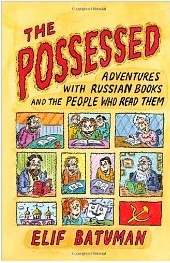
Day 45: The Possessed: Adventures with Russian Books and the People Who Read Them

Cover for The PossessedMaybe not many of you would be interested in a book like The Possessed: Adventures with Russian Books and the People Who Read Them by Elif Batuman, but as a previous student of Russian and also a previous literature graduate student, I found it very funny.

Batuman has written a book about her years as a graduate student of Russian language and literature that skewers many things, but particularly academic conferences with their absurd presentation topics and academic thinking, with the oblique reasoning process that sometimes accompanies it. For example, on the way to a conference on Tolstoy’s estate, Batuman loses her luggage and is forced to dress in flip-flops, sweatpants, and a flannel shirt. Some of the scholars attending the conference assume she is a Tolstoyan and that she has taken a vow to walk around in sandals and a peasant shirt for days. When she calls a Russian clerk to find out about her luggage, the clerk replies, “Are you familiar with our Russian phrase resignation of the soul?”

While relating her adventures in studying, travelling in Russia, and living in Turkey, where she went because her grant was too small for her to afford a stay in Russia, Batuman muses on ideas from literature and compares the lives of the people she meets with the adventures of characters in Tolstoy, Dostoevsky, and Chekhov. Her observations are colored with her own peculiar view of life, which poses that “the riddle of human behavior and the nature of love appear bound up with Russian.” In Turkey, when she is challenged by scholars to study Turkish literature, particularly because of her Turkish heritage, she concludes that no one reads it, even the Turks.

Batuman expanded articles she wrote for Harper’s and The New Yorker into this book, which is named after one of Doestoevsky’s more enigmatic novels. Although her musings are occasionally a trifle too erudite for me to follow (and perhaps my memories of Russian literature too rusty), I found the book amusing and couldn’t put it down.

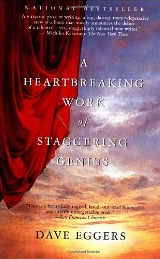
Day Twelve: A Heartbreaking Work of Staggering Genius

Cover for A Heartbreaking Work of Staggering GeniusBefore I start this review, I have to apologize for the untimely posts this week. I’ve told several people that I would try to post a review every weekday during my lunch, but lately we’ve been having a lot of Internet outages. So, I’m posting when I can.

A Heartbreaking Work of Staggering Genius is based upon true events of Dave Eggers’s life. When he was 22 years old, his mother and father died within months of each other, leaving his family to split up and himself in charge of his eight-year-old brother, Toph. They live in bachelor squalor while Eggers obsesses. Eventually, they move to San Francisco, where he becomes a founder of Might Magazine.

I didn’t read this book for a long time because I was put off by its title, but it received so many good reviews that I finally picked it up from curiosity. I have to preface my remarks by saying that I have lately gotten some clues that I don’t understand modern humor (i.e., I am officially a geezer), especially when I’ve tried to watch movies that are dubbed “hilarious.”

Readers might get a clue about how this book is going to proceed from its set of “Rules and Suggestions for the Enjoyment of this Book.” One of them is to skip the middle of the book. Good suggestion.

I found the first 100 pages or so about his parents’ deaths and his subsequent struggles affecting and absorbing. However, this is one of the few books that I just couldn’t finish. I found it so juvenile and smug that it was absolutely grating, but that’s not why I stopped. When Eggers abandons his straight narrative, he begins musing, and his prose devolves into unbelievably long, rambling paragraphs. His approach has been deemed “inventive” and even “the memoir as metafiction” (yikes!). I was actually only 30 pages from the end of the book when he started another of his lengthy asides, and I just couldn’t take it anymore. I gave up.