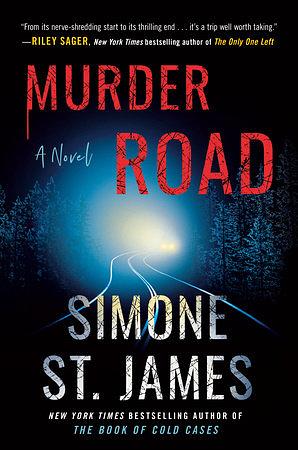
Review 2425: Murder Road

If you like a good ghost story, there’s no one to beat Simone St. James. Her last two books were especially excellent.

It’s July 1995. April and her new husband Eddie are on their honeymoon on the way to a motel on Lake Michigan when they get lost. Something about the road they are on, Atticus Line, feels wrong. April sees a light blinking in the woods and then they see a figure in the road, a girl who seems to have something wrong with her. Her name is Rhonda Jean, and once they realize she’s bleeding, they rush her to the hospital in Coldlake Falls.

Rhonda Jean has been stabbed, and she dies in the hospital. April and Eddie are covered with blood, as is their car, and they suddenly realize they look like murderers. And that’s how the cops see them.

April and Eddie soon realize that they need to try to solve the murder themselves. They learn that there had been a series of murders on the Atticus Line, mostly of hitchhikers on the way to a beach, starting in 1976 with an unidentified woman. There is also a story of a ghost who haunts the road. Once you see her, you die. April sees her when they return to the road, and the ghost tries to pull Eddie from the car, but they don’t die. What does the ghost want?

As far as the plot goes, and sympathy for the main characters, this one is right up there with St. James’s best. Unfortunately for me, Michigan native, it turned into What It Gets Wrong about Michigan, especially Midland, one of the novel’s settings and my home town.

Never mind me. If you like ghost stories, you’re going to love this one. No need to continue reading. However, if you like accuracy . . .

First, it was the weather. This is minor, but the characters experience a series of really hot days. Sure, it can be hot in Michigan, but in the northern lower peninsula, which is where the book is set, it’s usually not that hot in July. Mornings are usually cool and nights cold. There’s a bit about a flannel shirt that Eddie brought along in case it was cold. He would know it would be cold. Of course, weather in 2024 could be different, but I looked up the weather in that area in July 1995. They had one day in the 90s and a low in the 80s. Most days were in the 60s or 70s. But again, this is minor.

Then she shocked me by saying Midland was in the south, almost to the Indiana border, proving she never even looked at a map. Midland, as its name suggests, is smack dab in the middle of the lower peninsula, maybe a bit east of the middle. It’s a five-hour drive from Ohio. Indiana is further away. The main characters are from Ann Arbor, which is almost two hours further south than Midland, so they wouldn’t make that mistake.

I’m no Midland booster—I got out of there as soon as I could—but St. James depicts it as a sad little town. It’s actually quite prosperous as the home of Dow Chemical, which has pumped a lot of money into it, and it has a large percentage of people with PhDs. The characters think they are in a sad downtown area when they go to the library, but they are not, and in fact never get there. The downtown of MIdland was quite vibrant in the 90s, much more so than when I left in the 80s. The library is actually on a long main street that is commercial at both ends but middle- to upper-class residential in the middle where the library is, with the botanical gardens behind it and the performing arts center next to it. April is surprised that the library is surrounded by greenery, but most of Midland is quite green, although it gets a little seedy a few long blocks away, closer to downtown. Finally, there is no bank across the street from the library.

Just a little more research, even if she couldn’t make a visit, would have got these facts right. It’s kind of interesting that she didn’t do it or make up a different town, as she did with the setting farther north.

Related Posts

The Book of Cold Cases

The Sun Down Motel

The Broken Girls

Review 2289: Heat Lightning

Amy travels back to her childhood home in Michigan from New York ostensibly to recover from surgery but really to think about the situation with her husband, Geoffrey. There is tension among her relatives. The Westovers are a wealthy family, but it is 1930. Her father Alfred’s farm machinery factory doesn’t have many orders, but his brother DeWitt made some bad investments and is asking him for help.

Amy’s cousin Tom is drinking too much and soon has a more serious problem. Her redoubtable grandmother is managing her fortune but is dealing with requests for help from Tom and DeWitt.

Amy watches everyone’s interactions carefully, because she is looking for some inspiration. She feels that her generation has no code for behavior and is trying to formulate its own. She doesn’t know how she feels about Geoff and is looking for guidance in her parents’ loving interactions.

Although a lot of this novel is about family interactions, some of the dinner conversations are about scientific discoveries that came earlier than I expected, for example, about entropy. On the other hand, the idea of race expressed in the novel is not scientifically based (or perhaps language is not carefully used). Amy, for example, considers the European immigrant working class characters to be of a different race than her family and friends. They’re Italians and Swedes.

A distressing topic for modern audiences is what the family should do with Curly, the mentally disabled gardener.

Overall, I found this a thoughtful and interesting look at family dynamics.

Related Posts

The Tree of Heaven

Family Roundabout

Family Furnishings

Review 2264: Tom Lake

On the farm in Northern Michigan that has been in her husband’s family for generations, Lara has been coaxed by her three grown daughters to tell them about her relationship with Peter Duke, a now famous movie star. There has been a triggering event for these stories, but we don’t learn about it for a long time. In any case, these stories take place between sessions of cherry picking and other hard work.

Lara becomes an actress without planning to. When she is in high school helping with auditions for Our Town, the girls trying out for Emily are so bad that she tries out herself and gets the part. Later in college, she takes the part again, and it happens that Ripley, a movie producer, has been persuaded to attend to see his niece. Instead, he decides that Lara is perfect for an upcoming role.

Lara makes a movie, but there is a long delay before it comes out, so she ends up taking the part of Emily again at a summer stock theater in Michigan called Tom Lake. At Tom Lake, she is swept into an affair with Peter Duke, a young, charismatic actor, on her first day. The summer starts out magical, but Lara has a lot to learn about acting, herself, and Duke.

The present-time novel is set during the pandemic, but even though the story has some heart-wrenching parts, its overall atmosphere is so cozy, so happy in its setting, that it feels like the family has its own little nest. You want to go and live with this fictional family. I was born and grew up in Michigan, and although I never lived on a cherry farm, this book made me nostalgic.

Patchett is also a terrific storyteller. This novel is paced brilliantly. The sections where she tells her story seem just about right in length while the rest portrays a warm family life and hard work on the farm. I loved this book.

Related Posts

Commonwealth

State of Wonder

Once upon a River

Review 1686: You Don’t Have To Live Like This

Greg Marnier in his 30’s finds himself at loose ends. He has been in Wales teaching history classes as an adjunct during the last few years but has moved back home to Baton Rouge and can’t find a job. He is an overthinker, who seems generally clueless and inert throughout the novel.

Marny, as his friends call him, went to Yale with Robert James, who has made a fortune and now claims to want to do some good. It’s 2011, and property is cheap in deserted Detroit. Robert wants to buy a large number of houses and sell them to people who want to change their lives, fix up the houses, and create communities, thereby forcing urban renewal. Marny decides he’s in.

This idea is sort of interesting, but Marny right away struck me as deficient in something. For example, he doesn’t seem to think there’s anything wrong with Robert’s company having tried to force some of the original occupants in the five neighborhoods, most of whom are black, out of their houses, to displace them with newcomers who are mostly white. Marny makes tentative friends with an angry black Detroit native named Nolan, but when his friend Tony won’t let his small child play with Nolan’s small child because Tony is a racist, he says nothing and continues to be friends with both.

Marny half-heartedly pursues a black schoolteacher named Gloria romantically and then doesn’t seem to know what to do with her once he’s got her. But like all the conversations in this novel, their discussions of race seem strangely unfinished and unsatisfying.

In general, Markovits’s handling of the book’s themes of racism and gentrification seems deficient and naïve. Nothing much happens for a long time except an exhaustive retelling of Marny’s day-to-day life until there’s a series of events and a trial that change everything.

Markovits has a background in magazine writing, which I wouldn’t mention if it didn’t affect the novel. Just like in a magazine feature, Marny describes each character as he or she comes into the story and provides a short background. This is not an organic outgrowth of the novel, where it is more usual to find out about a character’s background through a conversation or some other organic construct (research on the part of another character, for example) unless the novel is omnisciently narrated. It seems very artificial in fiction as it does not in a magazine article, and frankly, some of the characters seem stereotypical. There are also a lot of them, as there are a lot of those unsatisfying conversations, many of which have little to do with the story.

I think that the subject matter of this novel is important, but I don’t think Markovits is the person to handle it, at least not judging by this book. Including its clumsy title (which seems to be a thing these days), his novel was not one of my favorites from my James Tait Black project.

Related Posts

The Long Take

We Need New Names

Broken Monsters

Review 1637: A Perfect Union of Contrary Things

I have a few disclaimers before I begin my review of this book. First, punk, progressive, and grunge rock are not genres I’ve listened to, so I am profoundly ignorant of Maynard James Keenan’s work, which is perhaps a handicap for my review. Second, the author, Sarah Jensen, is a friend and ex-housemate, with whom I’ve been out of touch until recently. My belated discovery that she had written this biography piqued my interest in reading it.

Jensen follows Keenan from the time when he was a boy, leading a difficult life, to his present life as a musician, actor, comic performer, artist, winemaker, and writer. Yes, he truly seems to be a Renaissance man, continually working at something and giving his many projects detailed attention and effort.

Keenan’s young life was disrupted many times—by his parents’ divorce, his mother’s being incapacitated by stroke, his many households and schools. Although he is a seeker, his attitudes about formal religion are formed by his skepticism, even very early, about his fundamentalist upbringing and his anger at how members of her church told his mother she must have done something very wrong for God to have stricken her so.

Starting at high school, it seems, Keenan developed the philosophy that if you’re going to do something, you should do it well, and if you have talent, you should use it. He was a high school track star and gifted artist, whose dream was to go to art school. He accomplished that by enlisting in the army, where he so excelled that he was offered a place at West Point’s preparatory school. He attended that but with no intention of becoming an officer.

His path to such bands as Tool and A Perfect Circle was anything but direct, so much so that old friends weren’t even aware he was a musician. The tale of his progress through life is truly interesting.

The book is beautifully written, lyrical at times, and explores Keenan’s music, lyrics, and philosophy in detail. I felt a bit at sea in following the discussions of his music and his comic performances as part of Puscifer, as I explained before, despite having watched a few clips on YouTube.

If there was one thing that threw me off a bit it was the tone of the book, especially in discussions of Keenan’s performances, which felt more like, say, a Rolling Stone appreciation than a biography. That being said, I am more accustomed to literary and political biographies, which have more distance from their subjects than ones about living celebrities.

Related Posts

Educated

Giving Up the Ghost

Wild

Day 445: Annals of the Former World: Crossing the Craton

Cover for Annals of the Former WorldIn the final short book of Annals of the Former World, John McPhee examines the craton, the flat land that lies in the central Midwest of the continental United States. If you have read my reviews of the other books, you might remember that McPhee wrote each one about a separate geologic area near I-80, along which he traveled with different geologists telling the story of the formation of the country. Each of those four books was published separately, but Crossing the Craton was added when the complete volume was published, perhaps for completeness. (I think it was published separately at a later time.)

Because there are few outcroppings in the Midwest, little can be seen of the rock underlying this area, a thin veneer over the basement rock that comprises 90% of geologic time.  McPhee explains that until very recently this basement, or Precambrian, rock was neglected in geology texts. Because Precambrian rock by definition has no carbon in it from living things, carbon dating was not available. Nothing was known about the rock.  For a long time it was thought to have been there since the creation of the earth, but that idea has been found to be incorrect.

Just in the last 40 years or so, new kinds of dating methods and other technological advances have allowed geologists more insight into what is going on beneath the surface in these older rocks. Gravity maps have revealed a huge tectonic rift, for example, that runs from eastern Nebraska through Iowa, Minnesota, and Wisconsin and under Lake Superior, where it joins one rift shooting north into Canada and another running right through Michigan. This three-pronged rift is similar to the one that runs down the Red Sea to meet the rift in the Gulf of Aden and the East African Rift, only that one is much younger.

In this book McPhee explains how the Canadian Shield and the central portion of North America were mostly likely created. He also looks at recent technologies such as zircon dating and aeromagnetic mapping, and speculates on the discoveries about the basement rock that could emerge in the future.

Although this is the shortest book in the volume, more the length of an essay, its emphasis on technology makes the subject matter of lesser interest to me than that of the previous books.

Day 236: The Loon Feather

Cover for The Loon FeatherBest Book of the Week!
The Loon Feather by Iola Fuller is one of my favorite books from when I was a girl, and I still read it every few years. A fascinating story set on Mackinac Island, it compelled me to visit every spot mentioned when I was on the island during a vacation.

Set in the early 1800’s, the book starts with the birth of its heroine Oneta. She is Ojibway and the (fictional) daughter of Tecumseh, the famous Shawnee leader. A prophecy at her birth says that she will bring a husband to her people who will be more powerful than a warrior. No one knows what that means, but prophecies are apparently always right.

The beginning of the book traces the seasonal nomadic life of her people, followed during her early childhood. Tecumseh is killed fighting for the British against the Americans in the War of 1812 when Oneta is young, and she is raised by her mother and her grandfather. A wise woman, Marthé, is also important to her as a young child, but Marthé leaves them all to marry a French trapper.

The Ojibway make a yearly trip to Mackinac Island, where part of the settlement from the war is payment of reparations from the Americans. The island is a fascinating mix of Native American, French, and American cultures. Here Oneta and her mother encounter Marthé, who lives on the island with her husband and young daughter, and they gladly visit back and forth. But before the tribe departs for the year, Oneta’s mother becomes ill, and Oneta is left there to care for her until her grandfather returns the next year. After Oneta’s mother recovers, she works as a maid up at Fort Mackinac and meets a French accountant for the Astor Fur Company, Pierre, who marries her.

At first we see things only from Oneta’s point of view as a Native American. As Pierre’s fastidiousness and different tastes clash with his bride’s customs, misunderstandings arise. However, Oneta is eventually sent away to a convent school to be raised as a French girl.

When she returns to the island as a proper young woman, she is at first inclined to disdain her true heritage and must find a balance between it and what she owes to Pierre and Madame, his mother. She also witnesses the struggles of Pierre and her younger brother Paul, who prefers his Native American roots and envies Oneta her heritage.

The colorful setting is populated by French voyageurs, American soldiers and capitalists, and the Native American tribes, who begin to become aware how the workings of history are fundamentally changing their way of life.

Day 138: Once Upon a River

Cover for Once Upon a RiverBest Book of the Week!

In 1970’s Michigan, Margo Crane has grown up on a tributary of the Kalamazoo River, learning how to hunt and fish from her grandfather and swimming across the river to play with her Murray cousins. The first chapters of Once Upon a River, Bonnie Jo Campbell’s coming-of-age novel, show her running wild while her depressed, alcoholic mother sleeps all day in the sun.

Margo is a young teenager when her mother abandons her and her father. The two of them manage until a party at the Murray’s, when Margo is sexually assaulted by her uncle Cal. This incident becomes very public, severing the Cranes’ ties with the Murrays. Although Margo is initially confused about how she feels, her eventual attempt to revenge herself on her uncle goes horribly wrong and results in her cousin Billy murdering her father. With no one to care for her, Margo takes a boat and her uncle’s best rifle and begins a journey on the river.

For Margo, this is a journey of discovery, about what kind of person she is and how she wants to live, about how to form her system of ethics and what it should be. Rather than being plot driven, the novel is about the people Margo meets and her interactions with them. It is a sometimes lyrical novel about a way of life that is almost completely gone except in remote areas of the continental United States.

I was attracted to reading this book because I grew up in Michigan a decade earlier than Margo. But this is a different Michigan. I had a hard time imagining that such a life was possible around the Kalamazoo, which is now and was then in a fairly populated area of the state. I would not have such a hard time with this if the novel was set further north. However, don’t misunderstand me. I am not implying that Campbell doesn’t know her subject.

I have seen the novel compared to the Adventures of Huckleberry Finn, but even though Margo travels up and down the river, the journeys here are mostly internal. Once Upon a River is beautifully written in spare prose, creating an unforgettable main character in Margo.