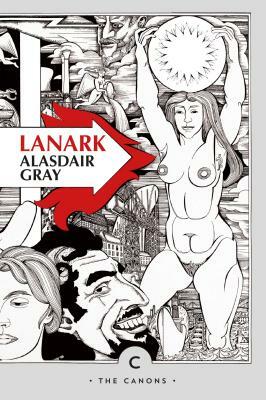
I was going to start my review of Lanark, considered by many to be a landmark of literature, by saying it has nothing to offer women. Its female characters are either cardboard creatures or sex objects or both. Its male protagonist fantasizes as a boy about raping girls. Its cover, with drawings by Gray, has a total of six naked women and one clothed man. (The rest of the figures are heads.) I was going to start with this (in fact, I have) until I came across a review in The Guardian from 2019 by Sarah Detum that calls it superb and talks about how clearly it sees how men regard women. But was it looking at that or exhibiting it? I’m not sure. And I don’t think that was Gray’s purpose. And I hope Detum isn’t right, because if so, it’s a depressing thought for most women.
The novel is broken into four parts and starts with Part 3. Then it breaks off into an apparently unrelated (but it isn’t) story, Parts 1 and 2, before returning to the original story in Part 4.
The novel begins in a city that has no sunlight. The protagonist, Lanark, is told it’s because developers have built the buildings so high up that light can only be seen for a few minutes at dawn. The city, Unthank, is an allegory for hell. Lanark can’t remember his past, and everyone else seems to spend their time hanging out in bars. Lanark can’t even get laid, despite ogling every woman he sees. What fresh hell is this?
I haven’t mentioned much of the science fiction/fantasy spin that seemed to fascinate critics in 1981, but that’s not unusual now. Of course, there’s the no-sun, but also people are developing weird diseases. Lanark begins getting dragon skin, where his skin turns black and scaly. And a woman has a mouth that talks appearing on her arm. I have to confess that this stuff seemed childish to me or like Gray took too much LSD when he was younger.
Lanark finally decides to make an end of it and drown himself in the sea. When he wakes up, he’s in an institute in an entirely different world. There, a seer begins telling him a story, set in post-World War II Glasgow, about Duncan Thaw (Part 1!).
The two sections about Duncan follow him through boyhood to young manhood. He is a stubborn person with his own ideas about what he wants to do, so he’s always butting up against authority figures. He finally begins studying to be an artist.
None of the sci-fi/fantasy elements exist in these two parts, and I found them the most readable. But Duncan is also the character with no social skills who fantasizes about raping women and never gets laid. What fresh hell is this again? (He gets a girl in the end. I can only wonder about her taste.)
Although the writing is such that I felt the novel was clipping along fairly well, it was when the book gets to Part 4 and returns to Unthank that I suddenly realized I had no interest in continuing it, in fact was dreading the return to Unthank despite knowing that most of the plot was in the last part of the book. That made me look around a bit to see if there was even one critic who agreed with me instead of gushing about what a masterpiece it was. (I was thinking maybe it was too dated.) Thank god for Jim Crowley of The New York Times, who, although largely complimentary, says, “The longer the book goes on, the more rapidly its magic leaks away,” (I didn’t think it had any) and calls its structure a Mobius strip.
Frankly, by then I was done, 200 pages from the end. Yes, it didn’t seem right to repay the effort it took to get that far by not finishing, but that’s what I did.
Lots of reviews called this novel playful, but to me it seemed distasteful and heavy. As for any magic it may have, that was overwhelmed for me by its misogyny.
Related Posts
The Fishermen
Snow Country
The Man in the High Castle

 What? Me Read?