Day 494: A View of the Harbour

Cover for A View of the HarborElizabeth Taylor was a mid-twentieth century writer who was interested in the realistic depiction of ordinary lives, particularly those of the working class. In A View of the Harbour, she provides glimpses into the lives of residents along the harbor of a shabby seaside village in post-World War II England.

Newby has seen better days. The trendy tourist area has moved away around the point, and all that is left aside from a few houses are a wax museum, a pub, a small store, a closed-down fun fair, and a lighthouse.

The main characters of this novel are Beth and Robert, a married couple, and Beth’s longtime friend Tory, recently divorced. Beth labors under the delusion that she is observant, but most of her focus is on her writing, as she is an author. Toward her family she is myopic. She doesn’t see when her five-year-old daughter Stevie is manipulating her, and she pays very little attention to her older daughter, Prudence, or to her husband. All family drama provides fodder for her prose.

Most people in town seem to think Prudence is slow, but she has noticed something that others haven’t—that her father is secretly visiting Tory.

Tory is torn between her feelings for Robert and her loyalty to Beth. She mostly seems to be at loose ends, however. She still cares for her ex-husband Teddy and makes a point of stopping in to see him if she is in London. In Newby she flirts with Bertram, a retired naval officer with ambitions to be a painter but little talent, and dallies with Robert.

Loneliness is a strong theme of this novel. Tory is clearly lonely, even though she is beautiful and has no trouble attracting attention. The attention she wants, from Teddy, is not available. Lily is a recent widow who goes to the pub nightly for companionship. She is timid and terrified of the walk home in the dark. The proprietor of the wax museum, she is afraid to pass the figures on the way up to her flat. The brief attention she gets from Bertram ends unfortunately.

Maisie, the hard-working daughter of invalid Mrs. Bracey, manages to attract Eddie, the boarder, but Mrs. Bracey is immediately jealous of the distraction of Maisie’s attention. Mrs. Bracey is a complex character. We have sympathy for her because she is paralyzed, but she has a terrible tongue and is a vicious gossip. She easily finds a way to squash Maisie’s romance.

Taylor’s characters are too realistic to be entirely likable, although Beth is less at fault than Robert or Tory. I found Maisie and Prudence the most sympathetic of the characters.

Taylor is highly regarded but relatively unknown because she was overshadowed in her time by the more famous Elizabeth Taylor. Her writing is observant of the small details of life. Although there is not much humor in the novel, Tory’s letters from her young son at school are believable and funny. My overall impression of the novel is that the lives of its characters are as sad and dilapidated as the village.

Day 488: As I Lay Dying

as-i-lay-dyingAs I Lay Dying is the first Faulkner novel set in the fictional Yoknapatawpha County, about the death of Addie Bundren and the efforts of her family to cart her body to Jefferson, Mississippi, for burial. As an early Faulkner work, it is one of the first in his experiments with stream of consciousness and is unusual in that its plot is conveyed solely through the thoughts of its many narrators.

At the beginning of the novel, Addie Bundren is dying. Her son Cash is building her coffin right outside her window while she watches. Her husband Anse and sons Darl and Jewell are discussing whether Darl and Jewell should go off to work a job that will earn $3 so close to the time of her death.

The plot is fairly simple—they go, she dies before they get back, there is a big storm that washes out the bridge, and the whole family takes her with great difficulty to Jefferson, trying to find a way to get across the river. The accomplishment of the novel is in revealing the complex relationships among the family members from the sometimes incoherent thoughts of themselves and some of the people they encounter on their journey.

This is a dark and pessimistic novel. Although its characters are uneducated, rough, and bluntly spoken, some of them, particularly Darl, have unexpected sophisticated and even poetic thoughts. On the other hand, there is Anse, shiftless and selfish, but stubborn as the dickens when he makes up his mind to do something.

Although Addie made Anse promise to bury her in Jefferson almost as punishment for the life she hated, it is not clear whether his new teeth or his promise is the reason for the trip. On the road, there are several occasions where his determination not to be “beholden” puts his family to major inconvenience or even danger, yet on another occasion he is outraged that his neighbor refuses the use of his mules for an attempt to cross the river that results in the death of Anse’s own  mules.

We don’t hear much directly from Addie. As Cash builds the coffin she is a staring presence who doesn’t utter a sound. She has only one chapter to herself, in which she reveals her true disdain for her husband and children except for her son Jewell, the fruit of an illicit affair. Why she married Anse in the first place is not entirely clear, except that she hated her life as a schoolteacher.

The trials that the family must face to get to Jefferson are almost epic, but for what? Addie makes clear that her wish was malicious. Anse has ulterior motives. Yet Jewell is driven to Herculean efforts and loses the only thing he loves, Anse’s stubbornness nearly makes Cash lose his leg, and Darl ends up perpetrating an infamous act and being committed. The young boy Vardaman is traumatized on several occasions, and in town the only daughter, Dewey Dell, is cruelly duped.

Some of the themes of this novel are those of selfhood and existence, the contrast between spoken words and thoughts, the treatment of different social classes, and the irony of extraordinary but pointless acts. The ending makes the pointlessness clear by its almost comic mundanity.

Although this novel has echoes of characters who will appear in later novels—mentions of Snopes, Quick, the Tulls, and other characters—it has none of the bleak humor of the Snopes trilogy. It is widely regarded, though, as one of Faulkner’s most powerful novels and as a vivid example of the then new stylistic techniques of Modernism.

Day 430: The Mansion

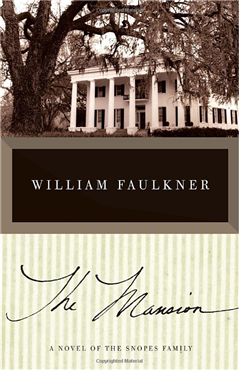
Cover for The MansionBest Book of the Week!

The Mansion is the compelling final novel in Faulkner’s Snopes Trilogy, a series remarkable for the way Faulkner is able to focus the activity on a character, Flem Snopes, who is less and less present in each novel. Told again by multiple narrators, each unreliable in his own way (they are all male), the story’s truth is one we don’t begin to really understand until the final omniscient chapters.

This last novel concludes the events of the previous two and in many ways reinterprets them. It begins with Mink Snopes, serving 20 years for a murder he committed in The Hamlet. This event, not so important in the first book except for demonstrating the sheer cussedness of the Snopes clan, becomes the focus of the third book. The Town related how Mink paid no attention to his own murder trial, simply waiting for his powerful cousin Flem to arrive and get him out of his mess. But Flem never arrived, respectability having bitten him by then, and Mink went to jail vowing to kill Flem when he got out.

The beginning of The Mansion returns us back a few years in the events covered by The Town to when Mink is two years from freedom, having rigorously followed the advice he was given when he went in, to do everything he is told to do and not try to escape. Mink has been concentrating all this time on one thing, getting out and having his revenge.

As he is also a Snopes, Flem knows this, so he frames another cousin, Montgomery Ward Snopes, for an offense that is worse than the one Montgomery actually committed, to get him in to the penitentiary. Then Flem pays Montgomery to convince Mink that Flem is helping him escape, further humiliating Mink by getting him to make the attempt in a dress, and then turning him in during the attempt. Mink earns himself twenty more years in the pen–or Flem earns it for him.

The middle portion of the novel focuses on Linda Snopes, Eula’s daughter, who thinks Flem is her father, and her relationship with the upright Gavin Stevens. Stevens helped her escape Jefferson in The Town, and the largest portion of The Mansion covers her life before and after her return to Jefferson from a more exotic life in New York City. Despite her willingness, Stevens refuses to marry her because of the 20 years difference in their ages. She embarks on an apparently naïve and bumbling career of good works.

Finally, the novel comes back to Mink, as he unexpectedly learns he may be eligible for parole two years early, if only he can find a relative to sign for him. His wife died years ago, his children are long dispersed, but a relative does sign for him, Linda Snopes. The novel builds to a climax after his release, following Mink as he tries to get his final revenge against Linda’s father Flem and Gavin Stevens tries to prevent it.

I think the achievement this trilogy represents is astounding, written as if it were gossip told around an old country store (and later in Gavin Stevens’ law office), centering on one man but leaving that man an enigma, almost a ghost in his own life. Events are told and retold, interpreted and reinterpreted, and so this “oral” history of Faulkner’s fictional county in Mississippi is created.

Day 403: The Town

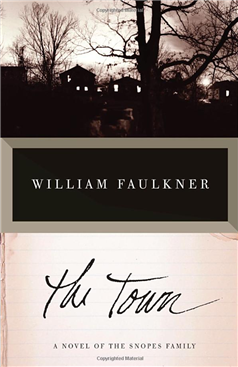
Cover for The TownThe Town is the second of Faulkner’s “Snopes” novels about the rise to power of Flem Snopes in Jefferson, Mississippi. Written in a style that is remindful of a bunch of old Southern men sitting on the porch swapping stories, it is narrated by three different alternating voices. As a pioneer in novels with multiple narrators, Faulkner is a master.

One of the narrators is a character we met already in The Hamlet, V. K. Ratliff, the itinerant sewing machine salesman who is most knowledgeable about Snopes’ true character, having been deeply scorched by him. Ratliff enlists the Jefferson city attorney, Gavin Stevens, in his observations of Snopes. The third narrator is Charles Mallison, Stevens’ nephew, who tells us himself that he wasn’t even alive during the times of his first tales but was told the stories by his cousin Gowan.

The novel covers the events of nearly 20 years, from the arrival of the Snopes family in Jefferson to the events shortly following the death of Flem’s wife Eula. Although some of the events are tragic, the tone of The Town is more comic than that of The Hamlet, perhaps because the lives of the folks in Jefferson are not as grim as those of the poor sharecroppers in the first novel.

The novel focuses first on the young Gavin’s infatuation with Eula Snopes. Rumor has it that Snopes’ appointment as power-plant supervisor–highlighted by his attempted theft of all the plant’s brass fixtures accompanied by an effort to frame the plant’s two black firemen for the theft–is in return for him closing his eyes to his wife Eula’s affair with Manfred de Spain, the town’s mayor. Young Gavin, newly returned from university at the time, is incensed by this rumor and determined to protect Mrs. Snopes’ reputation. Later, as Eula’s daughter Linda grows up, Gavin tries to save her from “Snopesism” by helping educate her and trying to get her a place in an eastern university.

These two novels are fascinating because of Faulkner’s ability to make central a character who barely has a line of dialogue in either book. He effectively makes Snopes the major presence in the novels by having the other characters observe the results of his actions while endlessly speculating about what he actually does and why he does it. As always with Faulkner, the prose is beautiful.

Day 383: The Hamlet

Cover for The HamletWhen I got into The Hamlet a bit, I realized that a bastardized version of it had been released as a movie years ago called The Long, Hot Summer. But Paul Newman’s charming rascal is not at all the same animal as his original, Flem Snopes, a despicable man who rises in life using chicanery, cheating, and blackmail to wrest what he can from the poorest of the poor.

The Hamlet is part of a trilogy of novels about the history of the fictional Yoknapatawpha County, Mississippi, beginning shortly after Reconstruction. In particular, it is about the rise of Snopes, the son of an impoverished sharecropper. It begins when Jody Varner, the son of Frenchman’s Bend’s most powerful citizen, Will Varner, leases a property to Snopes’s father Ab, suspected of being a barn-burner. Jody thinks he’ll be able to cheat Snopes out of his yearly crop by alluding to his alleged crimes at the appropriate time. But soon he is more inclined to fear that Snopes will burn him out, so he offers Snopes’s son Flem a job as clerk in the Varner store as insurance.

Soon Jody has lost his own position as manager of the store to Flem Snopes and Snopes has apparently taken over Jody’s standing with his own father. Somehow Snopes begins accruing valuable property and gives away many of the jobs in the village, over which Will Varner has control, to Snopes cousins, whether they are capable of doing them or not. Eventually, he makes a deal to marry Will Varner’s young daughter, the voluptuous Eula.

Life among the Frenchman’s Creek sharecroppers is grim, and the story of the rise of this gray, tight-lipped, cold man is told through a limited third-person narration that moves from person to person. This narrative style creates a sort of plural viewpoint of all the village folk and is combined with the intelligent observations of itinerant sewing-machine salesman V.K. Ratliff, who alertly follows Snopes’s maneuvers and understands all his cheats–or so he thinks.

This novel is created from a series of tales, and it is really about how the tales of an area form its history. It is elegantly written, reflecting a formidable intelligence and education, and is sometimes grimly comic. It comments on the decay of the South in the aftermath of the American Civil War and the Reconstruction, as Frenchman’s Bend is a run-down little village built on the ruins of a once-stately plantation. The legend of gold supposedly buried on the grounds of the plantation plays a pivotal part in the story.