Review 1861: Great Circle

After getting fired from a hit TV series with a cult following for damaging the brand, Hadley Baxter thinks her career might be over. However, she is approached about starring in an independent film about the life of Marian Graves, an early aviator who disappeared in 1950 while attempting to circumnavigate the earth via the poles.

Although the novel sometimes follows Hadley as she tries to figure herself out, its main focus is on Marian and her twin brother, Jamie. As babies, they are on their father’s ship when it sinks, and because he chooses to save them rather than go down with his ship, he serves time in jail. They are raised in Missoula, Montana, by their alcoholic artist uncle, who lets them run wild.

When a pair of barnstormers stop over, Marian is bit by the flying bug. She is already doing men’s work, so she begins working harder to earn enough for flying lessons. But no one will teach her until she meets Barclay Macqueen, a bootlegger.

Great Circle is a broad-ranging novel that takes us from bootlegging in the West to serving mining camps in Alaska to ferrying planes in England before the flight around the world. I found Marian’s story more compelling than Hadley’s but still found the novel fascinating. Since I read it, it has been nominated for the Booker prize, so is part of my project.

Related Posts

West with the Night

Circling the Sun

Straight on Till Morning

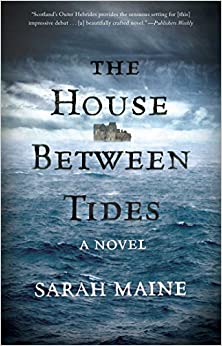
Review 1827: The House Between Tides

A house on an island separated from the main island by a causeway only open at low tide is the focus of this novel set in the Outer Hebrides. It’s a dual timeframe novel, which format I have to admit I am tiring of.

In 1910, Beatrice Blake arrives with her new husband, the famous artist Theo Blake, to his home on the island for the summer. In 2010, Hetty Devereaux has inherited the house and is considering turning it into a hotel.

Neither woman has made a good choice of partner. Theo thought Beatrice would drive away his thoughts of his first love Mailí but realizes very soon that she cannot compete and begins to neglect her. Hetty’s fiancé Simon has forced his way into her plans and has hired people to do surveys and look into such issues as financing before Hetty has even seen the property.

Both of these stories deal with how the property should be handled and how much claim the crofters have to the island, but in 2010, bones have been discovered under the foundation of the house. The 1910 story eventually reveals whose bones they are.

I found this novel interesting, and the descriptions of the island are lovely. However, even though I saw complaints about Hetty’s lack of backbone, I was more interested in the modern story than the older one. Possibly it’s because it was obvious to me why Theo is so interested in his factor’s son, Cameron, and also because I wasn’t interested in Beatrice’s romance. The final twist was obvious to me, although I didn’t figure out who the bones belonged to.

This novel is atmospheric but a little hackneyed, I think.

Related Posts

The Forgotten Garden

The Sea House

When They Lay Bare

Review 1820: The Drowning Kind

Jax’s sister Lex has been calling a lot lately. Jax knows that means Lex is off her meds and in one of her manic phases. So, Jax, who has been estranged from her sister, doesn’t answer the phone. Lex’s messages are cryptic and incomprehensible, something about measurements. Later, Jax’s aunt calls to tell her that Lex is dead, drowned in the spring-fed pool behind her house. Since Lex has spent much of her life in the pool, suicide is assumed.

Back in Vermont for the funeral, Jax finds the family home a wreck, filled with notes and other documents Lex collected about the history of the house. The house had been their grandmother’s, the place where the two sisters spent every summer. One reason Jax was angry was because the house was left to Lex, whom she believes everyone liked best. Jax decides to try to find out what happened to Lex, what Lex discovered. It all seems to center around the pool, which has a local reputation of being cursed. Several people have drowned in it.

In 1929, Ethel and Will Monroe take a romantic trip to a new hotel next to a spring-fed pool. The spring has a reputation for granting wishes and healing. Ethel has been trying to conceive, so she goes to the pool and says she will give anything to have a child.

Back in 2019, Jax finds wet footprints in the house and catches glimpses of something in the pool. She also figures out that Lex has been measuring its depth, although the girls have always been told it was bottomless.

In general, this is a nice, creepy story, although I felt that maybe it signaled the truth of the pool a little too early. Of course, that adds to the suspense, as the reader knows more than Jax does. Another good one for McMahon.

The Invited

Burntown

The Winter People

Review 1774: The Silent Companions

In the mid-1800’s, a badly burned Elsie Bainbridge is confined to an asylum. She is said to be dangerous. She cannot speak and has not been able to tell what happened to her. Her doctor suggests that writing her version may save her from being executed.

In 1635, Josiah and Anne Bainbridge excitedly begin preparing for the arrival at their home, The Bridge, of King Charles and Queen Henrietta Maria. Josiah decides, however, that their daughter Hetta will not participate in the festivities. Hetta was born with a deformed tongue, and Anne blames herself, because she took herbs to conceive when her doctors said she could not.

Elsie’s written account begins when she arrives at The Bridge to live there after her husband’s unexpected death. She finds the house decrepit and the people in the neighborhood unwelcoming. Then she and her companion, Sarah, find the silent companions, some wooden cut-out figures that appear lifelike.

This novel seemed as if it was going to be a good old creep fest. It was certainly a ghost story, but I prefer something—I was going to say that could actually happen, but that’s silly. I guess I prefer something more subtle without freakish gory events.

As far as the approach taken to the material is concerned, although all the chapters except the ones set in the asylum are supposed to be written, the later ones as Elsie’s account and the earlier as a diary, neither of them are convincing as such.

Although I make a final caveat that I don’t believe the doctor’s treatment reflects psychiatric treatment of the times, I am not saying I disliked this novel. I thought both stories were compelling, but not so much so that I didn’t think of these things while I was reading it.

The Poison Thread

This House Is Haunted

The Séance

Review 1746: The Hand That First Held Mine

Best of Ten!

It’s the mid-1950’s, and Lexie Sinclair has already made arrangements to leave her family home in Devon when she meets Innes Kent. He is a stylish magazine editor whose car has broken down on their road. When she tells him she is coming to London, he asks her to look him up. Instead, he looks her up.

Lexie takes up an exciting life as part of the Soho art scene. She and Innes are the loves of each other’s lives even though he is married. His wife has, however, taught her daughter Margo to hate Lexie even though she and Innes have been split up for years.

In present-day London, Elina and Ted have just had a baby. The birth was difficult, and Elina is having a hard time coping with the pressures of motherhood. At the same time, Ted, whose memory is notoriously poor, has begun having flashes of memory that do not correspond to what he understands of his life. Slowly, these two stories connect.

Maggie O’Farrell is always wonderful, I find, but this novel had me sobbing. It is beautiful and tragic as it explores the themes of motherhood and family secrets.

The Vanishing Act of Esme Lennox

After You’d Gone

Instructions for a Heat Wave

Review 1536: The Vanishing Act of Esme Lennox

Best of Ten!
I’m late to discover Maggie O’Farrell, but better late than never. I’ve read a few books by her now, and she just keeps getting better and better.

Iris Lockhart is contacted by a mental hospital, which wants to find out if she can offer a home to her great aunt, Esme, who has been incarcerated there for more than 60 years. The problem is that Iris has never heard of Esme and believes her grandmother to be an only child.

Her mother now lives in Australia and has never heard of Esme, either. When Iris tries to discuss Esme with her grandmother, Katherine, who is suffering from Alzheimers, she gets a fractured response that implies Esme is her sister. In particular, she says, “She wouldn’t let go of the baby.”

Through third-person narration from Iris’s point of view, Esme’s stream of consciousness memories, and Katherine’s more fractured ones, we learn how it came to pass that vibrant and unconventional Esme was abandoned in the hospital from the age of 16. Iris is shocked to learn that Esme was incarcerated for such outrages as insisting on keeping her hair long and dancing in her dead mother’s clothes. She learns that at the time women could be committed on the signature of one doctor.

This is a shattering, sad story about a girl whose life is stolen because she doesn’t fit in. It is spellbinding as it draws you along to learn Esme’s story. This is also fascinating tale about how sisterly love turns to jealousy and anger.

Related Posts

After You’d Gone

Instructions for a Heatwave

This Must Be the Place

Review 1519: Perdita

On holiday from his university job, Garth Hellyer takes on a task for the Longevity Project by calling on Marged Brice, who is supposed to be 134 years old. Garth can hardly believe she can be as old as she says she is, and although she has a birth certificate, she has no other form of identification. Marged says she would like to die, but she has to find someone to take care of Perdita.

Marged gives Garth her journals, and he begins to read the fascinating story of a girl attuned to nature, in particular to Georgian Bay off her home on the Bruce Peninsula of Ontario. The journals begin in 1887 and tell the story of the girl’s love for the bay and for George Stewart, an artist.

Meanwhile, Garth becomes reaquainted with Clare, a neighbor on the bay. She, it appears, has cared for him since they were teenagers, but he has never paid attention to her.

This novel is atmospheric with a strong sense of place, particularly the older story, and interesting, although I sometimes wondered when we would get to Perdita. It’s a long novel at 400+ pages, and it takes a long time to get to Perdita, but it kept my interest. If anything, the explanation of Perdita seemed a little unclear. I almost think I would prefer this as a ghost story, which it is not. It does have a faint ecological message.

I’ve said I’m getting tired of the split timeframe novel, but it didn’t bother me for this one and was, in fact, necessary. On the other hand, the historical portion of the novel was definitely the more important.

Related Posts

The Luminous Sea

Mortal Love

Melmoth

Review 1457: The Alice Network

I would estimate that 90% of the recent historical novels I’ve read in the last two years—and I’ve read a lot of them—are dual timeframe novels. Although I have read some excellent ones (The Weight of Ink comes to mind), I’m beginning to feel that they often indicate laziness on the author’s part. Why write a carefully researched novel about one period when you can write two hastily researched ones?

In post-World War II England, Charlie is on her way to Switzerland to a clinic for unmarried pregnant women when she ditches her mother to try to search out what became of her cousin Rose during the war. This all sounds very well, but the flippant first-person narrative style undermines everything serious about this section, turning it into, well, a historical romance.

She finds Eve, whose name as a preparer was on the reports her father received about Rose. And what are the odds that Eve is going to handle a report that mentions a name important to both her and Rose’s fates? Not too likely, I’m guessing, but that’s what happens.

In any case, then we plunge into the story of Eve, a spy during World War I, and back and forth we go for a book that is about 100 pages longer than it should be and very repetitive.

Worse, some of the detail and conversations, especially in the spy section, seem unlikely. I felt as if the characters were being put through their paces in benefit of the plot rather than evolving more organically. Characters are given traits to round them out, but these traits are just sort of thrown into the mix. For example, Charlie is supposedly a math whiz, but the most complicated thing she does is figure a tip or quote the Pythagorean Theorum (which I learned in 7th grade, and I think kids learn even earlier now). Neither is exactly high mathematics.

I know this book was very popular, and I think the subject matter is interesting, but I am not a fan of the execution of this novel. I wasn’t that drawn in by Manhattan Beach, but compared to this and some of the other World War II-based novels I’ve read lately, it was a masterpiece.

Related Posts

Lilac Girls

Salt to the Sea

Manhattan Beach

Review 1382: The Sport of Kings

To paraphrase Sophia Brownrigg, a reviewer from The Guardian, The Sport of Kings is about horse racing like Moby Dick is about whales. It is ambitious—attempting to tell the history of Kentucky through that of two families—one white, wealthy, elitist, and bigotted, the other black, poor, and beleagered. It is sometimes magnificent in its prose and sometimes overblown. It is Southern Gothic, focussing on the ramifications of slavery and bigotry.

Henry Forge is the only son of a proud Kentucky family. As a youngster, he was brutalized by his father and lectured about his place in history. We have some sympathy with him until, in his teens, he commits an unforgivable act.

He rebels against his father by turning the family corn plantation into a horse farm, but the nut doesn’t fall far from the tree. When his wife leaves him, his daughter is nine. He takes his daughter out of school and teaches her himself, all his lessons revolving around horses and breeding and including much out-of-date or just plain incorrect information. He is as elitist as his father—and worse.

Henrietta grows up with a talent for working with horses and a keen, cold intelligence. She also likes to pick up men for sex. Then she meets Allmon Shaughnessy, the new African-American groom, fresh from a prison program for working with horses.

Up to that point, the novel seems mostly a multigenerational saga, occasionally discoursing on geology, genetics, or history in the interludes. But after that it becomes wildly overblown at times, reminding me of the characteristics of Moby Dick that I disliked.

Like one other reader on Goodreads, every time I picked up this novel I wanted it to end. It is about deeply unpleasant characters; the least at fault—Allmon—whines his way through the novel. Its long asides are often irritating. It is sometimes beautiful and very dark, but it is often annoying.

Last year I read an essay—I can’t remember who wrote it—complaining about what I call “books only men like,” usually the ones that win awards. (I read this one for my James Tait Black prize project.) This essay commented that because a certain type of book gets attention and wins awards, now some women are beginning to write like men, using All the Birds, Singing as an example. I did not agree with the writer’s example but couldn’t help thinking of this essay while I read this novel.

Related Posts

Mother of Pearl

Wise Blood

Horse Heaven

Review 1370: Unsheltered

Unusual for Barbara Kingsolver, Unsheltered is a dual time-frame novel, changing centuries every other chapter. The setting is the same, though, the odd town of Vineland, New Jersey.

In the present time, Willa’s family has discovered that the house she inherited in Vineland is no asset. Both she and her husband, Iano, have recently lost their jobs through no fault of their own. Willa’s magazine failed, and so did the college in West Virginia where Iano was tenured. When he finally got hired in an inferior level for a one-year position, the inherited house nearby had seemed like a godsend. But now she has found that it is falling down, with part of the old house not even on a foundation, and too expensive to fix.

To make matters worse, they are the only people in the family who offered to take in Iano’s ornery dying father. Their daughter, Tig, has also unexpectedly returned from a year in Cuba. Finally, their son Zeke’s partner has committed suicide, leaving him in an apartment he can’t afford with a baby son. Willa and Iano offer him a place to stay, but what he wants is to leave his son with them.

In mid-19th century Vineland, Thatcher Greenwood has moved his new bride, Rose, back into the house she grew up in. They are also living with her mother, Aurelia, and young sister, Polly. Thatcher is delighted with his wife but is soon to find that they don’t share the same values. His position as a science teacher pays very little, but Rose and her mother continue to demand elegancies that belong to their former life, before Rose’s father went broke.

Next door, Thatcher meets Mary Treat. Rose knows her as the poor woman who was deserted by her husband, but Thatcher learns that she is a scientist, whose correspondents include Charles Darwin.

Vineland was founded as a sort of utopia by Captain Landis, but Thatcher begins to see the cracks in that utopia. One of them is his employer, who will not allow him to teach anything more than rote memorization and hates most recent scientific theories, particularly Darwin’s.

Both of these main characters are concerned with keeping shelter over their families’ heads, but while Kingsolver links the stories through Willa’s growing interest in Mary Treat, she is also able to draw many parallels between the two times. The present uncertainty in the poor economy of the Eastern Seaboard she compares to the uncertainty in the lives of Vineland’s population, of workers promised much by a man who can repossess their property if they fail. An unmistakable political figure in the present day, nicknamed by Willa The Bullhorn, bears a metaphorical resemblance to Landis, who is essentially a conman. The main characters’ housing insecurity stands for the insecurity of the entire population as a result of climate change and the death of the American dream. Kingsolver has lots to talk about.

I’m not so sure how much I liked the dual narrative. I was far more interested in the present-time story than I was in the older one. Kingsolver seemed to want to write about Mary Treat, but Treat features more as an important secondary character. And I have to say that some of Willa’s discussions with her daughter and her ruminations about those discussions border on the didactic (which we know has been a fault of Kingsolver in some other books).

Still, it is great to have another book out by Kingsolver. She can be hit or miss, but I have very fond memories of some of her books.

Related Posts

The Lacuna

The Weight of Ink

Maddaddam