Day 1034: Ulverton

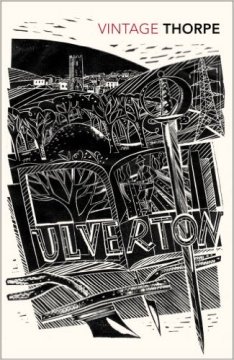
Cover for UlvertonBest Book of the Week!
We’re now more familiar with novels written as related short stories, but Ulverton was written in 1992 and may be the first novel of this kind. The novel covers 300 years of English history and is set in one place, the fictional village of Ulverton. Other hallmarks of this unusual novel are that each chapter is written in a distinctly different voice and the chapters are written in different formats, from a tale told in an inn to the captions from a photographic display to the script of a documentary.

In 1650, the novel opens with the return of Gabby Cobbold from the Cromwellian wars. He meets the narrator, a shepherd named William, on his way home, but William does not have the courage to tell him that his wife, Anne, thinking he was dead, has remarried Thomas Walters. Gabby explains that he was away earning money to support the farm. Gabby disappears, and William is sure that Thomas and Anne killed him. But three hundred years later, Gabby gets his own back against a descendent of Thomas.

In 1689, the foolish Reverend Brazier tells the story of a strange night out on the downs, when he, William Scablehorne, and Simon Kistle were making their way through a snowstorm. As related in his sermon, they were apparently attacked by the devil and Mr. Kistle went mad.

Diary entries made in 1717 reveal a farmer’s preoccupation with improvements to his property and begetting an heir. Since his wife is ill, he does not touch her but begins trying to impregnate the maid.

In 1743, Mrs. Chalmers writes letters to her lover while shut away after childbed. Apparently having read her letters, her husband gets his doctor to keep her isolated longer.

And so it goes, stopping in about every 30 years, so that we sometimes hear of characters again. Through time, names are repeated and the story of incidents changes.

On occasion I had problems with the vernacular, although I tried to stick with it. The most difficult stories for me were the 1775 letters of Sarah Shail to her son and one side of the 1887 conversation between a man plowing and two boys. Sarah Shail is illiterate and is dictating her letters to John Pounds. However, this chapter has its own humor as Sarah is writing to her son Francis, who apparently answers her abusively, to the indignation of Pounds, who begins adding threats to the letters. Pounds’ spelling is so bad, though, that the letters are sometimes incomprehensible. In the case of the plowman, his dialect is so thick that I kept rereading parts of it but was unable to understand very much.

This was just one chapter, though. Overall, I found this novel deeply original and interesting. The countryside is so integral to the story that it features almost as a character. The writing is lovely, and the novel contains a great deal of drama and humor.

Related Posts

The Wake

Harvest

The Quickening Maze


Day 984: A Tale for the Time Being

Cover for A Tale for the Time BeingMonths after the Japanese tsunami, Ruth, of Japanese descent, finds a barnacle-covered package on the beach of the island in British Columbia where she lives. The package contains a Hello Kitty box with the diary of a young Japanese girl.

Ruth gets involved in reading this diary. The girl, Nao, tells a difficult story of having been raised in Sunnyvale, California, until her father lost his job at a technology company. The family was forced to return to Japan, where her father has been unable to find work and is suicidal. Nao, seen as an outsider by her classmates, is viciously bullied. Nao, too, is considering suicide.

The only bright spot in the girl’s life seems to be Jiko, her 104-year-old great grandmother, a Zen Buddhist nun. Jiko has taught Nao a few of the fundamentals of Zen Buddhism, which help support her. Nao has stated an intention of writing about Jiko’s life, but she actually writes about whatever occurs to her, including the story of her uncle, a World War II kamikaze pilot.

This story is punctuated with scenes from Ruth’s quiet life on a small island with her husband Oliver, a biologist. Both stories dip into philosophy, Buddhist beliefs, and even a little magical realism. Ruth and Oliver become involved in Nao’s story and wonder if she committed suicide, if she survived the tsunami, and where she is.

At first I resisted this novel a bit. I probably wouldn’t have read it if it was not on my Man Booker Prize list. I wasn’t completely convinced by Nao’s voice, and I felt that the story was a way to sneak in lessons about Buddhist teachings. Eventually, though, I got sucked in and became just as interested in Nao’s fate as Ruth was.

However, in tackling its many subjects—suicide, bullying, the trash in the ocean, the nature of time, the tsunami, World War II, just to name a few—I sometimes felt this novel was all over the place. It is entertaining but kind of mind boggling.

Related Posts

The Brief Wondrous Life of Oscar Wao

We Need New Names

The Life and Death of Sophie Stark

Day 953: The Glass Room

Cover for The Glass RoomThe Glass Room is one of the books I’m reading for my Walter Scott Prize project. The novel is inspired by a real house in the Czech Republic designed by Mies van der Rohe. Most of the reviews of the novel, as well as the novel itself, have spent some time describing this house, and although architectural elevations appear before each section of the book, it helps to look at the pictures online when you’re trying to visualize the house.

Liesel and Viktor Landauer are recently married and have decided to build a modern home on a piece of property given to them by Liesel’s parents in the newly formed country of Czechoslovakia. Viktor wants a house that is open and will have no secrets, one of the ironies of a plot with many that I started to think of as mirrors. Viktor is excited at the beginning of what he sees as modern, changing times in the formation of the new country. But of course Czechoslovakia will not be in charge of itself for long, and in fact now no longer exists. Then we have the irony of the house itself, built for no secrets, that harbors many.

Viktor and Liesel’s marriage and day-to-day life are hardly at all the focus of this novel. We see Viktor getting a little annoyed at the depth of Liesel’s involvement with building and decorating the house, but otherwise Mawer actually spends very little time on them together. Instead, he focuses on their relationships with other people, Viktor’s with his mistress Kata and Liesel with her friend Hana. But World War II looms ever closer and eventually the family must leave the country, as Viktor is Jewish.

The book is divided almost exactly in half, the first half devoted to the building of the house and its existence as a family home. The second half explores its use by the different political entities that take it over, when it is never a family home, another mirror. First, it is a Nazi laboratory for attempting to identify physical characteristics of Jews and Slavs. During this time, Hana gets involved in a dangerous affair with one of the scientists. Next, it is a horse stable for Russian cavalry, then a physiotherapy lab for polio victims, and finally a museum.

The huge windowed glass room that makes up the living room, dining area, sitting area, and music room has at its heart a stone wall made of onyx. In the evening sunshine this wall glows and colors the room bright red. I think this is a metaphor—the clean, modern, uncluttered structure, one that may seem cold, is taken over by the unanticipated heart of the house, this red, for passion. I’m saying this clumsily, but one of Mawer’s focuses is the eroticism that is repeatedly evoked in these surroundings, not between Viktor and Liesel, but between other couples. At first, I was confused by why we know almost nothing about Viktor and Liesel together but dwell repeatedly on Viktor’s sexual relationship with Kata. But sex is one of the focuses of this novel, one of its mirrors. For example, in the icy surroundings of the lab designed for the most evil of purposes, Hana makes passionate love with Stahl, who later coldly discards her and even betrays her. Also, there is a tension between the openness of the house and a sense of voyeurism.

This novel was definitely not my favorite of the books I’ve read so far for this project. It is called a novel of ideas, but really it is so detached as to be almost cerebral. Yet, we are repeatedly entertained by descriptions of pubic hair or of how Hana’s labia just show beneath it. I found it unsettling and could understand a bit why the original owners of the house refer to the book as “probably pornography.” It is not pornography, of course, but the family is not buying Mawer’s stance that it’s a fictional story about a real house. They think it’s about them. Or perhaps they are afraid people will think it’s about them.

Despite this detachment from the characters, I still found some scenes toward the end of the novel touching. As for the rest, perhaps Mawer wanted to make readers feel like they were voyeurs. (See? Another mirror—the openness of the house versus voyeurism.) I am not sure, but I could have forgone some of the intense sexuality of this novel. There is another book by Mawer on my list, and I can’t say I’m looking forward to it. (Oh, dear, it just won the Man Booker prize.)

Related Posts

A God in Ruins

Snow Country

Death in Venice

Day 930: Early Warning

Cover for Early WarningEarly Warning is the second in Jane Smiley’s Last Hundred Years trilogy. It continues the story of the Langdon family, picking up in the 1950’s and ending in 1985.

The family, which began with a couple and their children and the occasional appearance of other relatives, expands during this period to grandchildren and eventually their children. As you can imagine, by 1985 we are dealing with many characters.

This is one of my criticisms of the novel. With so many characters, we don’t spend very much time with any, which creates distance from the novel. I already felt this with the first book, and this feeling increases for the second.

But is the purpose of this novel to follow the characters or the main events during these times? It seems to be the second, as we look at the ennui of suburban housewives in the 50’s, the Cold War, the Vietnam War and its associated protests, the counterculture and Jonestown, to name a few. Smiley manages to have at least one family member involved in each of these events or movements, which is quite an accomplishment for one family from Iowa.

Of the Langdon children whose families are the focus of this novel, Frank concentrates most of his attention on business and sexual escapades, while his wife Andie struggles with a feeling of pointlessness and self-absorption. Neither of them pays much attention to their children, except that Frank puposefully fosters competition between his two twin boys, Richie and Michael. All of his children suffer from this upbringing, and the boys are at times truly scary.

Joe is the only Langdon to stay on the farm, and although he was one of my favorite characters in the first book, we don’t see much of him in this one. He and Lois have had some lucky breaks, and the farm is in better financial shape than their neighbors’, but decisions of the Reagan administration make small farms a tough business.

Lillian and Arthur raise a rowdy and happy family in Washington, D.C. But Arthur’s job with the CIA brings him under terrific pressure, and a tragic loss creates ramifications for years. This family has more than its fair share of sorrows.

Claire eventually marries a doctor and settles down in Iowa. But she has selected her husband almost in competition with a friend and eventually regrets her choice.

The novel is saved somewhat at the very end by a touching event linked to the presence of a character who isn’t explained until the end, one who appears in the middle of the book and at intervals throughout. At first I found the introduction of this character confusing, but I figured he had to be a family member, so then it wasn’t too hard to guess who he is.

I will read the final book, but I fear that the distance I feel from the story will only increase.

Related Posts

Some Luck

A Thousand Acres

The All-True Travels and Adventures of Lidie Newton


Day 914: History of the Rain

Cover for History of the RainBest Book of the Week!
The distinctive voice of its narrator is what stands out to me about History of the Rain. But again, I feel as if I may not be able to convey just how wonderful I found this lovely novel.

Ruthie Swain is a young girl bedridden from an illness. In her attic bedroom under a watery skylight she is trying to read her father’s thousands of books. She is also writing a novel to try to understand him. During this effort, she writes about Ireland, her village, and the history of her family, especially about the Impossible Standard. Her story incorporates the mythological heritage of Ireland as well as references to countless literary authors and characters and the eccentric residents of her village.

Ruthie’s mother’s family, she says, evolved from salmon, and her mother first meets her father salmon fishing, and is hooked. But that gets way ahead of the story, which in unchronological order recites the history of her father’s family, the story of the Impossible Standard and his evolution into a poet.

To give a flavor of the novel, here is how Ruthie imagines the first time Ruthie’s father Virgil is invited to dinner at her mother’s house:

“So, how do you like it here?”
“Very much.”
“Good.”
That exhausts the dialog. She realizes she hasn’t folded the napkins and takes hers and begins to press it in halves. Virgil does the same. Both of them are useless at it. Maybe evenness is a thing intolerable to love. Maybe there’s some law, I don’t know. She lines up the halves of hers, runs her forefinger down the crease. When she picks it up the thing is crooked. So is his. She undoes the fold and goes at it again, but the napkin wants to fall into that same line again and does so to spite her, and does so to spite him, or to occupy both with conundrums or to say in the whimsical language of love that the way ahead will not be a straight line.

She doesn’t give up, and he doesn’t give up. And in that is the whole story, for those who read Napkin.

This novel is funny, heartbreaking, and lovely. It is about the loves of reading and poetry and Ireland and life. I loved this book.

Related Posts

Tell the Wolves I’m Home

The Fault in Our Stars

Nora Webster

Day 875: The River of No Return

Cover for The River of No ReturnThe River of No Return was popular a few years ago, but I didn’t get around to reading it until now. The plot combining time travel and romance reminded me of The Time-Traveler’s Wife, which I loved. I found Ridgway’s book not nearly as interesting, though.

Nick Davenport appears to be a wealthy dilettante dabbling in cheese making in 2013, but in 1810, he was Nicholas Falcott, Marquess of Blackdown. While fighting in the Peninsular Wars, he was suddenly thrust forward in time to 2003. There he was picked up by a society of time travelers called the Guild, trained to live in modern times, and given a potload of money to live on. Now, the Guild wants him to travel backward to 1815, something he didn’t even know could be done, and resume his earlier life to carry out a mission for them.

Back in 1815, Julia Percy’s grandfather has just died, leaving her at the mercy of an unknown cousin. Since she was a child, Julia has watched her grandfather play little tricks with time. She is just beginning to realize that she can do it, too. Then her cousin Eamon arrives and begins looking for something, a talisman. Julia eventually realizes that she herself is the talisman.

When Nick arrives back in time, he learns he is to find a representative of a rival time-travel society called the Ofan and kill that person. The Guild has learned that the time period within which they can go forward is moving backward in time, and they think the activities of the Ofan have affected the river of time. The Guild thinks this Ofan member lives in a house neighboring Nick’s, the home of Julia Percy.  But Nick has no intention of killing anyone.

A portion of this novel is more romance novelish than I like, a fairly standard romantic plot with unlikely (for the time) sex scenes. Since I am not a fan of the standard romance novel, this was not a plus for me.

Worse, though, is the theory of time travel and its link with human emotions and monetary exchange, which is scientifically absurd. Audrey Niffenegger’s genetic abnormality is at least faintly believable.

All in all, my reaction was fairly meh. The novel is well written, but I wasn’t particularly interested in most of the characters. I thought Nick was incredibly naive about the Guild and went along with it far too long. An alternate explanation of the moving time horizon seemed immediately obvious to me, although it is not addressed in this novel. Because this novel is clearly designed for a sequel, only the romance plot is resolved.

Related Posts

The Bone Clocks

The Shining Girls

1Q84

Day 852: The Lake House

Cover for The Lake HouseThe Lake House is another of Kate Morton’s enthralling novels about family secrets. It is set in two time periods, 1933 and 2003.

In 1933 Cornwall, Alice Edevane is 16. She loves her life in the woods and gardens of the family estate, Loeanneth, and she spends her time writing stories of romance and mystery. She reads her stories to Ben Munro, an itinerant gardener whom she loves. Her newest one is about a kidnapping, set in her own home.

In 2003, Sadie Sparrow is a police officer on an enforced holiday. She got over-involved in a case, in her partner’s opinion, and went to the media when she thought it was mishandled. Her partner is trying to keep her name out of the subsequent investigation, but he wants her on vacation for a month.

Sadie chooses to visit her grandfather Bertie in Cornwall, where he recently moved after her grandmother’s death. In traipsing around the woods with the dogs, she comes upon the abandoned house at Loeanneth. When she tries to find out about the house, she learns that it was deserted after the disappearance of a little boy, Theo Edevane, who was never found.

Sadie decides she would like to look into the cold case with the help of retired officer Clive Robinson. She tracks down Alice Edevane, now a famous novelist, and writes asking for permission to enter the house. But she hears nothing back.

Alice has always believed she knew what happened to Theo and thinks it is her fault. She has no desire to reopen the investigation, however unofficial. But a frank conversation with her sister Deborah reveals something she didn’t know, which leads her to re-evaluate her belief in what happened long ago. When the persistent Sadie writes again, she agrees to see her.

The story alternates between the investigation in the present and the events leading up to Theo’s disappearance. We see the past events from the points of view of several different characters but mostly from that of Eleanor, Alice’s mother.

I absolutely loved this novel, with one caveat. It is intricately plotted and beautifully written, as are Morton’s other novels. I also found it completely absorbing.

However, the coincidence of what happened to Theo I found a bit much. I can’t explain more, but read it yourself and tell me what you think.

Related Posts

The Distant Hours

The Forgotten Garden

The Secret Keeper

Day 845: The Brief Wondrous Life of Oscar Wao

Cover for The Brief Wondrous Life of Oscar WaoEven after thinking about the novel for some time, I can’t decide whether I liked The Brief Wondrous Life of Oscar Wao. On the one hand, there’s the energy with which it is written and its inventiveness, wedging a portion of the narrative into footnotes that convey some of the most interesting information (a technique used also in The Sunken Cathedral and by such writers as David Foster Wallace). On the other hand, there’s the unrelenting sexism and objectification of women expressed by the principal narrator as well as by other characters. Okay, that’s an important part of the character’s personality rather than an attitude of the author, but I found it disturbing.

Oscar is a misfit. He is a fat, nerdy boy from the Dominican Republic, highly intelligent and well read but unable to interact normally with people, especially girls. He is interested in Star Trek and Tolkien, but even his other geeky friends eventually get girlfriends while he remains alone and still preoccupied with his obsessions. He dreams of being a science fiction writer.

In college at Rutgers he has one reluctant friend. Because Yunior (Díaz’s persona for much of his fiction) is in love with Oscar’s sister Lola, he agrees to be Oscar’s roommate. He tries to get Oscar to exercise and invites him out with friends. But his efforts aren’t sincere, or perhaps it’s more accurate to say that his intentions are mixed, so he eventually gives up on trying to make Oscar more normal.

Of course, Yunior’s perceptions are all colored by his own preoccupation, sex. Although he loves Lola, they break up several times because of his unfaithfulness. Yunior sees Oscar as a young man wanting to get laid. Well, of course he does, but what he really wants is love.

Oscar has grown up with the romance of his sci-fi and fantasy epics. Yes, they are also full of action, but they are in a sense the continuation of the chivalric romances that obsessed another famous character, Don Quixote, and that’s the book this novel reminds me of. Of course, we know from the title that Oscar will die, and we can guess he will die for love. Also like Don Quixote, although the story is ultimately tragic, its tone is comic.

What I found most interesting in this novel was the story of Oscar’s family, for this is an inter-generational saga about the fortunes of his family in the Dominican Republic. In a combination of narrative and footnotes, the novel tells the recent history of the Dominican Republic and especially of the Trujillo regime, where Oscar’s family ran aground.

This time period was also the focus of another book I’ve reviewed, In the Time of Butterflies, which this novel references, along with a lot of other pop culture. I complained of that book that it assumed its readers already understood all about the Trujillo dictatorship. The Brief Wondrous Life of Oscar Wao does a much better job of explaining Dominican history and exposing us to its culture.

Related Posts

In the Time of the Butterflies

Don Quixote

The Sunken Cathedral

Day 838: The Forgotten Room

Cover for The Forgotten RoomThe Forgotten Room is a romance novel, which is not my genre, but it has enough of a focus on family secrets to keep my interest. The novel relates the stories of three romances, set at different times in the same mansion in New York. Written by three romance authors, I suspect that each one wrote one of the stories.

In 1892, Olive Van Allen is employed in the house as a servant, but she is there under false pretenses. The owner of the house, a nouveau-riche businessman named Pratt, hired her father as an architect for the house but then ruined him by refusing to pay him. Olive hopes to find paperwork to prove Pratt owed her father money, but she is distracted by falling madly in love with one of the sons of the house, the artistic Harry Pratt, and stealing meetings with him in his attic studio.

In 1920, Lucy Young takes a job as a secretary at the office of Cromwell, Polk, and Moore, a law office that handles the affairs of the Pratt family. She also takes a room in a boarding house that used to be the Pratt mansion. In addition to the desire for advancement, Lucy hopes to discover in the Pratt papers the connection between the Pratts and her mother and perhaps learn why her mother whispered “Harry” on her death bed. Lucy is also soon torn between two men, her boss, Philip Schuyler, and a handsome art dealer from Charleston, South Carolina, John Ravenel.

In 1944, Kate Schuyler is a doctor serving in a hospital that used to be the Pratt mansion. She gives one of her patients, Captain Cooper Ravenel, her own room in the top of the hospital because the hospital is overcrowded. But she is surprised when Captain Ravenel seems to recognize her and calls her Victorine.

The pleasures in this novel came from trying to figure out how these people are related and what happens to Kate’s mother and grandmother. The tension is supposed to come from whether Kate will be parted from Captain Ravenel, who is engaged to be married to someone else. There’s not much doubt about that, though, and it’s more interesting to find out what secrets kept the other lovers apart.

link to NetgalleyUnfortunately, Olive’s story is based on something a few words could have cleared up and the spitefulness of Prunella Pratt, Harry’s sister. Lucy’s is a little more understandable. What I found unlikely was Prunella’s conversion at the end of the novel to an old lady who regrets her actions and encourages Kate to follow her heart. Yeah.

Related Posts

The Other Daughter

At the Water’s Edge

Beautiful Ruins


Day 793: The Lives of Others

Cover for The Lives of OthersI probably haven’t read enough contemporary Indian novels, or maybe I wouldn’t be surprised that two of them are partially about the Naxilite rebellion of the 60’s and 70’s. Apparently, a good deal has been written about it without my being aware of it before.

The Lives of Others deals with the rebellion on the one hand and the lives of an upper-class family, the Ghoshes, on the other. Prafullanath Ghosh is a member of the wealthy Ghosh family, owners of an expensive jewelry store in Calcutta. But Prafullanath was robbed of his inheritance by his older brother when he was a young man. So, he has worked his way up to become the owner of several paper factories.

His family, however, is not so much interested in the business as in the benefits that accrue from it. His two oldest sons are dilatorily employed by the business while the third son wastes money through a publishing concern. The poor economic climate and Prafullanath’s ill-advised business decisions as an old man threaten the business, and then a strike shuts down the most productive factory.

But the family’s floundering fortunes aren’t so much the focus of the novel as the decadence of the family itself. With nothing much to occupy themselves, some of the wives and the sister bicker endlessly. The four-floor house is occupied according to prestige, with the more important family members living higher, away from the noise and dust. Purba, the widow of the youngest son, and her two children have one room on the ground floor while each other family has a whole floor. Purba is treated worse than the servants.

Although Prafullanath has been ill since his youngest son’s death, his other sons have their vices. Adinath is alcoholic, Priyo is subject to sexual obsessions, and Bhola practically throws money away. At first, Adinath’s son Supratik seems to have escaped the family decadence. He has left home and school without warning to work among the poor farmers and instruct them in Mao’s teachings. He is a Naxilite.

About a third of the novel consists of Supratik’s letters, written to someone who for a long time is not identified. He writes about the plight of the farmers, who are being plundered by large landowners in league with the police. He also writes about the activities of his small cadre.

Even though his deeds eventually become savage, for a long time Supratik seems to be the only Ghosh with praiseworthy motives, but this account is more nuanced than to paint anyone as simply good or evil. Almost all the adults in the novel are in some way corrupt.

Although set mostly in the 60’s and early 70’s with flashbacks to earlier times, an epilogue shows that the same kind of corruption is going on today. The Lives of Others is a novel that is powerful but difficult to read. It is an indictment of class and caste divides, corruption, and the imbalance between the rich and the poor.

Related Posts

The Lowland

The Circle of Reason

An Atlas of Impossible Longing