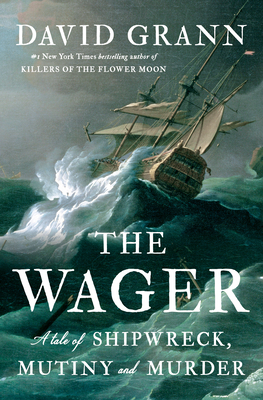
Review 2290: The Wager: A Tale of Shipwreck, Mutiny, and Murder

In 1740, a small fleet of ships set out from Portsmouth on a mission to try to capture Spanish ships laden with treasure in the Pacific Ocean. This poorly conceived and executed mission was part of the War of Jenkin’s Ear, essentially an excuse to try to gain wealth by pillaging Spanish ships.

Because of delays in refurbishing and equipping the ships, they left late. They were trying to round Cape Horn during the southern hemisphere’s summer, which they thought was the calmest time to venture through those dangerous waters. By the time they got to the Horn, the Wager, the smallest ship, had already experienced a bout of typhus and another of scurvy. The loss of officers to illness had given them a new leader, newly promoted Captain David Cheap. They made it around the Horn but lost contact with the other ships and then were shipwrecked.

Nearly a year after they were last sighted at the tip of South America, a few of the sailors made it back to England. Six months after that, a few more appeared, including Captain Cheap, accusing the first group of mutiny and other crimes. Two more appeared even later, accusing the first group of abandoning them on the coast of Patagonia.

Using the widely varying accounts in the journals and memoirs of some of the survivors, David Grann has attempted to reconstruct a fair account of what happened. One of these survivors was the sixteen-year-old midshipman, John Byron, who became the grandfather of the poet, Lord Byron. It’s a fascinating account, with some of the thrills of fictional naval adventure. Yet its all true.

Related Posts

Killers of the Flower Moon: The Osage Murders and the Birth of the FBI

The Lost City of Z

Fatal Journey: The Final Expedition of Henry Hudson

Day 1132: The Quality of Mercy

Cover for The Quality of MercyThe Quality of Mercy was another book I read for my Walter Scott Prize project. It concerns issues of slavery that were coming to the fore in 18th century England.

I did not become that involved with this novel, but that was not necessarily because of the novel itself. I didn’t realize until I started reading it that this novel was a sequel to Unsworth’s Sacred Hunger, which I had not read. After reading four C. J. Sansom mysteries just so that I could read Heartstone in context, I decided not to go back and read Sacred Hunger first, reasoning that a book should be able to stand on its own. It was fairly easy to figure out what had happened in that novel, but perhaps I missed some background for the characters that would have added to the enjoyment of this one.

Much of The Quality of Mercy has to do with action that took place in Sacred Hunger, and to write this review, I am forced into spoilers for the previous novel. A ship filled with slaves was on its way to the Caribbean when the captain decided to throw some sick slaves overboard. A lawsuit in the current novel contends that the aim was to be able to claim insurance on the slaves that would not apply if they died onboard. The reason given for “jettisoning the cargo” was that the ship was running out of water, but the insurance company’s lawyers have witnesses who say that wasn’t true. In any case, the slaves rose up, assisted by some of the sailors, and took over the ship. The slaves and sailors landed in Florida, where they lived together for 12 years.

But Erasmus Kemp, the son of the ship owner, made a vow to find these men after his father committed suicide because the incident ruined him. In Sacred Hunger he was successful in finding the men, and now the sailors involved are on trial for mutiny.

Frederick Ashton is a dedicated abolitionist who is attempting to defend the sailors in order to further the abolitionist cause. Both he and Kemp are zealots in their own ways. Ashton believes that nothing is more important that his cause and makes a request of his sister, Jane, that she considers unworthy of him when he realizes Kemp is attracted to her. Kemp is the type of person who always believes that what he wants is right. He was unstoppable in hunting down the sailors, who included his own cousin.

In the meantime, Sullivan, one of the sailors and an Irish fiddler, was able to walk out of jail when he substituted for a hired fiddler at a party in the jail. Trusting and feckless, he has vowed to go to Durham to see the family of one of his shipmates, who died in Florida. He does not know that Kemp is also on his way to Durham to examine the mine where his shipmate’s family is employed.

Although the novel is certainly well written and interesting, something held me back from being totally involved in the story. Maybe I would have been more interested if I had read the first book, but I’m not sure. I did not like either Kemp or Ashton, although Kemp undergoes some softening during this novel.

Related Posts

Mutiny on the Bounty

The Devil in the Marshalsea

The Fatal Flame