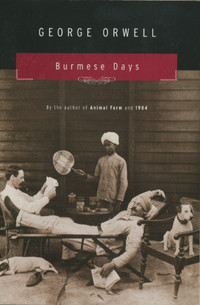
Review 2315: #ReadingOrwell24: Burmese Days

I picked out Burmese Days to read for Brona’s Reading Orwell event. It may be the only Orwell I read, though, unless one comes up in one of the biannual year reads hosted by Stuck in a Book.

There is nothing politically correct about Burmese Days, published in 1934 and probably set 10 years or so earlier. So, if bigotry bothers you, best stay away. Also, a warning for animal lovers—this book contains the murder of a dog.

John Flory is stationed in North Burma working for a timber concern. He hates most of the English people who live in Burma and spend their nights drinking and complaining about the natives. He wants to talk about books and more intellectual concerns, so his only friend is Dr. Veraswami, an educated Indian. However, when the subject of admitting an Asian to the European Club comes up, Flory doesn’t have the gumption to support the doctor’s admission.

He learns later that this admission is more important than he thinks, because Dr. Veraswami has offended U Po Kyin, a corrupt magistrate who is determined to ruin him. Membership in the club would make the doctor impregnable.

Flory doesn’t want to leave Burma, which he loves, but he is desperately lonely. He decides the only option is to find a woman who loves Burma too and is interested in intellectual discussion.

On the scene comes Elizabeth Lackersteen, a young woman who has been left penniless and has come to Burma to find a husband. Because she came from Paris, Flory immediately imagines her hanging out with artists and thinks he’s met his soulmate. He doesn’t even notice how she hates being among the Burmese and is exactly the type of woman he dislikes.

After Flory take Elizabeth on a hunting expedition, she seems inclined toward him, especially as her uncle has been approaching her inappropriately. But then the dashing Lieutenant Verrall appears, and Mrs. Lackersteen discovers he is an Honourable. In the meantime, U Po Kyin has expanded his efforts to disgrace the doctor to include his friend Flory.

This is a bitter satire against the British Raj with few likable characters and a dark ending. I’m sure it is meticulously observed, even though many of its characters seem like caricatures.

Related Posts

The Glass Palace

The Siege of Krishnapur

The Singapore Grip

Day 722: The Narrow Road to the Deep North

Cover for The Narrow Road to the Deep NorthDon’t expect good cheer and humor from The Narrow Road to the Deep North. It is the often harrowing novel based on the experiences of Richard Flanagan’s father as a POW during World War II, one of the hundreds of thousands of Australian soldiers forced to build a railroad through Burma with not much more than their bare hands. A much-sanitized version of this story was the basis for The Bridge on the River Kwai.

Dorrigo Evans is the main character of the novel, a surgeon who ends up being in charge of the prisoners simply by virtue of not having died. We meet him first as an older man, one of Australia’s greatest war heroes, feeling no self-worth, unhappily married, and unfaithful to his wife. The novel moves back and forth in time between the days when he is waiting to be shipped overseas at the beginning of the war until his death years later. In the summer before he went to war, we learn, he fell madly in love and had an affair with his uncle’s young wife Amy.

I think it is interesting that the New York Times reviewer thought this affair was a huge flaw in the novel while the Washington Post reviewer thought it was beautiful. I agree with neither of them (although I lean more toward the Times reviewer’s opinion) but think the Times reviewer was off base in blaming the affair for keeping Dorrigo from pulling his life together after the war. It wasn’t the affair at all but the memory of the decisions Evans was forced to make during the war. At one point, he must decide whether to try to save Darky Gardiner an undeserved beating or try to save another man’s leg. Both die, and the later revelation of Darky’s true identity makes this more painful. At another point Dorrigo is made to decide which of his starving, disease-ridden men must march 100 miles north of the camp. He picks the men with boots, reasoning they might have a chance of making it alive.

Occasionally, we see the thoughts of the men’s captors, the Japanese officers or Korean guards. In all his life after, only for a moment does the Japanese Major Nakamura have the slightest doubt of his behavior during the war. To him, the Australian soldiers had shamed themselves by surrendering and were being given a chance to redeem themselves by serving the Emperor. We occasionally also get glimpses of the brutality of mind that characterizes the Japanese military.

Whether you like this book or not, it is not one you will soon forget. This novel won the Booker Prize last year. Although I preferred several of the other short- and long-listed books for the prize, I still found it compelling reading.

Related Posts

Unbroken: A World War II Story of Survival, Resilience, and Redemption

Life After Life

A God in Ruins

Day 490: The Glass Palace

Cover for The Glass PalaceBest Book of the Week!
In the late 19th century, the kingdom of Burma was one of the wealthiest in southeast Asia. Its people were all literate, and no one in the country went hungry. Hundreds of thousands of Indians and people from other nearby countries traveled there to work on the waterways or the teak plantations.

In 1885, the Burmese government imposed a fine on a British trading company for avoiding taxes by under-reporting the amount of teak it was exporting. The British government used this incident as a pretext for invading the country and taking the royal family captive. King Thebaw and Queen Supalayat and their children, along with a few servants, were deported to India, where they were kept captive for the rest of the king’s life in a crumbling, poorly maintained house. Their personal possessions, including the king’s valuable jewelry collection, were confiscated and returned to England.

It is around this shameful incident that the beginning of The Glass Palace is constructed, an ambitious novel that tells the recent history of India and Burma/Myanmar through the stories of several related families. Rajkumar is a 10-year-old Indian orphan whose mother died in their attempt to reach Burma, and he is working at a small cooking stall near the palace when it is breached. He witnesses the removal of the queen and the princesses, and is struck by the beauty of Dolly, their young servant. Dolly is the only one of the lady’s maids who chooses to follow the royal family into exile.

Rajkumar goes to work for a Malayan businessman named Saya John Martins. With Saya John’s help and advice, Rajkumar eventually makes his fortune in the teak industry and finally travels to India to look for Dolly. She accepts his proposal and returns to Burma with her friend Uma, the recent widow of the first Indian Collector, the official in charge of the Burmese royal family.

These are just the bare bones of a dual story rich in characters and detail, on the one hand that of Rajkumar’s efforts to better himself, on the other hand that of the lives of Dolly and the royal family in exile. But this novel is not a love story, and that is just the beginning of this novel, which continues until the present. The novel follows the fates of Rajkumar and Dolly’s children and grandchildren and those of Uma’s nieces and nephews in India and Burma as the families intermarry with each other and with Saya John’s children. As we follow the fortunes of some family members in Burma and Malaya, other family members get involved in the Indian movement for independence from the British empire.

During the Japanese invasion and bombings of Burma and Malaya during World War II, various family members struggle to survive, one an Indian soldier in the British army, one a rubber plantation owner, one a photographer who disappears in Malaya. Rajkumar and Dolly and their daughter-in-law and grandchild are forced with thousands of other Indians to make the thousand-mile trek back to India.

Ghosh is interested in telling a complex story of culture and  history, so he keeps us at a remove from his characters, but that does not make the novel any less moving. The novel does an amazing job of exploring the roots of problems in Myanmar and India through its exposition of events and the varying points of view of its characters. This is a captivating and ambitious novel.