Review 1760: The Turning Tide

I’ve started to feel as though Catriona McPherson’s approach to a mystery is to throw clues at you until you’re impossibly confused. That’s probably why I prefer her cozy thrillers. Still, I like her characters Dandy Gilver and Alec Osborne, so I keep reading.

Dandy’s daughter-in-law has given birth to twins when Dandy and Alec finally decide to respond to a third letter asking for help. One reason they decide to come is they have just heard of the death of a family friend, Peter Haslett, that seems to be connected with the case. The Reverend Hogg has asked them to find out what is wrong with Vesper, the Cramond Ferry girl, who appears to have gone mad and now blames herself for Peter’s drowning.

When they arrive in Cramond, they are confused by a meeting with three people who seem to have different agendas, Reverend Hogg, Miss Speir, who runs an uncomfortable inn, and Miss Lumley, who owns a local pub. They also hear different versions of Peter’s death. Most say he fell off the ferry and drowned, but one person says he came off the path and had his head crushed in the mill race.

He supposedly was visiting some friends, agricultural students doing an experiment with potatoes, but when Dandy and Alex meet them, the students make nothing of the fact that they have planted the potatoes upside down. When Dandy and Alec meet Vesper, she certainly seems mad, half naked and babbling about Mercury and snakes. But soon, Vesper too is dead.

I think I defy anyone to figure out McPherson’s crime novels. Still, they’re fun to read.

Dandy Gilver and a Spot of Toil and Trouble

Dandy Gilver and the Unpleasantness in the Ballroom

The Reek of Red Herrings

Review 1758: Too Good To Be True

In looking for more to read by Ann Cleeves, I wasn’t aware that I had ordered something between a short story and a novella, packaged under the name of Quick Reads. This little volume cost almost as much as a regular paperback and took about a half hour to read.

At the request of his ex-wife Sarah, Jimmy Perez travels to the border town of Stonebridge. Here a young teacher, Anna Blackwell, has been found dead, an apparent suicide. Sarah is concerned because the village rumor mill is alleging that her husband Tom was having an affair with Anna. Sarah hasn’t helped the situation by heading a drive to remove her from her position.

When Jimmy investigates the crime scene, he finds some evidence to indicate that Anna may have been murdered. Also, a mysterious stranger seems to be following him.

I am not really a fan of mystery short stories, because I enjoy all the things that the short story in that genre has little time for, character development, atmosphere, and so on. As it turns out, the motive for this murder seems unbelievably flimsy. I don’t think I’ll be purchasing any more of these Quick Reads.

White Nights

Wild Fire

Thin Air

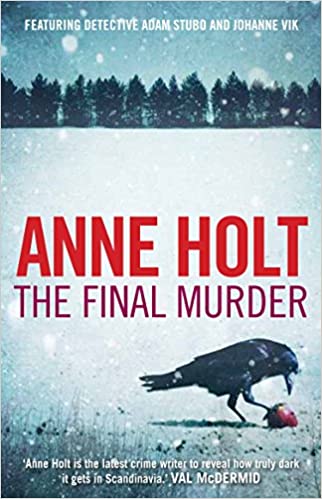
Review 1750: The Final Murder

Anne Holt’s Stubo and Vik series books are so far suspenseful, and her characters are convincing. I enjoyed The Final Murder but found it a bit far-fetched.

Johanne Vik and Adam Stubo are a couple five years after the events of the last book, and Johanne has just given birth to their daughter. She hasn’t been sleeping, and she is worried that the new baby may exhibit symptoms of the undiagnosed condition of Kristiane, her first child.

A TV personality is found dead in a bizarre murder with her tongue cut out, split, and placed in an elaborate origami bowl. Despite the efforts of Adam’s team, they cannot find anyone who bore her a grudge. Then a rising young politician is found crucified. The team begins to be afraid they have a serial murderer of celebrities.

Something about the murders seems familiar to Johanne. After the third one, she realizes that it is not just about celebrities—someone is re-creating five unrelated murders that Johanne’s FBI mentor regularly talks about in his lectures. We readers periodically check in on the murderer and know that she is a woman.

To explain my problems with this mystery, I have to reveal a spoiler, so stop reading now if you don’t want to know more. The murderer is actually targeting Johanne with these murders, trying to see if she can catch her. I found the re-creation idea a little iffy, but this plot point seems more like the old-fashioned diabolical mastermind challenging the detective—sort of Holmes/Moriarty—the kind of thing that has always seemed ridiculous and unlikely to me. I also felt frustrated by the ending, which I will not reveal.

Don’t misunderstand me, though. I still enjoyed reading the book and look forward to the next one, although I find Johanne a bit neurotic.

Punishment

The Mist

The Water’s Edge

Review 1748: Black Tide

I understand Peter Temple’s Jack Irish series is classified as hard-boiled crime, which is usually too much for me, but Temple’s writing is so effortless and funny and his characters so interesting that reading these books is a pleasure.

In this second book of the series, Jack is trying to help Des Connors, an old friend of his father. Des’s son Gary has borrowed all of Des’s savings and disappeared. Further, he has mortgaged Des’s house and not paid the bills. If Jack can’t find Gary, Des will be homeless and penniless.

Jack is also involved with his friends Harry and Cam in finding and betting on unlikely racehorses. While involved in this pursuit, they uncover serious cheating at the track.

One of the pleasures of this series besides its carefully constructed plots and punchy dialogue is the full life Temple has constructed for Jack. There is his bunch of elderly pals at the bar, who are obsessed with his dad’s old footie team, his woodworking apprenticeship under his severe teacher, Charlie, his disreputable clients, and his love life. This isn’t going so well as Linda Hillier has taken a job in Sydney.

As Jack looks for Gary, the plot becomes more and more tangled, and he keeps encountering dead bodies. These are really fun, exciting thrillers.

Bad Debts

Laura

In a Lonely Place

Review 1735: #1976 Club! Sleeping Murder

With the 1976 Club looming, I picked out some books to read for October that were published in 1976. Sleeping Murder also qualifies for RIP XVI! As usual, on this first post I’m also listing anything else I’ve reviewed published in 1976. As far as I know, there are only two:

Newlywed Gwenda Reed is house hunting along the south coast of England for herself and her husband Giles, both newly arrived from New Zealand. When she comes across a house in Dillmouth, she immediately feels at home there, although she experiences a fleeting panic on the stairs. Nevertheless, she buys the home.

Gwenda is residing in it to oversee updates to the house when she begins to experience something odd. She expects the stairs down from the terrace to be in one place but they are in another. When workmen remove some bushes where she thinks the steps should be, they find the stairs used to be there. Similarly, she keeps trying to walk through the wall in the dining room where she thinks there should be a doorway. When the workmen examine the wall, they say it had a door there. She imagines a particular wallpaper in what used to be the nursery, and when a blocked cupboard in that room is opened, she sees that wallpaper inside.

Gwenda is most upset because she’s had a vision of a woman dead at the bottom of the stairs and realized it was Helen. But she has no idea who Helen is. Feeling confused, she decides to consult friends in London. Accompanying the group out for the evening is her friends’ aunt, Miss Jane Marple. After she explains what’s been happening, Miss Marple says she should find out if she ever lived in England as a child.

Inquiries find that Gwenda lived in the house when she was three. At the time, her father had a second wife named Helen. But Helen supposedly ran off with another man. Gwenda and Giles find that Helen’s half brother, Dr. Kennedy, still lives in the area. He has some letters that she sent right after she left but hasn’t heard from her since.

Gwenda and Giles begin to believe that Helen was murdered. Did Gwenda’s father kill his wife, or did someone else?

It was hard for me to judge whether this was a difficult mystery, because I vividly remembered a TV production of it. However, knowing the identity of the killer made me appreciate how skillfully Christie salts in the clues without giving too much away. The characters are clearly defined, and Miss Marple is at her cleverest.

Related Posts

4:50 from Paddington

At Bertram’s Hotel

Murder at the Vicarage

Review 1732: A Day in the Death of Dorothea Cassidy

Here’s another book for RIP XVI, although a cozy one.

People in the town of Otterbridge are shocked when the body of Dorothea Cassidy, the vicar’s wife, is found murdered in the park. Most of the people in town loved her, she was so vibrant and enthusiastic.

Inspector Ramsey and Sergeant Hunter are having difficulty retracing her movements on the day before. Almost everyone who saw her is lying in some way. Old Walter Tanner found her car in his driveway that morning, and only he admits to disliking her, saying she was constantly after him to approve of changes she wanted to make to the church.

The Inspector Ramsey books are one of Cleeves’s earlier series. I have read all of her Vera Stanhope and Jimmy Perez books and a couple of stand-alones. Although this one has a clever premise, it feels less polished than the others. Cleeves often lets readers know some of what her suspects are thinking, but information about them is introduced naturally in the other books, for example, in conversations between characters. Here, we no sooner meet a character than we are told several facts about the person, a device which seemed clumsy to me. Also, character development seems quite a bit sketchier.

Related Posts

The Sleeping and the Dead

The Long Call

Blue Lightning

Review 1729: The Witch Hunter

Here’s another one for RIP XVI!

Best-selling author Roger Koponen is appearing on the other side of the country when his wife Maria is murdered and posed in a black evening gown with a gruesome smile. When Jessica Niemi’s department has him driven home by a police officer, the car is later found burnt out with two dead bodies inside. While the team is beginning to believe that the murders are connected to Koponen’s books, two more women in black evening dresses are found, one under the ice in the lake behind Koponen’s house and one popping up from the hole, alive but barely. All of the women look a lot like Jessica.

I am not sure what attracted me to this book, possibly its setting in Finland, but it is just terrible. Let me count the ways:

  1. The main character (Jessica) is a millionaire who hides her wealth by pretending to live in a barely furnished studio apartment while actually living in a large apartment next door. How ridiculous is that?
  2. The characters, including Jessica, are completely flat. They have traits, not personalities. Some of them don’t even have those.
  3. The reason behind the string of crimes seems to have nothing to do with the bizarre crimes themselves. A manifesto is mentioned but never explained.
  4. The interactions between the teams are stunningly unprofessional, and often conversational exchanges don’t make much sense. What a person replies doesn’t always seem to have anything to do with what was said to him or her.
  5. The actual investigation seems haphazard and is unconvincing.
  6. Much space is devoted to a summer in Murano when Jessica is 19. It has nothing to do with anything.
  7. The writing or translation (or both) is mediocre and full of clichés. Some turns of phrase are odd and not idiomatic.
  8. The whole plot is overcomplicated and just plain silly.
  9. The blurb on the back of the book both misinterprets and overly reveals the plot.
  10. Jessica hardly does anything.
  11. The big thriller climax is resolved by Jessica waking up in a hospital. The end.

Related Posts

The Redbreast

Unspoken

The Seven Deaths of Evelyn Hardcastle

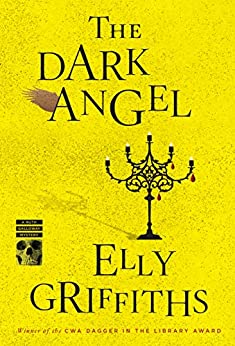
Review 1727: The Dark Angel

Here’s another review for RIP XVI!

Forensic anthropologist Ruth Galloway has been having a rough time lately. On the same day that it looked like Harry Nelson, the father of her daughter Kate, might split up with his wife Michelle for her, Michelle told him she was pregnant. Ruth’s mother died shortly thereafter. Now, after Detective Tim Heathfield sees her at a colleague’s wedding, he confesses to her that he is in love with Michelle and her baby might be his.

So, when she gets a call from colleague Angelo Morelli asking her to come look at some bones in Italy, she decides to go there for vacation. Angelo will put her and Kate up in an apartment in Castello degli Angeli, and her friend Shona decides to come along with her young son.

Ruth finds that Angelo’s request is mostly a ploy to get the producers of a television show he hosts interested again in his dig. However, she finds the atmosphere of the little medieval town strange, still full of enmities dating back to World War II.

For his part, Nelson is mildly concerned about the release from prison of Micky Webb, a man who paid to have his wife and children burned to death in their house. Nelson has seen Webb lurking in his neighborhood, but when he confronts him, Webb claims to be following a program that requires him to beg forgiveness of those he has wronged. He says he came to do that with Nelson but didn’t have the courage to knock. Soon, however, Nelson’s attention to this problem shifts when he learns there has been an earthquake in Italy where Ruth and Kate are staying. He and Cathbad jump on a plane for Italy.

In this novel, the emotional dynamics seemed almost more important than the mystery. However, I continue to find these characters interesting and enjoyed this installment in the series.

Related Posts

The Ghost Fields

The Woman in Blue

The Chalk Pit

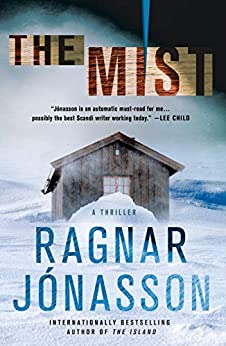
Review 1724: The Mist

Here’s another book for RIP XVI.

I didn’t realize until just now that The Mist is the third book in a trilogy. Having not read the other two books, I’m not sure how much it would have affected my reading if I had read them.

Detective Hulda Hermannsdóttir is back at her desk after a traumatic experience. She is having trouble focusing, however, on the case of a missing young woman. Then she is called out of the office to investigate bodies found on a remote farm in the east of Iceland.

The story goes back three months to show what happened to Hulda and on the farm. Erla and her husband Einar are snowbound at the farm just before Christmas when a mysterious man appears at their door, claiming to be separated from his friends on a hiking trip. Erla is immediately suspicious of him, and he certainly acts suspiciously. But Einar invites him to stay until the snowstorm stops.

This novel is complicated and at times suspenseful, but I had some problems with it. First, it’s obvious almost immediately what’s wrong with Hulda’s teenage daughter. Second, most of the action of the novel is triggered when a character receives a letter. The next obvious step would have been for him to take it to the police, whom he is already working with. But does he? Of course not. There wouldn’t be much of a story if he did, but novelists should avoid such silly pitfalls.

Related Posts

Jar City

The Cruel Stars of the Night

Unspoken

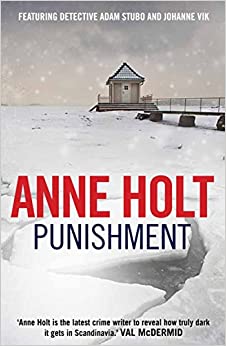
Review 1722: Punishment

Here’s another book for RIP XVI.

I thought maybe I had read an Anne Holt mystery years ago, but it appears not. In any case, I got interested in reading her Stubo/Vik series after watching Modus, a Swedish television series based on her Norwegian characters. It’s interesting, having seen the television series first, to notice the changes they’ve made.

Johanne Vik, a university researcher doing work on convicted criminals who maintain their innocence, is contacted by an old lady who has long been convinced of a miscarriage of justice. In 1988, Aksel Seier was convicted of the rape and murder of a young girl based on flimsy evidence. After he served nine years, he was mysteriously released from prison and all the case paperwork disappeared. The woman wants Johanne to find out if Seier was innocent. Although this is not the kind of work Johanne does, she becomes interested in the case and agrees to help.

At about the same time, Detective Adam Stubo sees Johanne on television and asks her to help brainstorm the case of a series of kidnapped and murdered children. At first, she refuses but is drawn in by his persistence.

All along, we follow the story of Emilie, one of the kidnapped children who has not been killed, as well as the thinking of the murderer. This lends an extra layer of suspense about whether she will be saved.

I think this is a complex and well-plotted novel with interesting characters. There are a couple of huge coincidences at the end that I’m not sure of, but I am more than willing to continue the series.

Related Posts

The Redbreast

The Water’s Edge

The Indian Bride