Review 1416: Thin Air

Four Londoners are visiting Unst for a hamefarin’, a party for a newly married couple. Late the night of the party, Eleanor disappears. She had recently been depressed after a stillbirth, but her friends report she has seemed much better recently.

After Jimmy Perez and his team arrive, Eleanor’s body is found stretched out next to a small lake. She seems to be in an unnatural position, and the team thinks she was struck in the head.

Eleanor was making a film about rational people who claim to have had a supernatural experience. The area where they are staying is supposed to be haunted by a young drowned girl named Peerie Lizzy. Eleanor claims to have seen a girl on the beach in an old-fashioned white dress. Later, Polly sees her, too.

Of course, the main suspects are the friends and Eleanor’s husband, Ian. Eleanor and Ian seem somewhat of a mismatch, and Ian had Eleanor committed during her depression over the stillbirth.

Polly is a dreamy, shy librarian. She and her outgoing, assured boyfriend, Marcus, seem to be an unusual couple. The groom, Lowry, dated Eleanor in college and was said to be devastated when she broke up with him. Caroline, his new wife, seems much more concerned with the couple’s plans to move to Unst than by Eleanor’s death.

This is another complex, clever mystery by Cleeves. I had no clue of the solution, although I did guess a major plot point. A small caveat, though. The motive for the murder, once it was revealed, seemed far-fetched.

Related Posts

Blue Lightning

Dead Water

White Nights

Review 1411: The Crossing Places

Even though I often tire of series fiction, I still enjoy finding a promising series, and Elly Griffiths’ Ruth Galloway series is off to a good start. I selected this mystery to have a suitable review near Halloween and also for Readers Imbibing Peril.

Ruth Galloway is a forensic archaeologist who lives by the Saltmarsh near Norfolk and teaches at the nearby university. Detective Inspector Harry Nelson asks her to help him with some bones that were found on a beach near where she participated in a dig five years ago. Harry Nelson was involved in the case of the disappearance of five-year-old Lucy Downey several years ago and fears they are her bones, but Ruth finds they are from the Iron Age.

A few months later, another little girl disappears from the area. Nelson begins consulting Ruth about the case, showing her the letters he received during the first case. Now, new letters are arriving.

Around this time, friends from the dig five years ago begin to resurface. Ruth’s professor Erik travels in from Norway, and her old boyfriend, Peter, reappears.

This novel is very atmospheric, using the bleak Saltmarsh effectively as a setting. The characters also are colorful yet believable. Although I guessed the identity of the criminal fairly early, Griffiths threw in some interesting red herrings. I’ll gladly read another Ruth Galloway book.

Related Posts

The Child Garden

Quiet Neighbors

Go to My Grave

Review 1410: The Catherine Wheel

Jacob Taverner, a rich eccentric, invites some of the cousins of his extensive family to the family inn, The Catherine Wheel, for a reunion. He seems to have an ulterior motive, though, because he questions several about the stories of a hidden tunnel.

The inn has a past as a smugglers’ nest, and Detective Abbott thinks it is still so used, for drugs and stolen jewelry He asks Miss Silver to take a room at the inn to observe activities.

Jane Heron and Jeremy Taverner are among the cousins invited to the inn. It is cheaply furnished, ill kept, and creepy, and Jane’s misgivings are furthered when she recognizes Miss Silver as a detective she met before. She makes sure Miss Silver gets a room. That night, Luke White is found dead. Luke is a cousin on the wrong side of the blanket who worked as a waiter at the inn. Earlier, he was overheard telling Eily, the maid, that he was going to have her whether she wanted him or not, and if she tried to marry her sweetheart, John Higgins, one of the cousins who chose not to attend the reunion, he would murder him. Eily was discovered near the body, but so was another cousin, Florence Duke.

The dull-witted Inspector Crisp is ready to arrest John Higgins, but Miss Silver is quite certain something else is going on.

Wentworth is good at creating eccentric or likable characters, but she also telegraphs the bad guys fairly obviously, so that you know who was likely to be involved, just not why. The problem of repetition that irritated me in The Arlington Inheritance isn’t quite so pronounced in this one. Overall, the book is entertaining enough but not a great mystery.

Related Posts

The Arlington Inheritance

Mischief

Laura

Review 1407: Murder at the Vicarage – #1930Club

I decided to reread Murder at the Vicarage for the 1930 Club, but it also applies to Readers Imbibing Peril. It is the first Miss Marple book, and for much of it she seems like a minor character.

The novel is narrated by Len Clement, the vicar of St. Mary Meade. He is called away one evening by what proves to be a false call for help. He arrives home late for a meeting with Mr. Protheroe, a wealthy man who is disliked by many. In his study he finds Protheroe dead, shot in the head.

Of course, there are lots of suspects and red herrings. Mr. Hawes, the curate, is behaving oddly. Mrs. Protheroe had just decided to part from Lawrence Redding, who is in love with her. Lettice Protheroe has inconsistencies in her alibi. Rumor reports that a local poacher has a grudge. A team exploring the local barrow seems to be up to something besides archaeology.

No sooner does Inspector Slack appear on the scene when first Lawrence Redding then Anne Protheroe make confessions of guilt. Miss Marple lives next to the vicarage so has some testimony to offer about its comings and goings. And she also has some interesting ideas about who may be guilty.

Related Posts

4:50 from Paddington

At Bertram’s Hotel

A Caribbean Mystery

Review 1406: Strong Poison – #1930Club

There are those who feel that Dorothy L. Sayers ruined her Lord Peter Wimsey series with the introduction of the character Harriet Vane. I am on the fence about this. On the one hand, I don’t really enjoy Peter’s sappiness as he courts and marries Harriet. On the other hand, I like Gaudy Night, the mystery that Harriet solves herself.

I also enjoyed Strong Poison, the novel in which Harriet is introduced. Harriet, a mystery writer, is accused of poisoning her ex-lover, Philip Boyes, with arsenic. In 1930, when the book was published, no one quite understands why Harriet broke off with Philip. Philip convinced her, against her principles, to live with him without marriage, stating that he did not believe in it. Then he turned around and asked her to marry him, which Harriet views as his having tried her out. Her resulting anger seems to be the police’s motive. Lord Peter doesn’t believe it for a moment. He thinks Harriet is innocent and wants to marry her himself. Luckily, there’s a hung jury, so Peter has a month to investigate.

At first, Peter can’t get anywhere, because he can find no motive. Yet he is struck by the precautions Philip’s host at dinner took when Philip was taken ill to preserve the food. Peter is even more struck by the precautions he took not to be left alone with Philip or give him medicine when he was ill. But this host, Mr. Urquhart, Boyes’s cousin, had no opportunity to administer the poison, and Harriet did. Moreover, Harriet purchased arsenic as research for her book.

About halfway through, this mystery becomes more a puzzle about motive and opportunity than the identity of the killer. It skillfully unwinds, however, and does not cheat by hiding information from the reader.

I reread this novel for the 1930 Club and Readers Imbibing Peril, and was glad I did. I had forgotten the witty dialogue and the deft characterization.

Related Posts

Busman’s Honeymoon

Whose Body?

Unnatural Death


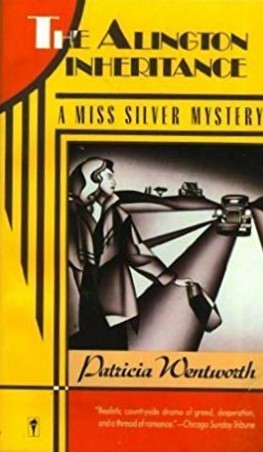
Review 1398: The Arlington Inheritance

The identity of the criminal is not a secret in The Arlington Inheritance. Instead, the suspense lies with how Miss Silver, Wentworth’s Marple-like sleuth, will find and put together the clues.

My friend and I have been trading books lately, and she loaned me this one. At the time, she commented that she didn’t like the repetition. More about that later.

Jenny Hill’s guardian, her old governess, Miss Garstone, dies unexpectedly in a hit and run accident. When she is dying, she tries to tell Jenny about a letter written from her father to her mother. Her father died in the war, and her mother was injured shortly thereafter, not speaking again until she died shortly after Jenny was born.

After Miss Garstone’s death, her sister immediately descends to claim her property and grudgingly gives Jenny the little chest that is supposed to contain the letter. But when she opens it, no letter is there.

Jenny has nowhere to go, but Mrs. Forbes, her neighbor across the road, offers her a job as governess for her two girls, Meg and Joyce. Jenny was born in Mrs. Forbes’s house, owned at the time by her father, but as he didn’t marry her mother, Jenny as a baby was dispossessed by Mr. and Mrs. Forbes, her father’s nearest relatives.

Jenny thinks she is in love with Mac Forbes, who is occasionally attentive to her, but when she is away from him, she has doubts. When Mac visits this time, he seems to be paying more attention to her. However, Jenny overhears a conversation that chills her. She hears Mac tell his mother that Jenny’s father did marry her mother. Rather than tell Jenny, he plans to marry her, assuring himself the possession of the house and property.

Appalled, Jenny runs away from home, but trouble comes after her.

Wentworth draws some appealing although mostly one-dimensional characters in Jenny, some of her relatives, and Miss Silver. Occasionally, I mildly enjoyed this effort even though Wentworth’s writing style deals in a lot of repetition. Someone will recount something that has happened, that we already know about, sometimes several times. It’s not done for a reason, for example, to show that a witness is leaving something out, but simply seems to be her style and makes the book slightly longer. This doesn’t occur until the crime, though, which happens well into the book (as far as we know). After that, it can certainly be annoying.

Related Posts

Coffin, Scarcely Used

Antidote to Venom

The Horizontal Man

Review 1397: Deep Waters

I have read several of British Library Crime Classics’ mystery story collections, usually themed around a locale. In Deep Waters, most of the stories are set at sea, although some involve rivers and one each a pond and a swimming pool. The stories are in chronological order by when they were published, from 1893 to 1975.

The first story, “The Adventure of the ‘Gloria Scott'” by Arthur Conan Doyle, is a Sherlock Holmes I have never encountered before, supposedly his first case. Like several of the first few stories, it presents and solves a puzzle so quickly that I was barely aware there was a puzzle. In fact, as I read these stories, I felt as if I was watching the evolution of the mystery story.

“The Eight-Mile Lock” by L. T. Meade and Robert Eustace, only the second story, was one of three written by women. It details the theft of a diamond bracelet from a party staying on a houseboat. The mystery is not so much about who stole the bracelet or how but where he put it to evade the police.

“The Gift of the Emperor” is a Raffles story written by E. W. Hornung, who was Arthur Conan Doyle’s brother-in-law. I don’t know if it was the last of Raffles’s career, but it seemed to be.

One of the stories I liked best was “A Question of Timing” by Phyllis Bentley. The main character, Robert Beringer, uses his observation skills as a writer to foil a criminal, save a detective’s life, and get the girl, all during a walk. This story takes place on an embankment of the Thames.

I have a frustration in general with mystery short stories as they really only have space to pose and solve a puzzle. So much that I enjoy about mystery novels is not possible at this length. Some of these stories, though, had beautiful descriptions of their settings. In any case, this is a good collection for those interested in the evolution of the mystery story.

I received a copy of this book free from the publishers in exchange for an honest review.

Related Posts

Murder at the Manor

Silent Nights

The Mistletoe Murder and Other Stories


Review 1396: Kingdom of the Blind

Here’s another review that is suitable for Readers Imbibing Peril!

* * *

Although I’ve enjoyed many of Louise Penny’s Armand Gamache series, I had stopped reading them. However, on impulse I picked Kingdom of the Blind up at the library.

Having skipped one book in the series caused a problem, as the last book apparently climaxed in a major event that forced Gamache to allow a new drug onto the street, a killer. Now, Gamache is suspended and under investigation, a familiar situation for him. And that’s one problem for me. Since the beginning of the series, different figures in law enforcement have been out to get him. Each time this plot line seems to be wrapped up, it isn’t. I’m frankly tired of it.

This novel centers on two plot threads, something common to Penny’s books. In one, Gamache is among three people asked to execute the will of a woman they don’t know. Why were they selected, and why has the woman, who worked as a house cleaner, left money and property she doesn’t seem to possess?

The second thread is related to the search for the drugs. It begins when Gamache has one of his proteges, Amelia, dismissed from the police academy for possession of drugs.

It wasn’t very hard to figure out what was going on in one of these plot lines. The other was more difficult.

But really, my problem with this series relates to its sameness, the reason why I almost always quit reading series. First, the same ancillary characters go through the same routines. Second, Penny doesn’t really trust her audience. If someone says half of a well-known phrase, someone else has to finish it. She constantly tells us what to think about exchanges between characters. There’s a certain heaviness to Gamache, whom she depicts as almost like a saint, so that despite some kidding around, everything feels heavy. And anyway, the jokes are always the same.

Finally, there’s the writing style. Penny uses lots of short sentences and sentence fragments in this novel, particularly when hammering home a point that the reader doesn’t really need hammered. I don’t remember her using this style before, but perhaps I just didn’t notice it in the previous books.

This all sounds like I hated the book. I didn’t. I am just tired of the series, as I often become tired of series. This series started out as a really good one, so if you’re interested, I suggest starting at the beginning. Penny almost always links story lines from one book to the next, so it’s best to read them in order.

Related Posts

A Great Reckoning

The Nature of the Beast

The Long Way Home

Review 1389: Murder in the Mill-Race

Murder in the Mill-Race is apparently E. C. R. Lorac’s 36th Chief Inspector Macdonald mystery, which means I have pleasure in store if only I can find others. I reported recently that I’d gotten up the nerve to request books from several publishing companies, and Poisoned Pen Press immediately sent me four books from their British Library Crime Classics. This was one of them.

When Anne Ferens, the new doctor’s wife, first meets “Sister” Monica, the warden of the children’s home in Milham in the Moor, she is taken aback by the dichotomy between the Sister’s reputation as a saint and her freakish appearance. What’s worse, Anne fears that the children are being terrorized by her. She soon learns the woman has a poison tongue, starting rumors by denying her belief in the scandal she’s trying to suggest.

Then Sister Monica’s body is found in the mill-race. The village is quick to assume the death was an accident. But Sergeant Peel is still bothered by the death a year before of Nancy Bilton, a resident of the home who was found dead in the same place. Peel finds the village just as closed as it was before. No one knows or saw anything. So, the authorities call in Chief Inspector Macdonald and Inspector Reeves. They soon ascertain that the death was no accident.

I enjoyed this mystery very much. It pays more attention to character than many of the books in this series, and the characters are believable. The mystery is not one of the over-complicated ones of the period. I guessed the identity of the killer but did not guess the motive except in general. The Ferens are a charming couple, and I liked the two detectives. This novel is a good choice for this series.

I received this book from the publishers in exchange for a fair and honest review.

Related Posts

Weekend at Thrackley

Murder at the Manor

The Sussex Downs Murder

Review 1387: The Glass Room

Inspector Vera Stanhope responds to a request from her neighbor, Jack Tobin, to find out where his wife, Joanna, has gone. She left abruptly, leaving only a note saying she needed space, but Jack is worried because she’s been behaving oddly and has stopped taking her medication for bipolar disorder.

Joanna isn’t hard to track down. She’s attending an institute at Writer’s House on the coast. When Vera arrives, however, she finds that one of the lecturers, Tony Ferdinand, has been found dead, stabbed with a knife, his body laid out awkwardly in the glass room, a sun porch where he liked to sit. Moreover, Joanna has been found in the hall with a knife.

Things don’t look good for Joanna, who was supposed to meet Ferdinand at the time he was killed. Shortly, however, the coroner verifies that the murder weapon was not the knife, which Joanna found lying in the room outside the glass room.

Nina Beckworth, another lecturer for the institute, begins writing a murder mystery set at the institute. In it, she imagines a body on the terrace, with the furniture and other trappings of the scene just so. Soon, the body of Miranda Barton, the founder of the institute, is found in exactly those circumstances. Vera realizes that someone is playing games.

Almost as soon as it was mentioned, I recognized the motivation for the murder and thereby the murderer. What I didn’t understand was how that linked to the victims. Cleeves is so clever with her red herrings and side plots, however, that by the end of the novel I was suspecting someone else, or rather, the original suspect and one other. This is another excellent detective novel from Cleeves.

Related Posts

Silent Voices

Telling Tales

Hidden Depths