Day 927: The Casebook of Carnaki the Ghost Finder

Cover for the Casebook of CarnakiW. H. Hodgson’s sleuth Carnaki is in answer to the fad for detective stories that came about after the success of the Sherlock Holmes stories. But Carnaki is not a regular detective. He is a psychic detective who investigates hauntings. The Casebook of Carnaki the Ghost Finder is a collection of nine Carnaki stories.

These stories all follow the same format. Carnaki summons a group of friends to his house for dinner. He speaks very little before and during dinner and will not talk about what he’s been doing. After dinner, he relaxes into his favorite chair and relates his latest case. This format is very common in earlier genre mysteries. Unfortunately, it removes some of the immediacy of the story.

These stories are straight wonder tales. There is no attempt made at characterization, of Carnaki or anyone else. The stories are simply meant to amaze and puzzle and so have more in common with earlier gothic stories than with Sherlock Holmes. The puzzle of whether the mystery will be of human or occult causes is probably the most interesting part of the stories.

I actually found one of these stories to be quite chilling. That was “The Gateway of the Monster.” In that story, Carnaki is called to investigate the Grey Room in a very old house. Although the door of the room is locked every night, it is slammed continually all night long. Each morning, the bedclothes are found jerked off the bed. Since three people were killed there years before, no one has slept in the room.

Unfortunately, Hodgson cheats by waiting until the end to tell us a key piece of the story. Also, this haunting, along with some of the others, runs more along the lines of something like The Castle of Otranto than a more modern ghost story, and I find things scarier that are more feasible.

In “The Thing Invisible,” Carnaki is summoned to figure out how the butler could have been struck with an ancient dagger when there was no one around him and he was in full view of everyone. This story is marred, too, because one person there understood what had happened and would never have summoned Carnaki.

Still, this book is full of haunted castles, spectral horses and pigs, a ship pursued by strange weather, and other wonders. It can be quickly read and should offer most folks some pleasure on a rainy afternoon (or a dark and stormy night).

Related Posts

This House Is Haunted

The Necromancer

The Castle of Wolfenbach

Day 915: Come to Harm

Cover for Come to HarmKeiko is a Japanese exchange student working on her doctorate who has accepted a grant from an association in Painchton, Scotland, near Edinburgh University. Her grant comes with a free flat that has even been stocked with food. Keiko is overwhelmed by everyone’s hospitality, particularly with their propensity for stuffing her with food, much of which she finds unappetizing.

Not everyone is welcoming, though. Her landlady Mrs. Poole is the proprietor of the butcher shop below Keiko’s flat. She is a recent widow, but her unfriendly behavior seems to indicate more than grief. She has two sons, Malcolm and Murray, and she certainly isn’t encouraging them to befriend Keiko. She also spends every morning cleaning the seldom-used slaughterhouse in the yard.

Early on, Keiko finds a note behind the radiator in her flat. It is clearly from a blackmailer, perhaps to the previous occupant of the flat. She also notices that several women have vanished from town. As Keiko tries to figure out what is going on in town, she also has quite a few misunderstandings with people through not understanding exactly what they’ve said.

I had a few problems with this novel that I haven’t had with other McPherson thrillers. For one thing, the reasoning behind the Painchton Trading Association’s grant to Keiko seems so flimsy that I had a hard time imagining even a child would believe it, let alone the entire town. The town committee seems to be up to something illegal, which lends to the atmosphere of the novel.

And then there is the resolution of the plot. First, Keiko’s suppositions run so berserk that I started to think the novel was an elaborate joke and that maybe I was reading an updated version of Northanger Abbey. But I won’t say whether I was right or not.

So, I wasn’t as happy with this novel as with others by McPherson, particularly as compared to the wonderful Quiet Neighbors. I thought it was obvious fairly early on that one character was dangerous, but Keiko doesn’t realize this until very late in the novel. Still, the novel is atmospheric and the ending is suspenseful, and parts of it are funny, so all that will probably keep most readers happy.

Related Posts

Quiet Neighbors

The Child Garden

The Day She Died

Day 913: The Unforgotten

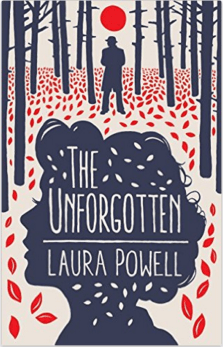
Cover for The UnforgottenA novel set in two time periods, The Unforgotten is a thriller and a mystery. But it is more than that—a story with deep-running themes offering its characters difficult choices.

In 1956 Cornwall, Betty Broadbent is an innocent, naive 15-year-old. She helps her unstable mother run a hotel and sometimes has to run it herself when her mother is in the throes of depression or alcoholism. The small fishing village has been invaded by reporters after the murders of several young women.

In 2006, Mary reads that the man who served time for the murders back in 1956 still insists he is innocent. Mary remembers him as the man her mother used to date and believes he is innocent. She thinks she knows who the actual killer is and is torn between telling what she knows and keeping a long-held secret. Although we don’t know why she is living under another name, we are soon sure that Mary is Betty.

This novel is about the painful choices two people must make under difficult circumstances. It is also about a sad and doomed love affair.

At first I thought that some of the dialogue and situations were unlikely, but I soon forgot those thoughts, driven forward by the sheer power of the story. It is one that has many more levels than first expected. This is a great first novel by Powell.

Full disclosure: I received a copy of this novel from the publisher in exchange for an honest review.

Related Posts

The Lace Reader

Sharp Objects

The Last Summer of the Camperdowns

Day 904: Some Must Watch

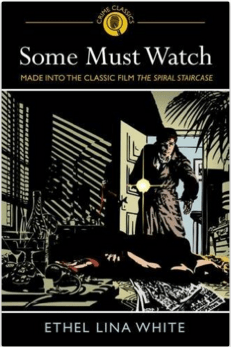
Cover for Some Must WatchSome Must Watch is the novel that inspired the thrilling old movie The Spiral Staircase. Ethel Lina White, the author, was one of the early women mystery writers, another novel of hers being the basis of the movie The Lady Vanishes.

This novel centers around an isolated country house, the home of Professor Sebastian Warren, his mother, sister, son, and daughter-in-law. The main character is Helen Capel, a servant in the household.

At the beginning of the novel, Helen is coming back to the house at dusk. She is worried because she must pass through a desolate landscape and young women have been murdered in the district. Her way takes her through a plantation, but she changes direction because she thinks she sees a man lurking among the trees.

The novel takes place in the space of one night during a violent storm. At the beginning of the evening, everyone becomes alarmed because another dead woman is found dead near the local pub and Dr. Parry thinks she was killed in the same plantation where Helen saw someone. The house is full of people, so the Professor decides that they should all stay inside during the storm and not admit anyone, and they will be safe.

However, as the evening continues, one incident after another occurs that causes the people to leave the house. After a while, it seems to Helen as if some intelligence is working so that she will be alone to face the killer.

In some ways, this novel seemed rather crude, especially in the interactions between characters and the dialogue. I have run into this before with novels of a certain vintage and am not sure if it reflects people’s actual behavior and way of speaking at the time, the expectations of the genre, or simply the ability of the writer. Not very much attention is given to character development either. The focus is squarely on the plot. Still, I think the novel is interesting as representative of an early thriller.

Occasionally I comment on the publication quality of a book. I believe that my copy is an on demand publication by Between Things (not the one pictured above). Its biggest eccentricities are the starting of chapters on the left page and a typographic oddity of placing an underscore before and after phrases that I assumed were in italics in the original. There were a few other careless errors but not as many as I have noticed lately in some other regular press runs. Still, I am beginning to avoid on demand printing, if I recognize it ahead of time.

Related Posts

Murder at the Manor

The Z Murders

The Tiger in the Smoke

Day 900: The Monogram Murders

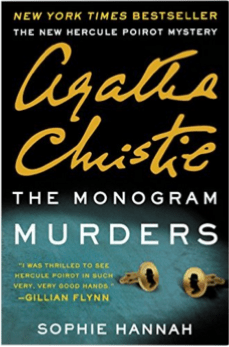
Cover for The Monogram MurdersThe Monogram Murders is the first Hercule Poirot mystery written since Agatha Christie’s death that was approved by her estate. It is written by the British thriller writer Sophie Hannah, whose books I have enjoyed. I was curious to see how authentic the novel seemed as a Christie mystery.

Hercule Poirot visits Pleasant’s Coffee House every Thursday night because he finds that its delicious coffee activates the little grey cells and he likes the astute observations of a waitress named Fee. One evening a regular patron comes in disturbed, behaving as if she fears for her life. When Poirot tries to convince her to confide in him or go to the police, she runs away. All Poirot can find out about her is that she works in some large house across town and her name is Jennie.

Hercule returns to his rooming house to confide in his fellow lodger, Mr. Catchpole, who works for Scotland Yard, but Catchpole is disturbed by having just attended the scene of a murder. Three people have been found dead at the exclusive Bloxham Hotel, and each had a monogrammed cufflink in his or her mouth.

Investigation soon finds that the two women victims, Harriet Sippel and Ida Gransbury, both lived in the small town of Great Holling. They traveled up separately to London and had rooms on different floors, but they both had tea with the third victim, Richard Negus, at 7:15 PM. They were all found dead in their rooms after 8 PM.

It soon becomes clear that the deaths have something to do with a tragedy years before in Great Holling, when lying rumors about the town’s vicar resulted in the loss of his reputation and the subsequent suicides of his wife and himself. The three dead were the couple’s biggest traducers, and a servant named Jennie Hobbs told the original lie. But who is the murderer? Some pieces don’t fit.

So, how does The Monogram Murders stack up against other Christie mysteries? It is certainly as complex as any other Poirot mystery and as difficult a puzzle. Hercule Poirot is very much himself. Catchpole is a suitably dense sidekick, a bit reminiscent of Mr. Watson in another series. The novel is engaging and interesting. The one distinctive characteristic of Christie’s novels that it lacks are her deft characterizations, her way of making readers be able to visualize them with just a few sentences. Still, this novel makes a fairly worthy entry into the series.

Related Posts

At Bertram’s Hotel

Death on the Nile

The Truth-Teller’s Lie

Day 889: An Inquiry into Love and Death

Cover for An Inquiry into Love and DeathFor light reading with a supernatural twist, I’m developing an affection for the novels of Simone St. James. Her romantic suspense novels are set in post-World War I England and feature spunky heroines who get embroiled in mystery, always with a supernatural element.

Jillian Leigh is an Oxford student in one of the few colleges for women. She is summoned away from her studies with news that her Uncle Toby has died. Her parents expect her to take care of his affairs, saying that her father is unable to leave his work in Paris.

Jillian hasn’t actually seen her uncle since her parents broke with him when she was 14, for reasons she does not know. The one thing she knows about him is embarrassing, that he worked as a ghost hunter. Other than that, she remembers him as a shy, quiet person who was kind to her.

She is appalled, however, to find she is expected to identify his body. He was staying in the seaside village of Rothewell, thought to be haunted by the ghost of a smuggler, when early one morning he fell off a cliff.

Jillian stays in the house where Toby lived, an isolated cottage nearest the activities of the purported ghost. Almost immediately, odd things begin happening. She finds things in odd places, a book in  the stove, for example. At night she hears what she thinks is a tree scratching her window, but in the daytime she sees there is no tree anywhere near it. Then Scotland Yard Inspector Drew Merriken arrives and tells her that Toby may have been murdered.

After reading a few of St. James’s novels, I have no doubt there will be a romance with the inspector, but her combination of ghost story and mystery is truly suspenseful. I found this to be another enjoyable romantic suspense novel.

Related Posts

The Haunting of Maddy Clare

The Other Side of Midnight

The Winter People

Day 881: Quiet Neighbors

Cover for Quiet NeighborsBest Book of the Week!
Jude is in trouble, thinking of fleeing the country. But when she gets to the train station, she remembers a kind face, so on an impulse she takes a train to Glasgow. In a nearby village, she walks into Lowland Glen Books. There she is taken under the wing of the owner, Lowell Glen, and sent to his house for an exhausted rest.

Jude’s trouble involves her ex-husband Max, but we don’t learn what it is for a while. She is afraid to read the online articles about whatever happened but just sees that they have thousands of hits. Then she destroys her phone.

Jude is a library cataloger with a bit of a phobia about disorder. She finds the squalor of Lowell’s home disturbing but is pleased when he offers her the attic apartment to live in and a job helping him catalog the books in his store. She is just settling in when another orphan of the storm arrives, a pregnant Irish teenager who announces that she is Lowell’s daughter, a person Lowell didn’t know existed.

Lowell immediately accepts Eddy, but Jude is skeptical. Eddy claims that her mother, Miranda, only told her about Lowell on her death bed, but Jude thinks she is lying about something. She is also upset when Lowell lets her know that Eddy would like her apartment. Lowell has a place for Jude, though, a cottage he owns next to a graveyard.

The cottage is so isolated that Jude is happy to accept it, figuring that no one will find her there. She is also enchanted to find that the cottage once belonged to T. Jolly, someone whose brief reviews in the backs of some of the books in Lowell’s store have delighted her. She starts making a collection of his books, but the notes in the later books in his collection take on a different, more ominous tone.

With Quiet Neighbors, Catriona McPherson moves away from contemporary thrillers back toward the mystery genre. Aside from the question of why Jude is hiding, there is a mystery connected with Lowell’s “summer of love” back in the 80’s that engendered Eddy, a mystery of what Eddy’s mother Miranda told her versus the facts they can determine about the time. And then there is the mystery of T. Jolly’s notes.

link to NetgalleyThere does turn out to be a murderer, and to me that person’s identity was obvious as soon as murder was suspected. But this did not interfere with my enjoyment of the novel. I loved most of the characters and the warm, unusual household that Lowell, Eddy, and Jude begin to build. I loved what McPherson does with two apparently menacing characters. I absolutely loved this novel.

Related Posts

The Child Garden

The Day She Died

Haunt Me Still

Day 878: Death on the Riviera

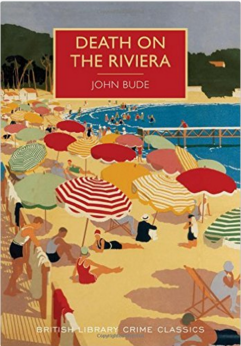
Cover for Death on the RivieraDetective-Inspector Meredith and Sergeant Freddy Strang are on an unusual mission. They are following up clues that a British counterfeiter, “Chalky” Cobbett, is operating a counterfeiting ring on the Riviera. Since Meredith has encountered Chalky before, the French police hope the D. I. can help find and identify him. Meredith cautions Strang that they are working undercover, but not before they meet a tourist named Bill Dillon.

Nesta Hedderwick is a rich, middle-aged British woman with a villa in Menton who sometimes patronizes young, handsome men. Currently, she has two living with her in addition to her niece Dilys. Tony Shenton, in Dilys’ opinion, has been sponging off her aunt for far too long. He has no employment and orders the servants around as if they were his. His aunt has even given him a sports car. Even worse, he has invited a girl to stay, Kitty Linden, who is clearly infatuated with him.

Paul Latour is the other man. He keeps odd hours and spends most of his time in his room, painting. But when Dilys goes to an art show, she recognizes some of his work—with someone else’s name on it.

At the show Dilys meets Freddy Strang, who introduces himself as John Smith. Later, he is embarrassed when they run into Bill Dillon, who has come looking for Kitty, and Dilys finds out he is using a false name.

link to NetgalleyThe murder mentioned in this novel doesn’t occur until fully halfway through the book. Instead, we follow the details of the investigation into the counterfeiting ring and Freddy’s romance with Dilys. This atmospheric novel is one of the more enjoyable of these Poisoned Pen class reprints. There isn’t a great deal of characterization, but in general that is common with these older mysteries.

Related Posts

The Singing Sands

Thirteen Guests

Antidote to Venom

Day 872: Elizabeth Is Missing

Cover for Elizabeth Is MIssingBefore I begin my review, here is a little bit of news about the Walter Scott Prize for Historical Fiction. Some of you may know that, along with Helen of She Reads Novels, I am attempting to read all the short-listed novels. Today the short list for 2016 was released. To see the list, check out my Walter Scott project page. I have only read one of the novels, but was disappointed, along with other readers, to see that A God in Ruins, which was on the long list, didn’t make the short list.

* * *

Elizabeth Is Missing is—I won’t disguise it—the third book about Alzheimers I’ve read in the last six months. When the book blurb says Maud is forgetful, that’s putting it mildly. After only a few pages of this novel, I wondered why Maud was living alone.

Maud is an old lady who is having trouble keeping track of just about everything. She writes herself reminder notes but loses them. She makes endless cups of tea and forgets them. Her caregiver comes in every morning and makes her lunch and she has eaten it by 9:30. She remembers occasionally that her friend Elizabeth is missing. Elizabeth doesn’t answer her phone and she isn’t home. But no one pays attention to a dotty old lady.

Of course, we realize fairly quickly that Elizabeth isn’t missing, but Maud has a more important mystery in her life. When she was a young girl just after World War II, her older sister Sukey disappeared, never to be seen again. Although Maud’s short-term memory is inconsistent, there’s nothing wrong with her long-term memory, at least not at first, so the more coherent narrative is the time around Sukey’s disappearance. Maud finds the boundaries between the past and present blurring.

I found this novel extremely painful to read at times, even more so than Still Alice. However, it is certainly compelling although not perhaps as realistic as Still Alice is.

One thing that bothered me, although only a bit, is that Maud clearly has all the information she needs to solve her sister’s disappearance, if only she can make sense of it. But she tried to investigate when she was young, and she had the same information then. That she would finally solve it in her current condition is a bit hard to buy. We’re to understand that she found something before the action of the novel, though. At least, that’s what I think happened, since sometimes the narration from the point of view of a confused old woman is a little opaque.

Related Posts

Still Alice

This Is Your Life, Harriet Chance!

Family Furnishings

Day 863: A Banquet of Consequences

Cover for A Banquet of ConsequencesDetective Sergeant Barbara Havers is in a lot of trouble with Superintendent Ardery since she nearly went off the rails in the previous Detective Lynley novel. So, Ardery is having Inspector Lynley keep her on a short leash. But Lynley thinks the leash is too short, because Barbara is tamping down everything, including her contributions to investigations. Finally, she is contacted about a case that Lynley thinks she can take charge of herself.

But the novel begins three years earlier. William Goldacre has been trying to reconcile with his girlfriend, Lily Foster. William has a condition that causes him to utter nonsense words and profanity when under stress. But Lily’s problem with him is the relationship he has with his family. William and Lily go on a camping trip, but Will commits suicide when he finds Lily reading his journal, and Lily is horrified about what she reads there.

In the present, Barbara encounters Caroline Goldacre, William’s mother, when she attends a talk by feminist Clare Abbott. Clare gives Barbara her card because she is interested in Barbara’s t-shirt, but Caroline, who is Clare’s assistant, takes it upon herself to ask for the card back. Rory Stratham, Clare’s agent and good friend, gives Barbara another card.

A few days later, Rory contacts Barbara to tell her that Clare was found dead in her hotel room. Although the death is considered natural, Rory finds it high suspicious. She also suspects someone, Caroline Goldacre, whose relationship with her employer seemed unusual at best.

When Barbara performs an initial investigation, she finds hotel staff who overheard Caroline and Clare arguing. An autopsy reveals that Clare was poisoned. Before Barbara can tell Rory, Rory herself has been poisoned, although she is not dead. Lynley dispatches Barbara and Sergeant Winston Nkata to Shaftsbury to investigate. Ardery’s orders are for Winston not to let Barbara out of his sight.

The evidence seems to point to Caroline Goldacre until the detectives find out that Clare borrowed Caroline’s toothpaste and that was the source of the poison for both women. But was someone trying to murder Caroline, or is Caroline simply a clever murderer who made it look that way? Caroline herself is manipulative and nasty to just about everyone.

I have been distressed by how melodramatic George’s series has been the past few books, basically since the death of Lynley’s wife. Although the Detective Lynley series is one of the few that has recurring characters who are as interesting as the mysteries, the last few years they have been behaving atypically. This book is the first in a while that seems back on track. The personal plots involve Lynley’s relationship with his current girlfriend and an amusing plan of Dorothea Harriman’s to spiff Barbara up and find her a boyfriend. I very much enjoyed this novel and feel that it is returning to the strong series it was when I first discovered it.

Related Posts

A Great Deliverance

Believing the Lie

Just One Evil Act