Day 501: Waiting for Wednesday

Cover for Waiting for WednesdayThe writing duo Nicci French has come out with another powerful Frieda Klein mystery with Waiting for Wednesday. Although it deals mostly with another case, there is still the threat of a serial killer from the first book in the background.

DCI Karlsson and his team are trying to solve the murder of Ruth Lennox, a housewife whose face was smashed by a heavy object. Although her death appears to be part of an interrupted robbery, when the police find the thief, he has an alibi for the actual time of the murder. Soon Karlsson and his team find evidence that Ruth was leading a secret life.

Frieda is recovering from injuries incurred at the end of Tuesday’s Gone, and she is on leave from her practice. Her absence from the case does not prevent another psychoanalyst who is working with the police, Hal Bradshaw, from seeing her as a threat and attempting to professionally humiliate her.

Bradshaw has set a trap for Frieda and some other analysts he dislikes by sending in graduate students for consultation who pretend to have sociopathic thoughts and ask for treatment. Frieda immediately realizes her subject is pretending and sends him away, but something he says captures her attention and she begins trying to track down the source of the story. In doing so, she meets Jim Feary, a retired journalist who is sure he has happened upon traces of a serial killer. When Frieda takes Jim and his evidence to see Karlsson, though, Karlsson believes that her judgment is impaired because she is still traumatized by her experiences and that Jim is a nutcase.

http://www.netgalley.comFrench presents a complex set of mysteries in this novel, which is really gripping and ultimately suspenseful. While Frieda flounders with too much going on in her usually quiet life to allow her to make her recovery, Karlsson, Yvette, and Riley struggle with a case that gets more and more complicated. Even if you can figure out a piece of one puzzle, as I did, there is still a lot more going on in this intelligent mystery novel.


Day 495: Just One Evil Act

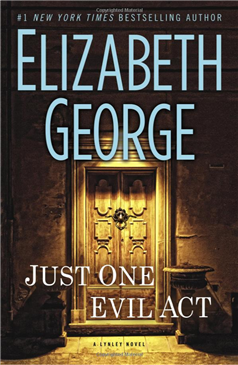
Cover for Just One Evil ActI can chart my changing attitude toward Elizabeth George’s Inspector Lynley mystery/thrillers simply by how I treat the new books. I used to get them as soon as they were available and read them immediately. This one I had for a couple of months before reading it. They are still page turners, don’t misunderstand me, but George has put her characters, and fans, through a lot.

George is not a proponent of the idea of keeping her characters’ private lives out of her mystery novels—very much the opposite. At first their absorbing lives made these novels stand out. But by now she has put Lynley through a brother accused of murder, a fiancée marrying his best friend, a seemingly hopeless romance, a murdered wife, and an ill-judged affair with his alcoholic boss. Heretofore, Sergeant Barbara Havers, although sometimes rebellious and unruly, has been a rock of good judgment, often better at finding the criminal than Lynley is. So, now it’s her turn to go off the deep end.

At the end of the previous novel, Believing the Lie, Barbara’s neighbor Taymullah Azhar had his sweet young daughter Hadiyyah kidnapped by the girl’s mother Angelina, who returned to Azhar pretending a reconciliation in order to get an opportunity to take the child. The situation is complicated because the parents never married and Azhar’s name is not on Hadiyyah’s birth certification, so for now he has no legal right to her (although, if that is so, since Angelina abandoned them, British law must be really weird). In addition, he has no idea where they have gone.

The Met can’t apparently help him, so Barbara takes Azhar to a private investigator, Dwayne Doughty, and they hire him to find Angelina and Hadiyyah. Eventually, though, Doughty reports back that there is no trace of the two to be found.

The tables turn quickly, though, when Angelina returns with her lover Lorenzo Mura, claiming that Hadiyyah has been kidnapped from them, so Azhar must have taken her. When it appears that Azhar is just as alarmed as Angelina and that he has an alibi for the time of the kidnapping, they all return to Lucca, Italy, where Angelina and Mura have been living. Inspector Lynley is assigned to go along as liaison between the parents and the Italian police. Isabelle Ardery, the boss, refuses to let Barbara come along.

Barbara absolutely refuses to believe that Azhar has had anything to do with the kidnapping. She has already given information to a tabloid journalist to create enough furor in Britain about the kidnapping for someone to be assigned to the case, and that liaison with Mitchell Corsico is not only a breach of trust but a major source of drama—and irritation—for the rest of the novel. The novel ends with Corsico assuming Barbara is in his debt. I certainly hope George doesn’t plan to pursue that subplot, because I found it to be too far over the top, with the journalist demanding more disclosures about every 15 minutes (an exaggeration, admittedly) and always when Barbara urgently needs to be doing something else.

Unfortunately for Barbara, as she breaks all the rules set by her new boss, John Stewart, to investigate the case from her end, it begins to look as though Azhar did indeed plan the kidnapping and execute it with the help of some of Doughty’s contacts in Italy. We readers actually know where Hadiyyah is, although we don’t know the identity of her kidnapper. But we also soon learn that her kidnapper has died, leaving Lynley and the excellent Italian detective Salvatore Lo Bianco to figure out who he was and where he put the child. Lo Bianco’s efforts are hindered by the actions of his incompetent boss.

In the midst of all this, Angelina dies, and it becomes obvious that she was murdered. Soon, it looks as though Azhar could be implicated in that, too.

My problem with this novel is Barbara’s behavior, as she goes overboard to protect Azhar. First, there are the leaks to Corsico which, after the first one, seem totally unnecessary. Then she begins concealing and attempting to alter evidence. I won’t go on. Even worse is how this trouble is wrapped up at the end of the novel, either by a cheat or a completely unlikely act on the part of Ardery.

You can tell I had a mixed reaction to this novel. On the one hand, it is extremely gripping. On the other hand, especially if you have been following the series and care about Barbara, you occasionally want to throw the book across the room. For the last four or five books, I’ve been wondering whether to quit the series, but I always end up picking up the next one.

Finally, I was upset by how the novel ends for Azhar and Hadiyyah, who for a large part of the series have been two of the most likable characters.

Day 493: Between Summer’s Longing and Winter’s End

Cover for Between Summer's Longing and Winter's EndBest Book of the Week!
Between Summer’s Longing and Winter’s End is difficult to place in genre because while it is about the investigation of a crime and its repercussions, it is also reminiscent of the more cerebral of John Le Carré’s political thrillers without so much being a thriller as a record of law enforcement incompetence. The novel is crammed with characters who are mostly concerned with pursuing their own agendas, whether it be the chief constable of Sweden with his ridiculous intellectual exercises or a member of the secret police who is more concerned with pursing graft and sexual exploits than doing his job.

The novel is a fictional dissection of the possible scenario behind the true-life assassination of the Swedish prime minister Olof Palme in 1986. It is the first of a trilogy of which only two novels have been published in English, but it stands fairly well on its own.

Between Summer’s Longing begins with an apparent suicide. A man living in a student apartment in Stockholm plunges to his death from his window. The apartment door is locked from the inside, and there does not appear to be any other explanation for the incident, even though the man’s shoe fell shortly after the body, killing the small dog that had just saved his master’s life from the falling body. The dead man is identified as John Krassner, an American journalist.

There are a few odd things about the crime scene, including the unusual message the man apparently left as a suicide note and the lack of a manuscript he had supposedly been writing. Still, everyone appears to be ready to wrap things up when police Superintendent Lars M. Johansson discovers that his own name and address are on a slip of paper inside a hollow heel of the man’s shoe.

In a separate time stream, the novel returns to several months earlier when the Swedish secret police get a tip to keep an eye on John Krassner. Chief Operations Officer Berg is informed by his people that they are having difficulty finding out what Krassner is up to because he seldom leaves his room, which is close by that of several students. He puts police Superintendent Waltin in charge of an operation to lure Krassner out of the house at a time when it will be empty and send an independent operative in to search his apartment. That operation takes place the night Krassner is killed, but Waltin’s operative assures him he was finished and out before the death.

Persson takes us down some labyrinthine trails before finally getting to the assassination and also before we find out exactly what happened to Krassner. In the meantime we encounter espionage agents, secret societies, sexual deviants, drunks, and incompetents, almost all of whom work for the regular or secret police or the government. If there is any hero of the novel, it is Superintendent Johansson, who figures almost everything out.

The novel is gripping and well written except for a couple of murky passages, but I wasn’t sure if I found them murky because of my own lack of understanding of Swedish politics of the 80’s or if they were perhaps even purposefully murky. Persson himself was a whistle blower in the Swedish police, so it should not be a surprise to learn that the novel is cynical, sly, and full of intrigue.

Day 480: Playing with Fire

Cover for Playing with FireThis DCI Alan Banks mystery begins with a fire on a couple of canal barges. A squatter named Tina Aspern has been killed on one and an artist named Tom McMahon on the other. Accelerant is present, and it appears that McMahon’s boat was the origin of the fire.

On the scene appears Tina’s boyfriend Mark Siddons, but his alibi that he was with another woman after a fight with Tina checks out. Banks and DI Annie Cabbot and their team are able to discover very little about McMahon except that he has failed as an artist and buys cheap old books from a store owned by Leslie Whitaker.

Soon another fire kills Roland Gardiner in his caravan (mobile home). The police are trying to link the two men, but Gardiner was unemployed and almost a recluse. Tests reveal that both McMahon and Gardiner were drugged before the fires were set.

Annie’s boyfriend Phil Keane, an art expert, suggests that one use for old paper is to employ it in forged artworks. When the police find a fire-proof safe in Gardiner’s caravan containing money and some drawings that seem to be Turners, Banks and Cabbot think they may at least have uncovered a motive. But who could the murderer be? Is it Leslie Whitaker?

Finally, tracing a rented Jeep leads them to a shadowy figure, a man who does not seem to exist. He turns out to be very dangerous indeed.

Playing with Fire is a fast-paced and complicated mystery. Some sixth sense made me guess the killer almost as soon as he appeared, but I don’t think the solution is obvious. If you enjoy an intelligent police procedural, I think you’ll like Robinson’s series. The only other book I have read by him, which was not really part of the series (a more atmospheric novel in which Banks appears but is not part of the story), I enjoyed even more.

Day 478: Mr. Timothy

Cover for Mr. TimothyAlthough not typical holiday fare, Mr. Timothy picks up some of Dickens’ characters about 20 years after A Christmas Carol and has the added similarity of being set at Christmas time. The main character is Timothy Cratchitt, familiar to us as Tiny Tim.

Timothy is depressed and aimless. The patronage of Ebenezer Scrooge, or Uncle N as he is known in this novel, has had the unfortunate effect of making Timothy dissatisfied with his roots while not fitting him for much else. Most of his family has died or moved away, and he is depressed about the death of his father six months before. In despair, he has left his usual haunts and gone to live in a brothel, where he teaches the owner, Mrs. Sharpe, how to read. Although he has some desire to make his own way, he lacks purpose and initiative, still accepting an allowance from Uncle N. He seems to be on his way down in life.

Timothy goes out dragging the river for bodies one night with his friend Captain Gully, and they pull out a young girl. She has an odd brand on her back, like a G with eyes. Timothy realizes he has seen this brand before, on another girl the police were examining as he went by, who was found dead in an alley.

Timothy has several times spotted another young girl around the city and tried to approach her, but she has always run away. With the help of a street urchin named Colin, he finally tracks her down. Philomela is Italian and has had something traumatic happen to her of which she will not speak. When Timothy tries to take her home to safety, two different parties attempt to remove her from his custody on the street. A charity worker insists she will take Philomela to a home, and a mysterious man in a coach tries to kidnap her. Philomela and Timothy get away, but now Timothy is determined to find out what is going on.

This novel is a slow starter and fairly depressing at the beginning. Although it is feasible to theorize that Scrooge’s help could result in such unhappiness (ala Great Expectations), I wasn’t sure I wanted to think of the original story in these terms. However, the novel successfully invokes a Dickensian atmosphere, including the comic characters and character names, and it picks up its pace as Timothy gets involved in the mystery. After the first 50 pages or so, I was involved and trying to figure out the mystery, which is as entangled as any Dickens effort.

Day 475: The Beggar King

Cover for The Beggar KingBehavior is a problem in The Beggar King, the third of Oliver Pötzsch’s Hangman’s Daughter series, but the first I have read. Characters who are in peril of their lives stop running away from their pursuers to have arguments; characters who are fighting for their lives start flashing back to their pasts instead of concentrating on not being killed. To be very clear about this problem, the characters do what the plot requires. When the plot requires the three main characters to be apart, for example, Pötzsch has them begin arguing or just has someone walk off instead of finding a plausible reason for separating them.

The novel begins in 1662, when the Schongau hangman, Jakob Kuisl, gets a letter from his sister in Regensburg saying she is very ill. When he arrives at the bathhouse her husband owns, he finds her and her husband brutally slain. Immediately afterwards, the authorities rush in and arrest him. Now it is up to the Regensburg hangman to torture him into a confession.

In the meantime, back in Schongau Magdalena Kuisl and her lover Simon Fronwieser have run into trouble. As the hangman’s daughter, Magdalena is considered to be among the lowest rungs of society, and she is not allowed to marry Simon, a member of the middle class. A series of encounters with a group of bullies finally ends in the Kuisls’ house being set on fire. Instead of helping her mother and her eight-year-old twin siblings (who by the way behave more like four or five than eight) as might be expected, Magdalena and Simon decide to run off to Regensburg to start a new life.

I have been to Regensburg, which is a beautiful medieval city with an interesting history. We learn a bit about this history, and that is probably the most interesting part of this novel. The city is mostly described to us in terms of its mud and filth, however, not in terms of its lovely pastel stucco buildings decorated with beautiful medieval-era murals or winding cobblestone streets.

However unlikely, our three main characters have stumbled into two plots, one of revenge against Jakob for events during the Thirty Years’ War, the other involving an imminent threat to the Reichstag. Soon, all three protagonists are wanted by the authorities, Magdalena and Simon for arson after someone burns down the bathhouse with them in it, Jakob because he has escaped. Nevertheless, they chase all over the city without anyone noticing them unless Pötzsch needs them to be noticed. In the meantime, they unfailingly trust the wrong people and assault the ones who are trying to help them.

This novel is certainly full of frantic activity. Whether it is plausible at all is the question. I was particularly irked by the last 50 to 75 pages, in which all three characters are in peril in separate locations. Just as one scene reaches a climax, Pötzsch switches the action to another location. This tactic might foster suspense if done once, but Pötzsch uses this technique repeatedly over 50 pages simply to spin things out. I found this tactic so irritating that I almost quit reading at the end of the book!

Although the novel is written moderately well, the characters are one-dimensional and their behavior is driven by plot. The plot itself is ridiculous.

Day 462: The Return of Captain John Emmett

Cover for The Return of Captain John EmmettThe Return of Captain John Emmett is the first of Elizabeth Speller’s Laurence Bertram mysteries set just after World War I. I previously reviewed the second in the series, The Strange Fate of Kitty Easton.

Laurence Bertram has felt himself at a loss since the war ended. He is haunted by his memories of the war and also by guilt at his lack of grief over the deaths of his wife Louise and baby son, whom he never saw. Ostensibly writing a book about church architecture, he is finding it difficult to work. So, it is with a bit of relief that he responds to a letter from Mary Emmett, the sister of an old school friend John Emmett, in which she asks him to come visit her.

Laurence has fond memories of some school leave visits with the Emmetts after his parents died but feels Mary has misunderstood the depth of his friendship with John, whom he has not seen in years. Of course, he has heard of John’s death, an apparent suicide. Mary explains that John had been staying in a rest home because of mental disturbance following the war. Since he seemed to be improving, she and her mother cannot understand why he committed suicide. She asks John to find out what he can about John’s motives.

Laurence feels uncomfortable but agrees to look into it because he has always been attracted to Mary. With the help of his friend Charles Carfax, who gets his detective skills from reading Agatha Christie books, Laurence investigates the rest home and anything he can find out about John’s state of mind before his death. Included in John’s curious scraps of paper and photos is a list of the beneficiaries of his will, some of whom cannot be identified or located, and some photos from the war.

Laurence comes to believe that John’s death has something to do with his war experience, possibly with an execution over which he was forced to preside. And it seems John may not have committed suicide after all.

Speller takes her time with these mysteries. The settings are beautifully described and the period effectively evoked. A true sense of depth of character emerges. Even though I was about 100 pages ahead of Laurence, not in identifying the perpetrator but in realizing the motive, I enjoyed every bit of this novel.

In the last few months, I have read several historical mysteries where the author did little with the time or place, simply using the historical events to frame the plot. Thankfully, Speller has taken more care with this interesting period of history.

Day 460: March Violets

Cover for March VioletsThe blurb on Philip Kerr’s collection of three noir mysteries, Berlin Noir, compares him to John Le Carré and Alan Furst. I wouldn’t say that is an apt comparison. For one thing, the other two are writing in a different genre. For another, they are better writers. Still, if you like noir, March Violets has its own qualities.

This novel is the first in a series featuring private detective Bernie Gunther. It bears many of the hallmarks of a typical noir mystery. Its main character is a smart, wise-cracking tough guy who used to be a cop. It features beatings, untrustworthy dames, thugs, and murder. What makes it stand out is its setting in 1936 Berlin.

Bernie is hired by millionaire industrialist Hermann Six to find a family heirloom necklace. It was stolen from the safe of his daughter Grete and her husband Paul Pfarr when the two were brutally murdered in their beds and their bodies burned. Herr Six explicitly instructs Bernie not to look into their deaths but to find the necklace and return it to him. Of course, Bernie begins looking into everything.

Using credentials as a representative of an insurance company investigating the fire, Bernie soon finds out that Pfarr was a member of the SS, with a mission from Himmler to seek out corruption in the labor movement. That mission made him a lot of enemies. He also had some kind of friction with Herr Six, who is rumored to have ties to organized crime. In addition, there were unexplained problems in the Pfarr’s marriage.

Typical of noir fiction, the plot becomes very involved. The setting is convincingly evoked, especially the constant threat of violence for ordinary citizens under the Nazis. Bernie specializes in missing persons, and the novel makes clear that hundreds of people go missing from Berlin daily.

Since I am more familiar with classic noir, the novel occasionally struck me as too coarse, but that didn’t bother me as much as other uses of language. First, idioms with which I am unfamiliar are used constantly. Perhaps they are period German idioms, but they often seem clumsy and inapt, which idiomatic  language seldom does. Also clumsy and inapt are Kerr’s many metaphors, for example:

The butler cruised smoothly into the room like a rubber wheel on a waxed floor and, smelling faintly of sweat and something spicy, he served the coffee, the water and his master’s brandy with the blank look of a man who changes his earplugs six times a day.

Perhaps this style of writing is meant as a send-up of traditional noir style, but it is certainly overblown and irritating. (To be entirely dated in my references, it sometimes reminds me of the passages read by Jeff Goldblum’s character in the old TV series Ten Speed and Brown Shoe, but those were explicitly tongue in cheek, and I’m not as sure about Kerr’s writing style.) Although at one point I considered putting the novel aside, I finally decided to continue, and found the book moderately entertaining.

Day 453: Burial Rites

Cover for Burial RitesBest Book of the Week!

Based on the true story of the last woman to be executed in Iceland, Burial Rites is an unusual and original novel.

Agnes Magnúsdóttir has been found guilty of the murder of her employer, Natan Ketílsson, and another man when the novel begins. There is no doubt that Fridrik Sigurdsson committed the act, but Agnes and her fellow servant Sigrídur Gudmundsdóttir have also been found guilty on little more evidence than that they were present at the scene. The younger, prettier Sigrídur, who was Natan’s mistress and Fridrik’s fiancée, is being considered for a pardon, but Agnes is not.

Because Iceland does not apparently have facilities for housing criminals at the time, the District Commissioner Björn Blöndal decides to lodge Agnes until her execution at Kórnsa, the farm of the District Officer of Vatnsdalur, Jón Jónsson. Agnes has requested that the young Reverend Thorvardur Jónsson, newly ordained, supervise her spiritual welfare.

Jón Jónsson’s wife and daughter are horrified to learn they are to have a convicted murderess in their house. Reverend Jónsson, known as Tóti, is confused, feeling insufficiently experienced for the task and unaware that he has already met Agnes.

We first see Agnes on her way to Kórnsa. She has been kept in a storeroom, living in filth and seldom fed, since her conviction. When she arrives at the farm, she seems almost subhuman, grimy and greasy and so thirsty that she gulps down some dirty dishwater given her to wash in. Slowly, through her hard work and unobjectionable demeanor and their own basic decency, the family comes to believe Agnes may not be guilty of the crime.

Although the focus of this novel is the life on the farm and the evolving relationship between Agnes and the family of Jón Jónsson, we eventually learn the truth about the crime, as Agnes confides it to Tóti and the family.

Kent’s gift is for depicting the hard life of 19th century Iceland—the merciless fate of itinerant servants, the prevalence of gossip and superstition, the brutal conditions and physically demanding work. Kent also describes the mental landscape of Agnes, her memories, thoughts, and nighttime dreams, and less frequently those of Margrét, Jón Jónsson’s wife, and of Tóti.

This novel is evocatively written in beautiful, spare prose. It tells a heartbreaking and haunting story.

Day 448: The Tiger in the Smoke

Cover for The Tiger in the SmokeI have only read one other Albert Campion novel, and that was so long ago that all I can remember is not having much of a sense of Campion. I can say the same thing after reading this novel, although it has other qualities. Perhaps one can only get an understanding of Campion through reading the series.

In this post-World War II novel, we get a feel for the effect of the war on London. The wealthier households no longer have servants, shoddy neighborhoods have sprung up near where service men used to gather, the ruins of bombed buildings are everywhere, as are groups of unemployed veterans. To this setting Allingham adds the further atmosphere of a heavy fog that persists over the course of the novel. This fog is vividly described and is almost a character in the novel.

Meg Elginbrodde, a young war widow, has recently announced her betrothal to Geoffrey Levett, a wealthy businessman. Beginning directly after the announcement, however, Meg receives poor-quality street photographs of someone who looks like her husband, Martin Elginbrodde, supposedly blown to bits during a battle. No message has arrived explaining these photos, and when we meet the engaged couple, Geoffrey is dropping Meg off for a rendezvous that Campion has arranged as a trap for the culprit.

Meg is to walk into the train station to meet the man, where Campion and the police will capture him. However, when Meg sees the man at a distance, his resemblance to Martin is so strong that she shouts his name and runs toward him, startling him away. Campion eventually captures him, and Meg is embarrassed and puzzled to find that close up, the man doesn’t look like Martin at all. He turns out to be a low-level criminal named Duds Morrison.

Campion and Detective Charlie Luke are fairly confident that someone hired Duds for the impersonation, but what was it meant to accomplish? Duds isn’t talking; in fact, he seems terrified, and rightly so. Within an hour of his release, he is found stabbed to death in an alley.

Campion notices one thing that helped Meg mistake Duds for her husband. He is wearing Martin’s distinctive coat. When Campion repairs to the unusual household of old Canon Avril, Meg’s father and Campion’s uncle, to investigate, he finds the coat was recently in the house. How could it have fallen into the imposter’s hands?

Soon the police find a connection between this case and the escape from jail of a very dangerous man, who calls himself John Havoc. Havoc murdered an eminent physician to escape and subsequently killed three people trying to break into the law office that handled Martin Elginbrodde’s estate. He did not escape, though, early enough to have killed Duds.

In the meantime, Geoffrey Levett is missing.

The plot of this novel, like many of those from the Golden Age of Detective Fiction, is absurd. However, the novel is notable for its strong and vivid characterizations—of one of fiction’s first sociopaths as well as of the many unusual and delightful characters living in Canon Avril’s house. Campion himself remains a quiet character instead of being a presence such as Lord Peter Wimsey or any of Christie’s detectives.