Day 444: Murder at Mansfield Park

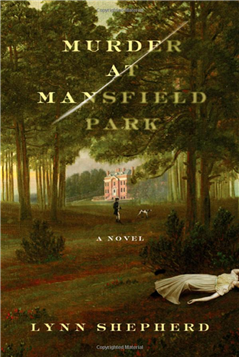
Cover for Murder at Mansfield ParkIt’s hard to explain my fascination with the books of Lynn Shepherd, even to myself, when she repeatedly skewers the books and some of the characters I love with her dark reinterpretations.

The cover of Murder at Mansfield Park quotes the literary critic Lionel Trilling: “Nobody, I believe, has ever found it possible to like the heroine of Mansfield Park.” Apparently, Shepherd shares his views.

That heroine, of course, is Fanny Price, and I have to admit I do like her in the original novel, even though she is not my favorite Austen heroine. Shepherd had to jump through some hoops in her recasting of Fanny, however, to get her to be really unlikable.

In Shepherd’s novel, instead of Fanny Price being the despised, impoverished orphan living with wealthier relatives, Shepherd transforms her into a spoiled heiress, whom the Bertrams and the dreadful Mrs. Norris treat better than their own children. Fanny’s marriage with her cousin Edmund Norris has long been planned, at least by Mrs. Norris.

Mary Crawford in the original novel was the worldly socialite whose lax views eventually shocked Edmund into dropping her, but in Murder at Mansfield Park, she is the heroine. Her brother has been hired to redesign the grounds of Mansfield Park. In this novel, she has switched positions with Fanny Price in that she and her brother have little money, and Mrs. Norris treats them with disdain.

Fanny shows little desire to wed the introverted Edmund and finds entertainment in filching suitors from her cousin Maria Bertram and being nasty to everyone. I would not usually give away an event that occurs well into the novel, but the blurb makes no secret that Fanny is eventually found murdered after going missing for some weeks. Suspects abound. Charles Maddox, Shepherd’s sleuth, arrives to solve the crime.

I don’t think I enjoyed this reimagining of Austen’s novel as much as I have some of Shepherd’s others, even though she is amazingly adept at recreating Austen’s writing style. I think my reaction is because she probably could have achieved a similar effect, more subtly, without changing so many aspects of the original story.

I don’t mean to imply, however, that I didn’t enjoy the novel. Shepherd has made a very interesting career for herself by putting a dark spin on classic novels, and it is always entertaining to read her. She is a wonderful writer, and she gets the period details and style of dialogue correct. I think my favorite of hers, however, is still her chilling rewrite of Bleak House.

Day 438: In the Lake of the Woods

Cover for In the Lake of the WoodsBest Book of the Week!

In the Lake of the Woods is a mystery, but not in the traditional sense. It is also a harrowing look at one man’s tormented psyche after the trauma of war.

It is September 1986. John Wade and his wife Kathy have retreated to a remote cabin on Lake of the Woods in far northern Minnesota after John sustained a brutal defeat in a state senatorial campaign. Wade had been beating his opponent handily until information about Wade’s past surfaced, or perhaps it was only rumor.

One day Kathy disappears. Thinking she is just out for a hike, Wade does nothing for awhile, waiting for her to return. Late that night he goes into the village for help.

This all seems fairly straightforward, but O’Brien periodically presents us with a story about what actually happened, only the story is different each time. As O’Brien reveals more, we learn that Wade was behaving oddly the night before Kathy disappeared–or did she disappear that night? Is she lost, did she leave on her own, did something happen to her? We learn that Wade has taught himself to forget anything he doesn’t want to think about–as if it never happened.

O’Brien shows us the psychological makeup of a man who has undergone a great deal of trauma–whose father committed suicide when he was ten, who spent his boyhood in the basement teaching himself magic tricks, who served in Vietnam. But he is also a man who periodically spies on his wife, who calls himself the Sorceror, who makes of himself a master manipulator, who has horrible nightmares.

O’Brien alternates chapters about the search with those that explore Wade’s past. He also includes chapters of excerpts from interviews of those involved and from other sources as diverse as books on psychology, biographies of politicians, and records of military massacres, such as the Battle of Little Bighorn and My Lai.

This novel is absolutely riveting, written in spare and beautiful prose, disturbing and powerful. It is not so much a mystery as a novel about mystery–why we find it fascinating and what we can never know, a single human soul.

Day 435: Literary Wives: The Wife, the Maid, and the Mistress

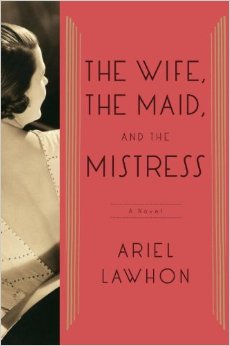
Cover for The Wife, the Maid, and the MistressToday is another Literary Wives posting, where along with several other bloggers, I post reviews of the same book with the theme of “wives.” For more information, see my Literary Wives page.

The famous disappearance of Judge Crater, who like Jimmy Hoffa was never heard from again, certainly has potential for a noirish whodunnit. I just wasn’t that satisfied with Ariel Lawhon’s version of the story.

For one thing, although the plot has all the elements of a noir mystery, the writing style doesn’t reflect the cold crispness and snappy dialogue I expect from noir. It is merely pedestrian.

At the beginning of the novel, Judge Crater’s wife Stella meets Jude Simon, the detective who was on the case, years later in 1969 to give him a confession. Then we return in time to 1930. The bulk of the novels flits restlessly between different days and times around and before this period, returning occasionally to 1969 to Stella and Jude’s meeting.

This time shifting was one of my problems with the novel. I do not remember dates readily, and it was difficult for me to keep my place in time. Possibly a fault that will be cleared up in the published book (I was reading an advanced reading copy) is the problem of the dates at the beginning of sections, which sometimes are there to signal a change in time and sometimes are not. The first time the time changed with no indication, I thought it was a mistake, but then it happened several more times.

In addition, a few scenes that return to an earlier time have no apparent purpose. Perhaps they are intended to establish something about the Craters’ relationship, but I find them unnecessary to the story. The example that comes to mind is a dinner scene where the judge tells Stella where he wants her to shop from then on.

For the plot, the judge disappears at the beginning of the book. His mistress Ritzi is hiding in the room when he is taken, so it is no surprise to find out who took him. His wife Stella and their maid Maria also have some guilty knowledge. Maria sees her husband Jude plant some money in the house after the judge’s disappearance, and Stella removes money from the house and all their assets from the bank before reporting the judge as missing.

Overall, I found the novel mildly entertaining. It does manage a surprise at the end, which I didn’t expect because the novel seemed otherwise predictable. I also think more could have been done to make the time period and the setting more evocative.

Now to our questions for Literary Wives.

What does this book say about wives or the experience of being a wife?

There are two prominent wives in the novel–Stella and Maria. The judge sees his wife’s role as being an ornament and an asset on his way to the top, and Stella seems to have agreed to take this role, although she obviously has lost her respect for him over time. There are some references to happier times, but we frankly can’t see that he has any redeeming qualities. Stella’s only other concern seems to be to make sure she has money after the judge’s disappearance.

Maria’s relationship is more loving. She seems to see her role as to protect and support her husband and to try to become a mother. However, we don’t really see very much of Jude and Maria together, and Jude seems to be preoccupied with his difficulties at work.

In what way does this woman define “wife” or is defined by “wife”?

Except for one central act, which I don’t want to give away, both women are essentially defined by their roles as wives, which are fairly stereotypical for the time. Stella is the society wife. Maria is the religious little woman. This defining act tells us there is more to both of them, but we don’t really understand these women very well as people, and this act is only revealed at the end of the novel, giving us no opportunity to view them in another way. I think Ritzi is the most fully developed character, and although she is actually a wife as well, that part of her character isn’t really explored.

Be sure to view the posts of the other “wives,” as follows. An interview with Ariel Lawhon is posted on Audra’s blog, Unabridged Chick.

Ariel of One Little Library
Audra of Unabridged Chick
Carolyn of Rosemary and Reading Glasses
Cecilia of Only You
Emily of The Bookshelf of Emily J.
Lynn of Smoke and Mirrors

Day 426: A Fatal Likeness

Cover for A Fatal LikenessIn A Fatal Likeness, Lynn Shepherd has created her own gothic horror around the mysteries in the real lives of two fans of the gothic, the poet Percy Bysshe Shelley and his wife, the writer Mary Shelley. It is not only a dark story, but some of it is relatively plausible, given the research Shepherd has done into their lives. Ever since I read Shepherd’s astounding reworking of Bleak House, The Solitary House, I have been a fan of her narrative skills, her writing skills, and her imagination.

Shepherd’s detective, Charles Maddox, is summoned to the home of Percy Shelley, the son of the deceased poet. Shelley and his wife have established a shrine to the poet’s memory and say they are worried about some papers someone is offering to sell them. Mrs. Shelley in particular has been responsible for destroying any papers that would tarnish Shelley’s legacy. They hire Charles to find out what is contained in these papers.

Charles has his own reasons for taking the job, for his beloved great-uncle, also Charles Maddox, the master detective who trained him and is his only family, suffered a stroke upon receiving a calling card bearing the name of his client. Charles learns from his assistant Abel that his great-uncle was employed on a case years before for William Godwin, the brilliant philosopher and Mary Shelley’s father. When the file on this case is located, though, some of the pages have been torn out.

Charles takes a room in the home of the person purveying the papers, whom Charles has been told is an Italian man, and it is not long before he realizes his landlady is Clair Clairmont. Clair, the step-sister of Mary Shelley, infamously ran off with Shelley and Mary when both the girls were only sixteen and Shelley was still married to his first wife, Harriet.

Charles is soon to realize that everyone involved in this case has ulterior motives, those of the Shelleys to find out whether a record of the earlier case still exists, as it certainly contains damaging information. With his great-uncle only slowly recovering, it is up to Charles to discover what mysteries lurk in the Shelleys’ past. As he investigates the earlier case, he finds records of an even earlier encounter with his great-uncle.

The Shelleys’ past is a rat’s nest, with two young suicided women, Shelley’s first wife and Mary’s other step-sister, with several dead infants, with Shelley’s own history of delusions, hallucinations, fits, and obsessions. Each person’s story of the fraught years of the Shelleys’ relationship is different, and it is difficult to know what or whom to believe. It is not long before Charles is to think Percy Shelley was something of a monster.

Doubles are a theme throughout the novel. Shelley is always involved with two women at once, two young women commit suicide, Shelley is obsessed with the idea of a doppelganger and thinks he has encountered a monster with his own face. Charles’ great-uncle was partially deceived long ago by the likeness he perceived between the young Mary Godwin and a lost love.

Shepherd’s writing style is distinctive. She writes in limited third person but overlays this voice occasionally with observations from a more knowing narrator of a later time, perhaps the present. The effect is slightly facetious and ironic in tone.

Her research into this time period and into the lives of the Shelleys is clearly extensive. She impressed me with The Solitary House and here she continues to do so with a fascinating, disturbing tale about some turbulent personalities.

Day 423: Accidents Happen

Cover for Accidents HappenKate Parker has lived the last five years in fear, not of something specific but of harm to herself or her son Jack. She believes she is cursed. First, her parents were killed in a freak accident on the night of her wedding, and then a few years later her beloved husband Hugo was viciously murdered by a gang of men who were trying to steal his car.

Since then, Kate has been obsessed with numbers, the odds of this or that happening that could hurt her or her son. She has gotten so fearful that her in-laws are threatening to sue for custody of her son, claiming she is harming his mental well-being.

Kate is not just being paranoid, though. Fairly early on, we learn that someone is regularly breaking into her house from the student rooming house that shares a wall.

Kate meets Jago Martin, a professor at Edinburg University who is visiting at Oxford. He has written a book that fascinates her on the statistics of events. Once he finds out her problem, he begins a series of unorthodox experiments with her to try to draw her out of her fears. Soon, she seems to be improving, and she is becoming attracted to Jago.

This novel does a fairly good job of building suspense. However, I feel the whole “treatment” idea to be unlikely, first that Kate would agree to do some of the experiments–actually any of them given how she was behaving before–and second that they would help her improve so quickly. There are other plot points I find unlikely, but I can’t discuss them without giving too much away. Let me just say that although the motivation for some actions may not be completely absurd, the chosen target makes no sense at all. Finally, after a villain comes into the open, given the time and effort expended on the tortuous plot, the manner of resolution seems too easy. With these mysterious comments, I will leave you to decide for yourself whether to read the book!

Day 419: The Bones of Paris

Cover for The Bones of ParisHappy Halloween! I tried to select a book that was appropriate for the occasion, although I didn’t have a ghost story lined up.

Laurie R. King’s series about Mary Russell and Sherlock Holmes is very popular, but I prefer her Kate Martinelli series or, even better, some of her dark psychological stand-alone novels. Folly is my favorite. With The Bones of Paris, she brings some of that darker sensibility to what looks like the beginning of a new mystery series.

Harris Stuyvesant is an ex-FBI agent who has been scraping a living in Europe by taking private investigation work. Among the hordes of American expatriates in 1929 Paris, he is searching for a young woman, Pip Crosby, whose relatives have not heard from her in months. A cause for possible embarrassment or worse is that Harris met Pip in Nice the year before and had a brief fling with her. Ever since a disastrous incident that ended his career and cost him his fiancée, he has been living an aimless and bohemian existence.

Two of Harris’ first stops in his search for Pip are Pip’s flatmate, Nancy Berger, and the Paris Missing Persons Bureau. Nancy seems to have a hangover but is actually suffering the effects of travel. She just returned from an archaeological dig in Greece and has not seen Pip for months. Harris finds the police officer, Doucet, concerned about what may be a series of killings.

Harris’ attentions soon narrow on three men connected with the art world whose names keep surfacing in connection with Pip and who all have a fascination with the macabre. The artist Man Ray‘s photographs of Pip focus on a gruesome scar from an accident in her youth. Count Dominic de Charmentier is a wealthy patron of the arts who owns a theatre that alternates grotesque and frightening scenes with comic ones. He also hosts parties that feature macabre decorations and terrifying staged events. Didi Moreau is a creepy, disturbing artist who makes displays of found objects, including human bones. Pip has a few of these displays in her room, as well as some of Man Ray’s photographs. When Harris begins investigating these men more closely, he finds to his alarm that his ex-fiancée, Sarah Grey, is working as de Charmentier’s assistant.

King evokes the time and place with mastery, introducing us to a dissolute café culture populated with famous figures such as Cole Porter and Josephine Baker. She also cleverly raises the creep factor by interjecting short chapters about the bones that underlie parts of Paris, foreboding snippets of conversation, and other indications that something monstrous is going on behind the scenes of glittering nightlife.

Day 412: Stone’s Fall

Cover for Stone's FallBest Book of the Week!
Ever since Iain Pears wrote the stunning An Instance of the Fingerpost, I have been waiting for him to come out with something that could match it for complexity and interest. He has finally achieved this with Stone’s Fall.

Did he fall or was he pushed? might be the question journalist Matthew Braddock is asked to answer when Elizabeth Stone hires him after her husband falls to his death from his office window. Instead, she asks him to find the child John Stone mentioned in his will. Stone’s estate is tied up during the search for this unknown heir, but Elizabeth says she has no ulterior motives except a sincere wish to follow her husband’s wishes. As Stone was an extremely wealthy but private arms manufacturer and the only person who could understand the complex structure of his inter-related companies, many are concerned in his affairs, even the British government.

Completely infatuated with the older woman and feeling wholly unqualified to find the child, Braddock instead concentrates on investigating the last days of Stone’s life and the state of his corporations. In doing so, he finds evidence that Stone’s net worth was not nearly as large as everyone thinks. He also has questions about the involvement of Henry Cort, a mysterious figure believed to work for the Foreign Office. Braddock relates the tale of what he discovered quite some time after his 1909 investigation, in 1953 after Elizabeth Stone’s funeral.

Braddock’s story does not answer many questions even though he believes he has found some facts, but after his narrative, he includes a manuscript sent to him by Henry Cort. Cort takes his own story back further, to events in Paris of 1890, when he befriends Elizabeth after having known her years before.

The final section of the novel takes us to Venice in 1867, when as a young man John Stone meets Cort’s parents and the man who invented the torpedo that began Stone’s empire. It is in this final section of the novel that we begin to understand the answers to the mysteries of John Stone’s life and death.

This series of narratives is like a set of nested gift boxes–as we unwrap each one, we learn more and go deeper into the story, finally beginning to understand the mysterious Stone. The novel is impeccably plotted and beautifully written–a great reading experience for those who appreciate a mystery that is not formulaic.

Day 409: The Secret in Their Eyes

Cover for The Secret in Their EyesBest Book of the Week!
I picked up this novel because I saw the excellent Oscar-winning movie from a few years ago. It had been long enough that, even though the movie stayed fairly close to the book, I didn’t remember some of the key plot points. The movie emphasized the crime-solving aspects of the novel, which is more about political corruption, Argentina’s violent history, and finally, a love story.

Written as a novel within a novel, the story spans more than 30 years. Benjamín Chaparro has retired after a long career as deputy clerk in an examining magistrate’s court, the court responsible for carrying on criminal investigations. As he wants to find something to occupy himself in his retirement, he decides to write about a case he worked on 30 years before, the ramifications of which seriously affected his life.

In this case from the 1970’s, a beautiful young woman, Liliana Colotto, has been found raped and murdered in her apartment. Although it is not a customary part of his duties, Chaparro’s judge sends him to the crime scene to observe the investigation. He is struck by the woman’s beauty and also by how the police are trampling all over the crime scene to get a look at her.

Her husband, Ricardo Morales, is in the clear, because a neighbor saw a man come to the woman’s door after her husband left for work. The investigation takes a false start when the other deputy clerk in Chaparro’s office decides that two workmen in the apartment building did it and has a confession beaten out of them. Chaparro figures out what is going on very quickly and files a complaint against the clerk, Pedro Romano. This incident has far-reaching effects on both the case and Chaparro’s life.

After this false start, the case goes nowhere. Chaparro has been meeting with Ricardo Morales periodically to keep him informed, but the investigators have been unable to find any clues to the identity of the mysterious man. The case is about to be closed when Morales shows Chaparro some snapshots of his wife, and Chaparro is able to discern the secret in the eyes of one man–that he was in love with Liliana Colotto and angry at her marriage. Chaparro sees the secret because he has his own–he has been in love with his married coworker, Irene Hornos, for years, since he first saw her. It is not revealing too much to say that Chaparro and Morales soon identify this man as Isidoro Gómez, because as I said, the focus is not on the solution of the crime but on the aftermath.

Several years go by before Gómez can be found. With the clever help of his friend and coworker Pablo Sandoval, Chaparro is able to get Gómez to confess to the murder, even though they have no evidence against him except the fact that he was late for work for the only time on the day of the murder. This should have been the end of the case, but because of corruption, political influence, and state-sponsored terrorism, the case and its ramifications follow Chaparro and Morales for more than 20 years.

The present-day story is concerned with the difficulties of writing and of Chaparro’s heart-yearning over Irene, who is now a judge. He has never spoken to her about his feelings, even though he left his first wife when he realized he loved Irene. He has been using his book as an excuse to meet with her to discuss it and the case.

This novel is wonderfully well written and absorbing. The conscientious, upright, deprecating Chaparro makes wry and cynical observations about the workings of the judicial system. The novel suspensefully shows how a state-sponsored reign of terror can affect the lives of even very ordinary citizens who are just trying to live their lives and how it can create injustice even in a case that has nothing to do with politics. The Secret in Their Eyes provides a fascinating look at a time in Argentina that many of us know little about.

Day 405: The Child’s Child

Cover for the Child's ChildEven though The Child’s Child is a relatively short novel, it seems to take a long time to get to the payoff. Although Barbara Vine’s novels are more character studies than thrillers, they always involve a certain amount of suspense.

This book uses a novel-within-a-novel structure, with the exterior novel taking place in 2011 while the interior one begins in 1929. The themes of unwed motherhood and homosexuality and the extent to which both are stigmatized are the same in both stories.

Grace Easton is a graduate student working on a thesis about the portrayal of unwed mothers in literature. She and her brother Andrew have inherited a house and impulsively decide to share it instead of selling it. However, they have not discussed issues such as how to deal with prospective mates, and soon enough Andrew, who is gay, has brought home James, a writer. Grace and James do not get on, and she begins to feel uncomfortable in her own home.

One evening Andrew and James witness a brutal crime against a gay friend, about which they will be called upon to testify. James is extremely upset by this event, and his reaction leads to unforeseen complications.

Grace has promised to read the manuscript (the interior novel) written by an acquaintance’s father with a view to telling the acquaintance whether it is publishable. She has been avoiding reading it while she works on her thesis but finally begins. We are led to understand that, while presented as a novel, it is actually a true story of the writer’s relative.

In the interior novel, Maud Goodwin becomes pregnant at fifteen and is immediately rebuffed by her family, with the exception of her brother John. John has recently taken a new job in a different county, and his solution to his sister’s problem is to set up housekeeping with her, the two of them posing as husband and wife to avoid her shame. John is homosexual, which of course was illegal in those days, and has vowed to remain celibate, so he knows he will never marry.

The interior novel takes up the bulk of the book, which I found unfortunate. I thought John was in some ways foolish, and Maud becomes a bitter, ungrateful woman. My immediate thought, even as John was deciding what to do, was that Maud’s situation could just as effectively and more sensibly have been taken care of by her posing as a widow and sharing a house with her brother.

Sadly, John lacks judgment in where he bestows his affections, and when he chooses a partner he basically seals his fate. I had some sympathy for John, but he exits the novel fairly early on, and I grew to dislike Maud more and more.

It isn’t until the narrative returns to the present time that I feel the novel regains its focus and finally provides some payoff, and the long-anticipated suspense. In addition, sadly, the themes of the novel seem labored and obvious, to the point where the author has characters voicing them instead of letting the reader figure them out. If you want to try Barbara Vine, the name Ruth Rendell uses for her psychological suspense novels, I suggest instead A Dark-Adapted Eye, which is one of my favorites.

Day 402: Dust and Shadow

Cover for Dust and ShadowIn Dust and Shadow: An Account of the Ripper Killings by Dr. John H. Watson, Lyndsay Faye combines a great deal of research into the Jack the Ripper killings in 1888 with a vast knowledge of Sherlock Holmes literature to offer an entertaining solution to the crimes. The novel begins nearly 50 years after the events, when Dr. Watson places his narrative of the murders into a safety deposit box on the eve of war.

Inspector Lestrade comes to consult Holmes after the second murder, when police begin to realize the two deaths may be linked. Holmes immediately begins pursuing his usual means of detection–inspecting the body and the scenes of the crimes, trying to find out where the victims were last sighted, questioning the victims’ friends–and he very quickly figures out that another murder is related. He even hires an alert young prostitute, Mary Ann Monk, to make her own enquiries and observations after she identifies the body of her friend, Mrs. Nichols. However, he is soon frustrated by his lack of progress. The only lead Holmes has come across is the story of an elusive sailor, being sought by a friend who thinks he may have been involved in the first murder, that of Mrs. Nichols.

Soon Holmes and Watson have something else to worry about, for a member of the press is printing details of the crimes unknown to but a few. He has been alleging that Holmes himself may be the murderer.

Faye’s novel is atmospheric and absorbing. Its greatest accomplishment, though, is in successfully capturing the narrative style of Doctor Watson, making us believe that this could be a Holmes story. Although I was about 100 pages ahead of Holmes in solving the murder (which would never happen in a real Holmes story), I still found the solution ingenious as well as the reason why the crimes are recorded in history as unsolved (when, of course, Holmes solved them). This novel is a very good first effort. I have Faye’s next book awaiting me in my pile.