
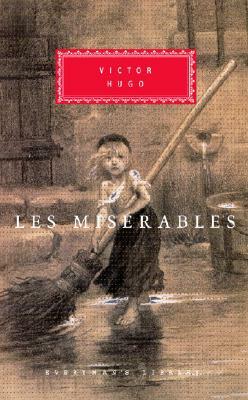
After reading Les Misérables for Classics Club, there couldn’t be anyone more miserable than me. It’s true that once Hugo gets going, he can write some exciting and interesting stuff. But he is so easily sidetracked into long discussions of peripheral or even no relation to the story—and that brings the narrative to a screeching halt. FictionFan kindly called these “digressions.” I call them, in some part, showing off.
Peter Washington in the introduction to my library’s Everyman edition surprised me by describing Hugo as
. . . vain, arrogant, pompous, selfish, cold and stingy; a windbag, a humbug and a fraud, absurdly puffed up with the immensity of his own greatness.
Then he wonders how such a man could have written such a masterpiece, and that made me think about what constitutes a masterpiece or at least what gets called one. Is it just a big long book by a bloviating male? Point of discussion for Classics Club maybe.
I started faithfully, reading all of the first 50 pages of examples proving what a saint the Bishop of D— is. Now, this bishop is pivotal to the plot in that he wins the conversion of Jean Valjean to goodness, but he also dies about 50 pages later. So, did we really need 50 pages about him?
For those who have been living under a bush, here is the setup for the novel. Jean Valjean is an escaped convict originally jailed for stealing a loaf of bread when he was hungry but now on stiffer penalties because he keeps escaping. In fact, he’s a galley slave for life.
Reformed by the bishop’s example of goodness, Valjean takes on the identity of Monsieur Madeleine and becomes a productive citizen, eventually owning a factory that produces jet. However, Inspector Javert is always looking for him.
Fantine, a lovely girl, is seduced by love and left with a child. She keeps herself alive by working in Madeleine’s factory, but she has to keep her daughter a secret because of the morals requirement of the factory. She has placed Cosette with the Thenadiers, who continually ask for more money while using Cosette as a servant. Eventually, someone rats out Fantine and she loses her job and later dies. Madeleine attends her deathbed, where she asks him to save Cosette. He is on his way there when he learns that Javert has mistaken another man for himself, so he goes to court and turns himself in. Back to the galleys.
All this action takes up the first 300 pages, but don’t worry—there are 1100 more. The novel is divided into six large books, let’s call them volumes for clarity, and each volume is divided into 8-15 books, which are divided into chapters and sections that are often short but sometimes not. I eventually figured out that the start of each volume was the place to begin a digression, but this also often happened at the start of a book. And sometimes just within someone’s speech. I started skipping whole sections once I figured out what was going on, and estimate that I skipped 200-300 pages. Frankly, I couldn’t take it.
Fifty pages on the battle of Waterloo AFTER he says he’s not going to explain the battle of Waterloo just to include a short section at the end—Read
Thirty pages on Paris and the bourgeois—Skipped
Thirty pages on the Restoration of the monarchy—Skipped
Forty pages of Jean Valjean’s soul searching—Skipped
These are only the skips obvious from the table of contents. I also recall the entire history of the convent where Jean Valjean hides with Cosette for years (only to end with a short section about his being taken on and then hardly another mention) and the history of the Paris sewers to name a few—SKIPPED and SKIPPED.
The problem even lurks in the characters’ dialogue. There are several passages meant to show off knowledge, say of literature or Greek classics—the last absurdly by Marius’s grandfather right after he says he doesn’t like books. And the one that made me laugh was a couple of paragraphs uttered about a new weapon (just before he’s about to shoot it) that sounded like they were from an encyclopedia. No one would talk like that.
If Hugo could just have stopped himself from rampaging off in every direction, this might have been a great book, and certainly the outlines of its plot have captured imaginations over time.
Finally, I have to take issue toward the end, when Jean Valjean confesses to Marius—all the bad stuff and none of the good. Marius gets it in his head that Jean has done terrible things. He has. He’s stolen a loaf of bread, escaped from terrible servitude, lived a blameless life, given plenty to poor people, confessed to save the wrongly accused, rescued and raised Colette, saved the lives of Marius and Javert. What a rotter! He is too tough on himself, and the book gets its tear-jerker ending at his expense.


Well a huge well done for getting it finished in time, that’s impressive! Ah yes, the sewers, on and on it went; my favourite part was Marius in his rooms rented from the Thénardier’s, very exciting I thought but so much baggage around it!
No kidding.
This sounds like a case where abridging would be not just advisable, but necessary!
You’d think.
I enjoyed this a lot more than you and FictionFan, but I can definitely understand why you had problems with it. My Penguin Classics edition took out the digressions on convents and sewers and put them at the end in an appendix, which I think was a good idea! Well done for managing to finish it.
Oh! Excellent idea!
Hahaha, I enjoyed your review far more than the book! I doubt I’ll ever be able to think of Paris again without thinking of the sewers. I think my favourite ‘digression’ was while they were all on the barricades and he suddenly gives us a lecture on the history of cannon-making – how to destroy tension! I stick to my belief – this one gets all the praise because people are in such a state of euphoria that they’ve finally finished the last page!
That’s what I meant when I talked about the weapon, the cannon-making digression, but I couldn’t remember the exact circumstances. I think you’re right about the euphoria!
At least it’s over now. Let the smugness begin! :D
I’m much happier now I’m not reading it.
Oh, I forgot when I wrote the post that the cover by Moberg somehow got in there, and do what I could, I could not select it and delete it! At least not from my phone! I have now deleted it.
This has got to be one of my favourite book reviews!! Your last paragraph is just the best — so much sentimental sanctimoniousness that ends up undermining the character by making him unbelievably good and self-effacing to boot. What kind of silly characterization is this, and how on earth can it carry such a long novel?! This is why I have never been able to read the whole book, despite repeated attempts: both the endless digressions and the cloying sentimental touches are just too annoying.
Also, your description of Peter Washington’s introduction is amusing. Why is Washington behaving as if he is unaware that many — perhaps even most! — famous writers are perfectly capable of being unpleasant individuals or living not-great private lives while also writing highly regarded books? Why is there such a persistent need to equate intellectual or creative talent with morality, and then be surprised when reality shows they’re actually different things . . . ?
His assessment, though, was kind of key to my review, because if Hugo was like that, then to me it explained his digressions. He was showing off what he knew! Thanks for the comments. Really, this is a painful book to read, and I’m not quite sure why its plot is even popular enough to warrant a musical.
I read this book years ago, pre-blogging days and the book was 1,100 pages long. I realized later I had read aa abridged version of the book and it was still that long! I loved it but I was in the Les Mis phase with the musical in my ear every day!
They probably cut out some of the passages I described.
It didn’t earn the nickname “The Brick” for nothing! It’s multi-purpose as a doorstop or an exercise weight.
I’ve only ever read an abridged version but I have high hopes of getting to the full version one day!
Well thank goodness I already took care of that!
I read this a decade ago and absolutely loved it.
Here is my review.
I took a whole year to read this (it has 52 chapters, so we read one a week), I cannot imagine reading it in 6 weeks! So congrats! That is a HUGE effort. And curiously, after eight years, it is the Waterloo chapter that has stayed with me the most!! I kid you not! It nearly did me in at the time, but it’s the first thing I think of when I see the words Les Mis!
That’s interesting. I didn’t mind the Waterloo chapter as much as some of the other digressions. If I had read a chapter a week, I might have actually read some of the digressions.
I still struggled with the sewer chapter!
I have no doubt!