Day 342: The Tryst

Cover for The TrystThe Tryst is an odd book by Michael Dibdin, the author of the Aurelio Zen mysteries. Although billed as a crime novel, it takes some time to get around to the crime. In fact, it misleads us into thinking it is one type of novel when it is actually another.

The novel follows the actions of two characters, a homeless boy and the therapist who is trying to figure out why the boy is pretending to be insane. Gary Dunn has come to the psychiatric hospital where Aileen Macklin works as a psychiatrist requesting institutionalization and insisting that someone is trying to kill him.

We find out that Gary, a glue-sniffing boy who lives with a bunch of junkies, has befriended an old man. Although Gary’s mates would like to rob the man, Gary has become involved in the old man’s long, involved story about a former employer who sees a beautiful woman no one else sees. In the story, the employer follows the woman to his death. This story eventually connects the fates of Aileen and Gary.

Ultimately, the novel doesn’t work that well, because it starts out being a crime thriller and turns into more of a gothic novel/ghost story. It is too much one kind of novel to work successfully as the other kind. Although the novel is well written and interesting, it reads almost as if Dibdin started with an idea and changed his mind in midstream. For a better example of a book that combines a crime story with a ghost story, read Johan Theorin’s fantastic The Darkest Room.

Day 340: Death on the Nile

Cover for Death on the NileIn this classic Agatha Christie mystery, Hercule Poirot observes a young couple at a restaurant in London and thinks their behavior indicates that the woman loves the man too much. A few months later he meets them again in Egypt, but the man, Simon Doyle, has married the woman’s rich friend Linnet. The first woman, Jacqueline de Bellefort, is haunting their every move during their honeymoon. Poirot thinks no good can come of it and tries to tell Jackie to leave the Doyles alone.

The Doyles sign on for the same Nile river cruise as Poirot. To their fury, Jackie appears on board. Also on board is Poirot’s friend Colonel Race. Race is hunting a criminal who has murdered several people. He believes the person is on board, but has not been able to identify him.

On a tour of some ancient ruins, a boulder falls, nearly missing Linnet and Simon. The obvious suspect is Jackie, but she was on the boat the entire time.

That evening, the drunken Jackie makes a scene in the lounge and then shoots Simon in the leg. The next morning Linnet is dead from a gunshot wound, but both Simon and Jackie seem to have solid alibis. The nurse was with Jackie all night, and Simon was incapacitated with his injury. Poirot and Colonel Race begin looking into other enemies that Linnet may have had.

I think Agatha Christie is the best of the “Golden Era” mystery writers at characterization. She quickly sketches convincing and sympathetic characters. Sometimes you even sympathize with the murderer. Her books are also often set in exotic locations and give you a flavor of a certain place and time. I always find Christie’s mysteries to be enjoyable, and they make fun beach reading.

Day 338: Raylan

Cover for RaylanMy husband and I recently got hooked on the TV show Justified, which is just as surprising to us as to anyone who knows us, because it is fairly violent. One of the things we like about it is the well written, darkly humorous script. After we watched a couple of episodes, I paid more attention to the credits and discovered that the series is based on stories by Elmore Leonard, which explains a lot. It was with interest, therefore, that I discovered this book, titled after the main character in the series, Raylan Givens.

Marijuana growing has become the cash crop for Harlan County, Kentucky. As a deputy US Marshall, Raylan Givens isn’t concerned with drug enforcement. But Dickie and Coover Crowe have decided to expand their drug business by dealing in body parts. When Raylan tries to serve a federal warrant against Angel Arenas, another marijuana dealer with ties to the Mexican Mafia, he finds him bloody in his motel room with his kidneys removed.

Raylan is on to Dickie and Coover very quickly, as they’re not the brightest of bulbs. He is more interested in catching the doctor who is removing the organs, figuring the Crowe boys aren’t smart enough to cook up this scheme themselves.

This case is solved about midway through the novel, and Raylan gets roped into providing security for Carol Conlan, a representative for a coal company that wants to blast the top off the last remaining mountain in the area. Raylan is not sympathetic, but he is more concerned about the old man who was supposedly shot to death by Boyd Crowder after firing his shotgun at Carol. The old timers who knew Otis claim that if he was shooting at Carol, she’d be dead.

The writing is darkly humorous, with the style of the local dialect skillfully recreated. My problem with this novel is it has no focus except perhaps around the character of Raylan. It reads as if it were quickly put together from several short stories rather than plotted out as a novel. I was a little disappointed.

Day 330: Adamtine

Cover for AdamtineAdamtine is the second of Hannah Berry’s moody noirish graphic novels after Britten and Brülightly. Whereas the first novel was a noir crime effort with a wry sense of humor (the detective’s partner is a tea bag), it is not clear to me whether Adamtine is a crime or a horror novel.

Four people who know something about an earlier series of disappearances are traveling home on a train when it stops in the middle of nowhere. At the time of the earlier crimes, a man named Rodney Moon was put on trial, but he claimed to have only passed notes to the victims. There are hints of the involvement of a large corporation.

The story is told with flashbacks to the previous crimes, although it was difficult for me to tell sometimes which scenes are those from the past and which are from the present. It was also unclear to me what exactly happens to the people, but perhaps the atmosphere created is of most importance.

The art is beautiful, with its muted, moody tones. I think this graphic novel is visually interesting and intriguing, but I find it difficult at times to completely understand the parts of the narrative that are told only in pictures.

Day 329: Still Life

Cover for Still LifeStill Life is the first of Louise Penny’s Inspector Gamache mysteries. It provides us an introduction to the kindly Gamache and his team and to the beautiful village of Three Pines, where many of the subsequent mysteries are set.

An elderly woman named Jane Neal is found dead in the woods near Three Pines, shot apparently by a careless bow hunter. Inspector Gamache and his team are initially called in to ascertain whether the suspicious death is an accident or a homicide. Gamache quickly determines that the death was a homicide and then begins to look for the murderer.

Although Jane was highly regarded by most folks in the village, one suspect is her cold and greedy niece, Yolande Fontaine, who can’t wait to get her hands on her aunt’s property. Her husband has a criminal record, and her son is a delinquent who may have been out with a bow on the day of the murder.

Through this novel we get to know the characters who recur throughout the series–Olivier and Gabri, the gay owners of the bistro and bed and breakfast; Clara and Peter Morrow, local artists; Myrna Landers, a former psychologist who owns the bookstore; and Ruth Zardo, an eccentric curmudgeon who turns out to be a famous poet. Another important character is Ben Hadley, Peter Morrow’s best friend for years, whose mother died a month before from cancer.

Penny’s mysteries have the feel of cozies set in a small village, like some of Agatha Christie’s Miss Marple books. Her characters are well developed and interesting. The peaceful atmosphere of the village is palpable. I had a disadvantage in reading this novel after most of the others, so it was clear to me that the murderer was someone who no longer lives in the village in the later books. This narrowed the field considerably. I would advise those who are interested in reading Louise Penny’s series to start with Still Life and try to move forward in order.

Day 327: The Five Red Herrings

Cover for Five Red HerringsAlthough I am normally a fan of Dorothy L. Sayers’ Lord Peter Wimsey series, The Five Red Herrings is exactly the novel I’m talking about when I say that I don’t care for the Golden Age mysteries full of railway timetables. This type of novel boils down to a puzzle designed to confuse the reader with a lot of detail. I do like Lord Peter, but I like him better when I have to keep track of fewer things.

Lord Peter is visiting an artists’ colony in Scotland when a painter is found dead. He is Sandy Campbell, a talented artist but one who also has a talent for getting drunk and picking fights. He is found in a stream with his half-finished painting on the bank high above, and the reasonable explanation is that he accidentally fell to his death. However, Lord Peter immediately notices inconsistencies that make it impossible for Campbell to have painted the picture.

Whoever the murderer is, he or she must also have been a talented painter, for the picture is exactly in Campbell’s style. Six other artists in the area who had quarrels with Campbell have enough ability to be the killer. Some of them have convincing alibis, and the solution revolves around–yes–railway timetables.

As usual, Lord Peter is entertaining. His man Bunter is not as much in evidence as in other novels, which is a little disappointing, but Sayers capably depicts a group of colorful suspects.

Day 324: Trick of the Dark

Cover for Trick of the DarkCharlie Flint is a profiler who is on probation because her testimony freed a man who went on to murder four women. She is asked by Corinna Newsam, her old tutor, to investigate the lesbian lover of the tutor’s daughter, Magda. Corinna Newsam thinks that this lover, Jay Stewart, may be a serial killer, because several people who were in her way conveniently died, including Magda Newsam’s husband on the night of their wedding.

Charlie finds herself attracted to a woman she meets in a seminar. (Spoilers follow in this paragraph and the next. I usually don’t include spoilers, but these are integral to my criticism.) This woman is clearly manipulating her from day one, and in the course of her investigation, Charlie violates the confidentiality of the people she is investigating by confiding in her. Of course, without this happening, there wouldn’t be a plot, but it is still the crux of my problem. I don’t think it would be likely that a person in her position would make the mistake of confiding information on a sensitive case to a new acquaintance, even if she is dating her.

It is the nature of this violation that bothers me most, as it is extremely unprofessional and I felt it unlikely from a profiler. Of course, the woman actually turns out to be connected to the murders, and this coincidence also bothered me.

Finally, I am reluctant to say this for fear it will be misconstrued, but at least five characters are fretting about their sexuality. These characters are lesbians, but I don’t enjoy this kind of emphasis in heterosexual literature either.

I am a big fan of the Tony Hill/Carol Jordan books, and I also like the Kate Brannigan series by McDermid. I know she has a Lindsay Gordon series, but I don’t think I have read any of those. McDermid has written some of the best stand-alone thrillers I have ever read, particularly A Place of Execution. I was disappointed not to enjoy this novel as much.

Day 321: The Dark Horse

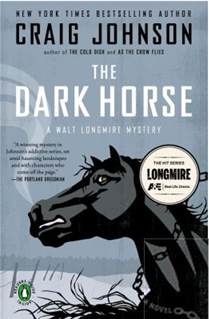
Cover for The Dark HorseSheriff Walt Longmire goes undercover in this exciting entry to the series. Mary Marsad has been sent to the Absaroka County jail after confessing to shooting her husband, Wade, after he burned down the couple’s barn with Mary’s horses in it. Not only has Mary confessed, she was found with the murder weapon and has gunshot residue on her hands.

Even though the case is out of his jurisdiction, Walt feels that Mary may be innocent and has been asked to look into the case by the sheriff of the other county. Walt goes to the town of Absalom posing as an insurance agent to see if he can figure out what happened. He discovers that Absalom holds many secrets, including motives for other people to want Wade Marsad dead.

This novel takes place during two different time frames, while Walt is undercover and two weeks beforehand, showing the reasons why Walt thinks Mary is innocent and why he doesn’t take his friends with him.

As usual, the recurring characters from this series have their places in the story, and we are always pleased to encounter Walt’s best friend, Henry Standing Bear, and his foul-mouthed deputy Victoria Moretti, among others. Johnson is a capable writer who creates convincing characters and vividly evokes the rugged landscape of Wyoming.

Day 320: The Malice of Fortune

Cover for The Malice of FortuneThe Malice of Fortune follows a current trend of mystery fiction to use actual historical people as detectives. In this case, the novel is set in 16th century Italy, and the historical detective is Niccolò Machiavelli, assisted at times by Leonardo da Vinci.

It is 1502 in the Papal States of Italy, and the infamous Pope Alexander VI, the former Rodrigo Borgia, has received word of his beloved son Juan, who was murdered years before. A woman was found butchered in Imola, and with her body was an amulet Juan always kept with him. The Pope summons the courtesan Damiata, whom he suspects of complicity in Juan’s death, and takes her little son hostage while he dispatches her to investigate.

In Imola, Damiata finds that someone has been murdering and butchering women and then leaving quarters of their bodies around the city. When she travels out to the scene of the latest discovery, she finds that Juan’s brother, the dangerous Duke Cesare (nicknamed Valentino) Borgia, has Leonardo da Vinci on the scene as his investigator. Da Vinci thinks that the killer is playing a game by constructing puzzles for him. At the scene some masked men provide an additional clue by fleeing the investigators.

Damiata also meets Niccolò Machiavelli, who is in town representing the city of Florence, which is afraid that Duke Valentino and his condottieri, or mercenaries, are planning to attack the city. Damiata suspects one of the three condottieri generals of being the murderer, but she does not know which one.

Machiavelli provides a different insight into the murderer. He has made a study of what he calls “the necessity” for each man–what drives him–and he begins trying to discover the murderer’s necessity. Machiavelli and Damiata team up to find the murderer.

This novel has interesting characters and situations, but at some point I felt as if the characters are chasing around too much with little result. Instead of building suspense, the plot seems unplanned and disorganized.

Michael Ennis is a historian, and the historical background is convincing and seems accurate. Compared to his previous novel about medieval Italy, The Duchess of Milan, a straight historical fiction novel about the powerful d’Este family, The Malice of Fortune is a little disappointing.

Day 319: Murder on the Orient Express

Cover for Murder on the Orient ExpressMurder on the Orient Express is Agatha Christie’s classic mystery featuring Hercule Poirot. Everyone has of course seen the lush 1974 movie featuring a flock of movie stars and Albert Finney as Poirot.

Hercule Poirot is visiting Istanbul when he unexpectedly receives a telegram prompting him to cancel his plans and book a seat on the Orient Express leaving that night. He is able to book a compartment in first class, but only after some difficulty.

Poirot’s fellow passengers include a Russian princess, a Hungarian count and countess, a Swedish missionary, a British colonel, an annoying American widow, and other unusual characters. As always with Christie, her characters are expertly and colorfully drawn.

On board the train, Poirot is approached by the repellent Mr. Ratchett, an American businessman who believes his life is being threatened, asking for protection. Poirot dislikes Ratchett and declines his offer.

After a disturbed night, during which Poirot is awakened by a cry and spies a woman in a lurid silk kimono walking down the hall, Ratchett’s body is found dead in his compartment. He has been stabbed 12 times. The railroad executive traveling on the train begs Poirot to attempt to solve the crime before the train reaches Yugoslavia.

It begins to look as if an intruder disguised in a railway uniform broke into Ratchett’s compartment and murdered him then escaped out into the snow. Poirot’s investigation turns up a suggestion that Ratchett was the leader of a gang who kidnapped and killed the child Daisy Armstrong (a crime based upon that of the Lindbergh kidnapping), resulting in much tragedy for the family. He also begins finding links between some of the passengers and the Armstrongs.

This particular mystery is famous not only for its exotic locales but also for the unusual solution to the murder. Despite my familiarity with the plot, it made enjoyable reading.