Day 303: The Girl Who Kicked the Hornet’s Nest

Cover for The Girl Who Kicked the Hornet's NestI just realized that, having reviewed the other two books in Stieg Larsson’s Millennium Trilogy, I never reviewed The Girl Who Kicked the Hornet’s Nest. This final novel will be difficult to discuss without giving away what happened in the previous books.

As Lisbeth Salander recovers in the hospital from her injuries, journalist Mikael Blomkvist investigates Alexander Zalachenko, the Soviet defector she shot in self-defense at the end of the last novel. He begins to think there has been a massive cover-up on the part of Säpo, Sweden’s security police, to hide Zalachenko’s crimes while he was viewed of value to them. Among those crimes were the horrendous beatings he gave Lisbeth’s mother, for he is her father.

Some former members of Säpo are currently colluding with Dr. Peter Teleborian, the psychiatrist who supervised Salander’s institutionalization when she was a girl, to either have Salander re-institutionalized or to murder her, so that their activities do not become known. Salander is able to assist in her own way with preparations for her trial when a sympathetic doctor smuggles her laptop computer and a phone into the hospital for her.

The freakish Niedermann is still loose, having murdered a police officer and carjacked a woman during his escape.

All these subplots are wrapped up through an exciting trial and a subsequent pursuit of Niedermann.

I believe this series is so successful because of a strong message about violence toward women, interesting and believable characters, complex but careful plotting, thrilling action, and a strong, compelling, and unusual heroine. If you have not read the series already, I strongly recommend it. Start with The Girl with the Dragon Tattoo.

Day 302: The Cradle in the Grave

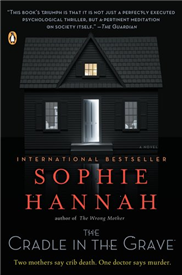
Cover for The Cradle in the GraveFliss Benson is a television producer who on the same day is unexpectedly handed control of an important documentary on women falsely accused of murdering their babies and then receives a mysterious card with 16 numbers on it.

As a result of her boss’s work, three women have been released from prison and the doctor who testified against them, Dr. Judith Duffy, is under investigation for misconduct. Now Fliss’ boss wants to resign and turn the project over to her. Shortly after receiving the job, Fliss learns that one of the mothers featured in the documentary was murdered–and a similar card was found in her pocket.

As Fliss tries to make sense of all the research materials she has been left with, DC Waterhouse is trying to untangle the evidence from his side. His boss “the Snowman” was the person who originally arrested the murder victim, although he knew her well and continued to protest her innocence. A little later, another of the freed mothers is attacked, and another card left for the police to find.

As usual with a Sophie Hannah novel, the characters are convincing, the plot is complex, and the conclusion is hair-raising. The dialog is bright and clever. Simon Waterhouse is as neurotic as ever, but he always eventually gets to the solution. When I am in the mood for some dark, twisted fun, Sophie Hannah is a great choice.

Day 298: Another Man’s Moccasins

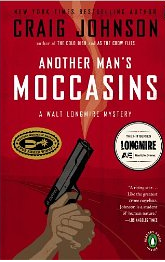
Cover for Another Man's MoccasinsThis Walt Longmire mystery interleaves the present-time story with flashbacks to Longmire’s experiences during the Vietnam War. I wasn’t sure I was going to enjoy this development, but the novel turned out to be very good, as the two stories are linked.

Walt is helping his daughter Cady recover from her experiences in Philadelphia (detailed in the previous book) when he is called out to the body of a young woman found along a county highway. Walt immediately recognizes the woman as Vietnamese. Next to the body is a huge Crow Indian, who runs away from Walt. In chasing him down, Walt discovers that he has been living in a culvert. When Walt takes him into custody, he won’t speak.

The discovery of the Vietnamese girl triggers memories of Walt’s first homicide investigation as a marine in Vietnam. The girl’s identification shows she is named Ho Thi Paquet, but in among her possessions, Walt find the picture of another woman who resembles someone he knew in Vietnam. With the help of his friend Henry Standing Bear, Walt finds out that the girl is connected with a large human trafficking ring in Los Angeles.

Walt decides that the Crow, identified as a mentally ill Vietnam vet named Virgil White Buffalo, probably didn’t kill Ho. He also doesn’t think it is a coincidence that a Vietnamese “tourist” has appeared, staying in a motel in Absaroka County.

As I have said before, I really enjoy this series. I enjoy the sense that the landscape of Wyoming is as much of a character as the people in the novels, and I like the recurring characters, who keep developing new dimensions.

Day 296: The Cruelest Month

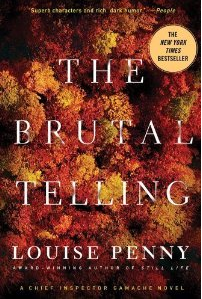
Cover for The Cruelest MonthThe village of Three Pines in remote southern Quebec has a psychic visiting, so bed and breakfast owner Gabri arranges a séance on Good Friday evening. It is not very successful, but some of the participants decide to try again at the deserted Hadley house the next night. A few additional people attend, and several of the group are filled with foreboding. The Hadley house has, after all, been the scene of frightful crimes.

In a dusty, candle-lit room, the participants hear a horrible noise and one of their party drops dead–Madeleine Favreau, a vibrant, popular woman who shares a house with Hazel Smyth. When Inspector Gamache and his team arrive, they find that someone has slipped Madeleine the banned drug ephedra, which, combined with a weak heart, has resulted in a fatal heart attack.

The investigators find motives for several of the people at the séance, mostly those of jealousy or thwarted love. But Gamache’s team is also dealing with its own problems. Senior officers want to destroy Gamache because of his role in accusing a popular superior officer of crimes years ago and so have inserted a spy into his team. However, they have found other ways to strike, as Gamache begins finding newspaper articles attacking him and his family.

As always with Louise Penny’s mysteries, the plot is compelling and Gamache and the other characters are interesting. Of course, it is unusual that a small village like Three Pines would suffer so many violent deaths, but it is a pleasure to continue revisiting the village and its inhabitants, so I think we have to suspend our disbelief. I also think the series deserves some kind of prize for the most beautiful cover art.

Day 294: Death on the Nevskii Prospekt

Cover for Death on the Nevskii ProspektGiven my interest in Russia and the time period, this novel should have been a slam-dunk for me, but I was disappointed. Lord Francis Powerscourt is asked to investigate the death of a British diplomat in Russia, who was discovered with his throat cut on a bridge across the Nevskii Prospekt. No one in the British government knows why the victim was in Russia, and the Russians, having reported his death, pretend that they know nothing about it.

Powerscourt’s investigations seem to be pointing to the victim having had a secret meeting with the Tsar. In addition, Powerscourt may be running up against the Russian secret police, the Okhrana.

The book begins with a completely unnecessary chapter or two devoted to efforts to try to persuade Lord Powerscourt’s wife to release him from his promise not to take any more investigations. In addition, the real circumstances of the death seem completely unlikely. Characterization was minimal, and the plot had several unlikely points.

Dickinson’s historical research is commented on in the blurbs, but there was little in the novel that anyone doing the most cursory reading about Tsarist Russia’s last days wouldn’t know.

Day 293: Before the Poison

Cover for Before the PoisonI never read anything by Peter Robinson before. I looked him up because of the TV series “DCI Banks,” as he is the author of the Inspector Banks series, but then I found that Before the Poison was already on my list of books to read. It is not an Inspector Banks novel, but I found it gripping from start to finish. Although it is not a mystery novel in the traditional sense, it involves an investigation of events in the past with revelations about the present and even the hint of a ghost story.

Chris Lowndes is a recent widower, a British composer of film scores who has been living in California for 35 years. He has purchased a large house in rural Yorkshire sight unseen with the intent of making his new home there and writing more serious music.

At the beginning of the novel, he arrives at his new home, which is beautiful and old but very isolated. He is puzzled to find some personal possessions left behind although the house has been leased for many years and asks his rental agent to find out who used to own it, as he bought it from a solicitor’s office.

Lowndes soon learns that his house was the scene of a notorious murder. Grace Elizabeth Fox, a nurse during World War II, was found guilty in 1952 of murdering her husband, the local doctor. Lowndes becomes interested in the murder and soon finds that the evidence against Grace was circumstantial and mostly based on the fact that she was having an affair with a much younger man. As he tracks down information and villagers who were alive at the time, Lowndes begins to wonder if there was a crime at all or if Doctor Fox died from natural causes.

Alone in the house most of the time, sometimes stranded by bad weather, Lowndes occasionally battles with depression, misses his wife, and is kept awake by strange noises in the house and thinks he glimpses a woman in the mirror of a wardrobe. He is also attracted to Heather, the realtor, who is having marital problems. And he keeps seeing a hooded figure out by the old lime kiln. Eventually he comes across a diary belonging to Grace, which relates her experiences as a nurse during the war.

This novel is atmospheric and very interesting. A few times I thought I knew where it was going, but it went somewhere else. I wasn’t really interested in the subplot involving Heather–I didn’t really like her–but otherwise I was totally engrossed by the novel.

Day 291: Brat Farrar

Cover for Brat FarrarI have only read a few mysteries by Josephine Tey and have had mixed reactions to them. I really enjoyed The Daughter of Time, but disliked The Franchise Affair. Brat Farrar is completely different from either of those novels, and I enjoyed reading it.

Patrick Ashby, the 13-year-old heir to the Ashby fortune, disappeared three years go. This novel isn’t a mystery about whether Brat Farrar is an imposter–we know that from the beginning–but about what actually happened to Patrick.

Brat, an orphan who bears a surprising resemblance to the Ashbys, is talked into impersonating Patrick, despite his better instincts, by a ne’er-do-well cousin of the Ashby’s. This cousin has carefully coached him for his part, with the understanding that after Brat inherits, he will pay the cousin a pension. Once Brat arrives at the house, he feels surprisingly at home with the place and the family, except for Simon, his supposed twin brother.

The characters are likeable, and the story keeps your attention, even though I figured out the solution to the mystery fairly early on.

Day 289: Birds of a Feather

Cover for Birds of a FeatherMaisie Dobbs is a “psychologist and investigator” solving cases in post World War I London. Birds of a Feather is the second book in the series by Jacqueline Winspear. Maisie’s background is unique, in that she is a former serving girl who was taken up by a mentor, educated, and trained in some unusual techniques to use in her investigations.

Maisie accepts the case of a wealthy owner of grocery stores, Joseph Waite, to find his daughter Charlotte, who is in her 30’s, and return her home. As Maisie investigates the case by locating Charlotte’s friends, they begin dying. At each crime scene, a white feather is left. White feathers were traditionally given to young men during World War I to shame them into enlisting, as they are a symbol of cowardice.

I read the first book in this series, Maisie Dobbs, and was not enthralled with it, so I only read this novel because it was chosen for my book club. I finally decided that I like the book a little, but it certainly has its flaws. Winspear is not very good at delineating Maisie’s character, I feel. Maisie also speaks surprisingly modern American English for a British woman in the 1930’s.

The biggest problem I have with Maisie, though, is that the unusual skills she has picked up to use in her investigations are far too New Agey to be convincing for a character in the 1930’s. It does not help my enjoyment of the novel, I fear, that I find many New Age ideas irritating.

In addition, it makes no sense to me at all that no one seems surprised to find the detective is a young woman. Even in P. D. James’ classic An Unsuitable Job for a Woman, written in 1972, characters express surprise to find a woman in that role. All-in-all, this makes too many anachronisms in the series to suit me.

Finally, I know this is a silly quibble, but I feel that Winspear spends too much time describing Maisie’s clothes.

Day 288: The Return

Cover for The ReturnDuring a nursery school outing in a forest, a little girl finds a body. A corpse, headless, handless, and footless, is buried in the woods and has been there at least six months.

Inspector Van Veeteren has some difficulties even identifying the body. Any man the age of the corpse who has been reported missing does not fit the description.

Van Veeteren has already entered the hospital for colon surgery before a woman reports that the body may belong to her estranged brother–once a famous athlete who was accused of cheating and was later found guilty of murdering two of his ex-lovers. It appears that the victim, Leopold Verhaven, had been released from prison shortly before the murder.

The investigation of Verhaven’s murder naturally leads back to the murders for which he was imprisoned. Van Veeteren has plenty of time to read the trial transcripts in the hospital and finds that Verhaven was convicted on very little evidence. Eventually the team is lead to consider whether Verhaven was guilty of the murders at all.

As Van Veeteren follows up on his own while on leave, his team having been removed from the case, we get a lot of insight into his character, although not as much into that of his team members. This novel is interesting and dark, and in the course of it, a line is to be crossed.

Day 285: Full Dark House

Cover for Full Dark HouseThe back cover of this mystery calls it “mapcap” and “great fun.” I found it mildly amusing in a silly way.

John May arrives at work in the present time to find the place has been blown up, apparently with his partner Arthur Bryant inside. He investigates this incident while he thinks back to their first case together.

John joined Arthur during the Blitz in World War II working in the Peculiar Crimes Unit. Their case was that of a dancer at a theatre in Covent Garden who is drugged and then dragged into the elevator with her feet sticking out, so that when the elevator moves, her feet are cut off.

There are many gothic touches in this novel, which is not surprising because the author is apparently a writer of horror fiction. However, after references to phantoms, vampires, spiritualism, and so on, the murderer turns out to be human after all. I came away feeling that this book promises more, in the way of humor and the unusual, than it actually delivers.