Day 250: The Last Detective

Cover for The Last DetectiveMy husband and I have been enjoying reruns of the older British TV series The Last Detective on Netflix, so I picked up this book. Unfortunately, I spent the first part of the novel bemoaning its lack of resemblance to the series. Since it has a strong message of lack of trust in “new” police methods and technology instead of reliance on the police’s judgment and intuition, I also couldn’t help thinking of recent cases such as that of Michael Morton, who spent 25 years in prison for murdering his wife based on very little but a scenario invented by the police and was last year found by DNA evidence to be innocent. However, since one of Lovesey’s hero’s traits is a dogged pursuit of the investigation rather than a rush to judgment, I got over that.

The body of a woman is discovered nude in a lake near Bath. Although the police aren’t certain of the cause of death, her clothes and possessions don’t turn up anywhere, and the pathologist believes she has been asphixiated. After some time, the body is identified as that of Geraldine Snoo, a soap opera star who had been written out of the plot months before.

One obvious suspect is Gregory Jackman, Gerry’s husband and a professor of English at the local college. Detective Superintendant Peter Diamond leads the investigation, which eventually seems to point toward another suspect, Dana Didrickson, a divorcee who seems to be in love with Jackman. The mystery also involves the whereabouts of letters purportedly written by Jane Austen.

My biggest problem with the novel is one of approach. It contains two long sections narrated first by Jackman and then Didrickson that are supposedly their statements to the police, an approach very similar to that used in older detective novels like The Moonstone. The Moonstone, though, had the excuse that its statements were written ones requested by the investigator to separately verify everyone’s statements of the crime. In the context of a more modern novel, I found them completely unlikely, written as they are like prose, containing too much detail, and with few questions interjected by the police.

Once the novel gets past these sections it improves a lot, though, and becomes lively and entertaining, including a chase through the Roman baths.
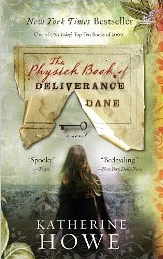
Day 249: The Physick Book of Deliverance Dane

Cover for The Physick Book of Deliverance DaneBest Book of the Week!
Connie Goodwin has just passed her orals in history at Harvard and is one thesis away from her doctorate when her advisor, Manning Chilton, challenges her to find an undiscovered primary source on which to base some subject about Colonial America. She is almost immediately side-tracked in her research by a request from her mother to sort out her grandmother’s long-abandoned house in Marblehead and sell it to pay off back taxes.

Connie finds a very old, filthy house with a gate so overgrown with vines that it’s hard to find the house. Almost immediately she has a few odd glimpses, as if she can vividly picture her grandparents and other people in the house.

While sorting through the objects and papers in the house, she finds evidence of a woman named Deliverance Dane, who was found guilty of witchcraft in the Salem trials and left behind a “recipe” book, possibly of spells. Chilton immediately begins putting pressure on Connie to find the book, as it could provide the first evidence that people were actually practicing witchcraft at that time in Massachusetts. As Connie searches for the book, she makes some astonishing discoveries about her family and herself.

Back in the 17th century, Deliverance Dane, a wise woman or healer, is called to attend a child she cannot save. When the child dies, her father accuses Deliverance of satanism.

Some small things at the beginning of the novel irritated me. In laying the foundation of some basic history, I think Howe condescends to the reader a bit too much. For example, she finds occasion to tell us what a familiar is. Although many people may assume that all familiars are cats and find out differently from this novel, I would be surprised if people didn’t know what they were, if only from remembering their grade school lessons about the Salem witch trials. But perhaps I’m wrong.

There are also a couple of instances where Connie takes awhile to figure out something that she, as a graduate history student, should already know. For example, she doesn’t immediately know that “receipt” is another word for “recipe,” and then she has to explain this term to her professor, supposedly an expert in Colonial America. I am no historian or even generally interested in this period of history, but I knew immediately what the word meant. She does the same thing with figuring out that “Deliverance Dane,” mysterious words on a piece of paper, is someone’s name, as if in all her studies of the period she never encountered such an unusual name.

It is also very easy to see where the novel is going and who will turn out to be a villain. However, I still found it interesting enough to regard it as a strong first novel, especially if you enjoy the mixture of historical fiction and the supernatural. The characters are believable, and both story lines kept my attention. The historical portion seems solidly researched.

And I won’t mention the tomatoes, because it’s just too picky.

Day 248: A Long Finish

Cover for A Long FinishAurelio Zen’s assignment in A Long Finish reflects the corruption in the Italian police force and government that is always being pointed out in these books. Zen is assigned to go to Alba not by his superiors but by a famous movie producer. The producer wants him to investigate the murder of Aldo Vincenzo, a noted winemaker–more importantly, to free Vincenzo’s son Manlio so he can get the grape harvest in and oversee the production of the wine. Vincenzo was found stabbed in his own vineyards with his genitals removed. The producer is a wine connoisseur who wants to make sure this year’s vintage isn’t wasted.

Zen finds himself in a dreamy, unfocused state, having nightmares because of several successive personal losses. Unfortunately, I’ve read the Aurelio Zen novels in an entirely random order, so I was confused about the sequence of the events in his personal life. Zen also has a severe cold, and someone is leaving him anonymous phone messages.

The first scene in the book, however, was of the murder, so the readers know that just before his death, Vincenzo encountered a trespassing truffle hunter. But which person was it? The truth may lie 40 years in the past, as indicated by the method of Vincenzo’s death, with echoes of partisan fighting during World War II, or maybe that is just a ruse.

I may be tiring a little of Aurelio Zen. I couldn’t put my finger on anything definite, but throughout this novel I got the impression that Dibdin is just trifling with his readers.

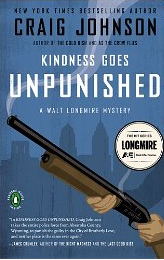
Day 246: Kindness Goes Unpunished

Cover for Kindness Goes UnpunishedHere it is, the first review of my second year of blogging. I just had to say that. Now, on to the review.

As much as I enjoy Craig Johnson’s series about Wyoming sheriff Walt Longmire, I find that I’ve been neglecting him and so am way behind in reviewing the series. One thing I admire most about this series is the sense of place–how Wyoming is depicted so clearly it is almost a character. Unfortunately, Kindness Goes Unpunished takes place in Philadelphia, so we miss that here, but the book is still action packed and lots of fun to read.

Sheriff Longmire and his best friend Henry Standing Bear travel to Philadelphia. Henry is setting up a collection of photos at a museum in preparation for giving a lecture, and Walt is visiting his daughter Cady, who works there as a lawyer.

Before Walt even gets a chance to see Cady, she is found at the bottom of some steps in a coma. Witness testimony seems to indicate that she was pushed down the stairs by her boyfriend, who turns out to have a drug habit. Shortly thereafter, however, the boyfriend is shoved off a bridge.

Philly cops wonder if Walt is responsible for the boyfriend’s death. Walt is torn between worry about Cady and his impulse to track down the killer, so Walt’s lippy deputy, Victoria Moretti, gets on a plane from Wyoming. It helps that she is a Philadelphia native and has relatives in the police force. Walt makes a deal with the Philly police to assist them in their investigation. (No, Brits, that doesn’t mean the same thing here as it does in the U.K.) We readers also get to meet the entire Moretti clan, including Victoria’s mother, who seems inclined to flirt with Walt.

Although I missed the Wyoming setting, Johnson effectively employs the fish-out-of-water technique to produce a novel that is as good as ever.

Day 244: The Killings on Jubilee Terrace

Cover for The Killings on Jubilee TerraceThe cast of a long-running British soap opera, “Jubilee Terrace,” is perturbed. Director Reggie Friedman has just informed them that a detested former cast member will be rejoining the show.

Not only is Hamish Fawly extremely nasty, he loves to cause trouble. In this case, he announces to everyone that he is engaged to marry Bet Garrett, an occasional cast member who is the real-life wife of Bill Garrett, the bartender on the show. Bet, who loves to make Bill miserable, promptly dispatches a letter from her lawyer claiming custody of their three daughters, even though she doesn’t really want them.

Detective Charlie Peace arrives on set because the police have received an anonymous letter claiming that the death of a previous cast member, Vernon Watts, was no accident. Finding no substance for the claim, Peace thinks he’s seen the last of the cast when someone sets Hamish’s house on fire, burning to death Hamish and a woman, presumed to be Bet. But shortly, it becomes clear that the victim is another woman, who also had a connection to Vernon Watts.

The novel has many characters, and they are so one-dimensional that I found it difficult to keep them straight, especially as most of them are called by two names, their character’s name and their own. I found The Killings on Jubilee Terrace only mildly interesting, even though it has a difficult solution.

Day 242: The Tuesday Club Murders

Cover for The Tuesday Club MurdersThe Tuesday Club Murders is a collection of Miss Marple short stories structured around a club in which the members tell each other about crimes or mysteries and the others try to solve them. Of course, Miss Marple is the only member to get the right solution, even though some of the club members are eminent jurists and a Scotland Yard detective. As usual, the other members of the club, except a few most in the know, completely underestimate her.

I’m not that fond of crime short stories because there isn’t really enough room to develop much of a plot. In particular, the format chosen for this book is even more sketchy than usual because the characters involved are only described by the story tellers. You don’t end up with a mystery so much as a puzzle, and one that you probably don’t have enough information about to solve. But then, Christie often withholds information in her novels, too.

That being said, Christie’s biggest talent is her ability to sketch believable characters with just a few words. Of course, her humor is another asset. I may have only solved half the crimes, but I laughed a few times.

Day 240: A Murderous Procession

Cover for A Murderous ProcessionWhen I first started reading Ariana Franklin’s “Mistress of the Art of Death” series, I had mixed feelings about the premise, which is that a 12th century Jewish woman doctor is trapped in England because of her usefulness to Henry II and is in love with a bishop. However, these books are well written and show a great deal of knowledge of the time and place. Ultimately, I find the books interesting and the characters compelling.

Adelia Aguilar is a medieval forensic pathologist trained in Italy who is forced in England to pretend that her Moorish servant Mansur is the doctor and she is his interpreter, since no one would believe a woman could be a trained doctor. In A Murderous Procession, Adelia is living a retired life in the countryside with her daughter when she is ordered to accompany Henry II’s daughter Joanna to her marriage with the King of Sicily. Adelia must leave her own daughter with Queen Eleanor until she returns.

However, Adelia herself is being followed, by a vengeful madman whose bandit lover she killed in a previous book. Unfortunately, I read and reviewed these books out of order. The previous book is Grave Goods, I believe.

Adelia’s lover Rawley is also a member of the party, but he is required to leave periodically on missions of diplomacy. In his absence, the madman incites the entire party, particularly the church men, against Adelia and Mansur, blaming them for the procession’s many mishaps.

Franklin was only able to write a few books in this series before she died. A Murderous Procession is the last. She also wrote the excellent pre-World War II book set in Berlin, City of Shadows, which I reviewed a few months ago. Her death is a sad loss to the fans of good historical fiction.

Day 238: And Then You Die

Cover for And Then You DieI started reading Michael Dibdin’s Aurelio Zen series after seeing the mysteries about the hapless Italian detective on Masterpiece Mystery. In And Then You Die, Zen is more hapless than usual. I had some problems reading this book because it is apparently a sequel to a book I had not read, and it requires some knowledge of the previous book. I felt this one boiled down to a series of unfocused mishaps.

At the beginning of the novel, Zen is staying under cover in a beach community waiting to be a witness against the Mafia, who apparently tried to kill him in the previous book. He has been a long time recovering from the murder attempt and has not been home for a year.

At the beach, families have reserved places, and someone has occupied the place that goes with his apartment, so he takes another and proceeds to carry on a flirtation with the woman across from him, Gemma. Later on, he finds out the man in his place is dead.

His minders move him, saying that the dead man was killed in mistake for him. Then the plan changes and they put him on a plane to the U.S. to testify there. But the plane has to force land in Iceland after he changes seats and the man who takes his seat dies.

It’s obvious that someone is trying to kill Zen throughout the book, but he doesn’t even seem to notice. I don’t know whether this is Dibdin’s idea of humor or not, but generally Zen is a little sharper than this. Moreover, the episode in Iceland is decidedly odd. In all, the plot seemed very unfocused, with Zen wandering all over the place. I honestly felt as if Dibdin was not putting much effort into this novel.

Day 235: The Eloquence of Blood

Cover for The Eloquence of BloodIn the second of Judith Rock’s series, the Louis le Grand school run by the Jesuits is under financial hardship in this cold winter of 1686. On a visit to Monsieur Callot to ask for a contribution to the alms budget, rhetorician Charles du Luc meets a lovely young woman, Martine Mynette.

Martine’s mother Anne has recently died, and Martine is very concerned, because Henri Brion, a notary and Monsieur Callot’s nephew, has been unable to find a copy of Martine’s donation entre vifs. Because Martine is adopted, according to French law of the time she cannot inherit, so the only way her mother could leave her an inheritance is through this document. The copy usually hidden in the house is gone, and M. Brion is looking for his own copy.

When Charles relates this story to the school’s rector, Pére le Picart, the rector is dismayed because the Jesuit order was expecting the money through a bequest by Anne Mynette’s father. If a donation entre vifs exists, the school will not be entitled to the bequest. Another concern is that M. Brion is the same person who has supposedly been following up on the order’s claim. The rector sends Charles to the Brion’s house to find out what is going on.

Charles finds the area in disorder. Martine–a neighbor of the Brion’s, and Isabelle Brion’s best friend–has been murdered. No one has seen M. Brion. Isabelle is concerned because her father was trying to force her brother Gilles to marry Martine, which gives Gilles a motive for murder.

In addition to finding out about the bequest, Charles is assigned to follow the investigation into Martine’s murder. There are rumors on the street that the Jesuits murdered Martine for the money, and Paris seems to be entering one of its periodic convulsions against the Jesuit order.

As usual for the two books in this series, the historical details seem convincing and interesting. The novel is well written and keeps you involved. One very small caveat that I did not notice in the first book–Rock explains even the simplest French, which is annoying.

Day 232: Darkside

Cover for DarksideThe holidays are over and it’s time to get my act back in gear!

Darkside is a mystery with an unusual twist and an even more unusual ending. Belinda Bauer again sets this novel in the town of Shipcott on the edge of the moor in the area of Exmoor explored in Blacklands.

An old, helpless woman seems to have died in her sleep, but the death turns out to be murder. The local constable, Jonas Holly, who is a resident of the town, is being sidelined and even ridiculed by police detective Marvel, who dislikes him on sight. With another death, the police begin to figure out that a serial killer may be murdering sick and mentally ill people.

Frighteningly, Jonas’s beloved wife Lucy has multiple sclerosis. Jonas begins getting notes from someone that say he is not doing his job, so he decides to investigate on his own.

The ending of the novel is ambiguous. Does Jonas know who the killer is or not?

Bauer manages as she did in her first book to create a tense, atmospheric thriller. Characters are plausibly drawn, and the writing is tight. I have been very pleased with Bauer’s dark psychological thrillers so far.