Day 178: Borkmann’s Point

Cover for Borkmann's PointI don’t know what tipped me off about the murderer in Håkan Nesser’s Borkmann’s Point, but I guessed the result early on. I do not think the solution was obvious, though.

Inspector Van Veeteren interrupts his vacation to help find a murderer who has killed two people with an ax in the small coastal town of Kaalbringen. There don’t seem to be any links between the victims except that they recently moved to Kaalbringen, and the police aren’t finding any leads, so Van Veeteren occupies his time playing chess with the retiring police chief. Then, another man is murdered.

Some scenes in this police procedural are written from the murderer’s point of view, a technique that could be hackneyed but works fairly well here. The writing is taut, and the pace, although not rapid, keeps you engaged. I have commented before on the pace of some Swedish police procedurals, thinking it is more realistic than that employed in American mysteries but can flag. I did not have that complaint about this novel, however.

I thought the novel is more involving than some of the Swedish mysteries I have read but not as involving as others. I believe an opportunity was missed, though, in that more could have been done with the setting in a seaside town.

Day 175: Death Angels

Cover for Death AngelsAlthough Death Angels is the fourth of Åke Edwardson’s books to be published in the United States, it is the first book in his Erik Winter series. I felt that this mystery flagged in the middle, although the beginning and ending were interesting.

Young men are murdered in a similar way in Sweden and London, so Erik Winter and his team get together with their London counterparts to solve the crime. When they begin to suspect that the murders may be connected with snuff films, Winter asks a childhood friend with ties to illicit porn for help. A break finally comes when a burglar reports seeing some blood-stained clothing in a house he’s broken into.

As I mentioned before, nothing much seems to happen in the middle of the book. It appears that some of the Scandinavian mystery writers are at pains to show realistically how long it takes to solve some crimes. This objective is a worthy one, but they need to also find a way to build suspense or keep the reader’s interest. The characters of the members of Winter’s team are not well developed, although an attempt is made to show other aspects of their lives. However, I especially disliked the subplot of the young cop with a pregnant wife who gets involved with a stripper.

Day 171: Eye of the Red Tsar

Cover for Eye of the Red TsarI had a strange reaction to Eye of the Red Tsar by Sam Eastland. I felt as if the author had researched the time and place without actually grasping anything about it. The novel is placed in post-revolutionary USSR with flashbacks to pre-revolutionary Russia. Tsar Nicholas II and Stalin are both characters in the book, in their different time periods, but you do not get any feeling that the author understands what kind of people they were or anything about the politics involved. Given my fascination with Russia, this novel would seem to be a great fit for me, but I have nothing but objections to it.

Pekkala, a Finnish soldier, is a prisoner in a labor camp in Siberia at the beginning of the novel. He was Nicholas II’s private investigator before the revolution, when he became known as The Emerald Eye. He remained completely faithful to the Romanovs, so when the family was captured by the Bolsheviks, he was exiled to Siberia. But at the beginning of the novel, he is released because Stalin wants him to find out exactly what happened the night the Tsar and his family were executed. Of course, this question has remained a mystery to the western world until recently, but I did not buy at all that Stalin and his predecessors would not have already known perfectly well what happened to the Romanovs.

My first objection is about how Stalin is characterized. The book takes place partly in 1929, when Stalin is only a few years away from his reign of terror. Yet he is depicted as quiet and thoughtful, not exactly true to the historical consensus. As a kind of extension of that thought, even though the book is about a time and place when everything is politicized, the novel provides no political context for the reader.

Another problem I have is with the narrative style. As Pekkala conducts his investigation, he remembers his past, in order. When I compare Eastland’s technique with that used in The Darkest Room, where characters have fleeting thoughts or disjointed memories that eventually add up to something, this novel seems incomparably clumsy in execution.

Finally (somewhat of a spoiler), I found it completely unbelievable, given the loyalty of the main character to the Romanovs, that he would willingly agree to work for Stalin at the end of the book. I forgive myself for revealing this turn of events, as it is easy to see it coming. Readers are told at the beginning of the book that Stalin is known as the Red Tsar. Obviously, since Pekkala was the Emerald Eye under the Nicholas, he will become the Eye of the Red Tsar under Stalin.

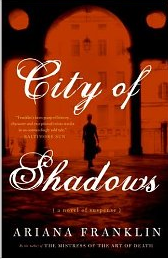
Day 167: City of Shadows

Cover for City of ShadowsAlthough I have read and liked books from Ariana Franklin’s “Mistress of the Art of Death” mystery series, I think that City of Shadows, a stand-alone thriller about a different period, is particularly good. On a side note, I am sorry to hear that Ariana Franklin has died, so we will never learn what her plans were for the characters in her series.

Esther Solomonova is a mysterious scarred woman who works for the phony Russian prince and nightclub owner Nick Potrovskov in 1920’s Berlin. However, the book begins a step before we get to Esther, when a woman is being chased through the streets of Berlin and dives into a canal to get away. Nick hears that this woman, Anna Anderson, is claiming to be Grand Duchess Anastasia of the murdered Romanov family, so he decides to take her under his wing in the hopes of getting a share of the Tsar’s fortune that has been left in England.

Anna is in an asylum, and the inmates claim that every six weeks a man lurks outside, trying to get a chance to murder her. After Nick removes her from the asylum, people begin dying. Only Detective Schmidt pays attention to Esther’s theory that someone is trying to kill Anna, since the only evidence is the testimony of insane people.

Franklin does a convincing job of mixing the true story of Anna Anderson with the completely fictional murder plot. She evokes a real sense of the chaotic, anarchic, starving Berlin in the time in which Hitler is coming to power.

Day 165: Alexandria

Cover for AlexandriaFor years I avidly collected all of Lindsey Davis’s Didius Falco mysteries. My passion has cooled a bit, as it usually does for series mysteries, but I still enjoy them enough to pick them up when I find them.

Marcus Didius Falco is a cynical, rascally, wisecracking “informer” during the Roman Empire of Vespasian. I have followed his path from the first book when he met Helena Justina, the fiery, unconventional daughter of a senator. Falco has had to work his way up from the plebeian rank and earn enough money so that he can legally be permitted to marry her.

In Alexandria, the 19th novel in this series, Falco and Helena Justina have been married for awhile when they travel to Alexandria with their two daughters, their adopted teenage daughter, and their mongrel dog for a vacation and visit to his uncle. Almost immediately upon arrival Falco is plunged into an investigation when his uncle’s dinner guest of the night before, Theon, the head of the famed library, is found dead, locked in his own office.

Of course, Falco has to figure out how Theon was murdered and why. He soon finds that several of the library’s scholars may want Theon’s job. Of course, people begin dropping like flies, including a philosophy student who is mauled by a crocodile. Falco begins to suspect that something else might be going on.

Davis’s books always involve a multitude of interesting, shifty characters and lots of dirty politics and other shenanigans, and Falco is always engaging and amusing. Davis does a convincing job of re-creating the ancient world in her books.

If you are interested in this series, I recommend that you start with the first book, Silver Pigs (recently renamed The Silver Pigs). Although the mysteries are stand-alone, developments in Falco’s personal life make it more enjoyable if you read this series in order.

Day 164: The Bone Garden

Cover for The Bone GardenThe Bone Garden is one of Tess Gerritsen’s Risoli and Isles series, but Isles only appears briefly, so it is more of a stand-alone mystery.

The novel takes place in two time periods. In the present day Julia Hamill has just purchased a 130-year-old house when she discovers an old skull in the overgrown garden. Medical examiner Maura Isles determines that the victim, a woman, was murdered long ago. Julia becomes fascinated with a box of newspaper clippings and letters that hold the key to the mystery.

In 1830’s Boston, Norris Marshall has joined the “resurrectionists,” grave robbers, in an effort to pay for his medical education. After a nurse and a doctor are murdered on the university hospital grounds, Norris finds he is a suspect. He seeks help from another student, Oliver Wendell Holmes.

I have only read a few Risoli and Isles books. I thought this one was passable, but I didn’t like it as well as others I have read. The attempt at 1830’s dialogue is awkward and painful to read, and in this case I didn’t see any reason to use a real historical person in the novel when a fictional one would have done just as well.

Day 160: A Rule Against Murder

Cover for A Rule Against MurderI am going to read Louise Penny’s latest soon, so in preparation I thought I’d review an earlier Inspector Gamache book, A Rule Against Murder. Inspector Gamache and his wife Reine-Marie are celebrating their anniversary at the remote but luxurious Manoir Bellechasse. The only other guests are the strange Finney family, there for a reunion. They intend to erect a statue on the grounds of the resort to the family patriarch, who is deceased. The Finneys are wealthy and privileged but treat each other and others with disdain.

Julia Martin, daughter of the family matriarch, Irene Finney, is attending the reunion for the first time in years, after her husband has been disgraced and imprisoned following a financial scandal. She is in the midst of divorcing him. The older brother is spiteful and his wife seems insecure. Gamache is surprised to find that “Spot” and his wife Claire, for whom the family has been waiting, are actually his friends from Three Pines, Peter and Clara Morrow. Unfortunately, Peter seems to revert to bad behavior under the family’s influence. The only pleasant member of the family is Irene’s second husband.

One night after a terrible storm they find Julia’s body, which has been crushed by the statue of her father. Gamache and his team must find out who murdered her, but they also must figure out how the huge statue could even have been moved.

As usual, I find Penny’s novels atmospheric and well written. Penny also creates believable and interesting characters. I am looking forward to reading her next book.

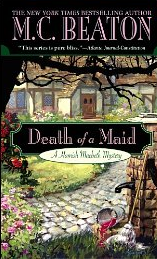
Day 158: Death of a Maid

Cover for Death of a MaidI have been curious about M.C. Beaton’s Hamish Macbeth series ever since seeing an episode or two of the TV series, so I finally picked up Death of a Maid. Luckily, I only invested a dollar in this purchase.

Mrs. Gillespie is the best maid in town, but she is also a malicious gossip. Hamish Macbeth has won her services in a raffle but he spends most of the day trying to avoid her. Then she is found bashed in the head with a bucket in the house of a retired professor who was out all day. Hamish, who spends his time trying not to look good at his job for fear of promotion, finds there are loads of suspects.

Meanwhile, an old girlfriend has arrived in town with a new suitor, and Hamish is feeling jealous.

I don’t think I have ever read a book where the author has made less of an effort. The novel devolves into a series of short scenes that all seem to be prematurely cut off, usually by someone flouncing away even in the midst of being questioned by the police. The mystery is only difficult to solve because the book is littered with suspects. Macbeth catches the murderer 20 or 30 pages from the end of the book, but it continues to maunder on as if the author doesn’t know how to finish. Although I know this is a popular series, in my opinion it has run its course.

Day 153: The Shadow Woman

Cover for The Shadow WomanIn The Shadow Woman, a woman is found dead in a park during the Gothenburg Party, a citywide festival that is taking place during a blazing summer. Chief Inspector Erik Winter and his team are having a hard time finding leads or even identifying the body. All they have is footage from a surveillance camera of a Ford Escort and a strange symbol painted on a nearby tree.

Sandwiched into the criminal investigation is the narration of a little girl who doesn’t know where her mommy is and is being kept by strangers. When Winter’s team finally identifies the body, they find that the woman had a little girl. No one seems to know where the child is.

During an investigation that lasts months, Winter and his team begin to find links between the crime and a robbery that occurred 25 years ago. In the meantime, Winter’s long-time girlfriend Angela is thinking of giving him an ultimatum about their relationship.

I haven’t been reading Åke Edwardson’s Erik Winter mysteries in order, making the private lives of the recurring characters a little difficult to follow. The books keep my interest and provide complex puzzles, but I still don’t feel like I get much insight into the personalities of the main characters. The slower pace of Edwardson’s police procedurals is probably more realistic than the speed with which crimes are usually solved in fiction, but the author’s ability to effectively build suspense is also affected by this pace.

Day 150: The Torso

Cover for The TorsoThe Torso is a pedestrian police procedural by Helene Tursten. A torso washes up on a Swedish beach. The investigation finds that a similar murder occurred in Copenhagen, so Detective Irene Huss travels there to consult with the Danish police. Victims are being strangled and then after death dismembered and their organs removed. Not only are the leads to the murderer few, but the police are having difficulty identifying the original torso.

The novel is ploddingly written with no particular suspense. The characters all remain sketchily depicted except Huss, and her every thought is recorded, no matter how mundane. Unfortunately, many of her thoughts are mundane. Every character is thoroughly described including each person’s changes of outfits.

Speaking of Huss’s thoughts, despite having a loving husband and two teenage daughters, she seems to be prepared at one point to launch into an affair with a Danish policeman without any thought at all for her family.

My biggest negative reaction has to do with unlikeliness in the investigation. Perhaps police procedure is different in Sweden than here, but I was surprised to find the coroner providing a profiler lecture based upon one examination of the body and a lot of supposition. For example, there is an assumption throughout that the organs are removed to be eaten, even though there is no proof of that. In addition, the reactions of Huss and other offficers to some sights and remarks seem to be implausibly squeamish, considering their positions. It also seems implausible to me that the team would retain the obnoxious alcoholic cop Jonny, who seems to be incompetent to boot. Rather than assume Swedish procedure and police behavior is that different, I am inclined to believe that Tursten doesn’t know anything about criminal investigations.

Finally, the denoument of the novel is anticlimactic. The murderer has been stalking Huss, so we might expect a terrifying finale. No such thing happens. Although the novel is clearly meant to appeal to those who like dark, gruesome fiction, it completely fails to provide any suspense or atmosphere.