Day 136: The Séance

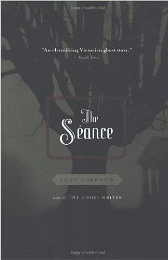
Cover for The SeanceThe Séance is a modern novel that is written like a Victorian gothic mystery. It features narrations by several different characters–a typical Victorian device that was used successfully in Wilkie Collins’s The Moonstone.

John Harwood’s novel is difficult to describe without going too far into the plot, because some important characters do not appear until later in the book. It begins with the story of Constance Langdon’s dreary childhood and young adulthood. Her mother has been depressed and nonfunctional since her sister died, and her father behaves as if he lives alone in the house. When Constance reaches the age of 11, her father withdraws her from school and abandons her and her mother to go live with his sister. Later, a disastrous experiment with spiritualism (very popular in Victorian times) in an attempt to help her mother results in her mother’s suicide.

Constance accepts her uncle’s invitation to live with him in order to avoid being thrust upon a father who doesn’t want her. But shortly after moving in with him, she finds she has inherited Wraxford Hall, an infamous house, old and crumbling, where two boys died; an old man mysteriously disappeared; and Magnus Wraxford was apparently murdered by his wife, Eleanor, who has also disappeared.

The next section of the novel is narrated by John Montague, a lawyer who visits Constance. He was involved in the experiment at Wraxford Hall that ended in the murder of Magnus Wraxford, and he tells the story of the experiment. This visit and Constance’s subsequent agreement to take part in a séance at Wraxford Hall lead us to Eleanor’s story, which is taken up by a diary that Eleanor wrote. Finally, we return to Constance. When she arrives at Wraxford Hall, she finds the experiment is to take place in a spooky gallery occupied by an odd-looking set of armor and a sarcophagus.

The novel is successfully creepy and mysterious. However, by the time of the séance I had figured out one character’s crucial secret identity, which made several other plot points clearer. Some readers may find it takes a long time to get to the crux of the novel, but I enjoyed the journey.

Day 134: A Red Herring Without Mustard

Cover for A Red Herring Without MustardBest Book of the Week!
A Red Herring without Mustard is another of Alan Bradley’s delightful, comic mysteries featuring Flavia de Luce, the eleven-year-old detective and chemist.

In this book a mysterious gypsy woman is nearly beaten to death after Flavia allows her to camp on de Luce land. Something odd is going on. After Flavia surprises a neighborhood thug in the de Luce’s drawing room when everyone else is in bed, she finds him dead the next day, hanging from the trident of a fountain of Poseidon.

As usual, Flavia races all over the countryside on her bike Gladys, feuds with her sisters, consorts with her father’s shell-shocked batman, and tumbles into trouble in this novel, set in England just after World War II.

Bradley’s plots are implausibly complex, but it is not for the mysteries that I read these books but for the funny, irrepressible character of Flavia.

Day 132: Life Sentences

Cover for Life SentencesThis is really my posting for Monday, because I’m traveling and will be without wifi tomorrow.

In Life Sentences, Cassandra, the author of two successful memoirs and a novel that was less successful, is looking for ideas for her next book. She attended a diverse middle school in Baltimore where her friends were all African-American while she is Anglo. In looking for a subject for her next book,  she learns that Calliope Jenkins, who was a quiet satellite to Cassandra’s group in middle school, later served seven years in jail, convicted of murdering her own son.

Cassandra decides to write her book about herself and her middle school friends and how their lives turned out, focusing especially on Calliope. However, she is surprised to find a cold reception from her old friends. As Cassandra investigates the past of all the girls, she begins to learn that things were not as she remembers or believed.

Laura Lippman’s novel kept my interest and was well written. I would rate it as better than average without being terrific.

Day 128: Echoes from the Dead

Cover for Echoes from the DeadEchoes from the Dead is another terrific book by Johan Theorin. It is his first book, and reading it explained a few minor points about The Darkest Room for me.

Julia’s young son Jens disappeared on the island of Öland in 1972, but her father just received a package containing the little boy’s sandal. After Julia’s father takes his friends Ernst and John along to look into what happened to her son, Ernst is found dead.

For years the island’s inhabitants have heard rumors of the return of Nils Kant, a notorious murderer who disappeared just after World War II. We readers know that these two stories are connected, but not how.  Although we also know who took Jens, we don’t understand what really happened to him until the very end of the book.

Julia returns to Oland to try to figure out what happened to Jens, if she can. After years of depression, she begins to take more of an interest in life and maybe to fall in love with Lennart, the island policeman.

This novel is not as atmospheric as The Darkest Room, but it is full of characters that you begin to know. The plot is complex, interleaved with the story of what actually happened to Nils Kant back in the past.

Day 127: Hush

Cover for HushI have read a few Kate White mysteries, but this one was disappointing. The heroine of Hush, Lake Warren, is a shallow, stupid woman who is so afraid she will lose her children in a custody battle that she lies to everyone all the way through the book, even when it doesn’t seem necessary. She is so stupid that even though she has been told to be careful about her behavior while custody is in question, she can’t resist having a one-night stand with a doctor she’s been flirting with at work. Afterwards, she falls asleep on his terrace, only to return to find he’s been murdered.

Her fears about drawing attention to herself extend to the point of ridiculousness. She doesn’t report that her cat was drugged and all its hair shaved off, that she has been receiving sinister calls, or that a man attacked her with a knife. Even when she finally finds someone she can trust, she never tells him what is really going on.

In the course of investigating the murder herself, she uncovers corruption at the doctor’s fertility clinic. Even an idiot would be about five steps ahead of her all the way. I used to enjoy the TV series “Sex and the City,” but this book reminds me of that sort of vapidity that often appears in chick lit, without the great script. A predictable, even annoying novel.

Day 124: Whose Body?

Cover for Whose BodyIt has been years since I read Whose Body? by the British writer from the Golden Age of Mysteries, Dorothy L. Sayers. Unfortunately, as soon as I saw the murderer’s name, I remembered who did it, so I was not able to judge how difficult it was to guess.

Mr. Thipps finds an unidentified body in his bathtub wearing nothing but a pair of pince-nez. The body bears a resemblance to a missing financier, but it is not him. Who is the dead man and how did the body get into the tub? Where is the missing financier? Is this one case or two? Of course, the police suspect Mr. Thipps. After Mr. Thipps’s mother asks him to help, Lord Peter Wimsey gets interested in the case and decides to find the answer to these questions in his inimitable way.

As always, Sayers is fine in characterization, much better than many of her Golden Age peers. Lord Peter is his usual apparently frivolous self. He and his man Bunter are fun. Lord Peter’s mother, the Dowager Duchess, is adorably ditzy. The plot is clever. However, as with many early mystery novels, it is overcomplicated and very unlikely. For people who haven’t read any Lord Peter books, I recommend Murder Must Advertise as a better starting place.

As a total side note, the cover I’m showing is not the one for the book I read, but is just one I found on Amazon. It occurs to me, why would they show the body of a woman when the victim is a man? This disconnect in publishing is always a mystery to me. One peek at the first few pages would have told the artist the sex of the body.

Day 121: Gone Girl

Cover for Gone GirlBest Book of the Week!

A lot of people are reading Gone Girl by Gillian Flynn, and no wonder! Usually, I would wait awhile to present another Flynn book after just having reviewed one last week, but I couldn’t wait to do this one! If you like dark, twisted plots, and great psychological thrillers with a smidgen of evil humor, this is the book for you.

Nick and Amy Dunne are having some marriage problems. When they met, they were both cool young Manhattanites. He was a magazine journalist and she a quiz writer and the model for a series of Amazing Amy children’s books written by her psychologist parents. Five years later, they have both lost their jobs and moved to a dying small town in Missouri to help his mother take care of his ailing father. With the rest of Amy’s money, Nick has bought a bar to keep himself and his twin sister Go busy. Their relationship has been deteriorating ever since.

On their fifth wedding anniversary, Amy disappears, leaving evidence of violence. Of course, Nick is the police’s prime suspect, and it doesn’t help that he hasn’t been altogether truthful with them. The public, galvanized by the Amazing Amy connection, almost immediately turns against him. The investigation turns up money problems and worse. Secrets are flushed out.

Most of the first part of the novel is narrated alternately by Nick and by diary entries written by Amy. Amy seems disingenuous and appealing, almost giddy, reminding me sometimes of Bridget Jones. Nick commits many lies of omission. Here’s a hint. Both Nick and Amy are liars.

Just when we think we know what’s next, the plot twists. The book is completely engrossing and very darkly funny, suspenseful and chilling. Think psychopath, but guessing who that person may be is just one of the book’s pleasures. In the reviews, I’ve seen several comparisons to Patricia Highsmith, and I think that’s about right.

Day 118: The Solitary House

Cover for The Solitary HouseBest Book of the Week!

I had an ambivalent reaction to The Solitary House, which is sort of a riff on Bleak House. It is not exactly a retelling of Dickens’s book. Although some story lines are re-interpreted, most of the Dickens characters appear in the background of the novel. My ambivalence is because Bleak House is one of my favorite Dickens novels, and I have not been happy with some of the retellings of classics that have appeared lately, particularly those that seem to miss the point of the original works. I am also a little dismayed by what Shepherd has done to some of my favorite Dickens characters. However, I find I have to admire the masterful way Shepherd has worked the threads of Dickens’s novel into such a different story. On the whole, almost despite myself, I am giving this novel a big recommendation for its originality.

Charles Maddox is a former detective for the London police force who left under undesirable circumstances. He is hired by Edward Tulkinghorn, a mysterious solicitor who has an evil reputation. A client of Tulkinghorn’s has been receiving threatening letters, and Maddox’s assignment is to find out who is sending them. Charles descends into the squalor of London to discover the author of the notes, but when he turns the information over to Tulkinghorn, the author of the notes is brutally murdered.

Thinking that this is not a coincidence, Charles begins investigating Tulkinghorn himself, as well as his client, Julius Cremorne. In doing so, he comes upon evidence of a serial killer. He also runs up against Inspector Bucket, his former police supervisor.

Charles’s story is written in a jokey third-person omniscient narration that often addresses the reader directly and is interlarded with many references to Dickens and some quotes from Shakespeare. Imagine a style that is like a postmodern Dickens. This narration is interleaved with the first-person narrative of Hester, seemingly the same quiet, loving, capable Esther Somerset of Bleak House. It is not until the end of the novel that these two stories merge horribly together.

Ultimately, I am coming down on the side of strong admiration for this book. It is completely absorbing and inventive, well written and literate, and actually convincing as a twisted alternate vision of Bleak House minus the case of Jarndyce vs. Jarndyce. It made me want to return to Bleak House, which I have not read recently, and dig out all the references. It is a gothic novel that becomes a serious creepfest, and you know how I love those.

I see that Shepherd has also riffed on Mansfield Park. As much as I am dreading what she will do to my beloved Jane Austen, I think I’m going to have to read it.

Day 115: Dark Places

Cover for Dark PlacesHappy Independence Day!

I just got a notice from Amazon that the latest Gillian Flynn book is finally shipping, so in celebration, I thought I’d post a review of a previous Flynn book. Gillian Flynn writes great, dark mysteries about women who have been severely damaged.

In Dark Places, Libby Day is the only surviving victim of a famous crime. When she was seven years old, her entire family was murdered, supposedly by her 15-year-old brother Ben. She survived by climbing out the bedroom window and hiding in the snow.

As an adult, she has been subsisting on the fringes of society, supported by donations made after the crime, sales of family memorabilia, and money from a book deal. But now she is almost completely broke and embittered, with no friends and her only relative serving a life sentence in prison. Although she is an unlikable character, a liar and manipulator, you somehow end up completely identifying with her.

The bizarre Kill Club contacts her. They are a group of amateur true crime buffs, and they want to hire her to investigate the murders. Most of them believe that the seven-year-old Libby lied in her testimony years ago and that Ben was wrongly convicted.

The true story of the murder is told partially in flashbacks, from the points of view of Libby’s mother and her brother Ben. As usual with Flynn, I found this book to be dark, enthralling, and perceptive.

Day 112: Fever of the Bone

Cover for Fever of the BloodVal McDermid is the author of an excellent series featuring Tony Hill, a troubled profiler. In Fever of the Bone, someone is luring teenagers over the Internet and murdering them.

Tony’s friend and colleague Inspector Carol Jordan’s new boss won’t allow her to employ Tony, so he goes off to Manchester to consult on a case. Later, two boys disappear in Bradfield. Neither Carol nor Tony know it, but they are both working on cases with the same killer.

Tony has also inherited some property from his father, whom he never met. He just wants to ignore the situation, but Carol thinks it’s important that he try to find out about his father.

As usual with a McDermid novel, the book introduces interesting characters and has an involving plot.