Day 40: The Damage Done

Cover for The Damage DoneIn The Damage Done by Hilary Davidson, Lily Moore comes home to New York from Spain when the police call her to tell her that her sister Claudia was found dead in the bathtub on the anniversary of their mother’s suicide. In an effort to support Claudia, but unable to deal with her lifestyle of drug addiction, Lily has been paying the rent on her own apartment so that her sister would have a place to live. Lily hasn’t seen her sister for three months, since she came home to visit a supposedly drug-free Claudia only to find her strung out. Since then, Claudia has not returned any of her calls.

When Lily goes to the morgue to identify the body, she realizes that the dead woman bears only a superficial resemblance to her sister, which makes the circumstances of her death–the supposed suicide on the date of their mother’s suicide–doubly suspicious. Lily realizes that Claudia has been missing for months, and that the other woman has stolen Claudia’s identity. She is determined to find her sister even as the police decide that Claudia is a suspect in the unknown woman’s death.

Davidson has written a capable, fast-moving mystery that keeps your attention. The characters are interesting, and readers will like Lily and her affectionate gay friend Jesse. I guessed one part of the puzzle fairly early in the book, but the solution was more complicated than I thought. The writing could have used another edit, but I don’t think editors actually edit books anymore. Overall, though, the book was enjoyable and fun to read.

Day 37: The Notting Hill Mystery

Cover for Notting Hill MysteryI have always understood that the first mystery novel was The Moonstone by Wilkie Collins, but last year I read an article that said the first mystery novel was actually The Notting Hill Mystery by Charles Felix (pen name for Charles Warren Adams), which was published serially  in 1862 before being published in a book. Even more interestingly, this article made a good case for the actual author being Benjamin Disraeli, the prime minister of England (that is, for Charles Felix being a pen name for a pen name). Well, of course I had to read it.

Two wealthy sisters have a sympathetic connection that makes them each get ill when the other is ill. The stronger sister is stolen away by gypsies at the age of five.

Years later, the other sister marries a wealthy man, and she and her husband fall under the spell of a mesmerist, the sinister Baron R. He has an assistant who develops a mysterious sympathy with the wife. Baron R. figures out the two are sisters and marries his assistant.

Soon, the Baroness is dead, having apparently swallowed a bottle of acid while sleepwalking in her husband’s laboratory. It looks like an accident until the insurance investigator, Ralph Henderson, learns that Baron R. took out several life insurance policies on his wife. As he investigates, he finds there may actually have been three murders.

If you have read many 19th century mysteries, you’ll know they tend to be overcomplicated, and this one is no exception. Also in common with other early mysteries, it has a strong flavor of the gothic.

The story is narrated entirely as depositions, which makes it seem more removed from the reader. Although Wilkie Collins used a similar device in The Moonstone, his character’s depositions teem with personality, and he is much more skillful at revealing prejudices and flaws.

In addition, the mystery is not very mysterious. Within 40 pages, it was perfectly clear where things were headed. However, as a new representative of a genre, I’m certain the story was blood-curdling to Victorian readers, whose only other exposure might have been to short stories by Edgar Allan Poe featuring detective C. August Dupin. It certainly compares at least equally or even favorably with some of the “Golden Age” mysteries I have read (for example, by John Dickson Carr) that concentrate more on timetables than on character development and motives.

Day 35: The End of the Wasp Season

Cover of End of the Wasp Season I have long been a fan of Denise Mina’s gritty mysteries, set in Glasgow. The End of the Wasp Season begins with two seemingly unrelated deaths: in Strathclyde, a crooked ex-millionaire banker named Lars Anderson commits suicide, and a young woman, Sarah Errol, is brutally murdered in a Glasgow suburb. Sarah was home temporarily taking care of her mother’s estate, and the wealthy suburban neighborhood is terrified by the seemingly random attack by hoodlums.

We know from the beginning that Sarah Errol was killed by two boys, but we don’t know exactly what happened or why.

As Detective Inspector Alex Morrow investigates, she runs into an old friend, the murdered woman’s housekeeper. Later Morrow’s friend Kay is accused of stealing from the dead woman’s estate. Kay’s teenaged boys are then arrested for the murder. Alex is convinced that her friend and the boys are innocent and tries to prevent a travesty.

DCI Morrow finds that one of the boys who broke into the home was the son of Lars Anderson, and that he mistakenly believed Sarah was his father’s mistress. As DCI Morrow investigates, she finds out about the boy’s horrible home life. Eventually we are lead to believe that the boys broke into Sarah’s house to scare her, and that the Anderson’s son stood there in horror and watched his companion go berserk. But the evidence is confusing.

I have been impressed by Mina’s work since I read the Garnethill series, her first three books. Her books feature strong women from working class backgrounds and criminal families who are trying to make their way on the right side of the law. Alex herself has a stepbrother who is a crime kingpin, from whom she has been trying to keep her distance.

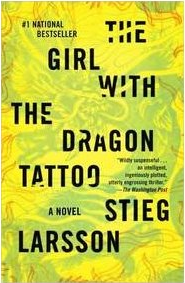
Day 32: The Girl with the Dragon Tattoo

Cover for The Girl with the Dragon TattooBest Book of Week 7!

Maybe everyone has read The Girl with the Dragon Tattoo by Stieg Larsson. But if you are one of the few who have not, you are missing an exciting thriller.

Editor and writer Mikael Blomkvist has just lost a libel case brought by a billionaire industrialist named Wennerström concerning Blomkvist’s allegations of corruption. Blomkvist has been sentenced to three months in prison. He had carefully checked his facts but then one of his witnesses recanted. In order to separate his magazine, Millenium, from this problem, he resigns.

After he gets out of jail, he is approached for a job by Henrik Vanger, the retired head of Vanger Corporation. Vanger wants Blomkvist to find out what happened to his great-niece Harriet, who disappeared off the family’s private island 36 years earlier during a day when the island was cut off from the mainland by an accident blocking the only bridge. He is afraid that some member of his family murdered her. He yearly receives a pressed flower on his niece’s birthday and believes the killer is expressing remorse through this means.

Although Blomkvist is initially reluctant, he eventually accepts the job and goes to live on the island. When he decides he needs a research assistant, Vanger’s lawyer connects him with Lisbeth Salander, a child-sized woman who dresses in a goth style and has a dragon tattoo.

Salander is a computer genius with a difficult past. When she was a teenager, she was institutionalized and is still under the care of a legal guardian, who controls her money and can have her institutionalized at any time. She is hostile and uncommunicative, and few people have bothered to try to get to know her. After her guardian has a stroke, he is replaced by Nils Bjurman, who uses his position to sexually abuse her.

Bjurman has seriously misjudged Salander, however, and she takes care of this problem in one of the most satisfying scenes of the novel.

As Blomkvist and Salander investigate Harriet Vanger’s disappearance, they begin to believe that they may be on the track of a serial killer. Ultimately, Blomkvist finds himself in grave danger.

With a complex, interesting plot, an engaging hero and formidable heroine, a slew of interesting characters, and a sense of Swedish politics and law, you will lap up this book and go looking for the next one. Larsson was an activist with strong feelings about violence against women, a theme in all of his books.

Day 30: Never End

Cover of Never EndNever End by Åke Edwardson is an interesting police procedural. A young woman is raped in the park during a sweltering summer evening in Gothenburg. What concerns the police even more than the rape is the fact that it took place in the same alcove where a girl of the same age was murdered five years ago. Jeanette, the victim, was also choked with something, perhaps a dog leash, while the murdered girl was strangled with her own belt.

Chief Inspector Erik Winter leads the investigation, and Inspector Handler tries to help while dealing with his ex-wife’s death.

The characters were interesting and the solution was difficult to guess. I have read a couple of Erik Winter books so far, and I still find myself unable to get much of a sense of the personalities of Winter and the other detectives. Edwardson provides some personal information about his detectives: Winter is happily married with a young son, and he is grappling with the idea of how much time his work takes away from his family; he is also battling with nicotine withdrawal. But Edwardson really concentrates on the methods and findings of the investigation. Perhaps as you read through the series, you slowly develop an idea of what the recurring characters are like.

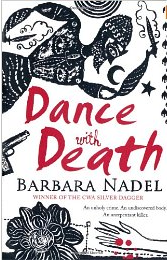
Day 28: Dance with Death

Barbara Nadel’s Turkish mystery novels are interesting because they usually involve one of the many minorities of Istanbul. Dance with Death takes place in the fascinating region of Cappodocia rather than in Istanbul, though. Inspector Çetin İkmen gets a call from his cousin asking him to come to Cappodocia. A body has been found in a cave, and his cousin believes it may be that of a girl with whom he was in love years ago. This girl, who was rambling around the Europe and then Turkey on vacation, simply disappeared, and he thought she had left him.

In the meantime, his colleague Mehmet Süleyman is still in Istanbul trying to catch an attacker of homosexuals.

Nadel’s Turkish mysteries are filled with detail about place and customs that I find irresistable. I almost always guess the killer fairly early, but sometimes this is my test of a mystery. If I still find it interesting even when I guess the solution, then it is worth reading. Dance with Death is full of the color of that mysterious region, and İkmen and Süleyman are sympathetic and interesting characters.

Except for one thing. A theme of men’s unfaithfulness runs through the books. Both Inspector İkmenand Süleyman have been unfaithful, even though they love their wives. I’m not sure if that is meant to indicate something cultural or not.

Day 23: The Dead Lie Down

Cover for The Dead Lie DownBest Book of Week 5!

Sophie Hannah is another writer of dark mysteries who I discovered during the past year. The Dead Lie Down was the first of her books that I read, not the first in the series. Be careful if you buy her books as some of them have two titles, depending upon whether you buy the British or the American version. I have bought two copies of the same book by mistake.

Ruth did something bad in the past but was punished far out of proportion to her crime. She is still trying to recover some confidence and self-esteem when she meets Aidan, a picture framer. The night they get engaged, they make a pact to tell each other everything and forgive each other their secrets, with no questions asked. But Ruth is shocked when Aidan confesses he strangled a woman named Mary Trelease years ago. She is even more confused when she realizes that she has met Mary Trelease and she is alive.

Ruth takes her case to Sergeant Charlie Zailer, a recently disgraced police officer, who dismisses it. At the same time, Aidan confesses to Charlie’s fiancé, DC Simon Waterhouse. After further consideration, both of them decide to investigate further, because they feel a sense of dread.

The Dead Lie Down is a compelling novel with a tangled plot. Sophie Hannah follows a convention in her novels of alternating the narrative between a usually victimized character (in this case Ruth) and the police officers. She indicates this alternation by changing the form of the dates that head each chapter. This confused me at first because for every other chapter she was using the European form of putting the day before the month, and I thought the chapters that took place in early March were actually flashbacks to January and February. Just something to keep in mind when you are reading Hannah.

I have found that Hannah’s novels are deliciously dark and always difficult to figure out, even though by now I know the pattern that someone is being deeply deceived. The trick is to figure out who and how. Her police officers are seriously flawed and have a difficult relationship. A bit of narrative that I have had difficulty following is the story of their romance, which is, however, just incidental to the novels. In other respects the books are stand-alone and do not have to be read in order.

Sophie Hannah is another find for those who like edgy, complex mysteries with a touch of the gothic thriller.

Day 21: The Sweetness at the Bottom of the Pie

Cover for The Sweetness at the Bottom of the PieI don’t know that anyone has invented a more delightful heroine than Flavia de Luce, the eleven-year-old sleuth in Alan Bradley’s funny, charming series. I haven’t read The Sweetness at the Bottom of the Pie in a few years, but for series books I am trying to start with the first one, so I’ll do the best I can.

It is 1950’s Britain, and Flavia is an eccentric in a family full of eccentrics. She spends her time cooking up dangerous chemicals in the laboratory she inherited from a great uncle or riding around on her bicycle, Gladys, looking for trouble. Her father is a reclusive widower who stays locked up in the library with his stamp collection and worries about how to support their ramshackle estate. She engages in all-out warfare with her two older sisters, which includes putting poison ivy extract in Ophelia’s lipstick. Her only ally is the Dogger the gardener, her father’s batman from WW II who suffers from post-traumatic stress disorder.

First, Mrs. Mullet the housekeeper finds a dead bird on the porch with a valuable stamp in its beak. Then a mysterious stranger calls upon her father, and they have an argument. Later Flavia finds the stranger dying in the cucumber patch. When her father is arrested for murder, Flavia decides to investigate. She finds out her father may have been involved in the suicide of a former schoolmaster and the theft of a valuable stamp. As Flavia cycles around the village of Bishop’s Lacey looking for clues and interviewing suspects, she may be putting herself in danger.

If you’re looking for a light mystery with plenty of twists and turns that will make you laugh out loud, look no further than any book featuring Flavia de Luce.

Day Eighteen: Jar City

Cover for Jar CityJar City is a police procedural from the Icelandic writer Arnaldur Indriðason, who has received several awards for his books. Although I found the plot interesting, I have several criticisms of this novel.

Within a few pages, I noticed a choppy, sometimes clumsy writing style. I saw some evidence of a poor translation, but it wasn’t clear whether this was because the translator’s English wasn’t good enough or he was translating too literally. Some idioms seemed dated, and although the translation was British, I think I read enough modern British novels to know which idioms are currently in use. For one of the many examples of what appears to be a simply bad translation, take this perhaps not literal quote (I’m writing it from memory) “the photographer must have had to bend his knees until he was very short.” In English we have a word for that. It’s called “crouching.” But there is also evidence that the writing just isn’t very good, the most noticable being a dream sequence that is one quite dreadful, long sentence.

I was unable to guess whether the poor writing was the fault of the translator or the writer. My guess is it was a combination of both.

Other problems emerge. Although Inspector Erlendur was developed as a character, all the other characters were pretty flat. I got no sense at all of the personalities of his fellow investigators, for example. What is more of a shame, I also got no sense of Iceland as a country or the Icelandic as a people (or even any individual Icelanders), which is one reason I like to read books from other countries.

What fills out the detective himself is some background about his family, his divorce, his struggles with his addicted daughter, his messiness, his sleeplessness or tendency to sleep in his clothes, and his worry about a pain in his chest. These details all seem very familiar to me, but I’m not sure whether Detective Erlendur or Kurt Wallender came first or whether either of the writers knew the other’s work, so I will say no more.

Arnaldur also plays the Christy-an trick of keeping some of the evidence to his detective for awhile. For example, the killer leaves a note on the body of the victim, but we’re not told what it says for some time. If the author was holding out for a dramatic moment, I don’t believe that attempt was successful.

My final criticism is of the detective, who seems notably stupid at times. Making the detective too busy to take care of something on time or just plain dense is a common tactic of some writers, who use it to drive up the suspense, but it just makes me angry. I want my detectives to be smarter than I am. An old woman saw the killer in her yard. When she calls the detective back, does it occur to him that she might have seen him there again? No, he is too busy interrogating someone else to take a second to call her back. In doing so, we would have missed the final scene. I’m sorry, but surely Indriðason could have handled that less clumsily.

All that being said, the plot and mystery were interesting enough to get me to finish the book, although I’m not as sure if I would pick up another one. An old man is found dead in his apartment, his head smashed in by a heavy ashtray and a note on his chest that says (we eventually learn) “I am HIM.” The only other clue is an old photograph found in the back of his desk of the grave of a child.

In investigating the victim’s past, Erlendur finds that he was accused of rape in the 60s but the case was mishandled and the woman did not get justice. The photograph, it turns out, is of the grave of the daughter of the rape victim.

As Erlendur investigates further, he realizes that the victim was a truly repellant creature. He also finds another mystery–one of the victim’s friends disappeared 25 years ago. Erlendur eventually figures it out, and in doing so encounters some interesting twists.

Day Sixteen: Sharp Objects

Cover for Sharp ObjectsI love dark mysteries with an edge. Two of my discoveries from last year  for this type of novel are Gillian Flynn and Belinda Bauer. My book journal for Gillian Flynn’s first book, Sharp Objects, starts out with “What a terrific book!”

Camille Preaker works for a Chicago newspaper, which sends her to her home town of Wind Gap, MO, because a young girl was murdered and another one has disappeared. Camille reluctantly returns to the home town she has avoided for eight years. Institutionalized for self-mutilation as a young girl, she has learned to resist cutting words into her body and now writes them on with a pen. But as she begins investigating her family problems and her disturbed childhood as well as the murder, she awakens her own demons.

Camille’s mother has never paid much attention to her, although she plays the doting mother outside of the home. Camille’s sister Marianne, who was loved by both Camille and her mother, died when she was young. Now Camille has a much younger stepsister, Amma, a 13-year-old who behaves like an angel at home but is a terrible bully outside the home, hanging out with a bunch of mean girls.

As Camille interviews her old friends and acquaintances, her leads all seem to be turning into dead ends, but the reader’s sense of horror grows. Discovering more of the truth about the murder and her own family, she begins spinning out of control and has difficulty resisting the urge to cut herself again.

Flynn’s writing is fast-paced and efficiently builds suspense. This book is a real page-turner.