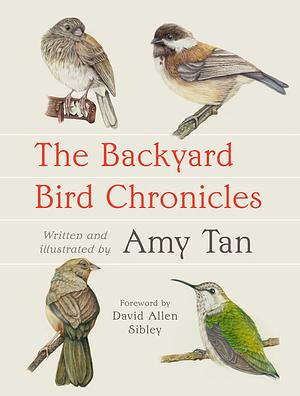
Review 2730: The Backyard Bird Chronicles

I am not really a bird watcher, but we have feeders out and I enjoy trying to identify the more distinctive birds who come to our feeders (not so much all the different kinds of little brown birds). I heard about this book from a radio interview a year or so ago, and it has taken this long for it to percolate up to the top of my pile.

In the interview, Amy Tan mentioned that she had started watching birds more avidly after she developed a condition that didn’t allow her to drive safely or be out alone. She doesn’t mention this in the book, just says she doesn’t drive, but talks about her childhood fascination with bugs and other things she found along a creek that somehow kept her looking down instead of up.

However, she began to observe birds seriously in 2017 and also returned to drawing. She had lots of questions about birds and felt she could answer some of them by drawing them accurately.

The result is a bird journal that she kept until 2022, when she decided to start a new journal that looked up even more, out of her own backyard and into the wooded places beyond. The journal is full of drawings, one for each journal entry, starting out fairly rudimentary (although better than I can draw) and getting more complex. Some of the entries are lighthearted, the drawings accurate but with quirky captions or imaginings of what the birds are saying or thinking. Although most of the drawings are black and white, there are two sections of colored illustrations, and other colored drawings pop up all over the journal.

Tan is a wonderer, and she has questions about a lot of things—what does it mean when a bird does this? can birds play? (I think she proves that they can) how much of their behavior is instinct and how much learning or even thinking?

One of the stories Tan told on the radio that had me hooked is how she got a hummingbird to eat out of a small feeder right in her hand. That entry is the first one in the book. How cool is that?

Although it’s more full of questions than answers, this book is a good one for anyone who is even vaguely interested in birds, like I am.

Related Posts

Birds, Beasts, and Relatives

H Is for Hawk

The Bird: A Natural History of Who Birds Are, Where They Came From, and How They Live

Day 761: The Bird: A Natural History of Who Birds Are, Where They Came From, and How They Live

Cover for The BirdAlthough I am interested in birds, I kept thinking while reading The Bird that science writer and zoologist Colin Tudge had not thought enough about who his audience was. The book is written in an accessible style for the general reader, but the level and amount of information is sometimes more suitable for a serious student.

For example, he spends several chapters on evolution in general, the evolution of birds, and the number of bird species. This information takes up the first 200 pages of the book, ending in a chapter of nearly 100 pages that describes each of the many species of bird. Who does he think is going to read and remember this? In particular, since most people have not even seen a tenth of these species, how can they visualize them from these descriptions? Pictures would be better, but all we get is an occasional line drawing.

Furthermore, he makes some notable mistakes in these first chapters. When he is discussing the evolution of bird species, he makes a comment referring to a figure. When I looked at the figure, I could find no correspondence between what he was saying about it and what it showed. Thinking that the reference was to a different figure, I looked at all of them, but still could not figure out what he was talking about. Later, in an even worse mistake, he refers to a figure that is not even in the book.

The second half of the book covers subjects such as what birds eat, where they live, how they mate, and what their familial and community relationships are. This is more interesting material, but it is still too exhaustive. We really probably don’t want to know the habits of every species of bird.

I also felt sometimes as if he gets too far off track in his musings. For example, in the chapter about the mind of the bird, he starts with a series of questions, and one of them is whether computers can think like humans. If there is some connection between that idea and the study of birds, he didn’t explain it well enough. It feels like a total nonsequitor, and this is not the only instance.

The final chapters are the most interesting. I enjoyed the descriptions of studies meant to demonstrate the intelligence of birds even though I had seen TV programs about most of the same studies. Mind, he doesn’t use the word “intelligence.” I do.

The book ends with a strong message about conservation that is probably the most important section.

Related Posts

The Rural Life

The Signature of All Things

The Crane Wife