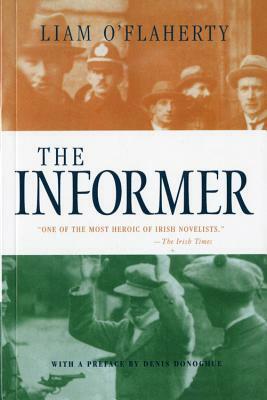
Review 2638: #1925Club! #HYH25! The Informer

Twice a year, Simon of Stuck in a Book and Kaggsy of Kaggsy’s Bookish Ramblings host a year club, and this October the year is 1925. For this club, participants read a few books from that year and all post their reviews on the same week. Just by coincidence, this year the books also qualify for Neeru’s Hundred Years Hence Club.

Previous Books from 1925

As usual for my first post for the year club, I’ll start out by listing books I have already read for that year with links to my reviews, if I read them while blogging:

My Review

I picked The Informer for the 1925 Club without knowing anything about it or about Liam O’Flaherty. It was a winner of the James Tait Black award, written in the style of Naturalism and set after the Irish Civil War.

Francis Joseph McPhillip is a wanted man. He was a member of the Revolutionary Organization when he murdered the president of the Farmer’s Union during a strike. He and his friend, Gypo Nolan, were booted out of the Organization as a result, and Frankie has been on the run with a price on his head. But he has become tired of running and has returned to Dublin. The first thing he does is search out Gypo to ask if his parents’ house is being watched, and then he goes home.

Gypo is a brute—huge, strong, ugly, and very stupid. He has always done what Frankie told him to do. But ever since he got thrown out of the Organization, he can’t get work. He has no home, and no one will help him. He doesn’t have anywhere to sleep that night. He gets an idea. If he turns Frankie in to the police, he’ll have the reward money. So, he does.

The word is soon out that Frankie is dead, shot by the police at his parents’ home. Being an idiot, Gypo is running around town spending money on liquor and women. He just manages to come up with a story that he robbed an American sailor.

Even as an ex-member of the Organization, Frankie is still in its sights, as it is clear someone informed against him. Commandant Dan Gallagher is already looking at Gypo, because Frankie told his parents he had seen Gypo. Gypo is not very good at thinking, but he makes up a story that he saw Rat Mulligan skulking after Frankie in the street. But Rat has an alibi.
Naturalism isn’t my thing, and true to the literary movement, many of these characters are the dregs of society. It’s hard to empathize with a stupid fool who turns in his friend for a few bucks. Other characters are mostly street people—hookers, addicts, and so on—and those in the Organization who have a philosophy spit out half-digested rhetoric. Also, the ending of the book is over the top. A powerful book in its time, but not my thing.
Related Posts

Troubles

Last September

The Islandman

Review 2514: Germinal

My copy of Germinal seems to be a special edition, released in 1942 by Nonesuch Press, and perhaps part of a book club, because inside its cover is a little insert that says it is part of a series called the Ten Great French Romances. Now, I’m not so sure of the other books, although some of them don’t strike me as Romances (not even using the original definition), but poor Zola would be rolling over in his grave. Why? Because he was basically the founder of a new kind of literary movement for his time that rejected Romanticism. It was called Naturalism and is supposed to be based in science and logic and takes an impersonal stance, observing but not commenting. It also takes determinism as one of its tenets—that is, a character’s fate is determined at the get-go.

One little personal comment before my review—I received this novel as a Christmas present from my brother after unthinkingly commenting that I had never read any Zola. After I started reading it, I realized there was a reason for that.

The novel begins and ends with Étienne Lantier. He is an engine-man who has lost his job after a dispute with the foreman, and he has been traveling north looking for work. He is starving and doesn’t expect to find any.

It’s 1866, and the revolution 70 years before has helped the middle class but not the poor. Étienne travels from place to place but finds nothing.

He meets an old man nicknamed Bonnemort whose family, the Maheus, has worked for the Montsou Mining Company for generations. He ends up hanging around one of the Montsou pits, the Voreau, and so is on hand when Maheu, Bonnemort’s son, learns that his best putter has died. (I never figured out what a putter is, but now I see it’s someone who brings empty containers up to the surface and brings filled ones down to the bottom.) Étienne has just walked off, but Maheu sends his daughter Catherine after him to fetch him back and gives him a job. (Yes, women worked in the mines, too.)

Étienne is a little better educated than the miners and has been writing to a representative of Workers International. Soon, he is talking about half-understood principles of socialism and unionism to the mine workers. The Maheus, whom he takes a bed with, are barely able to feed themselves on the wages of Maheu, Catherine, Bonnemore, and Zacharie, and in fact Zacharie is being prevented from marrying because his family needs his wages. Then the unexpected demand for repayment of a debt begins a period of starvation.

Although the novel is about an actual 1866 mining strike, a strong subplot is about Étienne’s relationship with Catherine. He at first takes her for a boy, she is so young, but because a man named Chaval is pursuing her, Étienne assumes she is loose, as most of the mining women are, so they start off badly. (Modern audiences may be upset, as I was, when they find that Catherine doesn’t enter puberty until long after she is involved in a sexual relationship with Chaval.)

After a period of hardship for all the miners, the company decides on a new policy of timbering that will essentially cut the miners’ wages. Étienne becomes their leader when the miners begin negotiations to avoid a strike.

This novel is unremittingly grim. Zola digs you right in to every detail of the miners’ lives and then includes a couple of passages that contrast this with what the middle class mine managers and owners are doing. For example, the village has just emerged from a period of starvation when Zola describes a several-course dinner party at the home of Hennebeau, the mine manager. Later, when the miners are destroying the mines, Hennebeau is too wrapped up in the discovery that his wife is unfaithful to pay much attention.

Although this novel is considered a very important work in French literature, naturalism is not for me. It is too brutal.

Related Posts

Manga Classics Les Misérables

Little

The Black Count: Glory, Revolution, Betrayal, and the Real Count of Monte Cristo

Day 762: The Call of the Wild

Cover for The Call of the WildThe Call of the Wild is no boys’ tale. It’s rough, embodying as it does Jack London’s ideas about the survival of the fittest. It is also London’s classic tale about the relationship between dog and man.

Buck is a large, pampered dog, the pet of a rich judge in California. But the Alaska gold rush is on, and all large dogs on the west coast are at risk. A gardener’s assistant with debts kidnaps Buck and sells him.

Buck is beaten with a club and then taken up to Alaska to work as a sled dog. But Buck never becomes submissive. Through intelligence, cunning, and brute strength he survives in brutal conditions. Eventually, he begins to feel the urge of his wild heritage.

Although London has the dog have fairly ridiculous “racial memories” of tree-living humans, they are probably about on par with what was believed at the time about evolution. London’s short novel is typical of the school of naturalism, which endeavoured to show the worst of reality. This is not really my favorite of my Classics Club list books so far.

Related Posts

Robinson Crusoe

The Devil’s Backbone

Kim