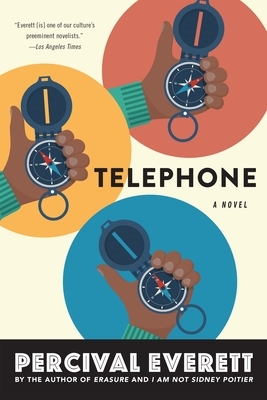
Review 2745: Telephone

Telephone famously has three versions, each one different than the others—something I might be able to comment on if I’d read more than one. The novel is also divided into three sections, signified by different devices separating the chapters. In the first, it is Latin phrases; in the second, chess annotation, neither of which I understood (although I admit to being too lazy to look up the Latin). The third is a repeated sentence.

Zach Wells is a geology professor and paleontologist whose focus on his work in the Grand Canyon becomes dislodged when he and his wife Meg notice changes in their 12-year-old daughter Sarah, the person Zach loves best in the world. She has begun having minor seizures and her vision is blurry.

After visiting several doctors, the Wellses learn that Sarah has a rare neurological disease that is going to kill her. Zach clearly doesn’t know what to do with his grief.

Around the same time, he finds notes asking for help in some shirts he ordered from eBay. Perhaps to distract himself, he discovers where the packages came from and goes to a small town in New Mexico to investigate, oddly leaving his wife home to cope with Sarah, who is entering dementia.

This is an odd novel. Although Sarah early on tells him he can’t save everyone, he isn’t trying. He is unnecessarily harsh with a colleague up for tenure and a student with a crush, then he turns around and is nicer to them.

For me, apparently not agreeing with the critics, although wonderfully well written, the novel seems to go in several directions that are unresolved. But then, perhaps this is true to life, truer anyway than stories that neatly wrap everything up.

Zach isn’t a particularly likable person, and his way of running off in the midst of trouble, leaving the burder on Meg, is egregious. This novel is about grief, but it’s also about trying to have some kind of control over the randomness of life.

This is the last book I had to read for the 2021 Pulitzer Prize shortlist.

Related Posts

Erasure

The Trees

Looking for Alaska

Day 647: Spider Woman’s Daughter

Cover for Spider Woman's DaughterIn summary, ho hum. I think I’ve read all of Tony Hillerman’s Joe Leaphorn and Jim Chee mysteries. I especially like Jim Chee, because he follows the Navajo Way, and I find the information about these customs and beliefs fascinating. I am not so fond, though, of writers picking up other writers’ series after their deaths. However, in the interests of being fair, I decided to try Spider Woman’s Daughter, a Leaphorn and Chee novel by Anne Hillerman, Tony’s daughter.

This novel is written from the point of view of Bernie Manuelito, now Jim Chee’s wife and a Navajo Nation police officer. She is attending a breakfast with retired Lieutenant Leaphorn and some other police officers when she witnesses Leaphorn being shot. In the parking lot of the restaurant in broad daylight, a short hooded figure emerges from the car next to his and shoots him.

Bernie does what she can to help him but feels as if she could have done more if she moved faster. Leaphorn is shot in the head and is moved from Albuquerque to Santa Fe to get care. Bernie is only allowed to follow through to contact relatives and then is off the case because she is a witness. The police are also having trouble finding Louisa, Leaphorn’s partner.

Because of Bernie’s thorough description of the getaway car, the police are able to identify it quickly. But it turns out that many people could have been driving it, as the owner’s son regularly loans it out.

Jim and Bernie become convinced that the attack relates to an old case, but a report is missing for a new case Leaphorn is on, evaluating the documents for a collection of native American artifacts that is being donated to a research facility in Santa Fe.

I was disappointed in this novel. First, except for Bernie, it does almost nothing to develop its characters. Frankly, Jim Chee did not seem like Jim, and Leaphorn was unconscious almost the whole time. The minor characters have little personality.

More importantly, by two thirds of the way through, I knew who the murderer was and why, while it took being abducted for either Chee or Bernie to figure it out. This is too early in the book to be thinking the detectives are idiots. With the old series, I seldom knew the murderer before Hillerman wanted me to, and if I did, I was interested enough in the plot or other details to want to continue.

Related Posts

The Cold Dish

The Wives of Los Alamos

Folk Tales of the Native American

Day 644: The Wives of Los Alamos

Cover for The Wives of Los AlamosA little note from me: I noticed that for awhile WordPress applied a feature to my blog that showed related posts at the bottom of the page. Then yesterday I noticed that the feature disappeared at some time. I couldn’t figure out a way to implement it on my blog automatically, but I was amused at its choices sometimes. So, a new feature of my blog is that every time I review a book, I’ll try to find three other reviews that share something in common with it, whether it’s the subject matter, the setting, the author. The reviews are links at the bottom of the page. Let me know how you like it!

* * *

The Wives of Los Alamos takes an unusual approach to historical fiction. It is narrated collectively, in first person plural, by all the wives of the scientists at Los Alamos during World War II. Of course, this approach has its disadvantages, as there are no characters who stand out from one another. Still, it is a fascinating way to point out what these people shared—and did not share.

The novel begins as the wives depart their former lives. They know nothing about where they are going or what their husbands are going to do when they get there. What little they know, they are not allowed to say. The novel tells their story throughout the war and their reactions when they finally learn what their husbands have created.

At times we see these women as selfish and privileged, especially when they become bored with the restrictions and begin gossiping and complaining about the “help.” But other times we realize how difficult their situation is, shipped off to a primitive environment where their housing is not even ready when they arrive, unable to learn what is going on, subject to restricted movements and stringent security even though they know very little.

http://www.netgalley.comThis is an interesting book that touches on topics that emerged during the war and after—like equal pay for equal work, the ethics of creating this powerful weapon, and family relationships and roles.

Related Posts

Lucky Us

The Zookeeper’s Wife

Shanghai Girls