Day 719: To Rise Again at a Decent Hour

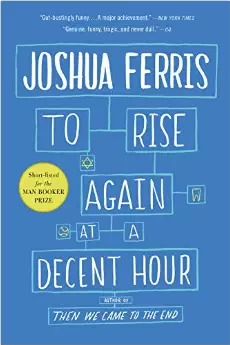
Cover for To Rise Again at a Decent HourThe descriptions I’ve read of this book in reviews and on the cover don’t really do a good job of conveying what it is like, and I’m afraid mine won’t be any better. Still, I’ll give it a try.

Paul O’Rourke is a rather neurotic New Yorker, a middle-aged dentist who loves the Red Sox. He wants to belong to something so badly that his desire has messed up his two most significant relationships. Each time, he has fallen madly for his girlfriend’s family—the first a close-knit Catholic family whom he offended by announcing he was an atheist, the second a close-knit Jewish family he tried to impress by his research into the Holocaust.

Paul feels he needs to engage more with life but instead engages less. He records and watches baseball games and eats take-out and does little else except worry about how little his patients floss. At least, that’s all he’s done since he and Connie, his office manager, broke up.

Although Paul texts, he does not use other Internet technology, so he is surprised when someone puts up a web site for his dental practice. He immediately contacts the designers of the site and asks them to take it down. Soon, someone is posting odd messages about a group called Ulm on the site and has also started a Facebook page and Twitter feed in his name.

Rather than simply working through a lawyer, Paul engages with this other “Paul” in long philosophical arguments by text. Soon Paul’s other self is trying to get him to visit his “homeland” in the Negev desert.

This novel creates a distinct personality in Paul as well as a fair amount of humor. I enjoyed it even though I thought many of the discussions were gratuitous and the plot a bit whacky.

Related Posts

Straight Man

Wife 22

Await Your Reply

Day 712: Literary Wives: My Father’s Wives

Cover for My Father's WivesToday is another Literary Wives discussion about the book My Father’s Wives by Mike Greenburg.

Be sure to read the reviews and comments of the other wives! If you have read the book, please participate by leaving comments on any of our blogs.

* * *

If there is such at thing as a male equivalent for chick lit, My Father’s Wives fits in the genre. Take a similar focus on romance and family, keep the background of wealth and focus on expensive brand names, replace shopping with basketball and witty dialogue with earnestness. Mix in a bunch of underdeveloped characters that readers don’t care about. Make it light as a feather despite themes that could be heavy and also make it thoroughly predictable. There you have it. This genre can even have a similarly rhyming name, but it would be rude to say it.

Jonathan Sweetwater has led a privileged existence. He is the son of a U.S. senator. He has a job as a banker that he enjoys, and he has been taken under the wing of the CEO because of a mutual love of basketball. He is happily married with two kids that he loves.

One day before he is due to leave for a business trip, he decides to come home early from work and sees what he thinks is evidence that his wife Claire is having an affair. I’m not giving away anything here. This happens almost at the beginning of the book.

Instead of simply walking into the room or, failing that, asking his wife about what he saw, Jonathan hires a private detective. This is what movie reviewers call the lame-brained plot, the plot that continues when the problem could be cleared up with a few sentences. If he had behaved at all rationally, there would be no story, however. By the way, this detective’s shenaningans, supposedly an effort to protect his client’s anonymity, are ridiculous.

Then for some reason, Jonathan decides he really needs to find out about his father, from whom he and his mother have been estranged since he was 9. I would call this the McGuffin if it had any other purpose than making the book a little longer. To do this, he tracks down all six of his father’s wives, doing so while pretending to be on business trips.

I felt the premise behind this novel, although not unlikely, didn’t really relate well to its trigger. That is, why would thinking his wife was having an affair make him run out to find out about his father? The people in the novel are very thinly characterized, even Jonathan. We know, for example, that he’s supposed to be destroyed by his discovery, but we don’t feel it. In any case, I think we all know that there will be some explanation for Claire’s apparent infidelity.

I would also like to mention the choices in this novel and the lack of a sense that some of the choices are not ethical or moral. Jonathan sees nothing wrong with hunting up his father’s wives while he’s pretending to work. His boss behaves more like a mafia don than a CEO, and if he was really spending his nights with cocaine-sniffing models, he wouldn’t take an employee along. In any case, that relationship is inexplicable and unlikely. Claire does one questionable thing that is unexplained, and I cannot say more about it.

What does the book say about wives or the experience of being a wife? In what way does the woman define “wife”—or in what way is she defined by “wife”?

Although there are a lot of wives in this book, I don’t think we learn much about them. We don’t even see that much of Claire. Her role seems to be very conventional—to be a good suburban wife and mother. She is warm and someone Jonathan feels comfortable with.

Literary Wives logoOf Percy Sweetwater’s six wives, we learn that he left each one for not being perfect. Jonathan’s mother is intelligent, educated, and cultured, but she doesn’t worship Percy, so he leaves her for Christine, who does. But he soon tires of Christine for her lack of the qualities he admires in his first wife. Next, he marries Elizabeth, a doctor, for her intelligence. He continues on, always marrying his current wife’s opposite. But we barely learn anything about them except their jobs. I don’t think we can gain much of a coherent view from this novel of how the author views wives. Clearly Percy views a wife as someone who has to meet all his needs for admiration, intelligence, charm, and beauty, but just as clearly, that is not Jonathan’s view of a wife. What is his view? That’s not clear. Maybe a companion.

Related Posts

Wife 22

Where’d You Go, Bernadette?

The Interestings

Day 677: The History of Love

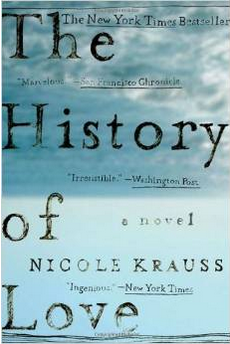
Cover of The History of LoveBest Book of the Week!
At times I wasn’t sure that I would be able to figure out what was going on in The History of Love. This feeling may not be unfamiliar to readers of Nicole Krauss. My book club was so frustrated by Great House a few years back that I had to draw a diagram to help figure out the series of owners of a desk. However, The History of Love eventually becomes clear, with an eminently satisfying ending.

For most of the novel, we follow two main characters. Leo Gursky is an old Jewish immigrant in New York, a survivor of the holocaust from Poland. Years ago he fell in love with Alma Mereminski but was separated from her just before World War II when she went to America. When he tracked her down after the war, she had married. Her oldest son, though, was 6.

Leo has led a lonely life, during which he yearned for Alma and for his unacknowledged son, Isaac Moritz, who became a famous writer. As an old man, he spends part of each day trying to draw attention to himself in some small way, so that if he dies that day, someone will have seen and remembered him.

Alma Singer is a lonely 14-year-old. Years ago her father died, and her mother has ever since lived a life of quasi-mourning, seldom coming out of her room and only doing some occasional translation work. Alma’s brother Bird is a strange boy who believes he is blessed by god. He is preparing an ark for the coming flood.

Alma has been trying to find a boyfriend for her mother so she won’t be sad. One project that interests her mother is a request to translate a book called The History of Love by Zvi Litvinoff that had a small publication run in Chile. This book was very important to Alma’s parents, and Alma was named after a character in the book. Alma thinks she perhaps can strike up a relationship between her mother and the man who requested the translation. But then she notices that the only character in the book who doesn’t have a Spanish name is Alma Mereminski. Reasoning that it may be a real person’s name, she decides to find Alma.

It is Leo who actually wrote The History of Love, we understand, inspired by his love for Alma. But then what happened?

This novel is intricate and vividly imagined. Ultimately, it is emotionally involving. I did not really enjoy the excerpts from the novel within the novel, which seem to be trying too hard to be profound, but those make up only a very small part of the book.

Related Posts

Great House

Beautiful Ruins

Tomorrow There Will Be Apricots


Day 648: The Snow Queen

Cover for The Snow QueenAlthough The Snow Queen is marketed as Michael Cunningham’s reworking of the classic fairy tale, the novel actually alludes to it more than rewrites it. Tyler Meek gets an ice crystal in his eye as does the main character of the fairy tale, so we know he will not be able to see clearly. The Snow Queen herself is the drugs Tyler takes.

The novel begins with Tyler’s younger brother Barrett walking home through a snowstorm. He has just been dumped by his lover by means of an abrupt text and is wondering what he did wrong. In his mid-40’s, Barrett, although a Yale graduate who had a seemingly bright future before him, has been unable to settle to any one thing. He has lost his apartment and now lives with Tyler and his girlfriend Beth and works as a clerk in a store.

Barrett notices an odd light above him in the sky and feels that it is looking back at him. This experience seems so extraordinary to him that he half fears he imagined it and doesn’t at first tell anyone about it.

At home, Tyler awakes to find the room full of snow because he and Beth left the window open. Tyler, Beth, and Barrett live in an ugly apartment in a shabby neighborhood in New York City. Tyler’s dreams of being a musician have ended with him working as a bartender and being allowed to play a couple of nights a week.

Tyler is trying to write a song for Beth for their wedding. Beth has liver cancer, and she presently is getting no better or worse. Tyler obsesses with the song and with the impending 2004 re-election of George Bush rather than trying to get himself off drugs, as he promised Beth. Now, he has begun lying about the drugs.

For a few months, Beth gets better. Barrett attributes her recovery in some part to his exchange with the light and begins attending church. Tyler, who has been good at taking care of Beth, feels a bit like he has lost his purpose.

Cunningham has written an intimate portrait of the two brothers in his masterly style. He forces us to examine our notions about success and failure and insightfully depicts Tyler’s growing dependence on the drugs. However, the story about the brothers and their friends isn’t really compelling, and the female characters are deficient. Beth is a palely drawn angel, and the only other important female character, Liz, looks too much like her opposite. Other characters seem to be there just to populate the novel. After the stunning The Hours, I found The Snow Queen disappointing.

Related Posts

The Hours

The Goldfinch

Boy, Snow, Bird

Day 571: The Goldfinch

Cover for The GoldfinchBest Book of the Week!
Theo Decker is hiding in an Amsterdam hotel, ill and terrified. He is afraid to set foot in the street. Through most of The Goldfinch, Theo relates the roots of his troubles, which lie 15 years in the past.

Thirteen-year-old Theo is out in New York City for a day with his mother. Normally, this would be a day he’d enjoy, but he is in trouble at his prep school, and they are on the way to school for a meeting. They are early, though, and his mother wants to stop at the museum to look at an exhibit.

Inside the museum, he spots an unusual couple—a hunch-backed old man and a fairy-like red-haired girl. He is only half attentive to his mother’s explanations of the paintings because he is looking at the girl. They stop to view a painting called The Goldfinch, one of the few remaining works by a Dutch artist named Fabritius.

Theo’s mother goes off to the gift shop while Theo trails after the girl. A few minutes later, Theo is knocked out by an explosion from a terrorist attack. When he comes to, the museum is oddly empty, but he finds the old man dying. The man gives him a ring and tells him to take it to an address, and then he suggests that Theo pick up The Goldfinch from a pile of dust and take it with him. He does, an act that becomes a defining moment of his life.

Assuming that his mother got out okay, Theo goes home, but he soon finds that she was killed. Since his ne’er-do-well father disappeared from their lives, it has been just the two of them for years. Social services ends up taking him to stay with the wealthy family of one of his school friends, the Barbours.

Suffering from grief and untreated post-traumatic stress disorder, Theo tries to hide his insecurity and discomfort. As formal as the Barbour household is, he likes Mrs. Barbour and worries that the family might want him to leave. Eventually, he takes the old man’s ring to the address and meets the man’s partner Hobie and the girl, Pippa, who was badly injured in the explosion. She soon goes away to live with her aunt, but Theo continues to visit Hobie, who is a furniture restorer. And he is always in love with Pippa.

Just after Theo is invited to spend the summer in Maine with the Barbours, his whole life changes again. His father arrives and removes him abruptly from New York to Las Vegas. Theo is left to himself most of the time in a deserted suburb at the edge of the desert. His father at first appears to be well off, but soon it is clear he is living on the edges. Theo befriends another outcast, a Ukranian boy named Boris, and the two begin a slide into drugs and alcohol and the margins of society. Even after he returns to New York and tries to pull his life together, the secret of the painting serves as both a pleasure and a hidden terror.

It seems as if I am giving away a lot, but I have covered only the beginning of this long, involving novel. It explores such themes as the trauma of loss, the yearning for love, and the fragility of happiness and the present. In losing his mother, Theo seems to have lost his moral compass, so that even as he tries to help people, he creates problems for them and himself.

Tartt’s characters are complex and fully realized. Even the villains have facets to their personalities. Although Theo thinks of his father as a scoundrel—and he certainly has few redeeming qualities—Boris points out to him that when Boris was alone with nothing, Theo’s father took him in. An older Theo fears he has too much of his father in him.

The Goldfinch remains a golden, potent symbol throughout the novel. Theo loves the painting and feels that owning it somehow gives him stature. Yet at the same time he is terrified he’ll be found with it. Just as the bird in the picture is shackled, so Theo is captive to the painting.

Throughout the novel Theo disappointed me with his self-destructive tendencies even though he has good intentions. Still, Tartt tells a story that absolutely impels you to keep reading. This is a wonderful job of storytelling.

Day 561: Lucky Us

Cover for Lucky UsI was enchanted by Away, so I was excited to find that Amy Bloom had another book out. This novel is good but does not live up to the other.

Eva Acton has not met her older half-sister Iris until Eva’s mother dumps her on the front porch of her father’s home. Up until then, Eva worshipped her father, but she begins to see that he has his flaws, a second family being a major one of them. Another is stealing the money Iris wins in talent competitions.

Once Iris has managed to hide enough money from her father, she and Eva take off for Hollywood, where Iris is determined to make it big. At that point, Eva’s formal education comes to a halt, when she is 14.

Iris is beginning to have some success when her chances are ruined by betrayal and scandal. The girls, their friend Francisco, and their father, who has joined them upon premature news of Iris’ success, set off for New York.

This Depression-era novel is written in a light, jaunty tone, narrated mostly from Eva’s point of view punctuated by letters. For after a lot has happened, the girls are eventually separated.

The conflict of the novel is around some choices Iris makes, causing Eva to take on responsibilities and struggles that Iris has initiated. Iris commits several unconscionable acts.

http://www.netgalley.comI cared about what would happen to Eva and some likable friends, but I felt that the end of the novel was too easy on Iris. I also felt that this novel lacked the originality of Away. It is interesting, though, because I was never sure what would happen next, and the narrative style has its charms.


Day 542: The Burgess Boys

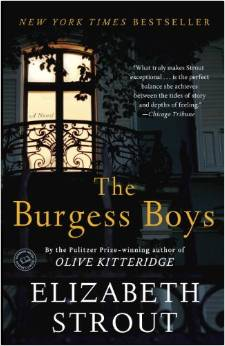
Cover for The Burgess BoysBest Book of the Week!
I had an unusual reaction to The Burgess Boys. Part of the way through, I was interested in how it would come out but at the same time wondered if I was liking it. By the end of the novel, though, I found it extremely satisfying.

The novel is about the clearly dysfunctional Burgess family, from a small town in Maine. When the three Burgess children were small, their father was killed in a freakish accident, run over by his own car rolling down the hilly driveway. All three kids were inside the car, and four-year-old Bob was behind the wheel when their mother came out to find their father dead. Mild-mannered Bob has carried this burden all his life, dealing with ridicule from his brother Jim and dislike from his twin sister Susan.

Jim and Bob long ago left Maine for New York City. But they are called back by a distraught Susan. Her son Zach has committed the inexplicable act of throwing a pig’s head into a mosque during Ramadan. Although Susan shows a good deal of ignorance about the local Somali population, the family cannot comprehend Zach’s action. He is a quiet misfit teenager, confused and pathetic, who has no friends. Unhappy especially since his father left for Sweden, he nevertheless does not seem to be angry or have any strong feelings at all except for being plainly terrified by the trouble he is in. He has a reason for his actions that is generally clueless, but it takes awhile for the family to discover it.

A former hotshot lawyer in Maine and famous for having won a high-profile case, Jim is the person Susan is relying on. Zach goes in to the police station to confess to the crime, and it seems as if the case will be handled quietly, but the civil liberties groups get involved and soon there is an uproar. When Jim’s grandstanding at a political event does more harm than good, Zach is charged with a hate crime.

As Jim takes charge while Bob tries to calm and comfort, the dynamics within the family emerge. At the same time, we learn a little about the terrified, disoriented Somali community. During the initial hearings, shopkeeper Abdikarim glimpses the true Zach and tries to help him.

As for the characters, I heartily disliked the person that everyone else admires. I think Strout intended that, and part of my satisfaction with the novel is about how that turns out.

Strout’s rich, detailed exposition is matched by her empathy for all her characters. Although I disliked some of them, they are complex and deeply human. This apparently simple story wisely examines the dynamics of guilt, family tensions, social isolation, and blind political correctness.

Life in the small Maine town seems gray and dismal at first, brightened only by the fall foliage and the hues of Somali garments. Jim and Bob have fled, and Susan and Zach are unhappy. There is little employment or hope for the residents. By the end of the novel, everyone has a little more hope.


Day 540: Empire Girls

Cover for Empire GirlsRose and Ivy Adams are stunned by the death of their father, but his will astonishes them. He has left the house that Rose loves to a brother the girls did not know existed. He has also left them in heavy debt. His attorney, Mr. Lawrence, explains that if they can’t find their brother Asher to clear up the will and pay off the taxes within three weeks, the bank will repossess their beautiful house in upstate New York. All the sisters have to go on is a postcard from a place called Empire House in New York City.

The two sisters make an uncomfortable team. Rose has always been the caretaker, treated by their father as the plain sister who takes care of the house. Ivy he thought beautiful and talented. Ivy is thrilled to go to New York, envisioning a brilliant future for herself as an actress. Rose, who is a homebody, only goes to save the house. The two are almost always at odds—Rose prim and disapproving, Ivy spoiled and childishly complaining that Rose ruins everything.

The girls go to stay at Empire House, a rooming house in Greenwich Village, hoping to find Asher. No one there admits to knowing him, but the girls think they are all lying.

After some initial coolness, Rose begins to fit into the household. She accepts a job doing housework from Nell, the owner of Empire House, and sews for Cat LeGrand, who owns a dress shop and speakeasy. She also almost immediately falls in love with the Empire House cook, Sonny Santino. Although Ivy at first seems to be in her element of 1920’s gaiety and gets a job as a waitress at Cat’s, she does not adjust as easily.

Written in alternating chapters by each sister, the novel doesn’t really evoke a colorful picture of the 20’s. Only the amount of drinking seems to reflect the time period.

The characters of the two sisters are almost cartoonish at first—they are so polarized. Yet at the same time their voices are indistinct enough that when I was reading a chapter, I would often forget which sister was speaking.

http://www.netgalley.comThe reasons the inhabitants are lying to the girls and what they are lying about seem contrived. The timeline of the novel is absurdly short and yet the girls only make a few feeble attempts to find Asher. Although Asher’s situation has some secrets, too, the ultimate fate of the  sisters is perfectly predictable. I found this novel lightweight and silly.


Day 529: The Interestings

Cover for The InterestingsIt took me awhile to get interested in The Interestings. (I just had to say that.) Reading it was ultimately worth it, but I found the novel difficult to get into, beginning as it does with a situation and characters to which I do not relate.

Jules Jacobson is an awkward teenager when she arrives at a summer camp for the arts during the mid-1970’s. The campers are mostly rich New Yorkers. She is not rich, but received a scholarship for the camp after her father’s death. Jules feels inferior to these kids, but she is unexpectedly adopted by a small group who call themselves the Interestings.

Ethan Figman is an unattractive but kind boy. He spends most of his time at the camp learning animation and drawing. Jonah Bay is the beautiful but elusive son of a famous folk singer. Cathy Kiplinger is a talented dancer. Ash and Goodman Wolf are a wealthy, attractive sister and brother. It is not clear what Goodman does at camp besides flirt with girls, but Ash is studying drama.

Jules is entranced by her friendship with these people, so much so that her relationship with them becomes a preoccupation of her life. She is particularly attracted to the Wolf family, and Ash becomes her best friend. Ethan early on makes overtures to her of a different nature, but she is not attracted to him.

The novel follows Jules’ relationship with her friends over a period of forty years. It particularly focuses on Ash and Ethan, who marry and become extremely successful.

For Jules, the Interestings glow with a special aura long after most of them have not lived up to their promise. Wolitzer’s intent is to examine issues such as how much value to place on a constant striving for success and its link with the need to feel special. She also examines the life of art—how far do you go for art before giving up? After having little success, Jules abandons her own desire to be a comic actor. She also goes through a long period of envy for Ash and Ethan while she and her “ordinary” husband Dennis struggle financially.

My problem with this novel is that I don’t understand the attraction the group, and particularly the Wolfs, have for Jules. In truth, she seems dazzled by the wealth and privilege of this family, even if she doesn’t realize it. Ash is a nice enough person, although somewhat vaguely depicted. But somehow these fascinating Wolfs manage to raise a self-absorbed, uncaring son and a daughter who is too eager to please her family. Early on, Goodman is accused of a serious crime. The way his family handles this problem is very telling, as is the fact that they never seem to consider he might be guilty.

Wolitzer sometimes tells us other things I personally feel the novel does not demonstrate, for example, how witty Jules is. I saw very little evidence of wit in the dialogue, and when I did, it usually came from Ethan. Maybe the novel would have been more compelling if we could feel the attraction of the Interestings ourselves or hear the sparkling wit. Or has Wolitzer planned for us to remain detached, to see through everyone from the first?

This novel provides many ideas to ponder. After I stuck with it, I got interested in what happened to the characters, but I didn’t  love it.


Day 425: The Gods of Gotham

Cover for The Gods of GothamBest Book of the Week!

New York in 1845 is a turbulent city. The political campaign between the Democrats and the Whigs is crooked and violent, and the recent influx of Irish poor is causing some Protestant leaders to preach against Papists. The recent establishment of a police force has been fought against by those claiming it impinges on their civil liberties.

Timothy Wilde is a bartender who has managed to save up $500 and intends to ask the woman he loves, Mercy Underhill, for her hand. A huge fire that ranges more than twenty blocks changes his plans, for his home is burned down with all his money in it and so is his place of work. His face is badly scarred as well, so Timothy believes his future is ruined.

His older brother Valentine, with whom he has a rocky relationship, has plans for him. Val has just been made a captain in the new police force and believes the copper stars–for that is what they are soon called because of their badges–is the place for his brother. Timothy is distrustful of Val’s intentions. His brother is a popular and charismatic leader of the firemen and the Democratic party, but Timothy also knows him as an opium addict and a wild man who hangs out with thugs. Timothy soon finds that the job suits him, however.

He is not long on the job before a child runs into him late one night, hysterical and covered with blood, saying “He’s going to tear him to pieces.” Wilde sees that she is a kinchin mab, or a child prostitute. He brings her home to the Dutch widow who is his new landlady instead of taking her in for questioning. When the girl recovers herself, she identifies herself as Bird and tells him a pack of lies. He soon finds out what she was talking about, however, when the body of a young male child prostitute is found in a trash receptacle.

Timothy’s investigation results in the discovery of a field full of bodies on the edge of the city–a total of 19 dead children with a cross carved into their torsos. Although the authorities try to keep this a secret, the word soon gets out. Then someone begins writing letters blaming the deaths on the Irish. Soon the city is a powder keg.

This novel is even better than Faye’s acclaimed first, Dust and Shadow. It depicts New York in all its grit and dissension and feels historically grounded. It introduces an honest, kind, and clever hero whom I hope we’ll see more of. The plot is full of twists, and although I managed to spot a perpetrator well in advance, the story was much more tangled than I expected. I thoroughly enjoyed this novel.