Review 2589: Lies and Sorcery

This book was the last one I read for my A Century of Books project. At nearly 800 pages in small type and a fairly bizarre plot, it was quite a slog for me, but I was determined to finish it, especially because I hadn’t finished several others.

The novel is set in Sicily and narrated by Elisa, a young woman who is looking back over the history of her family to try to understand some complicated and intertwined relationships. She is an intrusive narrator, popping in frequently to make observations, and she implies in the beginning that she’s been mentally ill and is not altogether to be trusted. But I didn’t experience a big reveal that labels her as unreliable. Notes in the Introduction indicate that the novel is fairly autobiographical.

Elisa begins with her maternal grandparents. Her grandmother, Cesira, is a schoolteacher who marries Teodor Massia because he looks like a gentleman and acts like a gentleman so he must have money. Unfortunately for her, the Massia family throws him off because he has married a schoolteacher. Worse, he is a wastrel who blows away any money they have, so their daughter Anna grows up in poverty but with an inflated sense of self-worth as the daughter of the upper class.

On the other side of the family, Alessandra, the servant of a peasant, is happy to marry her elderly employer Damiano De Salvi, because for her it is a big step up. Unfortunately, they are not blessed with a child, that is, until she is dazzled by Nicola Monaco, a land agent who seems to her to be a great gentleman. When she has his child, she raises Francesco to think of himself as a person of great potential. The De Salvis spend every penny sending him to school and are repaid by his being ashamed of them.

For her part, Anna Massia (Elisa’s mother) spots her cousin, Eduardo Massia di Carullo, when she is five years old. Her mother points out this wealthy branch of the family, and Anna is struck by how handsome he is, like a prince. When they meet, more than 10 years later, he is struck by how beautiful she is, and she is instantly enamored. Unfortunately, Eduardo, although charming, is not a nice person, and he spends most of his time tormenting her and making her prove she loves him. They are engaged, but his family doesn’t know about it.

Eduardo, for some reason, befriends Francesco, who is a student in town dressed in shabby clothes, but he has adorned himself with some flashy but cheap ornaments and is introducing himself as a baron. It is through Eduardo that Anna and Francesco meet at a time when Eduardo is tiring of Anna. Francesco has no idea of their actual relationship and in fact never has. Then Eduardo disappears.

Anna doesn’t know that the Massia di Carullo family has been paying her mother a small amount of money every month since her father died. When Eduardo discovers this, just before he is ready to break with Anna, he tells his mother to double the amount. But this makes Anna find out about it, and she in her pride goes to his mother and says they don’t want her money. Then she and her mother are destitute, her mother ill and still having to teach, while she, indolent and untrained for anything, lies around the house all day. Francesco having fallen in love with her, she marries him even though he revolts her.

Our narrator describes all this in great detail, along with her parents’ marriage. Her mother is not at all maternal and often is quite nasty to her, but of course that makes the little girl idolize her more and follow her lead in disdaining her father.

The novel begins to turn into absolute weirdness about 10 years after the marriage when Anna learns that Eduardo died some time before of tuberculosis. Eduardo’s mother, who worshipped her son, has retreated from that reality and believes Eduardo is traveling around writing letters to Anna. Dona Concetta asks Anna to bring her the letters, which Anna begins writing.

Even though I have told a lot, by now, I’m not kidding, we are at about page 350 with plenty more to go as the entire family descends into madness.

Morante is a terrific writer, but she really takes her time. At one point early on, she is showing how Eduardo taunts Anna and she provides not one lengthy example but several. And these are sickening conversations.

The Introduction to my NYRB edition states that the theme of the novel is the inability to get out of poverty. That is certainly there, but I think a more important theme, aside from that of the perceived importance of class, is unrequited love. Nearly every character in the book loves someone who either doesn’t love them back or even actively despises them. And these people are tempestuous! And as for sorcery? Is there really a ghost of Eduardo or are these people driving themselves freaking insane?

Although the novel handles human emotions and behavior insightfully, and I sometimes sympathized with Elisa and occasionally with Francesco, most of the characters are more or less terrible, especially in their treatment of others.

I received this book from the publishers in exchange for a free and fair review.
Related Posts

Siracusa

My Brilliant Friend

The Bee Sting

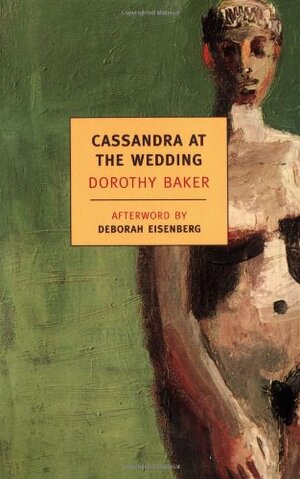
Review 2464: Cassandra at the Wedding

At the beginning of this novel, we meet Cassandra Edwards preparing to attend her twin sister’s wedding. Although her narrative is clever, entertaining, and disarmingly truthful, it is clear something is wrong.

Slowly we learn it is Cassandra’s intention to talk Judith out of the wedding, which she views as a horrible mistake. The Edwards have lived on their ranch as a self-contained until, intellectual, cultured, staying away from the affairs of others. When the girls began studying at Berkeley, Cassandra at any rate spent a lot of time with others, trying new things out. Despite having always tried to maintain their individuality, they finally decided, at lease according to Cassandra, that they only needed each other would move to Paris. But first, Judith decided she would try one year by herself studying music in New York. And now she has returned with a fiancé.

When Cassandra arrives at the ranch and we see the two women together, it seems clear that Cassandra is the less mature and more egotistical. She doesn’t seem to be able to see the situation from any point of view but her own. She is like a whirlwind of talk and distress, trying to push Judith toward her own goal. Cassandra does something drastic at the end of this section, but I don’t want to give it away.

In the second section, Judith narrates. We learn that although she loves Cassandra , contrary to what Cassandra believes, Judith wants to bet away from her. Judith is the calmer, more mature twin, and she finds Cassandra exciting but exhausting. I seems clear that Cassandra has attributed some of her own attitudes and ideas to both of them.

Cassandra may sound like an irritating character, but somehow she is appealing. We enjoy being with her as she navigates the rough seas of more maturity. I very much enjoyed this book, which has likable characters and looks honestly at the difficulties involved in finding an identity, especially if you’re a twin, and becoming one’s own whole person.

Related Posts

Beneath the Visiting Moon

Rhododendron Pie

Rebecca

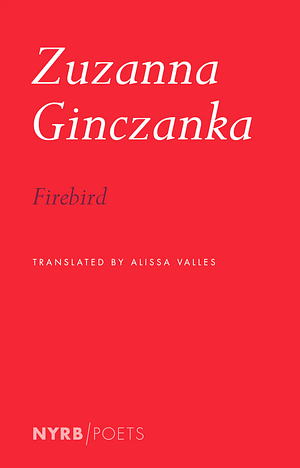
Review 2340: Firebird

I am not very comfortable with poetry, because I don’t have the patience to unpack a poem or the background to catch many of the allusions. Plus, I’m not good at wordplay, so, you’ll have to bear with me on this one.

Ginczanka was a Polish Jew who was executed by the Nazis toward the end of World War II. Firebird is a reprint of her only published book, On Centaurs, of 1936, and her uncollected poems from 1936-1944. Her last poem, “Non omnis moriar,” (it’s untitled, but these are the first words) is famous because it names the woman who turned her over to the Nazis and was used to prosecute her after the war.

I was more comfortable with the earlier poems, because I found them easier to understand. Later, the line lengths are longer and more prose-like, which I ironically find harder to read. Many of them have biblical allusions or allusions to mythology or ancient history, things I can catch but not necessarily understand.

These are my foibles, but I also noticed lots of striking phrases. Two poems struck me in particular—“Grammar,” about the love of words, and “Virginity,” which pits an earthy fecundity against an arid intellectualism.

I received this book from the publisher in exchange for a free and fair review.
Related Posts

The Bees

The World’s Wife

The Selected Poetry of Edna St. Vincent Millay

Review 2338: My Death

The unnamed narrator of My Death is a novelist who has been unable to write since her husband died a year ago. She has been isolated in a house in the west of Scotland. She decides to try biography instead and chooses the figure of Helen Ralston, whose accomplishments as an artist and writer were overshadowed by her tumultuous affair with her mentor, W. E. Logan, another artist.

When she begins to look into the subject, she finds that all of Ralston’s books are out of print but Logan’s are not. However, Ralston is in her 90s and eager to meet her and share her journals and photos. The narrator is struck with unease, however, when she sees a painting by Ralston entitled My Death, a supposed landscape of an island that is really a painting of the artist’s most intimate parts. As she continues her research, she keeps finding odd echoes of her own life.

This novella is described as gothic, but I wouldn’t exactly call it that, although it is unsettling and weird. Important to Tuttle is the theme of, as the Introduction by Amy Gentry puts it, “the erasure of women’s authorship by men.” That is certainly at work here, as she based some of the details of Ralson’s life on that of Laura Riding, an American poet and lover of Robert Graves, who accused Graves of stealing material.

This is an involving story that at first seems straightforward but gets odder and odder. I found it fascinating. Tuttle is in general a science fiction writer, but despite that I may look for more by her.

I received this book from the publishers in exchange for a free and fair review.

Related Posts

The Bloody Chamber

Luckenbooth

Ghostly

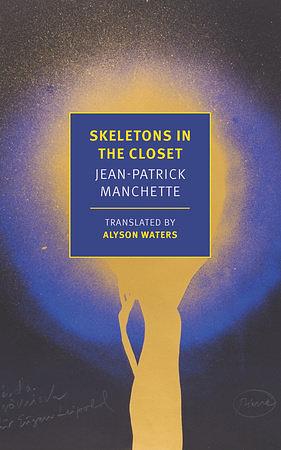
Review 2331: Skeletons in the Closet

A quote by Frederick Méziès on the cover of my edition of Skeletons in the Closet says, “Writing so dark it gives a new meaning to the word noir.” The novel was written in 1976, a bit after the height of French film noir, and it is certainly violent, although probably not as shocking to modern readers.

Eugene Tarpon is a private detective whose office is next to his bedroom. He only has one client when one of his contacts in the police department sends him an old lady, Mrs. Pigot. Her daughter, Philippine Pigot, has disappeared. She left for work one day and never arrived. Further, she is blind.

Tarpon’s contact, Coccioli, has strongly hinted that he shouldn’t actually look for Philippine, but he does. The next day, Mrs. Pigot arranges to meet him in a public square, and she is shot to death before his eyes. Soon, people are trying to kill him.

This novel is dark; nevertheless, there is a certain lightness and humor about it. Manchette is credited with redefining the noir genre for social criticism, but although there is certainly corruption going on, that theme is not so stressed in this novel.

I received this book from the publishers in exchange for a free and fair review.
Related Posts

The Disappearance of Adèle Bedeau

The Blank Wall

The Blunderer

Review 2296: Lament for Julia

I tried to read Lament for Julia several times, but I just couldn’t do it. Taubes’s father was a psychoanalyst who believed writing is a disease and her husband disapproved of it for religious reasons, so it’s no wonder it’s quite bizarre.

Lament for Julia is a novella that takes up more than half of the NYRB edition. It is narrated by a disembodied spirit that seems to be part of and not part of a girl named Julia Klopps. Since Taubes believed that each person is a multiplicity of selves, I took it more as another self. Nothing much seemed to be happening in the novella except Julia growing up and the second self obsessing about her, but I didn’t really find any of it interesting. The writing is beautiful, and the second self’s obsessions are akin to those of Humbert Humbert in Lolita. But while I found that novel fascinating, I found the novella too sexualized, too perverse, too Freudian, and too interested in dreams for my taste.

I tried reading some of the short stories, but “The Patient,” about a mental patient who lacks an identity, is told by her psychotherapist that her name is Judy Kopitz, and we seemed to be in for a rehash of Lament for Julia.

The next one was “The Sharks,” about a boy who keeps dreaming he is being eaten by sharks. (Julia also dreams of being eaten.) Nope, couldn’t do it.

I received this book from the publishers in exchange for a free and fair review.

Related Posts

Dangerous Ages

Murmur

Umbrella

Review 2279: The Fox in the Attic

My only other exposure to Richard Hughes was his A High Wind in Jamaica, the reading of which was certainly a different experience than that of The Fox in the Attic. Readers may find the structure of the latter unusual, but Hughes meant it to be the first part of a huge novel called The Human Predicament, for which he finished the second part but not the third.

The main character is a young man in his early 20s named Augustine. In her introduction to the NYRB edition, Hilary Mantel says that he doesn’t notice things. But it’s more than that. He has formed ideas about what things are like and seems incapable of understanding they are not as he believes.

He has inherited a remote property in Wales and has been living there recently like a hermit. When the novel opens, he is carrying the body of a little girl whom he and his hunting companion found drowned in a marsh. He brings her home instead of leaving her at the scene because the marsh is full of rats. But nasty ideas begin floating around, so he decides to go visit his sister Mary.

Mary suggests he stay with some German relatives she spent time with just before World War I. It is 1923, and Augustine firmly believes the Germans are peace-loving, cultured intellectuals, and there will never be another war. In fact, as soon as he arrives, his relative Walther begins telling him about an incident that happened after the war in which he and others were held prisoner in a hotel, and Augustine finds it so hard to believe him that he stops listening although he has seen the proof of the incident written on the wall of his hotel room in Munich. In fact, the political situation in Bavaria is completely unstable, and inflation is so bad that an educated boy is working in the hotel as a bellman because a professional salary would not pay for his pair of shoes.

The first night Augustine stays with his family, in fact, is the night of the famous Bierhall Putsch, and we see a detailed description of Adolf Hitler as a character. But Augustine has decided he is in love with Mitzi, Walther’s oldest daughter, and doesn’t pay any attention to the political discussion. Although he realizes with a shock that she is Catholic, he’s sure he can easily convince her there is no god. In fact, he doesn’t even know she’s devout.

All the while, Augustine dithers in his romance, thinking everyone is expecting him to propose when no one has noticed he’s in love and Mitzi barely knows he exists, the political situation is worsening and there is real danger from the upper floors of the house.

I liked this novel when it stuck to everyday events, even the political ones, but when it a few times broke off into philosophical asides, I couldn’t really follow it or maybe didn’t try. The political events are somewhat elliptically covered for someone like me who isn’t familiar with them, at least insomuch as some key figures are assumed to be familiar to his audience and to me some of them are not.

Related Posts

A High Wind in Jamaica

The Magician

They Were Found Wanting

Review 2253: #1962 Club! The Pumpkin Eater

I chose The Pumpkin Eater for the 1962 Club because the title seemed vaguely familiar (aside from its nursery rhyme connections) and because I don’t think I’ve read any Penelope Mortimer. I think the title is familiar because there was a reasonably popular movie of it in 1964 starring Anne Bancroft.

The unnamed narrator is a wife and mother of a large number of children, the number, names, and ages (except one) never specified. At a young age, she was already married three times, once a widow, and already had quite a few children, including three stepchildren whose father died. As the novel opens, she is recounting a discussion with her father to her psychiatrist, in which her father is trying to dissuade Jake from marrying her, basically saying she is too flaky and has too many children.

As she goes on to tell the story of her marriage, nothing improves. Her psychiatrist thinks her desire to have more children is a pathology (and also entirely her responsibility). Both her psychiatrist and her doctor are disdainful and condescending to her. Nothing seems to be thought of her husband having affairs (although she naïvely believes he is faithful for quite some time despite an early incident with a girl named Philpot).

The fact is, Jake, a screenwriter, is gone on set most of the time, most of their friends are his, the family is wealthy enough to have servants, and even the children are absorbed by nurses early and by schools later. So, she has little to occupy herself with except small children and cooking.

This book is billed as black humor. I didn’t find it funny, but I did sympathize with the narrator. Some horrendous things are done to her, and all of the men around her are manipulative. I thought the novel was bleak rather than funny.

Related Posts

The Women’s Room

The Transit of Venus

A Lady and Her Husband

Review 2214: Life and Fate

Finished in 1960, Russian author Vassily Grossman’s Life and Fate was confiscated by the NKVD (predecessor of the KGB) and had to be smuggled out to be published in Europe. Taking War and Peace as its model, it is about the pressures of totalitarian governments during the siege of Stalingrad. It centers around one extended family, the Shaposhnikovs, but it also includes some of the German officers and others, visiting a variety of wartime settings: a besieged plant in Stalingrad, a German concentration camp, a scientific institute in Moscow, a Russian tank corps, and so on.

Because of its broad scope and length (more than 800 pages), it has a lot of characters, maybe a dozen of whom we visit and revisit, but others whom we see only once or twice. Some of the ones we revisit are Krymov, a commisar who is the ex-husband of Yevgenia Shaposhnikova; Viktor Shtrum, a famous physicist married to Lyudmila Shaposhnikova; Pyotr Novikov, a tank commander in love with Yevgenia; Yevgenia herself, who is worried about both Krymov and Novikov; Sofya Levinton, a doctor and friend of Yevgenia on her way to a German gas chamber. There is an appendix to the book listing hundreds of characters, but it doesn’t list most of the male characters’ first names or patronymics, so at times I wasn’t sure who the characters were talking about.

Although the Russian characters are uniformly patriotic, almost all of them live in fear, remembering the Terror of 1937 when many people were disappeared or deported to labor camps. Those times aren’t really over, as several characters run into trouble for minor infractions or no infraction at all, resulting in imprisonment and torture for some, demotions or exile for others. One character is labeled an enemy of the state for reporting that a soldier on his own side shot at him. In addition, bureaucracy gets in the way of people trying to do their war work.

This novel is powerful at times, but because of its structure, I didn’t really feel much connection to any of the characters except maybe Novikov, who spends hundreds of pages yearning for Yevgenia, not knowing she has returned to Krymov. It wasn’t until I was well into the book that I realized it was a sequel to Grossman’s Stalingrad, and it refers back to events that presumably occurred in that book, but it’s hard to know whether reading it first would have helped.

Also, Grossman occasionally takes a paragraph or two, sometimes a whole chapter, to philosophize on some subject. That’s a kind of polemic writing I don’t appreciate.

Related Posts

Sofia Petrovna

The Raven’s Children

Punishment of a Hunter

Review 2206: The Ten Thousand Things

I picked out The Ten Thousand Things from a list of the New York Review of Books publications for my Classics Club list without knowing anything about it. It is an unusual book, but beautiful.

It begins with an extended vivid description of an island in the Moluccas, referring along the way to the island’s stories and myths. It does this for so long that you begin to wonder where it is going, but finally it comes to the story of Felicia. Felicia spends her childhood on the island, visiting her grandmother in the Small Garden, hearing stories about objects and ghosts on the property, and examining her grandmother’s box of treasures, many of them stones with properties or unusual or valuable shells. However, eventually there is a dispute between her grandmother and her mother, so her mother insists her immediate family move to Holland. Felicia’s grandmother gives her some valuable jewelry so she can afford to come back.

She returns a young mother, her husband, who married her for money, having taken all her money and jewels and disappeared when he learned she was pregnant. She has had to take out a loan to return.

Most of the bulk of the novel is the story of her life on the island raising her son Himpies. Although this is not a novel in the magical realism genre, the island, with its tales of ghosts and monsters and its extreme beauty, seems magical. Dermoût spent her childhood on such an island and clearly loved it.

About 2/3 of the way through the novel, which is only about 200 pages long, it abruptly moves to some other characters on the island, then does it again. This is at first surprising, but Dermoût returns to the Small Garden and wraps everything up beautifully.

I think I can fairly describe this novel as haunting—sad and just lovely.

Related Posts

My Family and Other Animals

The Signature of All Things

Enchanted Islands