Review 2204: The Summer Book

The event that informs The Summer Book has already occurred before the novel starts—six-year-old Sophie’s mother has lately died. Sophie, her father, and grandmother travel early to an island on the Gulf of Finland where they spend their summers.

There isn’t much plot to his novel, which is mostly centered on Sophie and her grandmother. Sophie is changeable and sometimes anxious. Her grandmother, who is not in good health, is usually wise and responsive but can be irritable. In between tales of a visiting neighbor, the construction of a new road and a large, intrusive house, a haunted bathrobe, an unfriendly cat, the construction of a miniature Venice, and some massive storms, Jansson minutely describes the world of the island—the terrain, the insects and birds, the plants.

This is a lyrical novel that implies—most of them are unstated—some truths about life, death, and love.

Jansson spent most of her summers on such an island. She wrote this novel shortly after the death of her mother.

Related Posts

Moominsummer Madness

The True Deceiver

Abigail

Review 2075: The Land Breakers

John Ehle grew up in North Carolina and can trace his ancestry back to one of the first three families to settle the remote western North Carolinian mountains (the Appalachians) in the 18th century. The Land Breakers is the first of a series of seven novels about the families who settled in that area.

It’s 1779: Mooney Wright and his wife Imy have been released from their indentures and are traveling around trying to buy land for a farm. However, no one will sell them land in the more settled areas. They find a store owner who offers them land in the remote western mountains, which have not yet been settled, and almost inadvertently they end up buying 600+ acres.

It is a hard journey to get there, but at last they end up in a pretty valley with soil that has never been cultivated. They are both hard workers, and they set about building a cabin and clearing land for planting the next spring. However, during the winter Imy dies of a sickness, and Mooney sinks into a depression.

Tinker Harrison, a comparatively wealthy man, arrives with his family and slaves the next spring. He wants to establish the valley as a settlement he can control. They arrive shortly after Mooney buries Imy. Following them are Ernest Plover and his family. The Plovers are in-laws to Harrison, because Ernest’s oldest daughter, Belle, married Tinker, although she is younger than Tinker’s son, Grover. Ernest is a shiftless man with seven daughters, the next oldest to Belle being Mina.

Once Mooney starts to come out of his depression, he becomes interested in Mina, who is beautiful but very young. However he has also noticed Lorry, Harrison’s daughter and the mother of two young boys. She married Lacey Pollard, but he left to look for a home in Kentucky four years earlier, and she never heard from him again. Mooney needs a wife to work for and make his plans succeed, and he is torn between the two women.

This novel is a sparely written story of the difficulties faced by those early settlers. These do not so much involve people as problems with wild animals and weather and the sheer remoteness of the area from anywhere else. Occasionally, when describing the landscape, the prose becomes lyrical. With its details of work, it reminded me a bit of the trilogy I read by Tim Pears, although that was set 150 years later. I was interested enough in this novel to order the second in the series.

Related Posts

Giants in the Earth

The Horseman

Harvest

Review 2051: #1929 Club! Classics Club Spin! Grand Hotel

The first book I chose for the 1929 Club was one that I have long heard of but never read. It was also coincidentally chosen for my Classics Club Spin!

In the 1920’s, the Grand Hotel is the most expensive in Berlin. Staying there are several guests whose lives are going to be changed.

Grusinskaya is a great ballet dancer still at the top of her form. But her clearly classical style has gone out of fashion, and after a lifetime of being alone, she’s very tired.

Kringelein is a poor clerk who has just found out he is dying and wants to experience a few weeks of luxury and “living.”

Doctor Otternschlag is an injured World War I veteran who hangs around the hotel doing nothing. He begins taking Kringelein around Berlin.

Baron Geigern is young, handsome, and personable, but he makes a living as a cat burglar, and he’s after Grusinskaya’s pearls.

Herr Preysing is the general manager of a company there to make a deal who ends up in a mid-life crisis.

Grand Hotel is a zeitgeist novel, very much a product of its time. Baum’s characters show their foibles or redeem themselves. Each one is flawed and complex.

Related Posts

They Were Found Wanting

No More Parades

The Long Take

Review 2043: The True Deceiver

Katri and Mats Kling are village outcasts. Katri has strange yellow eyes, and although she is very intelligent, she is brusque and has no people skills. Mats, her younger brother, is more accepted but seems lacking intellectually and is treated like the village idiot.

Katri wants two things—to find a stable home for Mats and get enough money to build the boat he wants. To do so, she has her eye on Anna Aemelin, an elderly illustrator of children’s books who is known for her drawings of fluffy bunnies.

By offering to deliver Anna’s mail and supplies, Katri begins to strike up a relationship with Anna and is soon working in her house as a servant. Katri sees herself as scrupulously honest, and when she begins managing Anna’s finances, she sees that Anna is being cheated by almost everyone. But Anna doesn’t want to see some things.

This is an odd little book about deception and self-deception but also about an unusual kind of friendship. Katri is accompanied everywhere with a wolf-like dog, while Anna is compared to the fluffy bunnies covered in flowers that she draws all over her meticulous forest floorscapes. But by the end of the novel, the dog has run away, and Anna has stopped painting bunnies.

Related Posts

Lolly Willowes

Miss Plum and Miss Penny

Your Presence Is Requested in Suvanto

Review 2039: Alien Hearts

It’s hard for me to start this review without a swear word. A lot of discussion goes on in this novel about the nature of love and the difference between men and women, but to my mind, neither Maupassant nor his characters have a clue. But maybe that’s what I should expect from a man who died of syphilis at 43.

André Mariolle is a young, rich dilettante who is introduced into the salon of Madame de Burne, who is known for her flirtations that only go so far. Her salon is peopled with artists and musicians, and Mariolle is an outlier, but she embarks on a flirtation as she would with any new man in her circle. However, this time the two fall in love and begin an affaire.

Mariolle isn’t happy for long, though, because he wants her to be as madly in love with him as he is with her. We get lots of descriptions of heart rendings.

The Introduction to the novel includes a quote about it from Tolstoy: “In this last novel the author does not know who is to be loved and who is to be hated, nor does the reader know it, consequently he does not believe in the events described and is not interested in them.” Yes.

Related Posts

Chéri

The Last of Chéri

The Parisian

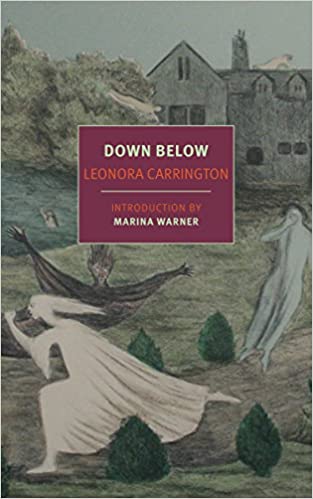
Review 2030: Down Below

Leonora Carrington was a Surrealist artist who for years had an affair with the much-older Max Ernst. During World War II, Ernst kept being imprisoned as an enemy alien in France, and the resultant tribulations broke Carrington’s mental health. As she and some friends traveled to Spain to escape the German invasion, she became disassociated from reality. Down Below is her recollection of her state of mind and thoughts during her break from reality.

Reading this very short work is an odd experience, as Carrington’s delusions seem as surrealistic as any artwork. It also feels elliptical, reticent about the events that brought on her insanity and really about anything personal except her state of mind. It would have been almost impossible to understand without the background provided in the Introduction to my NYRB edition.

It’s pretty crazy. Unfortunately, this breakdown made her a heroine of Surrealism, which must have been personally difficult for her.

Just as a coincidence, shortly after I read this book, I read Julie Orringer’s The Flight Portfolio, about Varian Fry, the man who helped many writers and artists, including Ernst, I think, escape the Nazis. Review coming in a few months.

Related Posts

Suite Française

Grand Days

Warlight

Review 1814: Temptation

From before his birth in a Hungarian village in 1912, Béla is unwanted. His mother, away working in Budapest, pays Rozi to care for him. But when his mother can’t pay, Rozi doesn’t feed him. So, at age seven, he begins stealing to feed himself.

Rozi also makes him work instead of going to school, that is until he, thirsting for knowledge, goes to the schoolteacher. At school, he begins finding success, until an incident results in him being shipped off to Budapest to live with his mother.

Béla must forget about schooling in Budapest, because his mother has found him a job in a fancy hotel. Unfortunately, as an apprentice he is not paid, and he and his mother are barely scraping by, scrambling to pay rent and eating seldom.

At work, Béla meets Elamér, who begins instructing him in Socialism. Although the Democratic Socialist party is legal, the right-wing government behaves as if it is not. Then Béla is distracted by his infatuation with Her Excellency, a beautiful member of the nobility who uses the boys in the hotel for sex.

Within a background of a country sliding toward chaos and Fascism, we follow Béla in his enthralling journey toward political self-awareness. This picaresque novel is vital and exciting. What a great story!

Jamrach’s Menagerie

American War

The Spoilt City

Review 1799: Summer Will Show

I have enjoyed the two other books I read by Sylvia Townsend Warner, but I am not as sure how I feel about Summer Will Show. According to the Introduction by Claire Harman, the two main characters bear a strong resemblance to Warner’s real-life companion, Valentine Ackland (Sophia) and herself (Minna). This may be the problem I have with this novel, because, as with Vita Sackville-West’s Challenge, depicting a semblance of her own true-life relationship, I think perhaps the closeness of the relationship inhibits the writing. In this case, I didn’t really get the attraction between the two women. It didn’t seem convincing.

in 1848, Sophia Willoughby has been running her estate and raising her children on her own for some time. She has long tolerated her husband’s affairs, but when she hears of one with Minna Lemuel, she is enraged. Minna is famous as a sort of actress/prostitute/mountebank, and she is not only unattractive but older than Sophia. Sophia tells her husband Frederick he can stay in Paris.

Although Sophia is an extremely competent manager, she is impatient in many ways with her woman’s role. She wants to live a free life. She is not happy in society and has no friends. Although an attentive mother, she thinks her children are too soft and doesn’t coddle them. Then a mistaken attempt to toughen them up ends in their deaths.

With no one to care for, Sophia decides to go Paris and talk her husband into having another child with her. She arrives there as the Parisians are preparing for another revolution.

In searching for Frederick, Sophia meets Minna and is immediately captivated. In a short time, she is caring for her instead of a new child. Minna is a revolutionary, however, and although Sophia is skeptical of the movement, whose advocates seem to hang around Minna’s flat and do little, she is slowly drawn to Communism. In the meantime, Paris is starving.

Aside from what I felt was an unconvincing love affair, I wasn’t really interested in the revolutionary setting or the turn to Communism, which wasn’t very coherently explained. I was also appalled by Sophia’s treatment of Caspar, her husband’s illegitimate half-caste son. So, not so excited about this one.

Lolly Willowes

The True Heart

Challenge

Review 1612: Abigail

Gina is a fourteen-year-old girl who is adored by her father, General Vitaly, and has led a carefree life in Budapest. Then some changes occur. Her adored governess, Marcelle, must leave home because she is French and thus on the opposite side of World War II. Then, her father enters her into Matula, a school for girls in the provinces. He does this with no warning, and Gina is at a loss to understand why he has chosen a cheerless, strict Calvinist school.

Upon arrival, Gina is stripped of her possessions and given charmless garments to wear. Her hair is cut off. The other girls in her class seem friendly at first, but after a horrible first day, she has a melt-down and blurts out a class secret. After that, no one will speak to her.

One of the school traditions, at least among the girls, is that if you write a note asking for help and put it in the vase held by a statue named Abigail in the garden, she will help you. This tradition is one of the things Gina finds ridiculous in her first days, but after a while, she comes to believe that someone, perhaps one of the staff, probably is helping.

When Gina becomes so miserable at school that she can’t take it, she plots to run away. She is prevented by one of the teachers, König, whom she despises. Soon, her father comes to see her and tells her a secret, something that requires her to stay in the school. She realizes she must try to make peace with her classmates.

This may sound like a standard novel about life in school, but it is an adventure novel that actually becomes quite suspenseful. The identity of Abigail wasn’t very hard to guess. It is Gina who is oblivious to all the clues until the last sentence of the novel. There is certainly a cast to pick from, including Susanna, the beautiful and strict prefect; Mr. Kalmár, the handsome young teacher who is in love with her; and Gedeon Torma, the director, the source of the cheerlessness and strictness. This is also Mitsi Horn, a former student who is a legend at the school.

Despite knowing who Abigail was almost from minute one, I really enjoyed this novel. Gina, headstrong and oblivious, is still appealing, and the plot is an interesting one.

Related Posts

Salt to the Sea

The Book Thief

The Nightingale

Review 1503: The Battle Lost and Won

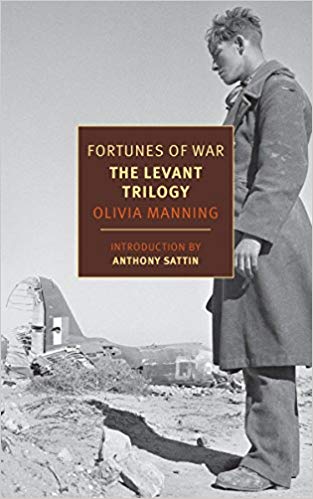
The second novel in Manning’s Levant Trilogy, The Battle Lost and Won begins one day after The Danger Tree ended. Simon Boulderstone continues his leave after finding out that his brother Hugo has been killed. He tags along with Harriet and her friends for an evening in Cairo, but when he hears that the big push is coming up, he returns to his unit hoping to be in on the action.

This book continues the pattern of its predecessor by alternating the points of view of Harriet and Simon. Simon becomes more closely involved in the second battle of El Alamein while Harriet becomes more frustrated with her husband Guy. As usual, Guy occupies all his time with projects and saves none for her, nor does he agree to anything she asks for. He is generous with anyone but her. Without any job or other occupation, she gets dragged into the love lives of her flatmates Angela and Edwina.

Like many middle novels, this one does not have its own climax but works its way to the final volume. Still, I am interested to see what happens to Guy and Harriet, and to some extent, Simon.

Related Posts

The Danger Tree

Friends and Heroes

The Map of Love