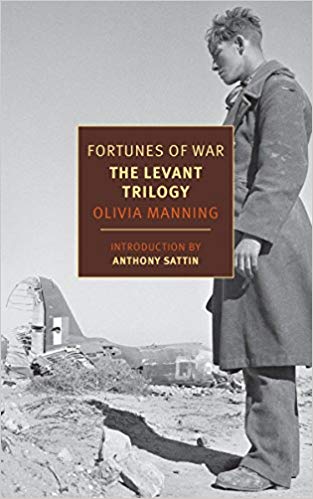
Review 1498: The Danger Tree

The Danger Tree is the first volume of The Levant Trilogy, the second half of Olivia Manning’s Fortunes of War. It begins with the adventures of a new character, Simon Boulderstone, a subaltern in the army who has missed his transport to his unit in Egypt. During the course of a day in Cairo, he meets Harriet Pringle, who seems at first as though she is going to be a minor character.

However, the book alternates chapters between Simon’s experiences in the desert and Harriet and Guy Pringle’s in Cairo and Alexandria. The last book of the Balkan Trilogy left the Pringles in Cairo after they fled Athens. It’s a year later. When they arrived in Cairo, Guy found Colin Gracey, his nemesis from Athens, in charge of the Organization, for which Guy works. Gracey is neglectful of his position, a characteristic that Guy despises, and has gone off traveling, so Guy has trouble meeting with him to ask about a position. Gracey has again employed the unqualified Dubedat and Toby Lush while ignoring the very qualified Guy.

Guy stupidly then offends Gracey by writing a limerick about him, which he hears of. As a result, Guy is finally posted to an unimportant school in Alexandria nearer to the front, and Harriet is stuck in Cairo living in one room in a pension and working for the American embassy.

The focus of Harriet’s portion of the book is the uncertainty in Cairo, as the Europeans wait for an attack from Rommel. For Simon’s section, it is the confusion he finds at the front.

This book made an interesting start to the second trilogy. I’m happy to follow Guy and Harriet a while longer as they make their way through World War II.

Related Posts

The Great Fortune

The Spoilt City

Friends and Heroes

Review 1393: Friends and Heroes

Cover of Fortunes of WarAt the end of the previous book of Olivia Manning’s Balkan Trilogy, Harriet Pringle flew out of a besieged Bucharest without knowing whether Guy would be able to follow. She ends up in Athens, and the first person she meets is Prince Yakimov. Although he betrayed the Pringles to the Germans through his foolishness, Harriet is happy to see a friendly face.

Guy does arrive in Athens in the hope of getting a teaching job at the Academy. He finds Duderat and Toby Lush ensconced there as teachers. Although he employed them in Bucharest despite their lack of credentials, they do not repay his kindness with assistance. Instead, they lie to the director about him to prevent him getting a position. The director will not allow the Pringles to live at the Academy, so they find themselves with only a room to stay in and no money.

Even after they manage to establish themselves, Harriet feels alone. She understands that Guy considers her part of himself, but he therefore expends himself in work and helping others and hardly thinks of her. Out of loneliness, she finds herself attracted to a young soldier.

I didn’t like the turn the plot took with the soldier, whom I thought tiresome, but I have found this series more and more interesting. Although Friends and Heroes is the third book in the Balkan Trilogy, it ends with another evacuation and feels incomplete, so I feel compelled to read the second trilogy in the series Fortunes of War, the Levant Trilogy.

Related Posts

The Great Fortune

The Spoilt City

Munich

Review 1384: The Spoilt City

Cover of Fortunes of WarThe Spoilt City is the second book of Olivia Manning’s Balkan Trilogy. I was confused about why this series had two series names until I read recently that this trilogy along with her Levant Trilogy are called The Fortunes of War.

The war, of course, is World War II. The Spoilt City begins during the summer of 1940 in Bucharest. When newly married Harriet Pringle arrived in the city less than a year before, it was opulent in its wealth, and Romania being agriculturally rich, loaded with good food. Although the country is neutral, it has been sending most of its food to Germany, and now it is becoming difficult to find anything good to eat.

King Carol has been trying to maneuver between threats from Germany and Russia. Romania has been an English ally, but when Russia is rumored to be ready to invade, Carol throws his lot in with the Germans. They immediately cede large portions of Transylvania to Hungary. The Iron Guard, an outlawed group of Fascists, reappear in the streets, and Germans begin arriving. People begin calling for Carol’s abdication. The English, who were formerly welcome, begin to feel threatened.

Harriet, who has married on three weeks’ acquaintance, is beginning to understand her husband, Guy. While he is popular with everyone and has an open, gregarious nature, he glosses over difficulties that she must tend to. He has offered the impoverished Prince Yakimov a place to stay while he acted in Guy’s play. When the play is over, Harriet doesn’t know how to get rid of him. Later, Yakimov repays this hospitality with a foolish betrayal.

The impending Drucker trial is all anyone talks about. Drucker, a wealthy Jew, is facing trumped-up charges after refusing to hand over his oil leases to the King’s mistress. Much of the family money is in the name of his son, Sasha, who has been forced into the army. Sasha, formerly Guy’s pupil, deserts and comes to Guy for help. Guy and Harriet hide him in a room on the roof, another danger to them.

Now that things have got going, I found this second book a lot more interesting than the first. I didn’t really like Harriet in the first book but found her much more likable in the second. With such a naïve and impractical husband, she is often faced with having to take care of unpleasantness. I am looking forward to the third novel and will probably also read the Levant Trilogy.

Related Posts

The Great Fortune

Midnight in Europe

Munich

Review 1357: Memories: From Moscow to the Black Sea

In the early 20th century, Teffi was Russia’s most famous writer, a journalist, short story writer, and playwright. In 1918, after the October Revolution, an impresario persuaded her to travel to Odessa along with a troupe of actors and other performers to give some readings. She ended up four years later in Paris, where she lived the rest of her life. This book relates the beginning of her journey.

The dangers of revolutionary Moscow convinced her to leave, but she never meant the move to be more than temporary. People had been disappearing from the city, and it wasn’t clear whether they left voluntarily, were killed, or were deported to Siberia.

The journey to Odessa was harrowing. Conditions were chaotic. At one stop in Ukraine, only their status as performers saved them from the authorities, who were murdering train passengers to take their valuables.

In Odessa, Teffi found almost a holiday atmosphere, meeting some of the people who had disappeared from Moscow. Soon, though, everyone was panicking at the approach of the Bolshevik army.

This book is written in a lively, quirky style with a great deal of humor. Although Teffi herself is sometimes naive, she observes events with a satirical eye. Yet, at times, she is lyrical in her longing for her homeland.

I put this book on my Classics Club list because I was unfamiliar with it and it sounded interesting. Then it came up for my Classics Club Spin. I am glad to have read it. I am interested in Russia, and it gives a much more accurate idea of the effects of the Russian revolution than books like A Gentleman in Moscow.

Related Posts

Diaries 1907-1914: Prodigious Youth

The Revolution of Marina M.

A Gentleman in Moscow

Review 1336: The Great Fortune

Cover of Fortunes of WarThe Great Fortune is the first book of Olivia Manning’s Balkan Trilogy called Fortunes of War. I didn’t know quite what to think of it but am interested enough to continue.

Harriet and Guy Pringle are newlyweds on their way to Bucharest in the autumn of 1939. War is on the horizon, but Guy is in a reserved profession as a teacher at a university. It is his second year in Bucharest, and Harriet realizes very quickly that, while she is a stranger, Guy has already made a place for himself there among the English expatriates and diplomatic staff, the university staff, as well as other groups.

Harriet is not always a fan of his friends, particularly Sophie, a Rumanian student who would like Guy for herself, and Prince Yakimov, an English-born son of a Russian expatriate. Yakimov was once the companion of a wealthy woman and has been left destitute upon her death.

Although everyone is interested in the worsening news from Western Europe, they are also oddly detached. For example, Guy has been warmly welcomed into the home of the Druckers, he a Jewish banker whose son is Guy’s student. When the king’s mistress wants his oil rights, both Drucker and his son are arrested for pro-German sympathies, the son because the father’s Swiss bank accounts are in his name. Although the agriculturally rich Rumanians are supplying much of the German food, he is not released, nor do we hear much about his fate.

I thought Harriet supercilious and Guy totally oblivious of the results of his actions on others, particularly Harriet. Still, I found this period and setting interesting.

Related Posts

Midnight in Europe

Munich

The Glass Room

Review 1304: Our Spoons Came from Woolworths

It’s typical of Barbara Comyns that she tells a horrifying story in a disarming, naive style. In Our Spoons Came from Woolworths, her theme is an ill-considered marriage.

Sophie marries Charles at 21 despite considerable opposition from his family. They make it plain that they don’t like her, think she isn’t good enough for Charles and that he shouldn’t marry before he can support a wife. They assume she has tricked Charles into marriage by getting pregnant when in reality she knows nothing whatever about sex. The fact that Charles says nothing in response to his family’s insults to his fianceé should have tipped Sophia off, but she’s not very good at picking up on things.

Charles is an artist, and apparently Sophia is meant to support him on her meager salary as a commercial artist. Although he occasionally picks up a contract, most of the time they are just getting by. Getting by, that is, until Sophia soon finds herself pregnant. Slowly, she learns that she has married a self-absorbed man who feels no responsibility toward her or their life.

This may sound like a depressing story, but there is something about its light, naive tone that lifts it up. Instead, it is a charming and funny story of depression-era poverty and a bohemian lifestyle.

Related Posts

Who Was Changed and Who Was Dead

The Vet’s Daughter

Sisters by a River

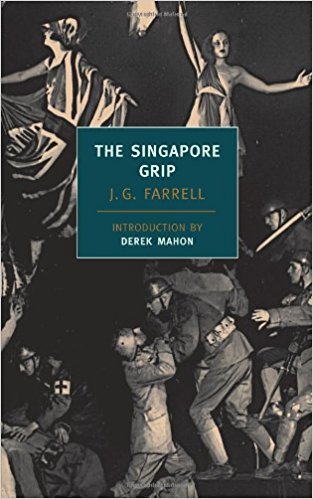
Day 1218: The Singapore Grip

Cover for The Singapore GripThe Singapore Grip is the third of J. G. Farrell’s Empire trilogy, which takes a sardonic look at various parts of the British Empire. The Siege of Krishnapur is set in the nineteenth century during the Sepoy rebellion. Troubles takes place in Ireland during the Troubles in the early 20th century. The Singapore Grip is set during the Japanese invasion of Malaya in World War II.

The novel begins in 1939. Walter Blackett is a powerful Singapore businessman whose sole concern is the profits of his company, Blackett and Webb. Despite the Allies’ need for rubber, Blackett is concerned with keeping the price up and spends his time fixing prices and manipulating the market.

His senior partner dies, and Walter awaits the arrival of Matthew Webb, his partner’s heir. Although Walter’s beautiful daughter, Joan, spends her time tormenting various young men, she readily agrees to help her father’s ambitions by marrying Matthew.

Matthew is a naive and feckless young man, whose ideals have been somewhat battered during his work for the League of Nations. Although he is chubby and unprepossessing, Joan makes a dead set for him, dismaying Ehrendorf, the previous favorite. But Matthew is more interested in Vera Chiang, a Eurasian girl who may be a prostitute or possibly a Communist or maybe neither.

This novel is peopled with Farrell’s usual peculiar characters, including a figure from Troubles, Major Brendan Archer. As Singapore begins descending into chaos, the Major attempts to organize a volunteer fire department. But his efforts are hampered by a lack of interest, as the Singaporians concentrate on selling things and the Blacketts focus all their activities on a Jubilee celebration of the company.

Farrell’s cynical look at the last years of the British in Singapore is occasionally hilarious, with a dark and deadpan humor. It also contains much to consider, as various characters discuss the benefits of colonization (whether there are any), theories of commerce, and other ideas that obsess them.

Related Posts

Troubles

The Siege of Krishnapur

The Garden of Evening Mists

Day 763: The Vet’s Daughter

Cover for The Vet's DaughterIt was several days before the doctor came. It was my father who sent for him. Even he noticed something was wrong with Mother. When he saw her all doubled up over the dining room sideboard, he suddenly bellowed, “For Christ’s sake, woman, send for the doctor, and if he can’t put you right, keep out of my sight!”

Best Book of the Week!
Alice and her mother live in terror of her father, the vet, in this novel written in 1959. He ignores Alice and treats his wife with brutality and contempt. Alice is in her teens, living in a dreary house in a London suburb with only one friend, a deaf girl, when her mother becomes ill. The one bright light for Alice is it brings vulgar but kindly Mrs. Churchill to help.

Mrs. Churchill continues to come after Alice’s mother dies, but within weeks Alice’s father has brought his lover home to live there, so Mrs. Churchill leaves. Rosa Fisher moves into Alice’s mother’s room and stays until she tries to pimp Alice out to an acquaintance.

Alice occasionally seems to have what first appears to be some kind of fits. But they are actually the slow development of an uncanny ability.

As with Sisters by a River, the simple, innocent manner in which this novel is narrated gives it a distinctive tone. Alice is a naive and unsophisticated girl whose isolation from society means she doesn’t always understand very common things. The plot is impossible to predict, as it takes us to some unusual places. The Vet’s Daughter is another strange and vivid novel from Barbara Comyns.

Related Posts

Sisters by a River

The Lace Reader

The Death of Bees


Day 716: The Siege of Krishnapur

Cover for The Siege of KrishnapurThe Siege of Krishnapur, the second in J.G. Farrell’s trilogy about the British Empire, is a novel of ideas, full of the mordant humor and irony that characterizes the first book, Troubles. Farrell based his novel on the true-life 1857 siege of Lucknow, during which British residents held out for five months against attacks from Indian sepoys.

As author Pankaj Mishra explains in the introduction, this siege and similar incidents generated at the time a popular romantic genre of fiction, wherein two young English people meet in India just before the rebellion and bravely withstand privation to prevail in the end. In The Siege of Krishnapur, Farrell is among other things satirizing this genre.

George Fleury arrives in Calcutta with his sister Miriam just before news of the first sepoy rebellions. Like Farrell’s protagonist of Troubles, Fleury is an unformed young man, and worse, he tends to the pedantic. He is inclined to the romantic and likes to lecture about the supremacy of feelings and ideas over the new plethora of objects and inventions resulting from the current Industrial Revolution.

In Calcutta, Fleury and Miriam meet another brother and sister, Harry and Louise Dunstable, offspring of one of Krishnapur’s doctors. Harry is a young lieutenant, and Louise is thought to be the prettiest (English) girl in India. Fleury is taken by her, but she spends her time flirting with the young soldiers.

Once the young people reach Krishnapur, it is not long before the rumors of trouble turn into reality. The Collector, who is in charge of the district, has been paying attention, though. The others have been ridiculing him for surrounding the Residency with trenches and sending his wife home to England.

The Collector can’t quite comprehend why the natives would want to attack the British, who in his mind are bringing them the wonderful benefits of civilization. He himself attended the Great Exhibition and has filled his house with some of the marvels exhibited there, including electroplated busts of some of the great poets. (Shakespeare’s head turns out later to make a great cannonball; Keats’ does not.)

Once the British are under attack, there are thrilling yet funny descriptions of the fighting, bravely and innovatively conducted by Harry and the other soldiers, who have limited resources, and incompetently assisted by Fleury. Fleury is continually arming himself with some bulky and impractical weapon. Inside the Residency, the British begin by maintaining strict social levels and having tea parties. Once Fleury and Harry have rescued Lucy, a suicidal fallen woman, from her bungalow outside the compound, the other ladies are horrified at having to share quarters with her, even though they are sleeping on billiard tables.

Many vibrant characters inhabit this novel. The Padre is an Anglican clergyman who endlessly tries to convert his flock’s thoughts into more pious channels, haranging them even in the midst of battle. Dr. Dunstable is so incensed by the more modern treatments of his rival, Dr. McNab, that he challenges him to verbal debates and eventually gets himself killed trying to prove Dr. McNab is wrong about the cause and treatment of cholera. Even when Dr. Dunstable’s death proves Dr. McNab is right, the supposedly rational and enlightened British still somehow believe he is wrong. The Magistrate is so interested in phrenology that he shocks everyone by feeling the back of Lucy’s head to determine its amativeness and is slapped for it.

As conditions in the Residency deteriorate, the true nature of the British rulers of India emerges, petty, jingoistic, and chauvinistic, caring little for the natives, who do not appear much in the novel except as servants or attackers. In one revealing speech, an opium grower rejoices at how much money has been made by forcing the Indians to grow opium and then using it to addict the Chinese. In fact, it was just at this time that the 8th Earl of Elgin stopped to hear about the rebellion in northern India while he was on his way to China to force the Chinese emperor to admit British opium dealers.

The novel tells a great story, while still being full of wit and philosophy.

Related Posts

Troubles

Sea of Poppies

River of Smoke


Day 556: Stoner

Cover for StonerBest Book of the Week!
When I first began reading Stoner, I was afraid it was going to be a bleak modernist novel. But it is the opposite of bleak. It is a novel about a shy, awkward man who loves. Williams called it “an escape into reality.”

Williams begins the novel by describing William Stoner’s career at the University of Missouri:

“He did not rise above the rank of assistant professor, and few students remembered him with any sharpness after they had taken his courses.”

It seems that Williams will be writing about a nonentity, but this is not the case.

On the surface, Stoner does not have a happy life. He is the son of a dirt-poor farmer who decides that William should attend college to learn new agricultural techniques. So, Stoner arrives at the University of Missouri a gawky, unsophisticated boy who has only a mild interest in his courses and begins an undistinguished career.

Then in his sophomore year, he takes a required English literature survey course. Although he is speechless in class, he realizes he has found the thing he loves and so changes his major. He eventually earns a doctorate and begins a teaching career at the university.

He makes an unfortunate choice for a wife, marrying a girl whose training makes her more suitable for a society wife than that of an impoverished instructor. It is not clear why Edith marries him except possibly to get away from home. She makes very clear how distasteful she finds sex, and he is too inexperienced to know what to do about it.

Edith’s sexuality changes briefly when she decides she wants a child. After their daughter Grace is born, though, Edith takes little interest in her or in him. Stoner, on the other hand, falls madly for Grace. He takes on almost all the care for her in her first five or six years of life. Then Edith does everything she can to separate them and mold Grace into the type of girl Edith thinks she should be.

Stoner’s solace is in his work, for which he eventually finds a talent for teaching Medieval literature. His progress in his career is hindered, though, by university politics. He finds himself in a dispute over the fitness of a student to enter the doctoral program. Although Stoner’s position is completely justified and his actions misrepresented, he earns himself the enmity of the student’s mentor, Hollis Lomax, who eventually becomes department chair.

Stoner falls in love and finds for awhile some tenderness, but he knows his relationship will be short-lived. It is also ended by university politics.

What Williams accomplishes in this novel is to turn that first assessment of Stoner on its head. Stoner is a flawed man who owes many of the difficulties of his life to inaction, but he is doing work he loves, he is completely conscientious in his efforts, and he even manages a minor victory over his enemy after years of patience. The introduction to the novel states that although readers think Williams is depicting a sad life, he sees it as a novel about love, all the forms it takes, and the forces against it.

You may think this novel sounds dreary. It is not, and it is not often that you feel as if you know and love a character so thoroughly.