
 Best Book of the Week!
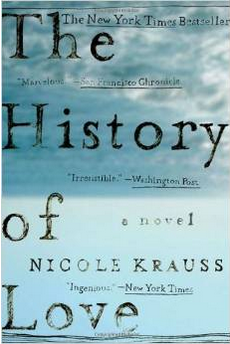
At times I wasn’t sure that I would be able to figure out what was going on in The History of Love. This feeling may not be unfamiliar to readers of Nicole Krauss. My book club was so frustrated by Great House a few years back that I had to draw a diagram to help figure out the series of owners of a desk. However, The History of Love eventually becomes clear, with an eminently satisfying ending.
For most of the novel, we follow two main characters. Leo Gursky is an old Jewish immigrant in New York, a survivor of the holocaust from Poland. Years ago he fell in love with Alma Mereminski but was separated from her just before World War II when she went to America. When he tracked her down after the war, she had married. Her oldest son, though, was 6.
Leo has led a lonely life, during which he yearned for Alma and for his unacknowledged son, Isaac Moritz, who became a famous writer. As an old man, he spends part of each day trying to draw attention to himself in some small way, so that if he dies that day, someone will have seen and remembered him.
Alma Singer is a lonely 14-year-old. Years ago her father died, and her mother has ever since lived a life of quasi-mourning, seldom coming out of her room and only doing some occasional translation work. Alma’s brother Bird is a strange boy who believes he is blessed by god. He is preparing an ark for the coming flood.
Alma has been trying to find a boyfriend for her mother so she won’t be sad. One project that interests her mother is a request to translate a book called The History of Love by Zvi Litvinoff that had a small publication run in Chile. This book was very important to Alma’s parents, and Alma was named after a character in the book. Alma thinks she perhaps can strike up a relationship between her mother and the man who requested the translation. But then she notices that the only character in the book who doesn’t have a Spanish name is Alma Mereminski. Reasoning that it may be a real person’s name, she decides to find Alma.
It is Leo who actually wrote The History of Love, we understand, inspired by his love for Alma. But then what happened?
This novel is intricate and vividly imagined. Ultimately, it is emotionally involving. I did not really enjoy the excerpts from the novel within the novel, which seem to be trying too hard to be profound, but those make up only a very small part of the book.
Related Posts
Tomorrow There Will Be Apricots
 What? Me Read?