Review 2644: RIPXX! The Absent One

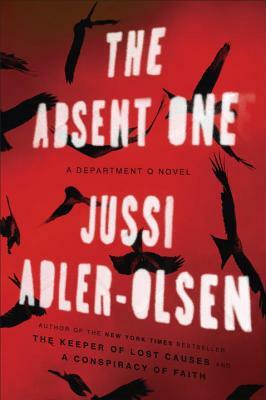
This book is the second in Adler-Olsen’s Department Q series. It’s Danish super noir.

Someone has put a file on Carl Morck’s desk. It’s the case of two murdered teens, brother and sister, from 20 years ago. The only thing is, it’s been solved. Nine years after the murders, Bjarne Thøgerson confessed. He was part of a group of students who were originally suspected of the crime—Ditlev Pram, now the owner of several hospitals; Torsten Florin, a famous designer; Ulrik Dybbal, a stock market analyst; and the deceased shipping magnate, Kristian Wolf. The other member of this group was Kirsten-Marie Lassen, who has disappeared. Of the group, only Bjarne did not come from wealth.

So, Carl wonders, was Bjarne innocent of the crime, or did he take the fall for the others? He has become wealthy in prison, which might indicate the answer.

In the meantime we learn that the above-mentioned group of powerful men—who prove to be vile human beings—are searching for Kirsten-Marie Lassen, whom they call Kimmie. That’s because she has proof that they committed not just the double murder but scores of beatings of random strangers and some other murders. Kimmie is now a homeless person who is hiding from them.

As Carl and Assad investigate, they are blocked by their boss because the case is closed but also because someone is bringing pressure from above. There is a spy in the force, and Carl is being personally threatened.

This is really a grim entry into the series, not because of the investigation but because of the activities of the super-rich, soulless bad guys. Also, FictionFan mentioned to me that she quit reading the series because it made Assad into a figure of fun. I’m not quite seeing that yet, but the Danish characters seem to be quite bigoted, even Carl at times.

Related Posts

The Keeper of Lost Causes

Roseanna

The Tenant

Review 2331: Skeletons in the Closet

A quote by Frederick Méziès on the cover of my edition of Skeletons in the Closet says, “Writing so dark it gives a new meaning to the word noir.” The novel was written in 1976, a bit after the height of French film noir, and it is certainly violent, although probably not as shocking to modern readers.

Eugene Tarpon is a private detective whose office is next to his bedroom. He only has one client when one of his contacts in the police department sends him an old lady, Mrs. Pigot. Her daughter, Philippine Pigot, has disappeared. She left for work one day and never arrived. Further, she is blind.

Tarpon’s contact, Coccioli, has strongly hinted that he shouldn’t actually look for Philippine, but he does. The next day, Mrs. Pigot arranges to meet him in a public square, and she is shot to death before his eyes. Soon, people are trying to kill him.

This novel is dark; nevertheless, there is a certain lightness and humor about it. Manchette is credited with redefining the noir genre for social criticism, but although there is certainly corruption going on, that theme is not so stressed in this novel.

I received this book from the publishers in exchange for a free and fair review.

Related Posts

The Disappearance of Adèle Bedeau

The Blank Wall

The Blunderer

Day 674: In a Lonely Place

Cover for In a Lonely PlaceWhat makes this post-World War II noir crime novel stand out is that it was written by a woman and the crime is solved by two sharp women. Although there are plenty of women mystery writers, it is less common to find women writing noir mysteries at that time. Reminiscent of The Killer Inside Me, In a Lonely Place tells the story of a serial killer of women from the point of view of the killer.

Dix Steele is an ex-pilot being supported by his uncle in Los Angeles while he pretends to write a novel. He is living in a posh apartment of an old Princeton friend, wearing his clothes and driving his car and telling everyone his friend is in Rio. About once a month he picks up a girl at a bus stop or some other lonely place and strangles her.

Dix decides to get in touch with an old friend from the military, Brub Nicholai, but is taken aback to find Brub is now a police detective. Brub has also married, and his wife Sylvia doesn’t like Dix.

Dix meets an attractive redhead, Laurel Gray, who lives in the apartment complex and is divorcing her wealthy husband. Soon they begin a torrid romance.

This novel was convincing in its depiction of a serial killer. Although we see things from Dix’s point of view, we are not drawn into his dilemmas as we are, say, for The Talented Mr. Ripley. We want him to be caught and worry about Laurel or about the next time he is going to find the need to kill.

Related Posts

The Killer Inside Me

The Talented Mr. Ripley

Roseanna

Day 460: March Violets

Cover for March VioletsThe blurb on Philip Kerr’s collection of three noir mysteries, Berlin Noir, compares him to John Le Carré and Alan Furst. I wouldn’t say that is an apt comparison. For one thing, the other two are writing in a different genre. For another, they are better writers. Still, if you like noir, March Violets has its own qualities.

This novel is the first in a series featuring private detective Bernie Gunther. It bears many of the hallmarks of a typical noir mystery. Its main character is a smart, wise-cracking tough guy who used to be a cop. It features beatings, untrustworthy dames, thugs, and murder. What makes it stand out is its setting in 1936 Berlin.

Bernie is hired by millionaire industrialist Hermann Six to find a family heirloom necklace. It was stolen from the safe of his daughter Grete and her husband Paul Pfarr when the two were brutally murdered in their beds and their bodies burned. Herr Six explicitly instructs Bernie not to look into their deaths but to find the necklace and return it to him. Of course, Bernie begins looking into everything.

Using credentials as a representative of an insurance company investigating the fire, Bernie soon finds out that Pfarr was a member of the SS, with a mission from Himmler to seek out corruption in the labor movement. That mission made him a lot of enemies. He also had some kind of friction with Herr Six, who is rumored to have ties to organized crime. In addition, there were unexplained problems in the Pfarr’s marriage.

Typical of noir fiction, the plot becomes very involved. The setting is convincingly evoked, especially the constant threat of violence for ordinary citizens under the Nazis. Bernie specializes in missing persons, and the novel makes clear that hundreds of people go missing from Berlin daily.

Since I am more familiar with classic noir, the novel occasionally struck me as too coarse, but that didn’t bother me as much as other uses of language. First, idioms with which I am unfamiliar are used constantly. Perhaps they are period German idioms, but they often seem clumsy and inapt, which idiomatic  language seldom does. Also clumsy and inapt are Kerr’s many metaphors, for example:

The butler cruised smoothly into the room like a rubber wheel on a waxed floor and, smelling faintly of sweat and something spicy, he served the coffee, the water and his master’s brandy with the blank look of a man who changes his earplugs six times a day.

Perhaps this style of writing is meant as a send-up of traditional noir style, but it is certainly overblown and irritating. (To be entirely dated in my references, it sometimes reminds me of the passages read by Jeff Goldblum’s character in the old TV series Ten Speed and Brown Shoe, but those were explicitly tongue in cheek, and I’m not as sure about Kerr’s writing style.) Although at one point I considered putting the novel aside, I finally decided to continue, and found the book moderately entertaining.

Day 454: Ripley Under Ground

Cover for Ripley Under GroundIn the second novel of Highsmith’s Ripley series, Tom Ripley seems much more of a bumbler than in The Talented Mr. Ripley and the plot unnecessarily convoluted. In the first book, Highsmith succeeded in making us care about Ripley’s fate almost despite ourselves, but in Ripley Under Ground, Ripley’s troubles seem to be caused by hubris.

Ripley is living in France in his beautiful house with his wealthy wife Heloise at the beginning of the novel. He has done well from the death of Dicky Greenleaf but occasionally finds ways to raise a little extra cash.

One recurring source of money has been some businesses built around the work of a famous artist named Derwatt. The businesses are completely fraudulent, however, because Derwatt has been dead for five years. He committed suicide in Greece, and Buckmaster Gallery was originally opened to sell his paintings as an homage by his friends. His paintings were soon all sold, however, and it was Tom’s idea to “resurrect” him, as a recluse living in Mexico. Derwatt’s devoted friend Bernard Tufts has been painting forgeries ever since, to be sold by the gallery with a small token going to Ripley.

Gallery owner Jeff Constant contacts Ripley in a panic. Thomas Murchison, the American owner of a Derwatt, thinks his painting is a fake, and he is coming to the next Derwatt opening to speak to the gallery owners. In an attempt to bamboozle Murchison, who is planning on meeting with an art expert, Tom masquerades as Derwatt at the opening and assures Murchison that the painting in question is his. Murchison has some theory about the use of color in the painting, though, and is unconvinced, even ridiculously suggesting that Derwatt may not remember his own painting.

As himself, Tom meets Murchison in the lobby of his hotel and invites him to France to see his own Derwatts. Tom’s intention is simply to try to convince Murchison he is wrong about the painting, but of course he ends up having to murder him.

This starts us on a complicated series of events, where Tom buries the body then digs it up, confesses his murder to no less than four people, travels all over Europe looking for an errant Bernard, and is, of course, the number one suspect in Murchison’s disappearance. If this isn’t enough, while Tom is trying to cope with all these problems, people continually arrive on his doorstep and the phone rings at every inopportune moment. Ripley’s return is not an unqualified success from my point of view, as everything is over-complicated and the pace of the novel is too frenetic.

Day 330: Adamtine

Cover for AdamtineAdamtine is the second of Hannah Berry’s moody noirish graphic novels after Britten and Brülightly. Whereas the first novel was a noir crime effort with a wry sense of humor (the detective’s partner is a tea bag), it is not clear to me whether Adamtine is a crime or a horror novel.

Four people who know something about an earlier series of disappearances are traveling home on a train when it stops in the middle of nowhere. At the time of the earlier crimes, a man named Rodney Moon was put on trial, but he claimed to have only passed notes to the victims. There are hints of the involvement of a large corporation.

The story is told with flashbacks to the previous crimes, although it was difficult for me to tell sometimes which scenes are those from the past and which are from the present. It was also unclear to me what exactly happens to the people, but perhaps the atmosphere created is of most importance.

The art is beautiful, with its muted, moody tones. I think this graphic novel is visually interesting and intriguing, but I find it difficult at times to completely understand the parts of the narrative that are told only in pictures.

Day 310: The Killer Inside Me

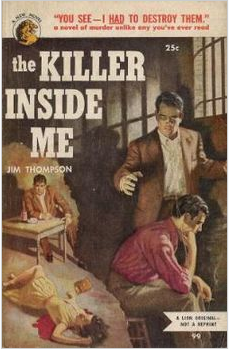
Cover for The Killer Inside MeJim Thompson’s classic noir thriller The Killer Inside Me was one I had never read, so I picked it up out of curiosity. Normally, I am not drawn to classic noir, even though I like a crime novel that is dark. This brief novel easily kept my attention, though.

Lou Ford is a deputy sheriff in a small Texas town. He projects the image of a jovial good guy, maybe even a little stupid, who continually spouts clichés. But he has actually been hiding his sociopathic tendencies for years.

Ford begins a sadomasochistic relationship with Joyce Lakeland, a prostitute. He sees a way to use his relationship with Joyce to get revenge for his brother’s death. As a teenager Ford sexually abused a little girl, and his foster brother Mike took the blame. After he got out of jail, Mike died in a construction accident, and Ford has blamed the local owner of the construction company for Mike’s death.

Ford and Joyce begin blackmailing the owner of the construction company in return for keeping his son’s affair with Joyce secret. Then Ford sees a way to take it all one step further. Of course, things don’t always go as planned.

As in reading Patricia Highsmith’s Ripley novels, a large part of the fascination of this disturbing book lies in wondering how Ford is going to get out of one fix after another. Thompson’s writing is deft and tight. You will be glued to the page, even if you don’t like noir.