Day 729: The Great Texas Wind Rush

Cover for The Great Texas Wind RushThe Great Texas Wind Rush is a history of the wind energy business written by Kate Galbraith and Asher Price, a couple of reporters. It begins with the building of wind turbines to pump water and then covers a few pioneers who tried to use turbines to produce electricity, with mixed results.

Finally, it follows the various attempts to do this as a business and the legislation that made it possible to make wind farming a serious business. These efforts finally culminated in the 2000’s with the establishment of many successful wind farms across Texas.

I have nothing against wind power. In fact, I am for green energy. But the book at times seems to be biased both for Texas and for wind power. I live in Texas, so I am used to the ridiculous pro-Texas bias that creeps into everything, but I felt that the cons of wind power were glossed over. The problems of migratory birds are mentioned, for example, several times, but there are no facts or figures even estimating the number of birds killed. This is disturbing, especially in discussions about wind farms off the coast, where there are many bird sanctuaries, including for the whooping crane, which already almost went extinct. And the admiring tone the book occasionally takes is not good journalism.

Books about business do not fall within my interests, and the only reason I read this one was because it was chosen for my book club. At first I found it more interesting than I expected, but eventually it seemed to become just one story after another about one company after another. I kept falling asleep. Unless you are really interested in wind power or business history, the book, although clearly written for a general audience, has limited appeal.

Related Posts

The Big Short: Inside the Doomsday Machine

The Information: A History, A Theory, A Flood

Annals of the Former World: Rising from the Plains

Day 702: Dead Wake: The Last Crossing of the Lusitania

Cover for Dead WakeIn Dead Wake, Erik Larson has written another fascinating history—the story of the last voyage of the Lusitania. As he sometimes does, Larson goes after the story with a two-pronged approach: on the one hand following preparations for the voyage and the actual trip, on the other hand following the progress of the U-20, the German U-boat that sank it. In this book, the story has a third, weaker prong—the romance of President Woodrow Wilson with Edith Bolling Galt, who would become his second wife.

Even though everyone reading the book knows what will happen to the Lusitania, a passenger ship en route to England from the United States during World War I, Larson manages to create a fair amount of suspense. He tells us about a number of the passengers, and we want to know who survives, of course. I think this ability of Larson’s to create suspense even from a story where we know the outcome is quite a talent.

Aside from learning about the ship, the voyage, and the results of the attack, we also learn about things that are more surprising. In particular, Larson leads us to wonder whether the British admiralty was incompetent or whether the hope that some event like this would force the Americans into the war made them negligent. There were several actions the admiralty could have taken to keep the ship safer.

I recently read an article about the man who bought the wreckage of the Lusitania, who believes that the ship secretly carried armament meant for England. It is true that there was an unexplained second explosion after the U-boat’s torpedo hit the ship, but if the theory turns out to be correct, that makes the British admiralty’s conduct even more perplexing.

Related Posts

In the Garden of the Beasts: Love, Terror, and an American Family in Hitler’s Berlin

The Daughters of Mars

Midnight in Europe

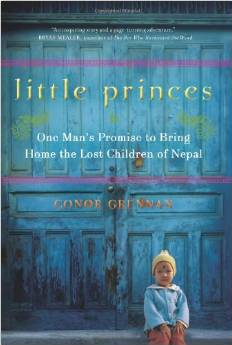
Day 696: Little Princes: One Man’s Promise to Bring Home the Lost Children of Nepal

Cover for Little PrincesAlthough I wrote this review several weeks ago, with the earthquake in Nepal, it is more timely now. I am happy to report that the children in the orphanages mentioned in this book are all well.

* * *

After the scandal of Three Cups of Tea, I wasn’t sure how much I wanted to read what seemed to be a similar book, but Little Princes was chosen by my book club. It’s the story of a man who volunteers for a Nepalese orphanage from fairly selfish motives but finds himself drawn in because of his affection for the children to do more.

Conor Grennan explains that he volunteered to work in the Little Princes orphanage in Nepal so that his decision to take a year off from work to travel wouldn’t look so selfish to others. This reasoning is an odd thing to admit and made me puzzle about his character. Still, once in place, he enjoyed work with the children enough to promise to come back.

It is right after he returned to Nepal that he met seven children from a remote province called Humla. Like many of the children, he learned, they were sent away by their parents from the district for their safety during civil war. What the parents didn’t know was that they were paying human traffickers, who got the children to Kathmandu and then sold them or abandoned them. Most of the children thought their parents were dead, and most of the parents had had no news of their children for years.

This was all to come out after Conor found the seven children from Humla in the custody of the wife of one of the traffickers. Just before he left the country again, he struggled to find a home that would take them in. A charity called the Umbrella Foundation, which had several orphanages, agreed. But after Conor returned home again, he learned that the trafficker had found out what was going on and removed the children before the Umbrella Foundation could fetch them.

Conor then decided to create his own foundation to work against child trafficking in Nepal. His first goal was to find those seven children. But after discovering that the mother of two of the children was alive and had not known of her children’s plight, he also decided to travel to Maoist Humla and try to find the parents of the seven children, as well as those of the children in Little Princes.

Conor does not do this all by himself. He has help from Gyan, a child welfare official; his coworker Farid, who founds an orphanage with him; the Nepalese men who go with him to Humla as guides and interpreters; and various European aid workers. Conor and the others eventually find the seven children and locate many parents in Humla, some of whom arrive to take their children back. The book also tells us how Conor met the woman he is now married to.

This book is interesting and makes you think about how much good can be done in poor countries with a small amount of money. The efforts of Grennan’s foundation and its results seem to be legitimate and worthy. What wasn’t entirely clear was how closely Grennan remains involved in the work now that he lives in Connecticut with his wife and child.

Related Posts

The Zookeeper’s Wife: A War Story

Conversations with Myself

My Father’s Eyes

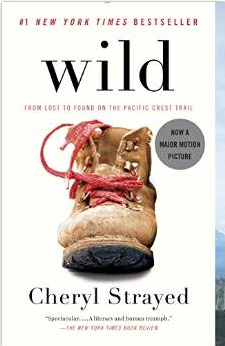
Day 689: Wild

Cover for WildI didn’t actually become interested in reading Wild until I saw the terrific movie adaptation. That and a few excellent reviews changed my mind about reading it. There was just something about the author having changed her name to Cheryl Strayed that annoyed me, to be honest, and was keeping me away from the book.

If you have seen the movie, it is amazingly similar to the book, only changing the sequence of some events and leaving a few things out.

This memoir is about Cheryl Strayed’s attempt to get her life back on track by hiking the Pacific Crest Trail from Southern California to near Portland, Oregon. After Cheryl’s mother’s death from cancer several years before, her life fell apart. She became promiscuous and eventually began using heroin. After she and her husband divorced, she decided to hike the trail alone in an attempt to return to her true self.

Although Cheryl views herself as an outdoorsy girl, she soon finds that she is unprepared for the rigors of the journey. Her pack is so heavy that she can barely lift it, her boots uncomfortable, she herself not in condition and not understanding that such an endeavor is painful even for an experienced hiker. She originally planned to hike about 20 miles a day but finds herself only making 6 to 8 miles, less at the beginning.

This memoir is vividly written and quite harrowing at times as it follows Strayed’s journey. She encounters snow and landslides, wild animals, friendly as well as scary people, and her own truth. Wild is an interesting journey into the wild and into self-awareness.

Related Posts

The Cruelest Journey: Six Hundred Miles to Timbuktu

A Walk in the Woods

A Time of Gifts: On Foot to Constantinople: From the Hook of Holland to the Middle Danube


Day 683: By a Woman’s Hand: Illustrators of the Golden Age

Cover for By a Woman's HandBy a Woman’s Hand is essentially a picture book for adults. It does not have much in the way of written content, but it has many lovely illustrations.

A short preface tells about the prevalence of woman illustrators toward the end of the 19th century and the beginning of the 20th. Then the book provides a very brief, one paragraph or so, biography of about 20 illustrators, surrounded by several pages of their work.

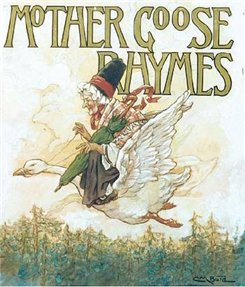
Mother Goose by Clara Burd

Although there are lots of chubby children, the illustrations show influences from several different art movements—Art Nouveau, the Pre-Raphaelites, for example. Some of the illustrations are complex and others look almost like paintings. Clara Burd also trained at the Tiffany Studios and designed stained glass windows.

I have been interested in illustrations for children’s books for a long time, although I have not made a study of it. This book is a nice little addition to my collection of children’s books with nice illustrations.

Related Posts

Clara and Mr. Tiffany

The Last Pre-Raphaelite

Studio St.-Ex

Day 672: The Etymologicon

Cover for The EtymologiconThe Etymologicon is an amusing look at the etymology of words and phrases, explaining connections between those that don’t always seem connected. It is written by Mark Forsyth, the author of a blog called The Inky Fool, and it does a rather clever thing. It starts with an explanation of “turn-up for the books,” a phrase I wasn’t actually familiar with. From that, it moves to a subject related to something he discussed in the first article, so that each article is linked to the next. The last one leads, you guessed it, right back to “a turn-up for the books.”

The book is amusingly written in a zippy style and is crammed full of facts, not just about the meaning of words. In style, it reminds me very much of the rapid fact-based videos done by John Green for Mental Floss. At the end, it even has some quizzes. It’s a good gift for someone interested in language or trivia.

I only have two critiques, and one I’m not sure of. First, the text is taken straight from the blog, it appears, with no attempt to remove the references to the next link. I call that lazy.

The second occurs in a section about butterflies. Forsyth says that the word for butterfly in Russian is the same as the word for little lady, bow tie, and girl, and that word, he says, is “babochkas (like babushkas).” (The s is of course the English plural, not the Russian. In context, he is talking in plurals.) Actually, “babochka” is the word for moth. I can let that go, because lots of people, including me, can’t tell a moth from a butterfly. But “dyevushka” is the Russian word for girl, unless there is some usage I’m not aware of. And “bábushka” means grandmother (whereas babúshka means kerchief). I have no idea what the word for bow tie is. The words for moth and grandmother are similar but they are certainly not the same. The word for girl is quite a bit different. This makes me wonder about the accuracy of other information, but maybe someone who is more familiar with Russian will correct me. Perhaps he’s trying to convey that the etymology of the words is the same, but what he actually says is that they’re the same word.

If so, I’ll be happy to be corrected, for I found this book an entertaining way to while away an afternoon.

Related Posts

The Adventure of English

White Heat: The Friendship of Emily Dickinson and Thomas Wentworth Higgins

My Life in Middlemarch

Day 669: Death by Black Hole and Other Cosmic Quandaries

Cover for Death by Black HoleA Quick Note: I just now published a new feature for my blog, an additional link called “List of Authors,” which lists all of the authors reviewed on this site and all their books. This new page will make it easier for people to find more books by authors they enjoy. Look for it at the top of the page!

* * *

Death by Black Hole is a collection of astrophysicist Neil deGrasse Tyson’s essays from Natural History magazine. In general, I’m not that fond of essay collections because just when I want an author to build on a point, the essay is over.

Tyson is always good, though, at explaining complex ideas in a way that a science novice like me can understand. He is also frequently amusing, funny enough for me to occasionally read passages out loud to my husband. Some of the pieces are probably written solely to provide amusement, like the one about the scientific errors in sci-fi movies. But he also includes essays about the creation of the universe, climate change, particle physics, cosmic curiosities, and the interface between science and the public.

If I can repeat a point, though, I think I would have appreciated even more a book that explained principles and then took me farther with them. Instead, by the nature of the beast, the essays are sometimes a bit repetitive, although none of them cover exactly the same ground.

I was really looking forward to the chapter on “intelligent design,” which is a sore point with me. But even though Tyson is clear that this is not a scientific viewpoint, his essay is a bit too tactful for my taste. At this point I would have appreciated some zingers.

Related Posts

Annals of the Former World

The Information: A History, A Theory, A Flood

Oryx and Crake

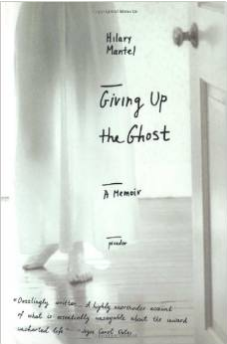
Day 629: Giving Up the Ghost

Cover for Giving Up the GhostBest Book of the Week!
In this gripping memoir, ghosts haunt author Hilary Mantel—the spectres of her past, her stepfather’s shade stumbling around the upper reaches of her holiday cottage, the spirit of her unborn daughter, the wisps of her yet unwritten books, and most confoundingly, the black smudge of an apparition that invaded her body when she was seven. Mantel’s is a memoir of wit, anger, and poetic truth.

It also meanders. It begins with the sale of Owl Cottage—where Hilary senses the ghost of her stepfather even though he never lived there—but then returns to the earliest memories of her childhood.

Of Irish Catholic parents, she grew up in the grim north England town of Hadfield, near Manchester. Although her family was poor, her earliest memories are the rich ones of her grandparents and aunts, who lived all along the lane, indulging the imagination of a child who was a knight of the round table, a red Indian, a priest, and was due to turn into a boy when she was four. To me, this last detail is one of the most charming. I can see this little girl.

Then a serious illness struck, changing her from a sturdy tough child with long black hair to a wispy, frail blonde girl, no longer due to change to a boy. From then on it seemed she was robbed of her true self.

The memoir details her rigid Catholic school education, where she developed an intolerance for ridiculous questions, from those asked by her teachers. It also tells of the more profound loss of her childhood, when her mother moved the family out of that lane of relatives so that she could take up life with her lover, Jack. Hilary’s father Henry was relegated to the status of a lodger and then left behind when Hilary won a place at a better school, never to be seen again.

The most debilitating events of her life began when she was a young married woman studying law. The extreme pains in her legs were diagnosed by patronizing and sexist doctors as mental rather than physical problems, caused by the stress of her studies on her feeble female brain, and she was treated first with Valium and later with anti-psychotics. What she actually had was endometriosis, which she finally diagnosed herself. It was left untreated so long that she ended up having a hysterectomy at age 29. She had put off having a child, and it was too late. The effects on her health continue to this day.

Mantel’s memoir is vividly and beautifully written. She strips herself bare, and it is unforgettable.

Day 617: Charles Dickens

Cover for Charles DickensReading this biography of Charles Dickens was very interesting to me after reading The Invisible Woman, about Dickens’ long illicit affair with Nelly Ternan. I have read biographies of Dickens before, but these two were the first I read that were forthright about some of Dickens’ inconsistencies and hypocrisies.

Renowned British actor Simon Callow puts a different spin on this book by examining Dickens’ love of and relationship to the theatre and his audience. Dickens adored the theatre and made quite a few forays into amateur theatrical productions, some of them quite large in scope, before settling on dramatic readings of his novels that were hugely successful.

It was of course during one of these productions, performances of a play he wrote with Wilkie Collins, where Dickens met Ellen Ternan, the young actress who became the focus of his mid-life crisis, which eventually ruined his marriage. She was brought in to replace Dickens’ daughter when a public performance made it improper for a young lady to appear.

This book is written in vivid and humorous style. It is entertaining and provides a view of Dickens’ career from the point of view of a theatrical background. Callow has himself played Charles Dickens more than once, most notably in a one-man performance, and is the author of nine books on theatre.

P. S. This book is sometimes titled Charles Dickens and the Great Theatre of the World.

Day 615: The Rural Life

Cover for The Rural LifeThe Rural Life is a collection of essays, more like musings by Verlyn Klinkenborg, a writer of the editorial board for the New York Times. Most of the essays were previously published in the Times and are related to his rural life, whether through his family history on an Iowa farm, his own farm in upstate New York, his father’s ranch in the Sierras, or travels to various western states.

I thought this would be an interesting and perhaps informative book, as I plan to be leading the rural life within a couple of years. Certainly many of Klinkenborg’s essays struck a chord with me. I liked best the pieces that do not go far from nature, whether he is discussing the care of bees, the lushness of his farm in the summer, or the beauty of a snow fall. Occasionally, he gets a little more philosophical than I am interested in.

The book is beautifully written. It occasionally confused me because it is ordered in chapters by month, and in the summer months he seems to be hopping back and forth between his farm and Wyoming. It wasn’t until a paragraph at the end that I discovered the book combines essays written over several years.