Day 601: The Talented Miss Highsmith

Cover for The Talented Miss HighsmithI became interested in reading this biography after hearing about interviews with Schenkar, who called Patricia Highsmith a sociopath. Patricia Highsmith is, of course, the author of many mid-20th century thrillers, the most famous being Strangers on a Train and The Talented Mr. Ripley. After reading the biography, I don’t really think Highsmith was a sociopath. I think she was fascinated with certain dark themes, but she strikes me as more of a social inept, perhaps partially on the autistic spectrum.

Highsmith was certainly a complex person of many contradictions. She was a lesbian misogynist, as contradictory as that sounds, who was a great womanizer in her younger years and was seldom faithful to any of her lovers. She was an outspoken anti-Semite who had Jewish lovers and a lot of Jewish friends. Known in later years as a recluse, she visited her neighbors every evening and corresponded with many people, as well as making an appearance whenever invited.

She certainly was a damaged person. She had a love-hate relationship with her mother for her entire life, blaming her for abandoning her briefly when she was young and for not divorcing her stepfather. She was a woman who always thought she should actually have been a man. A heavy drinker and smoker, she barely ate any food for years and was probably anorexic.

Her life was an interesting one. She did not seem to be a likable person and frequently behaved very badly. Yet, she had many sincerely devoted friends.

I was interested in this book but had some issues with its structure. Schenkar explains at the beginning that a chronological approach wouldn’t do Highsmith justice, so she approaches Highsmith’s life sort of organically. The problem I found with this approach was that after awhile I could not figure out what organizing principle is holding some of the chapters together. Sometimes they just seem to follow a stream of consciousness approach. It makes the information conveyed very repetitive and chronologically impossible to follow. Schenkar helpfully provides a chronology at the back of the book, along with about 100 pages of supplementary material, but by then I was exhausted and had no interest in exploring any of it.

Finally—this is a small quibble—I got irritated by Schenkar’s chapter naming. The table of contents shows only nine chapters in this very long book, but there are really forty-nine. That is because she actually names them Les Girls Part 1, Les Girls Part 2, and so on. Perhaps I’m being unfair, but I could just imagine Schenkar’s editor telling her she couldn’t have a 150-page chapter, which is the length of Les Girls, Parts 1–14. Such an approach does not strike me as being very imaginative.

Day 600: My Father’s Eyes

Cover for My Father's EyesWhen she was in high school, author Sheila Allee discovered that her father had a brother she didn’t know existed. Melrose Allee, nicknamed Pie, was born with profound intellectual disabilities. Once Allee’s father “Dub,” who had taken much of the burden for Melrose’s care, left home in 1937, his parents placed Melrose in Austin State School. Even though her father was angry with his parents and swore to get his brother out, he never did, and Melrose eventually became an unmentioned subject.

Sheila could not understand how her family could have institutionalized her uncle in the first place and even worse, how they could have left him for years, unvisited. When she moved to Austin as an adult, she set about finding Melrose, eventually locating him in Travis State School in 1991.

This short book is the touching story of Allee’s own self-discovery through the agency of her impaired uncle. It is also the story of her discovery of the profoundly disturbing beliefs and practices surrounding the mentally handicapped that were practiced in this country in the first half of the 20th century.

In the interests of full disclosure, I know Ms. Allee, and I received a copy of her book in return for an honest review.

Day 591: Goodbye to All That

Cover for Goodbye to All ThatThis is my book for the most recent Classics Club Spin! I originally announced that I would post my review a day late, on October 7, but I decided to post it early instead, so as to meet the spin deadline, since Monday, the deadline, is Literary Wives.

Goodbye to All That is the only memoir by Robert Graves, written in his 30’s about a dozen years after World War I. Nowadays, Graves may be best known as the author of I, Claudius, but the publication of Goodbye to All That was extremely controversial. It was one of the first memoirs about the war, and it was one of the most critical.

But before Graves turned a satiric eye on the war, he pointed it at the public school system. I did not always understand what was going on in his boy’s school, but the layers of hierarchy and the customs seem ridiculous. Not surprisingly, this same complexity extends to the different regiments in the military and their customs—where to wear their decorations, what to wear (for one regiment in France, the answer is shorts), and who may speak or drink in the officer’s mess.

Graves, who enlisted early in the war at the age of 21, was soon viewing it all skeptically. One scene of high satire takes place in a meeting of battalion officers, who are all called in to listen to the complaints of their colonel that the men aren’t buttoning their pocket flaps and so on—the worst offence being that he heard a soldier actually call a noncommissioned officer “Jack”! This meeting takes place at the same time that the division is issuing commands for the men to perform impossible missions that would have gotten them all killed had they not been cancelled at the last minute.

Graves also deals somewhat facetiously with the premature reports of his own death, sent by the military to his family after he was wounded, by putting a polite announcement in the Times.

This memoir is interesting enough, although at times I could not follow the nuances of the events, having no knowledge of British school or military terms. There is a short glossary of military terms at the beginning of the book, but it is insufficient. These days, news of incompetency and jingoism during the war is no surprise, but when this book was published, it was the cause of a storm of letters containing all kinds of accusations against Graves.

Day 588: I Await the Devil’s Coming

Cover for I Await the Devil's ComingI had a strong reaction to I Await the Devil’s Coming, which I will explain in a moment. This book was written in 1901 and belongs in the category of confessional literature. It apparently was quite a sensation at the time and had a great following by young women.

Mary MacLane was a 19-year-old woman living in a Montana mining town. In the book she declares herself a genius and an egoist who is waiting for her life to start when the Devil takes her away to be his love. This book is claimed as an early feminist work, and in the introduction, there is a statement to the effect that if MacLane had been a young man, she could have gone off and made her mark.

I don’t see this book as a feminist work at all but more likely as an expression of mental illness. I have met a similar person in a relative, who complained that life was hell on earth and that the people of our town were all provincial philistines. MacLane wasn’t going to act, she was waiting for things to happen to her. You could reply that in her time and place there was nothing a respectable woman could do to change her life, but of course, MacLane didn’t care about being respectable, at least she said she didn’t.

MacLane was mentally ill not because she said she was waiting for the Devil, but because she showed signs of severe depression alternating with fervor and euphoria, and she heard voices. If she had been a young man, she would have been incapable of striking out on her own and making a success of herself.

In fact, she did not. Her book was published and she was kicked out of the house. We don’t really know how she led her life after that. She wrote another book years later that was not a success, and she died alone in her 40’s in a hotel room.

It is a sad story. The book is well written, visceral at times, but it is not a feminist masterpiece. Charlotte Perkins Gilman was a feminist. George Eliot was to some extent a feminist. Mary Wollstonecraft was a feminist. Mary MacLane was not.

Could the situation of women at the turn of the century make a woman ill? That is another question. Charlotte Perkins Gilman obviously thought so.


Day 583: I Know Why the Caged Bird Sings

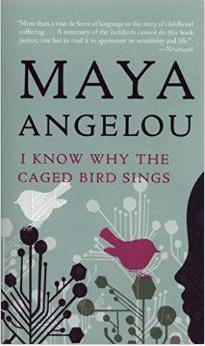
Cover for I Know Why the Caged Bird SingsThe picture on the cover of my old copy of I Know Why the Caged Bird Sings shows an angry and dignified woman, and in some ways this is an angry memoir. Although I’m sure this anger helped sustain Maya Angelou during a difficult life and pushed her to make significant advances for herself and her people, I hope she became happier later. She earned it.

This book is the powerful story of the first 16 years of Maya Angelou’s life. She and her brother Bailey were raised by their grandmother in the small town of Stamps, Arkansas, after being sent there alone on a train from California at the ages of three and four by their parents. Much of the book deals with her upbringing by a strict and religious, somewhat reserved but caring grandmother in the racially segregated South.

Although life in Stamps was no picnic, her brief visit to her mother in St. Louis when she was eight was disastrous. There she was raped by her mother’s boyfriend. That was not the only event in her life that could have proved catastrophic.

Angelou speaks with raw transparency about the feelings of insecurity that she battled through her girlhood, a combination of her treatment by whites and her own feelings of unattractiveness. In her younger years she was saved by her love of reading, later by her own dignity and will to succeed.

This book is deeply involving and at the same time sometimes disturbing reading. I was brought to tears at the description of Angelou’s nearly ruined graduation, not when the pompous white guest speaker put the class in its place, but by how the valedictorian rescued the occasion. I was thrilled when Angelou’s perseverance won her a position, at the age of 15, as the first African-American cable car employee of San Francisco.

I think this story of pride and dignity against bigotry is inspiring for anyone.

Day 580: The Broken Road: From the Iron Gates to Mount Athos

Cover for The Broken RoadIn December 1933, eighteen-year-old Patrick Leigh Fermor began a journey on foot from Holland to Istanbul. Last year I reviewed the two books that cover the first two legs of the journey, A Time of Gifts and Between the Woods and the Water, but had to wait until this third volume was published to finish the journey.

Unfortunately, Leigh Fermor never completed this book. He actually began writing it first, about ten years after his journey, but stalled. Many years later he wrote the other two books and finally returned to this one. The editors explain in the introduction that they had to piece bits of it together from the manuscript, one of his surviving diaries (others were lost), and other documents. They did a great job, for it only seems fragmentary for a few pages in the middle.

This travelogue picks up at the Iron Gates by the Danube in Rumania but almost immediately moves to Bulgaria. Leigh Fermor spends a great deal of the book traipsing around the Bulgarian countryside meeting colorful characters before abruptly deciding to go to Bucharest. As most of this section of the book is written from his memories of what happened because of his lost diaries, I can only say that his memory must have been remarkable. He writes in a vividly descriptive style, allowing you to imagine yourself along on his trip through a world that is long gone.

It is remarkable also that almost everywhere on this journey he meets with kindness and hospitality. Only one night as he miserably hobbled along in Bulgaria after his foot was rubbed all day by a boot nail were his requests for a ride on two different passing wagons met with demands for money. Since he was living on a pound a week, wired periodically by his parents, he chose to walk. That same night his appeal for shelter at one house met no response from inhabitants who were clearly home. But farther down the road some charcoal burners cheerfully took him in.

Only at all disappointing is his description, which is almost nonexistent, of Istanbul. (He persists in calling it Constantinople.) I can only suppose his visit was in some way spoiled, as it is clear from his comments on the way there that he had romantic notions of the East. A footnote repeats his remark that he never left Constantinople without a lightening of the heart.

Leigh Fermor’s book ends where his green diary picks up, with his travels all over Mount Athos, Greece’s Holy Mountain. There he visited one Eastern Orthodox monastery after another. This section is fascinating for its glimpses into this unusual mode of life. Fermor came to love Greece so much that he lived there much of his life, and this was his first experience of it.

I actually found this book easier to read than the other two more polished efforts, as enjoyable as they are. I think it is because it was written by his younger self. For although he was kicked out of prep school before this journey and never returned to a formal education, he plainly was frightfully well read and knowledgeable and constantly lost me in the earlier books with classical or poetic allusions that I was too lazy to look up.

Apparently Leigh Fermor, who was clearly adventurous, went on to live an exciting life. I have a biography of him waiting for me in my pile.

If you have read my reviews of Leigh Fermor’s other books, you may have noticed a discrepancy. In those I say he was nineteen at the beginning of his adventures. Well, that’s what he said, but since he celebrated his 20th birthday at a monastery in February 1935 and started his journey in December more than a year before, even I can do the math. I did notice him referring to himself as twenty before he actually turned it, so that’s probably what happened in the earlier books.

Day 566: Savage Beauty: The Life of Edna St. Vincent Millay

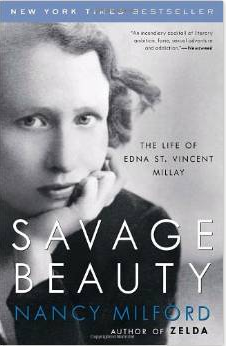
Cover for Savage BeautyNancy Milford, author of an acclaimed biography of Zelda Fitzgerald, was able to gain unlooked-for access to Edna St. Vincent Millay’s papers to write this compelling biography. She explains in the prologue that she stopped by the house of Millay’s sister Norma in 1972, hoping to talk her into working with her on a biography. Norma, who had all along refused access to her sister’s legacy, decided it was time.

The result is a riveting biography, full of excerpts of letters—some never sent—poetry and scraps of poetry, and notes. It is unflinching in looking at Millay’s lifestyle and addictions.

Millay, of course, is famous as the voice of a newly liberated youth, particularly of women, in the Jazz Age. She began publishing her poetry at a young age and became famous after her first book, when she was in her early twenties. For a long time, she was wildly popular—movie star popular—which is interesting in a nation that generally doesn’t love poetry. And, like many a modern idol, she had a lot of attention paid to her appearance, which was small, with fiery red hair, and sprite-like.

That is about all I knew about her—that and a bit of her verse. Her childhood was hard. Her mother left her father when Edna and her sisters were young and was away much of the time trying to make a living for them as a nurse, while the girls fended for themselves. Still, she brought the girls up with a love of music and poetry. Millay published a few poems in a children’s poetry magazine and won all their awards, but her big break came when she attracted the attention of a wealthy patroness, who arranged for her to attend Vassar.

I am not going to relate Millay’s life story in this review—you can read the book for that—but instead ruminate on some ideas this book made me consider. One is the strange relationship Millay had with her mother Cora and her sisters Norma and Katherine. For Cora, her letters always expressed much affection, often resorting to baby talk. Yet increasingly, Millay kept her mother at arm’s length, sending money instead of visiting her.

With Norma, too, the messages were affectionate, but the visits were few. In her case, there seems to be fair enough evidence that Edna’s husband Eugen Boissevain acted as a barrier between Millay and some people, including her family. As time progressed, for example, almost all of Norma and Katherine’s letters to Edna were answered by Eugen.

Katherine’s case was different, a life that seemed to be an attempt to compete with Edna in her own backyard, and failed. Edna’s patroness also saw Katherine into Vassar, from which she failed to graduate. She published a couple of prose books and some poetry, but her work was deemed too similar to her sister’s to succeed. This evaluation must have been disheartening, but in later years she claimed that Edna stole her ideas, an allegation that was patently absurd, especially as they had barely been in touch for years. Katherine’s relationship with Edna toward the end consisted solely of letters that were a combination of vituperation and demands for money. Like Edna, Katherine was an alcoholic, although not apparently a high-functioning one.

Edna’s relationship with her husband was unusual, too. After a gay and determinedly single life including many affairs with both men and women, Millay married not long after the failure of an affair with another man. Eugen is frequently described as a man who did everything for Edna, including absenting himself so that she could have an affair with a much younger man. Her family and some of her friends seemed to blame him for keeping her apart from them, but I can’t help feeling that most of that was at her desire, since she seemed to see who she wanted to see.

All of this makes me wonder how far a creative person can go in selfishness—how acceptable that is in the service of art. Millay was certainly one of those extremely charismatic people who attracted others like moths. How often such people are completely self-absorbed, even if they are not geniuses. If a person’s genius is fueled by intense emotion, is it okay to fire that  emotion at the expense of others? To blow hot and cold on people’s passions until they are madly in love and then discard them? I don’t really know. Many of Millay’s lovers remained her lifelong friends after the affair was over, but it seems that charismatic people are more often forgiven their actions than others. I haven’t come to any conclusions on this. These ideas are just some the biography made me consider.

I read this book in tandem with The Selected Poetry of Edna St. Vincent Millay. Review to come.


Day 555: Mastering the Art of Soviet Cooking

Cover for Mastering the Art of Soviet CookingAlthough Mastering the Art of Soviet Cooking is billed as a memoir, it is written with the help of the author’s mother and begins long before Von Bremzen was born, with the start of the Soviet Union. It is an unusual memoir, tracing as it does the history of the Soviet Union, decade by decade, through the meals cooked by one family.

In an entertainingly wry writing style, Von Bremzen relates the changes in Soviet approaches to government over time and the way these changes affected the populace. She begins by explaining how Lenin’s asceticism nearly eliminated Russian cuisine because of the idea that food was decadent (and hardly any food was available).

Von Bremzen ironically and knowingly traces the history of Soviet Russia through famine and glut, for each decade featuring a dish that seems to represent it (although one decade features ration cards). The recipes are at the end.

Von Bremzen relates her own mother’s history as the rebellious daughter of a prominent Soviet military officer, her mother totally rejecting the party line. Larisa was terrified throughout the Stalinist era and longed to leave the country. Anya, herself with a difficult start as a child not allowed to join the Young Pioneers or visit Lenin’s tomb (things she secretly yearned for), had finally found a comfortable place when her mother dragged her off to Philadelphia.

This amusing book is fascinating for people who are interested in Russia, which I have always been. Darkly funny are the countless contrasts between the official views of the country and Von Bremzen’s descriptions of the actual plight of the population. It is difficult to describe the divided viewpoint of the author, who obviously loves Russia and the 60’s vision of what it was, while at the same time being deeply skeptical of everything about it.

This book is unusual, intelligent, and well-written, about a woman’s attempts to reconcile her feelings about her country and upbringing.

Day 550: The Invisible Woman: The Story of Charles Dickens and Nelly Ternan

Cover for The Invisible WomanThe Invisible Woman is the interesting story of the relationship between Charles Dickens and Ellen Ternan, the true nature of which is still being debated. Although Dickens’ reputation was jealously guarded by himself during his life and by his friends and family after his death, Claire Tomalin shows convincing evidence that the two had an affair during the last 13 years of his life.

They met when Nelly was just 18 and he was at the height of his fame at 45. She and her mother and two sisters were struggling, hard working but respectable actresses, or as respectable as actresses could be during the Victorian era. It is possible that Dickens at first thought he had latched onto a bird of a different feather as he befriended the family.

Although Nelly was excited by the attention of such a famous man, it seems clear that she succumbed to him only reluctantly. He offered her a chance at a life free from the worries of poverty but one in which she could not be a member of society.

This is a fascinating story, particularly because of the lengths Dickens went to protect his own image even while shedding his wife Catherine in a cruelly public way and telling lies about it. The actions of his sister-in-law at this time toward her own sister seem almost inexplicable. Also interesting is how Nelly managed to reinvent herself after Dickens’ death.

This book is an engrossing, well written, carefully researched account of events in Dickens’ life that were hidden for years. Only a few years ago I read another biography of Dickens that glossed over this friendship, alternately suggesting that it was perfectly innocent and that Nelly was a gold digger while never actually committing itself about the nature of the relationship. Although there were rumors even at the time of the affair, the cover-up was so pervasive that details are still being uncovered.

Day 534: And the Sea Will Tell

Cover for And the Sea Will TellYears ago, I was living in a house with a bunch of other students. It was then that I read Helter Skelter, the book by Vincent Bugliosi about the Manson murders. Bugliosi was, of course, the prosecutor on that famous case.

I am the type of person who is much more scared by books and movies about things that could or did happen than things that could not. I watched countless horror movies (the classics of the 40’s and 50’s) as a kid without being scared (Saturday night with my older brother, all lights off for the Christopher Coffin show), but I was terrified at the same age by The Three Faces of Eve. After I read Helter Skelter, I realized for the first time that because my bedroom was the former living room of the old farmhouse and right next to the door, it would be the first stop for anyone who broke in during the night. I was creeped out!

image of Christoper Coffin
Christopher Coffin in his coffin

This newer Bugliosi book is about a crime that occurred in the 1970’s but was not tried until the 1990’s. It involves two couples who arrived coincidentally at what was supposed to be a deserted island far south of Hawaii, Palmyra.

One couple, the Grahams, was wealthy, with a beautiful boat, fully stocked. Their plan was to stay on the island a year, although Muff Graham was there only because Mac wanted to be. Buck Walker was a fugitive from a drug-selling charge. He and his girlfriend Jennifer Jenkins arrived on a leaky, battered old boat with few stores, planning to stay there indefinitely.

In late August of 1974, after staying on the island a couple of months, Buck and Jennifer were preparing their boat for a tough sail to Fanning Island to buy more supplies. They were tired of living mostly on fish and coconuts. A couple months later, the couple sailed into Ala Wai harbor in Hawaii in a beautiful boat, clearly the one that belonged to the Grahams.

Although Walker and Jenkins were prosecuted for the theft of the boat, visits to Palmyra turned up no evidence of what happened to the Grahams. Jenkins’ story was that they found the Grahams’ overturned Zodiac on the beach after Mac and Muff told Buck they were going fishing. Walker and Jenkins claimed to have searched for the couple, but said they could find no sign of them and thought they drowned or were killed by sharks. Nevertheless, they had not reported the incident to the authorities because they had stolen the Grahams’ boat.

Seven years later, a visitor to Palmyra discovered a human skull, a wrist watch, and other bones on the beach. They appeared to have fallen out of a metal box that had been fastened shut with wires and had drifted ashore. The skull was identified as that of Muff Graham.

Buck Walker was convicted of the murder. Bugliosi’s book is about Jennifer’s trial.

First, I was surprised to find Bugliosi had changed from prosecution and defended Jenkins. He makes a major point that he only defends people he thinks are innocent of the crime they’re charged with. I was not as sure as he was about Jennifer.

This book is well written and for the most part moves along nicely. It has a few flaws, though.

For one thing, it is extremely long at more than 700 pages. In my opinion, it does not  need to be that lengthy. The crime itself occupies less than 200 pages. The rest is about the investigation and the trial. Although most of the material is interesting, at times it seems as though Bugliosi is confusing his role of storyteller with that of a litigation instructor. He spends a lot of time explaining legal procedure and concepts, some of which are very basic. For example, within the same 20 or so pages, he spends four pages explaining the difference between the verdict of not guilty and actual innocence and another four pages on the importance of the summation. He also constantly gives his opinion of the job the prosecution was doing. I sensed a lot of ego here.

Approaching the end of the book, I was astonished to find nearly 100 pages devoted to Bugliosi’s summation, which is quoted almost verbatim. Although he makes some important points not raised elsewhere, he covers a lot of ground already discussed during the trial. He could have hit the highlights.

A lot of dialogue is quoted throughout the book. Although this technique makes the book move along, it seems impossible to me that so much conversation could be accurately recounted almost 20 years (by the time of the trial) after some of the events. This approach to nonfiction makes me uncomfortable.

If you like true crime, you’ll probably find this book interesting enough to stick with it. Like me, you may find yourself skipping over pages of material. While I was reading, I often imagined Henderson, Bugliosi’s ghostwriter, arguing with him that some things should be left out.