Day 522: Véra (Mrs. Vladimir Nabokov)

Cover for VeraBefore I start on my review of Véra, I just wanted to comment on the death of Mary Stewart, which I just heard about. I have been reading and re-reading Mary Stewart’s books since I was a young girl. Not only did she write some of the best romantic suspense stories ever, but she also wrote a much-praised historical-fantasy series about Merlin. Her works were well grounded in their settings and beautifully evoked places (some of which we will never see again, such as 60’s Damascus and Beirut). To my surprise, my post about her book This Rough Magic continues to be one of the most visited on my site. We are going to miss Mary Stewart. I have re-read Stewart’s books so many times that I can write reviews of them from memory. I’ll post another one soon.

***

I’ve read two biographies now by Stacy Schiff, and both of them are about elusive women. Cleopatra was elusive because most of the information about her life is available only from prejudiced sources. Véra Evseevna Nabokov was elusive because she wanted to be.

Véra considered Nabokov to be a genius and his work to be of sole importance. She never publicly acknowledged her own contribution to it. Even the subtitle of this biography reflects the way she presented herself, always as Mrs. Vladimir Nabokov.

I don’t know a lot about Nabokov. I have read only one of his books, Lolita, but I found it astounding. Despite my dislike of the subject matter, reading it was an amazing experience, and I found the use of language astonishingly beautiful. But you do not need to be familiar with Nabokov’s oeuvre to find this biography, which won the Pulitzer, fascinating.

The Nabokovs had a truly collaborative relationship even though they never publicly acknowledged it. Although Véra denied helping him write, he often called her his first reader. Visitors heard her tell him to reword phrases or even remark, “You can’t say that!” For years, she typed up his manuscripts from his note cards or his dictation. She oversaw the translations of his work into different languages, even laboriously correcting them in the several languages she spoke. She was exacting about the use of words. She took care of all Nabokov’s correspondence, even to friends and family, as well as his business and financial affairs. She was the gatekeeper for interviews and visitors. She also drove him everywhere (and carried the luggage). Her entire married life was dedicated to providing him time and peace to write.

In areas even more directly affecting the success of his literary career, it was at Véra’s suggestion that Nabokov begin to write fiction in addition to poetry. Once the Nabokovs emigrated to America, Véra convinced Vladimir to begin writing in English. She pulled the manuscript of Lolita out of the fire on three different occasions, and it became his most famous work. Students taking his classes at Cornell were bemused by his “assistant,” who provided quotations or page references just when he needed them, drew complex diagrams on the blackboard, and erased it after class. Véra also taught his literature and language classes for him on many occasions and was acknowledged as a better, more systematic Russian language teacher than her husband.

Véra never seemed to resent this role she had taken on; she fostered it. But she was in no sense a nonentity. In correspondence she was much more direct than her husband. Although they tended to share correspondence—he would start a letter, perhaps; she would finish it; he would sign it—she was always left to impart the hard news—the refusal of contracts, the dictation of terms, the correction of translations. Many people believed that she was a dragon who was screening Nabokov’s mail or keeping people away from him, but she was doing what he wanted.

The couple was seldom seen apart. Although Nabokov had an affair early in their marriage and liked to flirt with women, he dedicated almost all his books to Véra. They had an extraordinary marriage, and this is an extraordinary, surprisingly entertaining book.

Day 518: The Fall of the House of Walworth: A Tale of Madness and Murder in Gilded Age America

Cover for The Fall of the House of WalworthJust a quick note before I get started about the Classics Club Spin #6. The spin selected #1, so I’ll be reading Herland, by Charlotte Perkins Gillman!

The Fall of the House of Walworth begins in the 1950’s with Clara Walworth living in a crumbling mansion in Saratoga Springs. She obsessively goes through the possessions of her once-eminent family, not realizing that its members have hidden from her a shocking truth. Her father was once imprisoned for the murder of his own father.

The book then returns to trace the history of the Walworths, a family of prominent figures who became New York state aristocracy. In particular, it looks at the career of Reuben Hyde Walworth, the last Chancellor of New York. It was his younger son Mansfield Walworth who was murdered in a New York City hotel room by Mansfield’s own son Frank, then only 19 years old.

The book relates the story of the marriage of Mansfield and Ellen Hardin. Ellen was Mansfield’s step-sister after the marriage of his father to her mother, Sarah. As a young girl, Ellen was apparently carried away by Mansfield’s streak of romanticism. But she did not realize he had already gained a reputation as a wastrel and a bully. O’Brien theorizes that the family may have hoped the love of a good woman would help him to reform.

The book examines the history of Mansfield and Ellen’s marriage and the reasons the situation reached such heights of drama, including a strain of mental instability in the family. Mansfield was an author of overblown romantic novels, who saw himself as a misunderstood genius. O’Brien’s comments about his dreadful writing and excerpts from his novels show us how deluded Mansfield was about his own talents, even in a sentimental age. They also provide a hint of amusement to the book.

Cultural historian O’Brien has written an interesting true story of an unusual crime that shocked the country. Frank Walworth’s trial provided the test case for the new concept in law of second degree murder. The book also provides insight into the views and treatment of epilepsy, at the time considered a mental illness.

Day 508: Conversations with Myself

Cover for Conversations with MyselfI was deeply disappointed with Conversations with Myself, which reads as if it was thrown together by people who don’t know much about publishing or the interests of readers. It was assembled from notes, diary extracts, letters, and interviews, probably without much interaction with the man himself. (Although it is solely credited to Mandela, it is fairly obvious from some of the notes that it was put together by committee.)

Context is one of the biggest problems with the book, that and organization. Perhaps some attempt was made to order the excerpts by subject or time. It is hard to tell. But except for short notes about where the information came from, no effort is made to explain the context of the excerpts. It is as if the editors of the book are assuming that its readers are intimately familiar with the events in Mandela’s life. He makes a journey, for example, and writes about it in his diary, but there is no introduction about the journey’s purpose.

One of the first things I encountered on beginning to read (besides three typos on the first two pages) was a note that an entry was from a letter to a particular person. The back of the book includes an alphabetical list with descriptions of some of the people mentioned. Naturally, I wanted to understand who Mandela was writing to. But the name was not listed.

Even if it had been listed, the information there is written like an abbreviated biographical dictionary or business résumé—in partial sentences, listing the person’s work positions, accomplishments, imprisonments, with lots of acronyms. When I am reading a book like this, I want to know the person’s relationship to Mandela. I want to read a blurb that gives me some sense of the person. I want to know if someone was Mandela’s friend for many years or a trusted colleague. As an extreme example, sandwiched between Winnie Mandela’s employment history and memberships in various organizations is the bald statement “Married to Nelson Mandela, 1958-96 (separated 1992).” That’s it for Winnie.

Let’s not forget the acronyms and organizations. Between my early attempts to look up names and acronyms in the back and the little information gleaned from doing so, I soon gave up referring to that list. As an example of the type of information offered, the African National Congress is explained in terms of its founding date, the dates it was banned, and its current status. But why was it formed? What are its goals? What has it achieved? Of course, I have heard of it for years, but I really don’t know much about it. Again, context.

This book could have been effective and interesting with more attempts to organize the material, write more informative introductions, and rework the appendix. Instead, it is simply confusing, with a few gems of thoughtful prose. I wish I had read The Long Walk to Freedom instead.

Day 504: The Power of Habit: Why We Do What We Do in Life and Business

Cover for The Power of HabitI borrowed The Power of Habit from the library because it was mentioned in an advice column and because I have some habits I would like to change. Its conclusions are based on solid research, but my main criticism of the book is that it is exactly one of those management books I have learned to despise. I guess I should have known by the inclusion of the word “business” in the subtitle.

What characterizes these books is that they have very little actual content. They usually make a few points, no more than 10, and the lack of substance is disguised by filling the book with anecdotes and repetition. As some of them are very popular, I guess business managers haven’t figured out that one example doesn’t prove anything.

Unlike most of these books, this one at least is full of notes and other evidences of an actual basis in research. However, its emphasis is on changing habits in a business environment or community. Only the first few chapters, which are admittedly interesting, and the appendix have much useful application for an individual.

If you are interested in the neuroscience behind the conclusions in this book, you can probably find more in-depth information in its source material, which is abundant. The actual content of the book only takes up 286 pages, with the same concepts and simple illustration repeated endlessly, and the final 100 pages devoted to notes, source material, and an index.

If you are simply interested in this subject, the book is well written and easy to understand. Note that all of the raves on the back cover are by authors who write exactly the same kinds of books.

Duhigg is obviously talented, as he is a writer for the New York Times and a contributor to some serious news magazines. I would like to see him tackle something of substance.

Day 499: Literary Wives! The Zookeeper’s Wife: A War Story

Cover for The Zookeeper's Wife

Here it is time for another Literary Wives club meeting. Please also see the reviews of my fellow “wives!”

If you have read the book and would like to participate, you can add comments to any of our pages or to the Literary Wives Facebook page.

Let’s get right to the book!

The Zookeeper’s Wife tells the true story of Jan and Antonina Zabiński, the keeper of the Warsaw zoo and his wife during World War II. After the bombardment by the Germans and their invasion, the Zabińskis struggled to keep the zoo animals alive, but they were also responsible for providing temporary shelter in the zoo grounds and in their house to hundreds of Jews. Jan, who was a member of the Polish Underground, found ways of smuggling people out of the ghetto, and he and Antonina kept them at the zoo until they could be placed elsewhere, sometimes for a few days, sometimes for longer periods.

The book is rich with details about life in their unusual household, full of animals and of hidden people who came out cautiously at night. It tells stories of lucky escapes and frightening encounters with the Nazis. It also provides information about life in the ghetto and some of its heroic leaders. I found some of these stories extremely touching, such as that of Henryk Goldzmit, a children’s author who went by Janusz Korczak. He abandoned his literary career to found an orphanage for Jewish children, and when the Nazis decided to ship all the children to Treblinka and almost certain death, went with them so they would not be frightened.

Although some of Ackerman’s many digressions from the main story add interest and color to the book, I unfortunately found others disruptive to the flow. For example, she spends more than a page on Jacques Offenbach simply because Antonina played one of his pieces on the piano to warn the hidden residents when strangers approached. Ackerman, a nature writer, spends another very long paragraph just listing the types of bugs in an insect collection entrusted to the Zabińskis. After awhile, these digressions began to feel like padding.

I also felt that Ackerman’s writing sometimes verges a little too closely on fiction. She is prone to rather florid descriptions of things she can only be imagining, often including inapt or odd metaphorical language. Although she introduces the book by saying she got the dialogue directly from Antonina’s diaries, she fictionalizes other things, such as the thoughts of sculptor Magdalena Gross, that could not have come from her sources. This style of writing for a nonfiction subject makes me uncomfortable. In fact, I read this book when it first came out and remembered it as a work of fiction.

What does the book say about wives or the experience of being a wife?

Literary Wives logoIn what way does this woman define “wife”—or in what way is she defined by “wife?”
It is interesting to me that Jan Zabiński describes Antonina at one time as “just a housewife,” because she is clearly so much more than that. She helps him administer the zoo and take care of the animals even before the war. During the war, she takes care of a household of refugees while Jan is out until late most nights and is gone for some extended periods of time. Although he is described as authoritarian and occasionally harsh, he trusts her implicitly to run things and keep everyone safe, even through scary encounters with Nazi officials and drunk soldiers. Although she would define herself as a wife and her husband as the master of the house, it is clear that the two respect each other and trust each other to handle difficult and dangerous situations. Antonina also defines herself as a mother, with the fierce determination to protect her children and her other charges.


Day 492: The Life and Times of the Thunderbolt Kid

Cover for The Life and Times of the Thunderbolt KidThe Life and Times of the Thunderbolt Kid is billed as a memoir, but it is even more a collection of information and odd facts about 1950’s America, each chapter headed by a strange newspaper clipping from the time. This book is one of nostalgia similar to the work of Jean Shepherd, the humorist whose works centered on a slightly earlier time and author of the books that spawned A Christmas Story.

The memoirs bear many similarities to Shepherd’s, possibly because of the similarities in the imaginations and predilections of young boys, although Bryson’s continue on into the 1960’s and lose a lot of their innocence as the boys become obsessed with gaining glimpses of naked women and stealing beer. I’m guessing that a lot of the humor, with its emphasis on body functions and pranks, would be more amusing to men than to women.

Still, I found the book mildly funny. It turns out that I am roughly one month older than Bill Bryson, so I can vividly remember many of the things that Bryson relates as curiosities, clambering under our desks for the absurd air raid drills, for example, or going to view model air-raid shelters. Bryson grew up in Des Moines, a much bigger town than my own, so his memories are a little more urban than mine.

One place where my memory differs from his is in his repeated assertions that the Russians would never bomb Des Moines. When I was in the seventh grade, I distinctly remember being forced to watch an “educational” film during which we were informed that our town was among the top three bombing targets in the country (which is, of course, absurd, but we believed it). My subsequent informal research (occasionally asking people) has lead me to believe that every school child in America was told the same thing.

Readers Bryson’s age can take a brief look back through time in an afternoon of light reading. Younger readers might be surprised at some of the tidbits Bryson has uncovered, but they were no surprise to me.

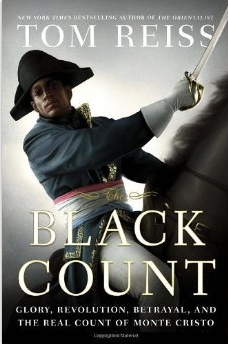
Day 484: The Black Count: Glory, Revolution, Betrayal, and the Real Count of Monte Cristo

Cover for The Black CountTom Reiss, previously the author of the fascinating biography The Orientalist, seems to be drawn to unusual figures who were famous in their own time but have become virtually unknown. Such is the case with Thomas-Alexandre Dumas—the father of the famous author of The Count of Monte Cristo, among other classics—who reached the heights of his fame as a great soldier and general of revolutionary France.

Dumas, who went by Alex rather than Alexandre or Thomas, had a colorful past. He was born on the island of Saint-Domingue (now Haiti), the son of a black slave and a French marquis, Antoine Davy de la Pailleterie. His father was a wastrel and a scoundrel who, although he apparently did not raise his son in slavery, sold him in order to raise the passage money for his own return to France after his family had thought him dead for years. After claiming his right to his title and property (which his relatives had been maintaining and improving for years at their own expense), Pailleterie redeemed his teenage son and brought him up in privilege.

However, shortly after entering manhood, Alex broke with his father, took his mother’s name, and proceeded to make his own way as a soldier. He was the first person of color to become a general-in-chief of the French army and was the highest ranking black officer in the western world of his time.

This book is an account of Dumas’ fascinating life, in which his physical courage, ability, and principled behavior won him acclaim. Unfortunately, he was not as gifted politically and inadvertently made an enemy of Napoleon Bonaparte, who perceived him as a rival and really comes off here as a jealous and power-hungry opportunist. Bonaparte’s resentment, in combination with an abrupt change in policy of the French government to remove the rights previously granted subjects of color, ended in the loss of his career and a death in neglect and poverty.

The book is written in an energetic and informal style for the general public, although it is copiously documented in the back. The Black Count is an engrossing story of an event-filled life.

Day 479: Jane Austen: A Life

Cover for Jane Austen: A LifeIn Jane Austen: A Life, noted biographer Claire Tomalin has handily accomplished a difficult task. Because most of Jane Austen’s letters and papers were destroyed by well-meaning relatives, very little first-hand information about her life is available. As a 19th century unmarried woman, her experience was circumscribed, so the events of her life are ordinary ones. Descriptions of a life like this could be thin and lifeless, but Tomalin manages to provide us with a biography that is full of interest and lively and creates a convincing idea of Austen’s character.

From records, letters, the remaining few of Austen’s papers, and accounts of her by relatives, friends, and neighbors, Tomalin reconstructs the story of not only Austen’s life but of those who were important to her. Tomalin acquaints us with the members of Austen’s family and the bustling environment in the Steventon Rectory, where Jane’s father ran a small boys’ school. She describes friendships and visits to neighboring families. Even though Austen never used her own neighborhood in her books, it is easy from them to imagine the daily social calls and the housewifely tasks with which she and her female relatives were engaged.

It is not too hard to imagine the relationship between Jane and her sister Cassandra as close to that of Lizzie and her sister Jane in Pride and Prejudice, although Tomalin never mentions that either of these characters were based on real people. Still, the two sisters were extremely close.

Unlike Lizzie and Jane, though, both Jane and Cassandra were disappointed in love, Cassandra because her fiancé died, and Jane because her suitor needed to marry a woman with money. Tomalin makes the points that a married Jane Austen would probably have been too busy or too distracted to produce a body of literature and that later in life she seemed to understand some of the benefits of remaining single. As to the first point, it is certainly true that being removed without warning and against her will from Steventon because of the retirement of her father, and her family’s failure to settle anywhere for ten years afterward, completely cut off Austen’s literary production for that time period.

It seems that Austen’s status as a spinster with no money of her own gave her no control at all in her life about such questions as where she would live and even in one case when she could return home from a family visit. That is, she had no control until her late thirties, when she began to publish her novels. Even then, she ultimately earned very little money from them but enough to give her a small amount of autonomy.

Although most of the events of Austen’s life were relatively small, Tomalin’s book provides an absorbing account. I did not always agree with her interpretations of Austen’s novels, but I feel that this book allows me to know Austen and her family and friends a little better.

Day 473: The Immortal Life of Henrietta Lacks

Cover for The Immortal Life of Henrietta LacksIn 1951 an African-American woman died of cervical cancer in the colored ward of Johns Hopkins, founded as a hospital for the poor. Her doctors had routinely removed cells from her unusually virulent cancer. The cancer was fast acting and when the woman died, her body was riddled with tumors. Her name was Henrietta Lacks, and her cells have been used ever since for research and experimentation, resulting in many medical breakthroughs.

At that time, scientists had been trying to find a way to preserve cells, but all their attempts failed. None of the cells lived more than a few days. At Johns Hopkins the staff used their usual method of attempted preservation for Henrietta’s cells with little hope of success. Henrietta’s healthy cells died like the others, but not only did the cancerous cells survive, they reproduced dramatically.

Henrietta’s cells helped solve a fundamental problem in biological and medical research, that of having a supply of human cells readily available for use in various experimental studies. George Gey, the head of the department, immediately began shipping them to any scientist who needed them. Henrietta’s cells, called HeLa, are known and used throughout the world.

In the meantime, the Lacks family was completely unaware that Henrietta’s cells were in use. An impoverished family of little education, they had difficulty understanding the use the cells were put to when they did learn about them, which wasn’t until 1973. Even at that time, researchers at Johns Hopkins took further samples from the family without their informed consent. Deborah Lacks, Henrietta’s daughter, understood them to be performing a test for cancer, not medically available at the time. Even though the removal of Henrietta’s cells was commonplace in the 1950’s and did not break any medical code of ethics, at the later time that further samples were taken from the family, this was certainly not the case.

In clear prose, Rebecca Skloot tells the story of Henrietta Lacks’ cells and their uses in the biomedical industry but also the story that has hitherto been neglected, that of Henrietta herself and her family. The book brings up issues of racial discrimination, medical ethics, and other issues in biomedical research, such as cell contamination. It also affectingly tells the story of the Lacks family.

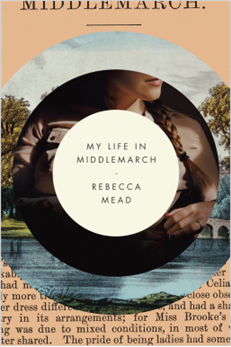
Day 461: My Life in Middlemarch

Cover for My Life in MiddlemarchMy Life in Middlemarch is a difficult book to categorize and an unusual effort. It is part memoir, part literary criticism, part literary history and biography, part thoughtful examination. Its focus is on George Eliot’s greatest novel, Middlemarch.

New Yorker writer Rebecca Mead muses about what the novel, her favorite as it is mine, has meant to her during different periods of her life, how different parts of the novel and different characters have spoken to her and how her sympathies with characters and comprehension of the novel’s themes have changed as her life was in its varying stages. She also examines events in Eliot’s own life—how they and the people she knew may have contributed to her works.

This book is about all things Middlemarch. Mead visits the towns and homes where Eliot resided and places where she may have set the novel. She reports on the ways that literary criticism of the novel changed over time—how it was immediately popular and then fell out of favor in later years to be rehabilitated, partially by the appreciation of Virginia Woolf. The book provides interesting insights into the novel and into Eliot’s life and possible thought processes as she wrote the novel.

http://www.netgalley.comFor those who have not read Middlemarch, the book still may hold some interest, but a lot will be lost. To those who have read and loved it, you will probably, like me, be compelled to pick it up again and reread it. I’ll be doing that soon.