Day 335: A Time of Gifts: On Foot to Constantinople: From the Hook of Holland to the Middle Danube

Cover for A Time of GiftsIn December 1933, nineteen-year-old Patrick Leigh Fermor set out alone on a great adventure, a walking trip from Amsterdam to Istanbul, or as Fermor still called it, Constantinople. (It was renamed in 1930.) He had no idea when he left that he would not return until 1937. In 1977, he collected his notebooks from the trip and wrote A Time of Gifts and its sequel Between the Woods and the Water.

Although Leigh Fermor had one notebook stolen from him with all the rest of his gear, he otherwise must have kept careful account and his memories of the trip must still have been vivid, for the result is an entrancing account of scenery and architecture, tales of chance encounters, glimpses of foreign customs and celebrations, and so on. Jan Morris, who wrote the introduction, calls him “one of the great prose stylists of our time,” and Wikipedia, quoting an unnamed British journalist, “a cross between Indiana Jones, James Bond and Graham Greene,” presumably for his work with the Cretan resistance in World War II as well as his writing. (He was also a friend of Ian Fleming.)

From his drinking bouts with Dutch barge men to his extended stays in various German, Austrian, and Czech castles, Leigh Fermor plunges enthusiastically into every experience on offer. At one moment he is sleeping in a barn, in the next hanging out with fashionable youth in Vienna. Along the banks of the Danube he is mistaken for a 50-year-old smuggler. All of these adventures as well as his observations of nature are described in beautiful, evocative prose. To add interest to the modern reader, he is describing a Europe that no longer exists.

If I have any complaint, it is one of my own education, for Leigh Fermor’s writing assumes for his audience a familiarity with classical culture that is no longer common. The book often alludes to mythology and refers to obscure historical events that I do not fully understand. Finally, in the footnotes, which are Leigh Fermor’s original ones, all utterances in modern languages (some of which I could have taken a stab at) are translated, but the quotations in Latin are not. They are not integral to comprehension, but it is a little frustrating to be unable to understand them. (Of course, I could have googled them, but I was almost always reading this on the bus.) That being said, I look forward to reading the sequel.

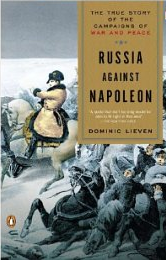
Day 292: Russia Against Napoleon: The True Story of the Campaigns of War and Peace

Cover for Russia Against NapoleonDominic Lieven explains in the introduction to Russia Against Napoleon that the popular conception of Russia’s role in the battles with Napoleon in 1812-14 is mostly derived from Tolstoy’s War and Peace. Tolstoy posited that the fate of Napoleon’s army was mostly a result of luck on the part of the Russians and the brutality of the Russian winter. Lieven also explains the reasons why most scholarship on this subject has been done from French, German, Austrian, or British records.

However, Lieven is able to convincingly show that the Russian victories, although of course partially due to luck, were mostly because of the understanding of Russia’s Emperor Alexander I and his field marshall, Mikhail Barclay de Tolly, of the kind of war Napoleon was good at and their refusal to give it to him. That is, Alexander and Barclay de Tolly planned from the beginning for a long, drawn-out war that would lure Napoleon deep into Russia, to be followed by a second campaign in Germany and France.

Lieven is a professor of history with the London School of Economics and an acknowledged expert on Russian history. Interestingly, he is also the descendent of three of the generals at the Battle of Leipzig.

Lieven’s book explains in the clearest terms the details of every campaign in those three years, taken from the Russian letters, diaries, and records that have not been readily available until recent years, as well as from the records of British observers and others of the combatants. He provides insight into the political jealousy and maneuverings and even to the details of staffing and provisioning the armies and maintaining the long supply lines needed when the Russian army entered western Europe.

Lieven’s analysis of war is comprehensive, and even though it is very detailed, it never seems to get bogged down in minutia. It introduces us to some colorful characters and vividly and suspensefully describes the battles.

The book’s only weakness for me was that it assumed a little more knowledge of the events immediately preceding these years than I had and knowledge also of the functions of the vast numbers of different types of troops. However, that lack of knowledge on my part did not really impede my understanding or detract from this very interesting history.

Day 284: The Big Short: Inside the Doomsday Machine

Cover for The Big ShortIn The Big Short, Michael Lewis, a former Wall Street bond trader and financial journalist turned author of best-selling nonfiction, explains what happened in the bond market from 2002 through 2008 that nearly destroyed the economy. He begins, however, a little earlier, with the first financial debacle involving the subprime mortgage market in the 1990’s that, once it was weathered, everyone assumed would not reoccur.

Let me start with a quick comment that I am not by any means knowledgeable in financial matters or even usually interested in them, so it’s possible my brief synopsis could have some mistakes, but this is my understanding.

The problem began with greedy subprime mortgage dealers lending money to people for houses they could not afford (and for which they would normally not qualify) using adjustable rate mortgages and balloon payments and sometimes requiring no down payment. That this money was loaned at all was a reflection of the profitability of this market, where deals were made and then put into packages with other deals and sold immediately to someone else.

Eventually, a few discerning traders and analysts who set out to understand the structure of some of these bonds realized that when the higher interest rates kicked in on the mortgages, or sometimes when the first payment was due, the home owners would default. They also realized that if enough of these bad mortgages were packaged together, the bonds encompassing these packages of subprime mortgage deals would default. Once they could find no serious difficulties with their reasoning, these few traders decided to bet against–or short–these bonds.

A disturbing feeding frenzy went on among traders who did not understand how risky these packages were. And those that did not understand the packages included the rating agencies, like Standard and Poor’s, who apparently made no effort to understand them. In fact, the bond traders willfully convinced the rating agencies to rate bond packages almost completely composed of these bad mortgages as triple A.

The book is full of colorful characters and stories that lend interest to the descriptions of the financial details. I occasionally had problems grasping the details of what was going on, but by and large, Lewis has explained this disaster in a way that is eminently readable and incredibly scary. If you have any illusions about the morals of the people running our financial institutions before you start reading, prepare to give them up.

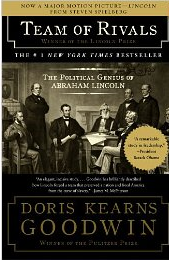
Day 260: Team of Rivals: The Political Genius of Abraham Lincoln

Cover for Team of RivalsBest Book of the Week!

Doris Kearns Goodwin begins her examination of Lincoln’s administration by remarking that because so much has been written about him, everything might be thought to have been said. However, by examining his career in terms of the team he put together to run the country, she found much more to write about.

This team consisted of his rivals in politics. Edwin Stanton, who treated Lincoln with contempt on their first meeting and who Lincoln made Secretary of War, was griefstricken at Lincoln’s death. Salmon P. Chase, eternally Lincoln’s rival for the presidency and a frequent undercutter, was an extremely competent Secretary of the Treasury. William H. Seward, the favorite for the Republican presidential nomination that Lincoln won, was at first inclined to underestimate Lincoln but became his closest friend and advisor as Secretary of State. Edward Bates, the Attorney General, was a homebody who was not sure he wanted a public life and at first looked upon Lincoln as well-meaning but incompetent, but ended up thinking he was very nearly perfect.

Team of Rivals begins on the day of the Republican convention of 1860, in which, of the rivals who had some expectation of winning the nomination of the party, Lincoln would seem to have the least. Seward was the odds-on favorite, but he had made many enemies in the party. Chase’s overwhelming ambition for the presidency lead him on several occasions to ignore the warning signs that he would not be the nominee. Bates was willing to act if nominated but made no extraordinary efforts because he preferred his home life.

Goodwin’s narrative then turns farther into the past to trace the men’s respective careers. In this examination she shows how Lincoln cleverly set himself up to be everyone’s second choice for the Republican nomination.

The book follows Lincoln’s nomination, campaign, and stunning victory, but the bulk of it concerns the compelling story of how he put together a cabinet containing these men, who were not only rivals for the office but who were from different regions of the country and who had different views on the important issues of the day. He then managed to work with these men and run the country during one of its most difficult times. It was frequently rumored that Seward actually held the power, but Goodwin shows us that Lincoln was always in charge.

Through an examination of the diaries of the men, letters, and other sources, Goodwin provides us with the fascinating details of political machinations, the conduct of the war, the fights among the generals, the alliances and friendships, and the story of how several men, who began with no esteem of Lincoln at all, grew to respect and love him.

Goodwin’s book is one of the most absorbing history books I have read. Although it is long and takes awhile to read, it explains each issue in completely lucid terms and interesting detail. The most important thing I got from the book was a fuller understanding of Lincoln’s greatness, his humor, kindness, and magnanimity–and what a disaster for the country his death was.

Day 245: Unbroken: A World War II Story of Survival, Resilience, and Redemption

Cover for UnbrokenUnbroken is the incredible story of Louis Zamperini, an Olympic runner whose plane went down in the Pacific during World War II. He and his pilot Phil (Russell Allen Phillips) survived many days on a small raft only to be captured by the Japanese and interred in a series of brutal POW camps.

The book begins with Zamperini’s childhood in California as an almost feral creature who was always in trouble for stealing and other mischief. His unconquerable spirit served him well through his travails in adulthood but caused problems for his parents and himself when he was a child. His unruly years were ended, or at least subdued, by his brother Pete’s interest in training him as a runner, as he had always been the kid who ran away from his pranks the fastest. Once Louie began to take the sport seriously, he became a very fast runner and began winning medals. Although he only finished 8th at the 1936 Olympics, he ran his last lap in 56 seconds, and his dream was to return to the Olympics and medal.

After Pearl Harbor Louie became a bombadier and made many flights in dangerous and ill-equipped planes until his B-24, known as a lemon, went down during a search for another missing plane. I was particularly surprised at how unsafe the planes were and how ill-equipped the men were when their plane went down. Their raft contained only some chocolate and a few flares, and its repair kit pieces were ruined because they weren’t kept in a waterproof envelope. The three men who survived the crash had no equipment to make drinking water from sea water and were reduced to attempting to catch rain water. They had no food except the chocolate (which one of the men ate the first night). Braving strafing by a Japanese plane, shark attacks, dehydration, starvation, and a typhoon, Louie and Phil survived more than 40 days at sea. The other man died.

Their raft landed on an atoll in the Marshall Islands, where they were immediately captured by the Japanese. At first treated kindly, once they were transferred to POW camps, they encountered unbelievable brutality. Aside from being routinely starved–while Red Cross shipments intended for them were stolen by the Japanese–they were forced into hard labor and regularly beaten. Louie in particular because of his ungovernable nature became the scapegoat of an insane, brutal guard named Mutsuhiro Watanabe.

About half of this book is devoted to the men’s experiences in the camps, with the focus on Louie after he and Phil were separated. Eventually, though, the men were saved with the end of the war. The rest of the book related Louie’s trials with PTSD and alcoholism and how he overcame those problems to live a productive life. The book ends with his accomplishments even in an active old age, including carrying the torch at the 1988 Olympics in Nagano on his 81st birthday.

Overall, this is an interesting book, but I found the descriptions of the brutality at the camps overwhelming. Although I am not squeamish by any means, I kept reading a few sentences only to have to put the book down. I read it for a book club, and the other members reported having the same difficulty, even skipping over complete sections. The writing was excellent–Laura Hillenbrand’s Seabiscuit is a favorite–and the story compelling, but the details difficult to absorb.

Day 237: Neverland: J.M. Barrie, the du Mauriers, and the Dark Side of Peter Pan

Cover for NeverlandDuring the past year I read Margaret Forsters’ biography of Daphne du Maurier, and I find that Neverland makes a fascinating contrast with it. Piers Dudgeon traces the history of the du Maurier family and speculates how their relationships with J.M. Barrie, the author of Peter Pan, adversely affected them. Several members of the family were indeed disturbed, but the question is, how much, if anything, did that have to do with Barrie?

Dudgeon paints Barrie as a sociopath without exactly calling him one. Barrie grew up unloved by his hypochondriac mother, who took to her bed with the death at fourteen of her favorite son David. Barrie was six at the time and was never able to attract much of her attention, even resorting to dressing up as his brother and imitating him to try to get her to love him. This behavior is indeed bizarre, but Dudgeon makes the first leap by alleging that Barrie must have somehow caused his brother’s death to have been so neglected.

The early life of George du Maurier is not similarly examined (George being Daphne du Maurier’s grandfather); instead, Dudgeon zeroes in on du Maurier’s experiences as a young bohemian in Paris. Du Maurier is best known as the author of Trilby, a novel in which Svengali takes over the life of a young woman by means of hypnosis and eventually ruins her. This novel is based at least in part on the experiments of du Maurier and a group of friends during which they repeatedly hypnotized a young artist’s model. Du Maurier apparently regretted this episode in later life, although he did not give up “mesmerism,” and what he called “dreaming true” (self-hypnosis) until he married, and he later returned to his experiments.

Dudgeon uses this background to weave the theory that Barrie–who admired du Maurier’s first book, Peter Ibbetson, a story about a man who can escape the bounds of space and time by “dreaming true”–was somehow rejected by du Maurier and took his revenge by purposefully befriending and dominating members of du Maurier’s family, causing changes in their behavior. There is actually no proof that du Maurier and Barrie ever met, although Barrie certainly befriended Sylvia Llewellyn Davies, George’s daughter, and her children. It is also clear that he “stole” her children. Both Sylvia and her husband Arthur died when the boys were quite young, and Barrie copied the letter that Sylvia wrote during her last illness requesting the children’s nanny and her sister Jenny to take charge of the children, changing “Jenny” to “Jimmy,” and thereby co-opting the children. Oddly, none of the du Mauriers seems to have objected to that, to which Dudgeon ascribes more sinister goings-on. Of those boys, only one seemed not to be at all disturbed by their upbringing with Barrie.

Modern minds will think sexual abuse, of which there are indeed some indications, but Dudgeon thinks Satanism, if that’s not an exaggeration. And here we get to Peter Pan, who was not intended to be everyone’s picture of innocent, irresponsible boyhood, but who Barrie intended to be a villain, a Pan or “demon boy” figure, a pixie who stole other people’s children, who hated mothers, and who killed without compunction. Barrie was good at hiding the antisocial nature of his work behind saccharine sentiments, but this depiction is indeed what he intended, and Dudgeon of course sees Peter Pan as a self portrait of Barrie.

Dudgeon presents a great deal of information about the various fates of the Llewellyn Davies boys, but he spends his final chapters on Daphne du Maurier, their cousin. Margaret Forster’s view is that du Maurier’s tendencies toward homosexuality (borne out by some affairs and statements by du Maurier herself) and possible affair with her own father colored her life and affected her relationships with her husband and children–that and an appalling degree of selfishness. But Dudgeon doesn’t think she was homosexual at all. He believes that she and her father Gerald, a well-known actor who appeared in several Barrie plays, were so overshadowed by Barrie that her “demon boy” self came out in adolescence and dominated most of her life, until she suffered a breakdown in her 50’s.

I am not criticizing this book for lack of interest–it is indeed engrossing. But Dudgeon hangs a great deal too much of his tale on the assumption that most of Barrie’s and both the du Mauriers’ writings were autobiographical in some way. Even if they were, many of the quoted passages can be interpreted in more than one way. Barrie’s submersion of the children into a fantasy life certainly doesn’t seem to have been good for them, and as I said before, there is some indication in his own writings of the possibility of child sexual abuse, but I don’t know what else can be said with authority.

Day 222: The Hare with Amber Eyes: A Hidden Inheritance

Cover for The Hare with Amber EyesBest Book of the Week!

In 1994, the world-class ceramics artist Edmund de Waal inherited a collection of 264 netsuke from his great uncle Ignace (Iggie). De Waal decided to trace the history of the netsuke from the time they came into his family, and in doing so, to trace the history of the family itself and the times they lived in. The result is a fascinating combination of memoir, history, art history, and collection of musings on related topics, The Hare with Amber Eyes.

Charles Ephrussi originally purchased the netsuke in Paris during the second half of the nineteenth century. The Ephrussis were at that time a wealthy family of bankers, originally from Odessa, who in previous generations had expanded their offices to Vienna and from there to Paris. Charles Ephrussi was not a banker but a noted art collector and critic, friend of Impressionists such as Degas and Manet, and one of the two models Proust used for his character Charles Swann.

De Waal attempts to understand Charles through an examination of his writings and possessions and through events in his time, particularly the effect of the Dreyfuss case on antisemitism in France. Charles’s work in art was an important part of his life, and in this section of the book I was struck by the connection de Waal makes between Japonisme–the interest in and collection of Japanese artifacts, with their focus on nature and everyday life–and the rise of Impressionism, which was considered revolutionary partly because of its focus on nature and everyday life instead of “noble” subject matter such as historical scenes or stories from the Bible or mythology.

In 1899, Charles sent the netsuke to Vienna as a wedding present for his younger cousin Viktor Ephrussi, de Waal’s great grandfather and eventual head of the Ephrussi bank in Vienna. De Waal traced what he could of the life of Viktor and his family, this story culminating shortly after the dual terrors of the Anschluss and Kristalnacht. During this time, everything that this branch of the family owned was confiscated by the Gestapo. In these pages of the book, de Waal does a better job of conveying the fears and anxieties of those times than any of the recent books I have read.

De Waal’s grandmother Elisabeth recovered the netsuke after the war. How they returned to the family is an incredible story that I will not reveal. Shortly after she returned to England with them, where some of the family had made their home, they traveled to post-war Japan with de Waal’s great uncle Iggie.

I have just supplied the barest outline of the fate of the netsuke, which provides a focus for de Waal’s investigations and musings, but the family’s story and the story of their times is fascinating and imaginatively reconstructed. The book is at once a meditation on and enthralling depiction of the life and times of an extraordinary family.

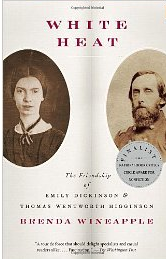
Day 210: White Heat: The Friendship of Emily Dickinson and Thomas Wentworth Higginson

Cover for White HeatBest Book of the Week!

White Heat is an unusual biography that focuses on the friendship between Emily Dickinson and Thomas Wentworth Higginson. The book is unusual because so little is known of the daily life of Dickinson and much is known of that of Higginson. Brenda Wineapple has pieced together the story of their relationship from what is left of letters (Higginson’s to Dickinson were destroyed with much of Dickinson’s correspondence, but there are letters to others) and from poems sent to Higginson by Dickinson. Wineapple is the author of an admired biography of Nathaniel Hawthorne.

Their relationship was almost entirely in letters. By the time they began their correspondence, Higginson was a well-known writer of essays on nature and politics but was even better known as an ardent and radical abolitionist and advocate of women’s suffrage. He ran guns to Kansas during the free soil days and helped encourage many women poets and got them published. Later, he formed the first African-American regiment in the Civil War. On the other hand, Dickinson had published one or two poems and frankly didn’t seem much interested in publishing more, but preferred to send them off to friends. She remained obscure and unknown, in her later years not even leaving the grounds of her father’s house in Amherst.

Dickinson initiated the correspondence by sending Higginson a flattering letter containing a few poems and asking him to be her preceptor–to tell her if her poems “sing” and to give her advice. Of course, she knew her poems sang and apparently had no intention of taking his advice, so it can be assumed that she wrote hoping to start a correspondence.

Although Higginson has been criticized as too conservative in his poetic tastes and as a bungler for his role in Dickinson’s legacy, part of Wineapple’s purpose is to rehabilitate his reputation, for he was in his own time a brave man of principle whose poetic instincts far surpassed his own abilities as a writer. He found Dickinson’s poetry both shocking in its unconventionality, especially of form, and breathtaking in its beauty.

The two remained friends for the rest of Dickinson’s life, although they only actually met twice. Their letters were sometimes flirtatious, but Wineapple convincingly suggests that most likely neither of them had any intentions beyond friendship and esteem. Higginson was married to a lifelong invalid and seemed to be too upright to consider the idea of dalliance. When his wife Mary died, he shortly remarried a younger woman in the hopes of finally having a family. Later, Dickinson became enamored with and probably engaged to a much older man who unfortunately died.

One purpose of Wineapple’s book is to show what actually happened to Dickinson’s poems after her death, when they were published in two volumes in an edited form, with grammatical, punctuation, and even wording changes by Higginson and Mabel Todd. Higginson has been excoriated for this, but Wineapple suggests that Todd did most of the editing, some of which Higginson strenuously objected to. Certainly Todd alone released a third volume of poetry that was even more heavily edited. Higginson seemed unaware that Todd was handling Dickinson’s poems (with her sister’s permission) as an act of both self-aggrandisement and of petty revenge against Sue Dickinson, Emily’s good friend and sister-in-law, and the wife of Todd’s lover.

Wineapple’s biography is engrossing and occasionally poetic in its own right. It is an excellent analysis of this unusual friendship.

Day 197: The Adventure of English: The Biography of a Language

Cover for The Adventure of EnglishThe Adventure of English: The Biography of a Language is a history of the English language written for the general public. The author, writer and television personality Melvyn Bragg, has been responsible for some acclaimed television shows on the subject in England.

The book takes us from the introduction of English (or rather, the languages that would become English) into Britain with the invasions of the Angles and Jutes up to modern times and the versions of English spoken around the world. Bragg explains how English pushed other languages, liked Celtic, to the brink of extinction, and how numerous times the language has been threated by extinction itself, most particularly with the Norman invasion. The Normans spoke French among themselves and enforced its use at court and for all matters of legal business, a condition that lasted for centuries and posed a real threat for the survival of English. However, eventually the Norman kings began thinking of themselves more as Englishmen than Frenchmen and using English for business, starting with Henry V.

The book provides many interesting factoids, such as, that of all languages, Old English was most closely related to Frisian, still spoken by some people in the Low Countries. The explanation of how the British developed such extremely varied regional dialects (much more distinct from each other than American dialects) from the settlement and isolation of different peoples and tribes in different regions is interesting, especially the tale of how a man from rural Cumberland was able to communicate with Icelanders during World War II because of it.

However, the book contains some real irritants. One is the relentless personification of the language as a metaphor throughout the book. English is always gobbling up other languages or fighting them off. Another is the spin put on some of the information. For example, when the Catholic Church insisted on exclusive use of Latin and made translation of the Bible into other languages a heresy, it wasn’t seeking explicitly to destroy English but was rather protecting its priestly prerogatives. If priests weren’t needed to translate and interpret the Bible to their flocks, what would be their purpose? Of course, Bragg explains this, but he implies that the decision was a purposeful attempt to destroy English.

The lack of authority for some of Bragg’s statements is certainly a weakness throughout the book. There were times when I, with my little knowledge, thought he may have misrepresented or put a spin on some facts, but until I finished the book, I was assuming Bragg was a linguist, so I just thought that I was wrong. Now I’m not so sure.

Finally, although the TV series was probably very good, the book’s roots in television show too clearly in the shallowness of the approach. Some chapters, for example, are almost nothing but lists of words with a few paragraphs in between. Overall, although I learned a few interesting facts, I was disappointed.

Day 190: Open: An Autobiography

Cover for OpenBest Book of the Week!

Those of you who know me will probably be surprised to see the review of a sports biography on my blog. I will freely admit that this is not a book I would have chosen for myself; instead, it was a choice of my book club. That being said, I found Open: An Autobiography by Andre Agassi to be extremely interesting and even touching.

In making notes for my review, though, I came across another problem–how to review a biography of a living, well-known figure except by relating some of its disclosures. For some assistance on this, I took a peek at the review in the New York Times, but they obviously had the same problem. However, a phrase in that review caught my attention. The reviewer remarked that from the first time Agassi first appeared in the sport, he looked like a deer in the headlights. Now, look at the picture of him from the cover of the book.

This expression is a lead-in to a story about a sad, sad boy who seems to have finally grown up into a mostly happy, contented man. His big secret, which by now everyone knows, is that this athlete, who is considered one of the best tennis players in the world, ever, has always hated tennis. He was forced into the game as a young boy by his fiercely competitive (and I would say, although he never does, abusive) father, a former Olympic boxer who never succeeded professionally but was trying to live his life through his son.

His fate was so predetermined that his father gave him a tennis racket to hold in his cradle, and when as a boy he found he preferred soccer because of the camraderie (he frequently remarks on how lonely a sport tennis is), his father made him quit so he could spend more time on tennis. The vision of Agassi as a small boy facing the machine his father had rigged to fire thousands of tennis balls at him at an unbelievable speed is a chilling one.

I was particularly outraged by the attitude of his father and other adults toward his schooling. Agassi is clearly an intelligent person. He can remember, literally, everything, but as he explains in the book, except in English class he had difficulty grasping concepts. He had to have them explained to him a few times, and then he could remember them. When you watch his farewell speech at the 2009 U.S. Open or any of his speeches about his charter schools, you can see that he is a thoughtful, reasoned, even eloquent speaker who does not need notes. I am guessing that he may have had some sort of learning disability.

I feel so sorry for a boy who needed help with his lessons instead of a father who regularly had him skip school to play more tennis. Later he was sent to a tennis training school at the age of 14 (a school that sometimes sounds like something from Dickens and other times like Lord of the Flies), from which he was allowed to drop out of school to pursue, you guessed it, more tennis. This “preparation” gave him no other recourse–he was forced to follow a career in tennis because he had no other prospects and couldn’t do anything else.

Open is about Agassi learning to grow up and make peace with himself. It is terrifically engrossing, and his descriptions of some of the games made me wish that I had seen them. (Actually, I watched some of them on YouTube.) He avoids any kind of self-aggrandisement. In fact, as the title says, he is open for the first time in his life. Although he expresses himself honestly, he does not use the occasion of writing this memoir to slam other people or tell anyone’s secrets but his own. His depiction of certain other well-known figures (for example, his marriage to Brooke Shields and his rivalry with Pete Sampras) is balanced, and it seems, fair. Finally, I found it touching to see how a person who grew up in such a harsh environment would turn out to be so caring of others.