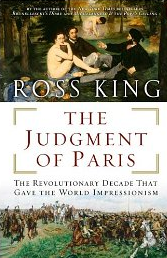
Day 123: The Judgment of Paris

Cover for The Judgment of ParisThe Judgment of Paris: The Revolutionary Decade That Gave the World Impressionism is Ross King’s account of the art and politics of the decade beginning in 1863 and ending in 1874 with the first Impressionist show. The book follows the lives and careers of several significant French artists in the years leading up to the introduction of what was eventually called “Impressionism.”

At that time in France, artists were taught that the proper subjects for art were scenes from history, mythology, or the Bible. The “best” paintings observed the minutest of details, colors were muted, and the surface of the painting was smooth so that brush marks could not be distinguished.

Although the book touches upon the careers of many artists, in particular it follows the fortunes of two–Ernest Meissonier, who was considered one of the greatest artists of his time and was certainly the highest paid, and Edouard Manet, an unofficial representative for the younger painters. Meissonier progressed from painting small, very detailed scenes from the 17th or 18th Century of “goodfellows” in ordinary domestic scenes, such as playing chess or smoking, to huge  historical paintings, several of events in Napoleon’s career. The younger painters were more interested in depicting scenes from modern life. At that time they were called Realists, not for their painting style but for their subject matter.

The book begins with the preparations for the Paris Salon of 1863. The Salon was the most important art show of its time, almost essential to getting an artist’s work viewed. King explains how changes in the rules affecting how the jury was selected resulted in most of the landscape painters and those with less traditional approaches being shut out of the show. So many artists were excluded and the outcry was so great that Emperor Louis-Napoleon authorized a second exhibition called the Salon des Refusés to show the paintings refused by the jury. Ross continues on from there to show how the new art moved slowly from the scorn and derision of the artistic community to acceptance and admiration. I was particularly surprised to find that the first place this new way of looking at the world was accepted was not France, but the United States.

King’s explication of the prejudices and politics surrounding the evolution of new approaches to painting is extremely interesting, as is his corollary discussion of the reign of Napoleon III, the disastrous Franco-Prussian War, and the subsequent shifts in the government of France, and how all this had its effect on the acceptance of the new art.
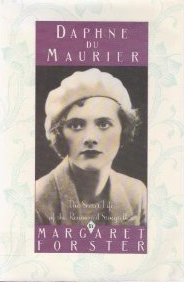
Day 119: Daphne Du Maurier: The Secret Life of the Renowned Storyteller

Cover for Daphne Du MaurierI have enjoyed reading Daphne Du Maurier’s books for many years, so I was interested to come across this biography by Margaret Forster. The main revelation of the biography is that Du Maurier struggled with bisexual and homosexual feelings all her life and always thought she was putting on a show of a normal life. She explained to others that she was two people, one with a female side–wife and mother–and the other with a male side–lover–that was the fuel for her creative energy.

The book examines Du Maurier’s life and works in terms of these feelings and how they conflicted with her roles as a wife and a mother. In fact, she seemed at times extremely self-obsessed and stunningly unkind to her children when they were young, as she was cold and immersed in her work. She was also unkind to her husband when he returned from service in World War II. By that time, she was living in the home in Cornwall that she never wanted to leave. Her husband “Tommy” Browning was asked to serve the royal family, which he had to do from London. He was obviously lonely, but she refused to move there or even visit. Instead, he made the trip out there every weekend for years after his strenuous, lonely weeks working for the royals. Until he didn’t. She eventually divorced him and later remarried.

The book also tells about Du Maurier’s long-time affair with the actress Gertrude Lawrence and her attraction to Ellen Doubleday, the wife of her American publisher.

Du Maurier tended to hide herself in her Cornwell home while she was writing. Although she became more sociable as she aged and many people remembered her as a warm and funny hostess, she eventually ended up almost a recluse who was devoted to her own daily routines.

The biography is interesting and well written.

Day 114: A Walk in the Woods

Cover for A Walk in the WoodsIn A Walk in the Woods: Rediscovering America on the Appalachian Trail, Bill Bryson recounts his attempts to walk the Appalachian Trail. After living in England for years, Bryson has moved back to the States, and he decides to reacquaint himself with America and try to get into better shape by walking the trail. To his surprise, an old friend named Katz, a reformed drug user, decides to come along.

Bryson is an amusing writer. He mixes interesting facts about the trail and information about the environment with stories about who he and Katz meet and what happens to them. I was particularly struck by how two such mismatched companions not only did not kill each other but actually treated each other considerately.

The two out-of-shape and inexperienced hikers start out with far too much equipment and then as they continue, Katz begins throwing things out, including the food. It seems they make just about every mistake a couple of neophyte campers can make, except being eaten by bears.

They run out of time after walking a few hundred miles of the trail in the south, and Bryson’s attempts to finish the trail devolve to what he can accomplish by driving to different portions of it and hiking on long weekends. But the longer hike that the two of them take is the meat of the book.

A few people have criticized the book because Bryson didn’t actually manage to hike the entire length of the trail. I think they are missing the point of the book, which is about friendship, about the interesting things that happen on the trail, and the history of the trail itself. In fact, few people do manage to complete the entire length of the trail, from Maine all the way to Georgia.

Day 106: The Information: A History, A Theory, A Flood

Cover for The InformationRight up front I must admit that The Information is not my kind of reading. I persisted through this extremely long book but quit reading about 100 pages from the end. One review says the book is better if it is savored, which is exactly what I was not inclined to do.

Science writer James Gleick’s book is a comprehensive history of information and information theory. His thesis has to do with how people’s relationship to information has changed the nature of human consciousness.

Some of the book is very interesting, especially at the beginning when the ideas people are investigating seem more concrete, but it more often deals with subjects that are too obscure to interest me. On at least one occasion, he clearly misunderstands a concept or at least explains it carelessly, and the New York Times review points out another occasion. (Unfortunately, when writing up the notes for this review, before I started this blog, I did not specify to myself which concept.)

Another criticism is that Gleick does not appear to have decided who he is writing for. At some points he does a masterful job of explaining complex ideas, seeming to address an audience of ordinary people like me, while at other times he presents ideas without really explaining them or alleges concepts to be truths without showing that they are, as if he were addressing a more knowledgeable audience. A review by Nicholas Carr, although much more positive than mine, also points this out, saying that Gleick’s powers of explanation break down the closer he gets to the present, particularly in his explanations of quantum mechanics. This is precisely where he lost me.

But really, my problem boils down to a personal dislike of philosophy and abstruse theory. I couldn’t at times stop myself from wondering why anyone would spend time thinking about some of the things Gleick explained. They are too esoteric to interest me. Or perhaps it is the fault of the presentation, since I have enjoyed books before on topics that I would normally assume held no inherent interest for me, Fermat’s Enigma by Simon Singh being an example.

However, if this topic sounds interesting, you may find you enjoy the book much more than I did.

Day 102: Who Murdered Chaucer? A Medieval Mystery

Cover to Who Murdered ChaucerIt is an accepted interpretation of history that Richard II was a weak, dissolute ruler who was hated by the English people. But Who Murdered Chaucer? A Medieval Mystery makes a plausible case for the truth having been rewritten by the victors after Richard was deposed.

The version of events that has been accepted for centuries is that Henry IV saved the English kingdom by overthrowing the corrupt Richard II at the urging of the populace. Authors Terry Jones, Robert Yeager, Alan Fletcher, Juliette Dor, and Terry Dolan provide plausible evidence that Richard was neither unpopular nor weak, but that he was a relatively enlightened monarch–a patron of the arts and an advocate for the new fashion of authors writing in their own languages instead of in Latin–and that he permitted criticism of the church.

However, his rule was periodically threatened by several of the more conservative members of nobility and the church, including especially Thomas Arundel, the younger brother of the Earl of Arundel. Richard eventually had to banish some of them, including Arundel, and others were killed. The end of Richard II’s reign actually came later when he felt secure enough to travel to Ireland.

As the result of a proposed duel, Richard also banished Henry of Bolingbroke, the son of John of Gaunt. Henry was considered the consumate knight and was admired throughout the kingdom. Richard seemed to be fond of him and probably considered him his heir. Henry’s dispute with Thomas de Mowbray resulted in charges of treason, and they were both banished. Henry was banished for 10 years, but Jones et al. find plausible indications that Richard had an agreement to allow Henry back early. One was that Richard initially did not take Henry’s property, as was usual.

But Henry met with Arundel on his European travels, despite strict injunctions not to have dealings with him. The two plotted to overthrow Richard, attacking England when he was away in Ireland with his army. Henry won and became Henry IV, treating Richard shamefully. No one was sure what happened to him, except that he was dead. (Henry’s own son, after he became Henry V, had Richard’s bones brought to Westminster to be buried.)

The book shows that Henry relentlessly rooted out records that were approving of Richard, even implicitly, or that were negative to himself. He assiduously promoted propaganda alleging that Richard was hated, weak, and dissolute. He gave Arundel free reign, as Archbishop of Canterbury, to burn heretics for the first time in England and to set his own criteria for judging heretics. In short, he instituted a reign of terror.

What does this have to do with Chaucer? This shift in power left him very vulnerable. His works under Richard II had criticized the very things about the church that Arundel considered to be heresy. Chaucer disappears from the historical record right around 1400, about a year after Richard was deposed.

The book makes a shakier case that Arundel either caused Chaucer’s death, possibly in imprisonment, or paid to have him killed. There is no evidence of this, of course; the authors’ conclusions are drawn from things that happened to other writers, from some vague accounting records, and from hazy interpretations of some of Chaucer’s work. Although I feel that they have certainly pointed toward some possibilities, even they admit that it is unlikely anyone will know the truth.

The book is easy to follow and amusing at times. It is beautifully illustrated with pictures from illuminated manuscripts. The political and historical theories about Richard’s and Henry’s reigns are very interesting. However, I believe the book falls off a bit at the end when it settles down to examining the story of Chaucer’s end, especially when it resorts to interpreting Chaucer’s poetry.

Day 97: The Mystery of Lewis Carroll

Cover for The Mystery of Lewis CarrollThe Mystery of Lewis Carroll: Discovering the Whimsical, Thoughtful, and Sometimes Lonely Man Who Created “Alice in Wonderland” examines modern ideas about Charles Dodgson (Lewis Carroll) and attempts to debunk them. Jenny Woolf does a good job of providing evidence that his friendships with children, rather than being pedophilic tendencies as is interpreted today, were regarded by Victorians as innocent and probably were innocent. She also shows that the modern interpretation of his pictures of nude children was not one held by people of his own time, and that they regarded this pastime and the resulting pictures as harmless because children were considered innocent.

In fact, Woolf provides evidence that his friendships with young women were much more subject to question and talk. She posits that he cultivated a persona of being older than he actually was so that they would not be questioned, even though these relationships were almost certainly innocent as well.

Woolf depicts the Reverend Dodgson as a sensitive, artistic man who cared for his family and loved entertaining children. His position at Oxford did not at that time allow him to marry. A number of years during the time he was a young man are missing from his diaries and he refers to feelings of guilt in later entries, leading Woolf to conclude that something happened, possibly with a woman, that he regretted. Her theory is that he cultivated relationships with young girls as a return to innocence.

The book is interesting, but with a caveat. It is very short, almost shorter than the subtitle, but Woolf is so focused on one or two ideas that it often seems repetitive. A good deal of information about Carroll’s life is missing because he or his relatives removed pages from his diaries and his relatives destroyed a great deal of material after he died. Although this has often been interpreted as the family’s attempt to hide nasty secrets, Woolf is not convinced that there was much to hide. She blames a good deal of the current perception of Carroll on the initial emergence and misapplication of certain theories of psychology in the infancy of the science.

Day 93: The Johnstown Flood

Cover for The Johnstown FloodOn May 31, 1889, the dam above Johnstown, Pennsylvania, broke, sending a wall of water and debris down the mountain to the bustling steel town. It wiped away small towns on the way down and smashed into Johnstown, destroying the town and killing more than 2,000 people. It was the biggest tragedy in America to that time and became a national scandal.

The Johnstown Flood is David McCullough’s enthralling account of the tragedy, its causes and outcomes. Although the dam was originally well built, it was repaired when the property above Johnstown was purchased by a group of wealthy industrialists, among them Andrew Carnegie and Andrew Mellon, to create a private resort. The repair work was not done by qualified people and several warnings about the state of the dam and the danger for the communities downstream had been ignored by resort managers.

The book related the events leading up to the disaster and tells the personal stories of many of the survivors. It discusses the relief efforts and lawsuits that followed and explains the outcomes for the survivors. The book is extremely well written and guaranteed to keep you riveted.

Day 89: The Wars of the Roses

Cover for The Wars of the RosesThe Wars of the Roses were a series of complex events involving numerous significant figures. As such, when I have previously read about them, I’ve found it confusing to keep track of events and people.

In The Wars of the Roses: Through the Lives of Five Men and Women of the Fifteenth Century, Desmond Seward presents the clearest and most interesting explication I have read. He organizes the material and infuses interest by following the effects of the wars on five people–William Hastings, Edward IV’s best friend and one of the most powerful men in the realm during his (Yorkist) reign; John de Vere, Earl of Oxford, head of an ancient family and a loyal Lancastrian; Lady Margaret Beaufort, Henry Tudor’s mother; Dr. John Morton, a loyal Lancastrian clergyman who turned Yorkist; and Jane Shore, mistress of Edward IV and daughter of a successful London businessman.

A series of battles between rival factions of the Plantagenet family for the throne, the Wars of the Roses lasted 32 years. The roots of the dispute lay in Henry IV’s usurpation of the crown from Richard II years before. Henry IV and his son, Henry V, were strong rulers, but Henry V’s heir, Henry VI, succeeded at the age of 15. He proved a weak and ineffective ruler who was dominated by his favorites and his wife’s rapacious relatives. Henry also managed to lose the portion of France that his father had so arduously and expensively won back, and England’s state of law and order had almost completely broken down.

The shift in government began when Henry VI had a son who replaced Edward Duke of York (later to be Edward IV) as heir to the throne. This made Edward’s position precarious and he had to flee to Europe. His subsequent battles against Henry’s adherents were only the beginning of years of instability that resulted in the end of the Plantagenet dynasty and the beginning of that of the Tudors.

History can be written with too much detail or in a too academic and dry style, or it can be so lightly researched as to seem like fluff. Seward hits the perfect balance with a terrifically interesting book that is wonderfully well written.

Day 83: Travels in Siberia

Cover for Travels in SiberiaIn Travels in Siberia, Ian Frazier relates the incidents and observations of several trips to Siberia over the course of 10 or so years. Frazier explains his fascination with Siberia as a sort of embarrassing infection and makes repeated trips to visit it, first crossing the Bering Strait, then traveling along the entire breadth of the region from the west to the Pacific, and finally journeying from Yakutsk to the “coldest place on earth outside Antarctica.” In doing so, he tells us about what happens to him and relates a lot of interesting history and facts.

The book is quirky and not what you would expect from a travelogue. For one thing, he seems strangely reluctant to take part in the adventure himself but often sits aside. He is sometimes an insensitive traveller–he often stays apart from his guides; he is not always grateful or gracious to his hosts, refusing to drink any vodka; insisting on viewing things that his Russian guide would rather avoid, to the point of rudeness (although maybe you had to do that in Soviet times); and actually treating his principal Russian guide at times as a menial when I believe he is a university professor trying to earn extra money.

Another fault of the book from my own point of view is that he often concentrates on his own philosophical musings. I am much more interested in the sights and people of the area. Frankly, he often doesn’t seem very interested in interacting with the people, even though he has the opportunity for some unique experiences, for example, being stopped along the highway by a wedding party and invited to attend the wedding (and contribute money to the bride and groom). This could have been an entertaining social occasion but he seems to view it more as a delay. He also sticks pretty much to the highways instead of investigating any of the byways and wilderness parks.

The book contains no photographs, but it has quite a few good little drawings that Frazier made of what he saw, like the one on the cover. It is most interesting when it is reporting the results of his research rather than his travels, however. Travels in Siberia is written about a fascinating subject, but I couldn’t help feeling that Frazier was almost the wrong person to make the trips!

Day 79: A Mountain of Crumbs

Cover for A Mountain of CrumbsIn A Mountain of Crumbs, Elena Gorokhova has written an engrossing memoir about growing up in Soviet Russia during the Cold War. What makes it most interesting, besides the details of life in such a different environment from our own, is how, while misunderstanding many things about Western culture and not being brought up with an accurate understanding of history, even of her own country, she still learns to doubt what she is taught.

Gorokhova’s upbringing is fairly ordinary, although she is both slightly privileged (her family has its own two-room apartment instead of sharing with other families) and disadvantaged (she has to earn her own way by merit since she is not the child of a peasant). However, from an early age her interest in learning English makes her fascinated with the world outside the Soviet Union. At the same time, her cynicism and disillusionment with her country grows.

Most of the book is about Gorokhova’s inability to live in lock-step, both with the state and with her own mother, so that she always feels like she is lying. As she says, “they (the state) lie to us, we know they’re lying, they know we know.”

The book is beautifully written in the first person as if Gorokhova is currently of that particular age rather than as if she were recalling her memories. (For example, when she is telling about when she is five, she narrates it as if she is five.) I can’t completely accept this style of narration for sections about her childhood, because the thoughts she claims to have are too sophisticated for a small child. In particular, I am struck by one comment she makes about thinking something is ironic. Five-year-old children don’t have thoughts about irony–it’s hard enough to get teenagers to understand what it is. However, the same narrative style works very well when she recalls her thoughts as an older child and young adult.

(As a side note, I have to contrast the chapters narrated by herself as a child with Jennifer Lauck’s wonderful memoir Blackbird, which at the beginning employs a narrative style that is absolutely convincing as the thoughts of a small child, allowing the reader to understand things that the child Jennifer doesn’t.)

I have one frustration with the book. Gorokhova describes so many misunderstandings about American life and so much anticipation and anxiety about going to live in the States that I would have liked a chapter about what it was like when she finally arrived. Instead, the book ends as she leaves Russia and contains a short epilogue about her life more than 20 years later.