Day 71: Thinking, Fast and Slow

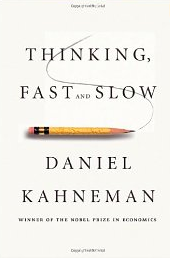
Cover for Thinking, Fast and SlowEarly in his career, Daniel Kahneman got interesting in why people, even experts, do not seem to use statistics and follow economic models in making decisions and judgments. His research with his main collaborator Amos Tversky eventually ended in his winning the 2002 Nobel prize in economic science, which is unusual because he is a psychologist. Thinking, Fast and Slow explains the results of years of studies on understanding how the human brain makes decisions and judgments. His major theme in this extremely interesting, well-written book is human irrationality. His work with Tversky, he says, “challenges the idea that people are generally rational.”

For better understanding of the ideas explained in the book, Kahneman begins with the analogy that there are two systems employed in decision making: the fast-thinking, intuitive, unconscious system that keeps us safe and handles our day-to-day actions but is prone to error, and the deliberative system that reasons through more informed decisions but is lazy and has to be actively engaged.

Kahneman shows the evidence from experiments that many more of our decisions are controlled by our unconscious than by conscious decision-making, and therefore, we do not always make decisions the way that economic models have assumed. He makes his points using fairly simple experiments that you can try yourself, so that you recognize the faulty assumptions and cognitive biases underlying your own reasoning. In examining these experiments, he shows their profound implications. The result is an entertaining book full of intellectual surprises that was chosen as one of the New York Times Best Books for 2011.

Although Kahneman provides some ways of recognizing patterns that can result in bad decisions, he cautions that it may be impossible to teach yourself to always avoid these pitfalls and says that he is unable to do it consistently himself. He reminds us that all of us tend to have an exaggerated sense of our understanding of the world and shows that much more of what happens is random than we acknowledge or understand.

Day 67: Life Itself: a Memoir

Cover for Life ItselfWriters of memoirs and biographies have the same difficult problem to deal with. There is a fine line between giving too much detail for the work to be interesting or not telling enough. (I once read a biography of Aldous Huxley written by his niece that told everything he did every single day but gave absolutely no insight into him as a person, for example, his opinions or the conversations he had with other people.) When you are writing a memoir, you have the additional difficulty of drawing the line between what should remain private and keeping readers’ interest.

In reading Life Itself, Roger Ebert’s memoir, I admit to feeling a little frustrated at times about the level of information provided while at the same time recognizing Ebert’s intent to be open. I certainly wouldn’t want to read a tell-all, because I think the world is unfortunately losing its sense of privacy, but although his memoir forthrightly confronts some issues like alcoholism in the family and his own physical problems, it seems to skip over certain periods of his life.

Ebert chooses an unusual organizational approach to his memoir. Instead of going chronologically (although the book is roughly chronological), he writes each chapter on a different topic, as if it were a series of essays. And perhaps the book originated with some of the blog entries and articles he has been writing for years. This approach made it sometimes repetitive and sometimes seem like little more than impressions and lists of things and people. Of course, it has some delightful chapters, especially the nostalgic ones about his youth.

Perhaps because Ebert is trying to protect other people’s privacy, aside from his family he hasn’t written very much about ordinary people in his adult life but a lot about the famous ones, which gives a bit of an impression that Ebert is a name-dropper (even though I don’t think he is). For example, although the information about his adult ordinary life is limited (though he writes a lot more about his life since his illness), the book contains complete chapters about famous people he interviewed only once or twice. You can’t help having the impression, time after time, that Ebert has really gotten a kick out of hanging out with famous people.

Again, this skewing gives me another reason to suspect that many of these chapters originated as blog entries and articles he has written over the years. Because of this aspect of the book, it may be more likely to appeal to people who are fascinated by everyone in show business than those like me who think famous people are just ordinary people who happen to be famous and wish everyone would leave them alone.

(As sort of an anti-intuitive “proof” of this idea, I point out the reviews on Amazon. The people who disliked the book criticize it for spending too much time on his childhood and youth, which I thought was the interesting part, and not enough time talking about famous people. In other words, they want even more information about famous people than he provided, whereas I wanted more about him as a person. Perhaps they don’t understand the point of a memoir.)

The chapters on Gene Siskel and Ebert’s wife Chaz are touching. The book is, of course, very well written. We have a lot of sympathy for Ebert’s condition–a talker who is unable talk–and come away from the book believing he is handling it with dignity and an amazing optimism. My overall impression of Ebert from this book was that he went through a lot of his life being pleased with himself for his own intelligence (and must have been extremely annoying to some of his teachers in school and professors in college) and the luck he has had in his career, but that–as he himself admits–he has finally learned later in life about what is most important.

This review sounds like I did not enjoy the book. I enjoyed it but also found it frustrating at the same time.

Day 64: The River of Doubt: Theodore Roosevelt’s Darkest Journey

Cover for River of DoubtIn 1913, ex-President Theodore Roosevelt departed on a trip up an unknown river in the Amazon with a party that included his son Kermit, Brazil’s most famous explorer Candido Mariano da Silva Rondon, and the naturalist George Cherrie. Because the trip was originally planned to be less challenging and also because it was provisioned (by the leader of a failed arctic expedition) with more of an eye to comfort than practicality, the party soon found itself in dire straits, and by the end of the trip Roosevelt was near death.

In The River of Doubt: Theodore Roosevelt’s Darkest Journey, Candice Millard writes a compelling tale of this dangerous journey to a completely unexplored region, which ended by putting a 1000-mile river on the map of Brazil. In a hostile environment that the explorers found strangely lacking in food, they were at times very close to attack from the Cinta Larga Indians, who had only had a small amount of exposure to Brazilian rubber hunters–and that had been violent. The group also had to deal with boats that were unsuited to the rapids they encountered, disease, dangerous animals, and theft and murder by one of their party.

Whether Millard is explaining the scientific reasons behind the jungle’s apparent lack of food, the geology of the region, or the dramatic events of the trip, she writes with absolute clarity and interest. Although this book reminded me a great deal of The Lost City of Z, which I reviewed earlier and also enjoyed, I thought it was much more interesting and better written.

Day 57: A Jury of Her Peers: American Women Writers from Anne Bradstreet to Annie Proulx

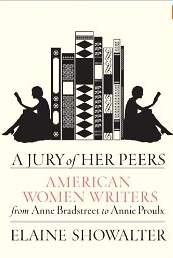
Cover for A Jury of Her PeersIn A Jury of Her Peers: American Women Writers from Anne Bradstreet to Annie Proulx, Elaine Showalter has compiled an astonishingly complete literary history of the work of American women, beginning in the early 17th Century and covering through the 20th. She has written this book, she explains, because literature by American women has been consistently ignored or omitted from criticism, anthologies, and scholarly works. She points out that even novels and poetry that were very popular and widely read in their own times sank like a stone into oblivion afterwards because the works were left out of volumes of literary analysis and anthologies and not taught in literature classes. Her work is an attempt to bring attention back to many of these writers.

Showalter starts with the metaphor of a jury of her peers from a play of the same name by Susan Glaspell, written in the 1970’s. In the play, a woman has murdered her husband. While the sheriff and his male helpers loudly make jokes and judgments about the crime, their wives quietly observe the evidence that the woman has been abused. Showalter’s message is that women writers deserve judgment by their own peers–whom she defines as people who will read and think about their work on its own terms and with open minds.

She shows how works that were highly respected during their times were repeatedly trivialized or criticized as dealing with “women’s issues.” She also shows how consistently through history women have been unable to devote time to writing because of their household responsibilities or have been attacked for not devoting most of their time to those responsibilities.

Showalter’s task was monumental. She has written a short biography, career history, and description of the work of literally every serious American woman writer–and some not so serious–putting the work in context of events and themes of the times. She has even briefly covered the works of many genre writers.

Written in a readable and interesting manner, the book made me wish I had time to read it along with my Norton Anthology of Literature by Women (if I could find the works there–I know some of them are). It also made me painfully aware, avid reader though I am, of how few of these writers I have read.

As a side note of interest, the Amazon.com page for this book includes Showalter’s list of her top ten books by American women writers that you probably haven’t read. We used this list one time for one of the meetings of my book club, each person picking the one he or she wanted to read. I can personally recommend The Country of Lost Borders, a collection of stories by Mary Hunter Austin from her life in the California desert east of the Sierras, and for an entirely different experience, We Have Always Lived in a Castle by Shirley Jackson, a chilling gothic novel.

Day 53: The House of Mitford

Cover for House of MitfordMany of you may be familiar with the famous Mitford sisters from Nancy Mitford’s wonderful books The Pursuit of Love and Love in a Cold Climate, thinly veiled novels about her own eccentric family. Last year, after reading several books by Nancy Mitford and wondering about the kind of family that could have produced such extreme offspring as Nancy the social satirist, Decca the devoted communist, Diana the fascist and wife of Oswald Mosley, and Unity the fanatical worshipper of Hitler, I struggled to find an unbiased book about the Mitfords. I thought I had found one when I located The House of Mitford, which was written up as the “authoritative Mitford biography.” It wasn’t until I was halfway through that I realized the authors, Jonathan and Catherine Guinness, were Diana Mitford’s son and granddaughter. In fact, any books I could locate about the Mitfords were written by the Mitfords, a prolific family indeed.

The book is certainly interesting and often amusing, and it provides a lot of insight into the 1930’s, an especially turbulent time in Great Britain, but it has its faults.

Although the authors deplore both the extreme leftist and rightist views of the family and point out how all believed what they wanted to believe, the book shows certain biases and likes. It is much harder on Decca’s communist sympathies than on Mosley’s Naziism, for example. We are invited to admire Mosley’s ideals and prescience, and yet the book almost ignores the fact that he tolerated his followers’ rabid anti-Semitism.

On the other hand, Decca is made out to be a liar in what she writes in her book Hons and Rebels about the family, while other family members are depicted simply as having selective memories. Yet when I read Hons and Rebels after this book, expecting it to depict the family in a cruel and critical manner, I found it to be more the story of teenage rebellion. Decca (Jessica) left the family at 17 and what she remembers is colored by her feelings when she left.

Nancy, seemingly the most harmless of all the famous sisters, is depicted as two-faced. Great efforts are made to deny that Unity was a sort of groupie for Hitler, when she clearly was one. Unity’s most famous act besides the photos of her at Hitler’s rallies in Nuremburg was to shoot herself in the head on the day that England declared war on Germany.

Nevertheless, the book successfully shows that despite all the family disagreements and bickering, underlying it all was strong family affection and unity. The book didn’t do much, however, to answer my initial questions about how an admittedly eccentric but not very political upbringing could produce such extremes of personalities and beliefs in a single generation.

Day 48: The Cruelest Journey: Six Hundred Miles to Timbuktu

Cover for The Cruelest JourneyMore than two hundred years ago, the Scottish explorer Mungo Park set off on a journey to try to discover where the Niger River ends up. At the time, it was not known whether the Niger comes out in the Mediterranean, joins with the Nile, or does something else. (It does–curves back out into the Atlantic.) Park made it as far as Timbuktu, but after he left, he was never seen again. Later he was reported to have been murdered.

In The Cruelest Journey: Six Hundred Miles to Timbuktu, Kira Salak relates her attempt to re-create Park’s journey by kayaking alone up the Niger River from Old Segou in Mali to Timbuktu. Although modern readers might believe that there are much fewer dangers in this journey than the one taken by Mungo Park, it is still one of the most desolate regions in Africa. She states that she is the first person and only Caucasian woman to travel alone in the region after one was murdered in the 30s.

Taking only what she can carry in her little kayak, Salak is forced to come ashore for food and shelter, sometimes when she would prefer not to. She encounters friendly people, hostile people, and people who are threatening, including some men who chase after her down the river to demand money. Although the river seems to be mostly slow moving, she runs into stormy weather and worries about being attacked by hippos. She has to keep paddling despite injuring her arm on the first day, and later she has an attack of dysentary after eating spoiled food fed to her by some villagers.

Although she is certainly alone for much of the time, she periodically meets up with a larger craft containing a National Geographic photographer and his crew. They have a deal that he is not to interfere in her trip, but simply to take pictures. I feel it was unfortunate that none of the photos were included in the book except on the cover. Instead an address is given to the National Geographic web site.

The book is well written and interesting, although it contains a lot more of her musings and fewer descriptions of what she saw than I would have preferred. She also appears to have made this journey without much preparation, including understanding the customs of the people she will be visiting, as she finds when she attempts to buy the freedom of some slaves.

As she approaches Timbuktu, she is struck by how much more the villagers seem to be changed by tourism than earlier on the river, increasingly hostile or begging for money as she passes by. Considering that she knew in advance that Timbuktu is no longer the legendary city it used to be, I was surprised by how disappointed she is when she reaches it. It is hard to decide which she is more disappointed about, that there is no sign of the legendary city built by the gold and salt trades or that she can’t stay in a nice hotel as she planned because the town is packed with tourists (or maybe that the town IS packed with tourists).

Although perhaps it was part of her sense of adventure to be relatively unprepared, I felt that more research before she made the trip would have been in order. I couldn’t help feeling at times that her reactions to a few events or sights were uninformed. (As one Amazon reviewer points out, she mistakes a pile of rubble for the National Museum in Bamako.) Nevertheless, it is an interesting story. I couldn’t help feeling that Salak combines in herself both courage and foolhardiness.

Day 45: The Possessed: Adventures with Russian Books and the People Who Read Them

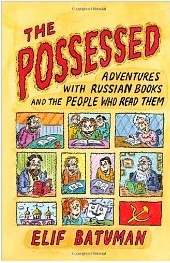
Cover for The PossessedMaybe not many of you would be interested in a book like The Possessed: Adventures with Russian Books and the People Who Read Them by Elif Batuman, but as a previous student of Russian and also a previous literature graduate student, I found it very funny.

Batuman has written a book about her years as a graduate student of Russian language and literature that skewers many things, but particularly academic conferences with their absurd presentation topics and academic thinking, with the oblique reasoning process that sometimes accompanies it. For example, on the way to a conference on Tolstoy’s estate, Batuman loses her luggage and is forced to dress in flip-flops, sweatpants, and a flannel shirt. Some of the scholars attending the conference assume she is a Tolstoyan and that she has taken a vow to walk around in sandals and a peasant shirt for days. When she calls a Russian clerk to find out about her luggage, the clerk replies, “Are you familiar with our Russian phrase resignation of the soul?”

While relating her adventures in studying, travelling in Russia, and living in Turkey, where she went because her grant was too small for her to afford a stay in Russia, Batuman muses on ideas from literature and compares the lives of the people she meets with the adventures of characters in Tolstoy, Dostoevsky, and Chekhov. Her observations are colored with her own peculiar view of life, which poses that “the riddle of human behavior and the nature of love appear bound up with Russian.” In Turkey, when she is challenged by scholars to study Turkish literature, particularly because of her Turkish heritage, she concludes that no one reads it, even the Turks.

Batuman expanded articles she wrote for Harper’s and The New Yorker into this book, which is named after one of Doestoevsky’s more enigmatic novels. Although her musings are occasionally a trifle too erudite for me to follow (and perhaps my memories of Russian literature too rusty), I found the book amusing and couldn’t put it down.

Day 39: Away Off Shore: Nantucket Island and Its People, 1602-1890

Cover for Away Off ShoreIn Away Off Shore, Nathaniel Philbrick explores the history of Nantucket Island, from the first boat of British people leaving the restrictions of the mainland to the final death throes of the whaling industry.

This book could probably be called a microhistory because it is the history of one small island. I had a feeling when reading it that it might be one of Philbrick’s earlier books, and sure enough it was written in 1994, well before his other books. It was apparently reprinted on the shirttails of his more recent, very successful histories.

Philbrick explains how different Nantucket was from mainland New England even from its beginnings. It was occupied by Wampanoag Indians when the Pilgrims arrived to find the rest of the coast almost empty of Native Americans. These people were first treated well by the new settlers, who even purchased their land from one of the two groups (the wrong one, however), but this relationship slowly changed. The Indians were eventually enslaved to some of the other islanders by incurring debts they could not pay, for which an exorbitant amount of work was demanded in return. The islanders’ isolation from the mainland, their strong Quaker roots, and their eventual success in the whaling industry as the first men to go after sperm whales singled them out from other New Englanders.

Philbrick relates the history of the island largely by focusing on a few colorful individuals and families, and principally on two antagonistic factions. Although that strategy makes the book interesting, I’m not sure it provides a true reflection of the island through time.

I felt that the book makes assumptions about the readers’ knowledge of Nantucket, as if it was written for the inhabitants or at least those who are frequent visitors. He often makes comments like “the house was located where the post office is now.”

This last comment is a minor criticism, but it relates to a more major one, which is the lack of good maps and pictures. The book has two reproductions of old maps, but they are so small and fuzzy as to be unreadable. I am a  map person, so when Philbrick is describing where things are, I want to see them on the map. That was almost always impossible. In addition, most histories of this type contain reproductions of paintings or old photographs so that we can see what some of the people or the old town looked like, but this book has none. Indeed, Philbrick actually compares photographs of two men, but the photos do not appear in the book. It would have been nice if the book contained pictures of some of the people and places.

Philbrick is known as an expert on Nantucket, and the book certainly shows meticulous research. It is very interesting, but also frustrating at times.

Day 33: The Great Game: On Secret Service in High Asia

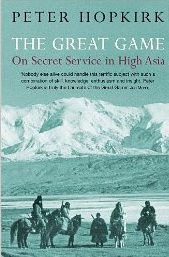
cover for The Great GameThe Great Game by Peter Hopkirk details the history of the 19th century shadow war for supremacy in Central Asia–that is, the spying, territory-grabbing, and general skullduggery accompanying the land grab of the Central Asian states and countries by Tsarist Russia and Victorian Great Britain. A great deal of the activity was centered around Afghanistan, which provides a lot of background about why the situation is so messed up today.

Investigations (exploring and snooping) were first begun in the area because of the British occupation of India. The greatest fear of the British occupiers was that the Russians would come swooping down on them through the Khyber Pass to take away what they had gained in India. So they sent small groups of men into the forbidding, wild regions to investigate the terrain, establish outposts, and try to make pacts with local war lords, khans, and other rulers.

This history is written by a Brit, so the Russians are the tacit bad guys. However, it would seem that often the Russians were more reliable partners to these states and countries than the British, who consistently let down their allies by doing nothing when the Russians invaded their territories. For their part, the Russians seemed often to be more brutal, but not always.

The book contains the enthralling stories of many young officers and civilians who took on dangerous missions into unknown, very wild territory with little or no backup from the British government, some of them simply to explore the areas but others to actively spy. Often these young men received no thanks from the British government for their efforts.

Note that a different edition of this same book is called The Great Game: The Struggle for Empire in Central Asia. I believe these are both the same book but that On Secret Service has been updated, taking into consideration recent events. I am not exactly sure which one I read because my edition was a special one from the Folio Society (just called The Great Game), but was published around the same time as the more recent book.

Day 26: Love, Poverty, and War

Cover for Love, Poverty, and WarEssays are not really my genre since I was terrorized by Ralph Waldo Emerson and Henry David Thoreau in my teens, but I’ll give this a try.

Love, Poverty, and War is a collection of articles written by Christopher Hitchens between 1998 and 2005. It is a mixed bag containing book reviews, biographical opinion pieces, travelogues, and political polemics. I have read that he has said or written something to irritate everyone. I found him scarily intelligent and well-informed, although he has also been accused of picking his facts and disregarding those that don’t agree with his beliefs. He has a strong opinion about everything, it seems.

Hitchens’s book reviews are difficult for me to assess because I had not read a single one of the books (although I had read the authors) except Brave New World, which I read about 1970. I thought it was curious that most of the literature he reviews was written before the 1960s. Those reviews are included in the section called “Love,” so I suppose they are some of his favorite classic authors, but his selections made me wonder how he picked the essays to include in this book (if he did). I loved his review of a book by some academic that compared Bob Dylan’s songs to religious poetry by counting how many words the pieces had in common. His comments on this methodology are hilarious.

His portrait of Churchill was startling and shocking to me, as it was almost entirely negative. But then I started wondering about why it is included in the section called “Love” along with essays about Kipling, Kingsley Amis, and Orwell. I decided that he is fascinated by people of contradictions, although certainly he does not appreciate hypocrites.

I regret to say that I am not familiar enough with the details of events he discusses under “War.” For example, he repeatedly brings up the U.S. bombing of a Sudanese chemical plant, which I don’t recollect at all. He has been criticized for a shift from leftist to rightist politics because of his opinions about the U.S. handling (or lack thereof) of Salman Rushdie’s situation when he was under fatwa and then his reaction to 9/11 and the attacks following. I noticed that between essays he certainly shifted his position on the Sudanese bombing, maintaining at first that the factory produced aspirin and later that there were strong indications that it was used to produce WMD.

I didn’t see this as a political shift as much as the result of his knowledge of the situations in Iraq and Afghanistan and an honest abhorrence of some of the left-wing apologists after 9/11. Unfortunately, it seems that some of his optimism about the interventions in Iraq and Afghanistan was a bit premature.

Hitchens is sharp and witty. I laughed out loud frequently even if I didn’t agree with him. However, if you are not very familiar with the events he discusses, he is sometimes hard to follow. And since these are essays, he does not cite his sources. Sometimes he states things as facts that make me wonder where he got his information.