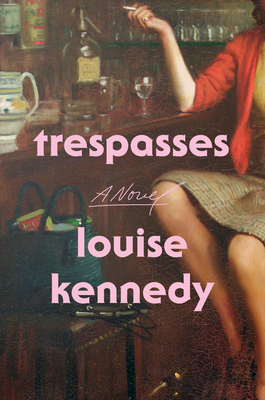
Review 2302: Trespasses

I read somewhere that Kennedy inserted the romance into Trespasses to make the political and social environment of her childhood palatable to readers. If that is so, I personally found the political and social parts more interesting, although the romance seems to take over the novel. However, the addition of the romance helped create the extremely touching ending.

Cushla is a Catholic schoolteacher who helps out at her brother’s pub in 1970’s Northern Ireland. One day Michael Agnew comes into the pub. He is nearly twice as old as she is, a Protestant, married, and a lawyer. She is immediately attracted to him even after she finds out he’s known as a womanizer. Soon he invites her to teach a group of his friends Irish, which leads to an affair.

At school, the children pick on one of her students, an eight-year-old named Davy McGeown, who is poor and who has a Catholic father and a Protestant mother. The family is threatened at home, and soon after Davy’s father finally gets a job, he is beaten mercilessly and left a cripple. Even the principal of the school treats Davy and the family badly, and there are hints of potential child abuse in the attentions toward Davy from the local priest. Cushla begins trying to help out Davy and his family, including his sullen older brother, Tommy.

Although Cushla’s family has successfully stayed out of the internecine conflict and serves people of both religions at the pub, things begin to change for them.

For quite a while that I was reading this novel, I was only mildly interested in the main story line but fascinated with the other things that were going on. However, towards the end, I was completely drawn in and found the ending particularly touching.

Related Posts

Milkman

The Last September

Troubles

Review 1454: Milkman

Best of Ten!
Middle sister, the unnamed narrator in a novel where no one has a name, has a stalker. Actually, she has two. She lives in the 1970s in an unnamed city that is clearly Belfast, and at 18 she has no way to explain what is happening to her and no one to tell, anyway. The man she’s worried about is known as the Milkman, rumored to be a powerful renouncer-of-the-state. This stalking begins with him driving up next to her and offering her a ride. She knows not to get into his car.

That is all it takes for rumors to begin flying about that middle sister is having an affair with the Milkman. Eldest sister, egged on by her husband, who has been letching after middle sister since she was 11, arrives to berate her for this supposed affair with a middle-aged, married man.

But middle sister’s strategy for keeping safe in a dangerous world is to tell nothing about herself. That, and her mother’s constant queries about why she isn’t married yet, have caused her to keep secret her real relationship with maybe-boyfriend. It is the maybe part of this relationship that decides her not to tell maybe-boyfriend about the stalking either, when it progresses to the Milkman joining her while running and making clear that he knows every aspect of her life.

She does finally tell her Ma the truth, but her Ma is too busy upbraiding her for bringing shame upon the family with the affair and calls her a liar. So, middle sister is left to cope with her fears alone.

This sounds like a grim tale, and at some times it is, but it is told exuberantly, in a torrent of words, ideas, stories, asides, and circumlocutions. To give you an idea, about page 80 middle sister steps into an area called the ten-minute zone because it takes ten minutes to cross it. She describes the ten-minute zone and an explosion within it, then she goes into what she calls “the provenance of the eeriness of the ten-minute area” from which she relates a discussion with Ma about her asking weird questions, tells about her father’s history of depression and her Ma’s “hierarchy of suffering,” discusses her bafflement in “shiny people,” those who go around looking happy, finds the head of a dead cat and decides to bury it, compares cats and dogs and tells about an incident where the state killed all the neighborhood dogs, has another encounter with the Milkman and then with one real milkman, and so on until page 139, when she steps out of the ten-minute area. I would include an excerpt, but a short one would seem nonsensical and a long one would be, well, long.

Above all, the novel is funny, dazzling, gleeming. I was absolutely entranced by it. It is about more than middle sister and her adventures, it is about the effects on society of everyday terror, paranoia, gossip, constant attention to the behavior of your neighbors. This is a stunning novel that won the Booker Prize. It deserves it.

Related Posts

History of the Rain

After You’d Gone

Tell the Wolves I’m Home