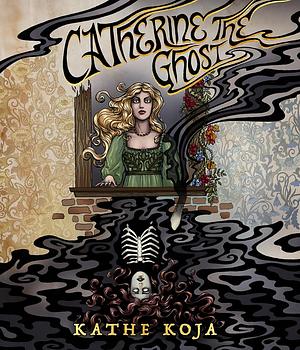
Review 2578: Catherine the Ghost

I took a break from reading A Short HIstory of Nearly Everything to read this novella. After putting it on my list, I had forgotten that it was based on Wuthering Heights. If you’ve read that book, you should be okay, but otherwise Catherine the Ghost may be hard to follow.

Like Wuthering Heights, Catherine the Ghost begins with the arrival to the house of Mr. Lockwood, who is stranded and spends the night in Catherine’s bedroom. The ghost Catherine demands to be let in.

The novella begins there but goes forward with glimpses into the past instead of the other way around. It focuses on Catherine’s haunting of Heathcliff and ends at about the same place as the original novel. The ghost is one narrator.

The other narrator is the other Catherine, Catherine the ghost’s daughter, who was tricked into marrying Linton, her cousin, the son of Heathcliff’s enemy, Hindley.

Koja’s style of writing is poetical and unusual, as she frequently uses sentence fragments. However, it is easy to follow. This is a haunting novella. I liked it a lot.

Related Posts

The Tenant of Wildfell Hall

The Solitary House

Murder at Mansfield Park

Review 2338: My Death

The unnamed narrator of My Death is a novelist who has been unable to write since her husband died a year ago. She has been isolated in a house in the west of Scotland. She decides to try biography instead and chooses the figure of Helen Ralston, whose accomplishments as an artist and writer were overshadowed by her tumultuous affair with her mentor, W. E. Logan, another artist.

When she begins to look into the subject, she finds that all of Ralston’s books are out of print but Logan’s are not. However, Ralston is in her 90s and eager to meet her and share her journals and photos. The narrator is struck with unease, however, when she sees a painting by Ralston entitled My Death, a supposed landscape of an island that is really a painting of the artist’s most intimate parts. As she continues her research, she keeps finding odd echoes of her own life.

This novella is described as gothic, but I wouldn’t exactly call it that, although it is unsettling and weird. Important to Tuttle is the theme of, as the Introduction by Amy Gentry puts it, “the erasure of women’s authorship by men.” That is certainly at work here, as she based some of the details of Ralson’s life on that of Laura Riding, an American poet and lover of Robert Graves, who accused Graves of stealing material.

This is an involving story that at first seems straightforward but gets odder and odder. I found it fascinating. Tuttle is in general a science fiction writer, but despite that I may look for more by her.

I received this book from the publishers in exchange for a free and fair review.

Related Posts

The Bloody Chamber

Luckenbooth

Ghostly